June 25, 2026
The Strategic Burden of Inheriting the World's Largest Miner at a Crossroads
Few moments in corporate leadership carry as much weight as stepping into the chief executive role of a Tier-1 mining giant during a period of genuine structural disruption. The global resources industry is no longer simply navigating commodity cycles. It is contending with energy transition pressures, geopolitical realignment, inflationary capital cost environments, and a profound rethinking of which raw materials underpin the next phase of industrial civilisation. Into this complexity steps Brandon Craig, who assumed leadership of BHP Group on 1 July 2026, inheriting a company trading near record share price highs while simultaneously facing some of the most operationally demanding conditions in recent memory.
Understanding the full weight of the BHP new CEO challenges requires more than cataloguing immediate problems. It demands a strategic framework that maps risk domains, capability requirements, and the decisions that will shape BHP's competitive position across the coming decade.
When big ASX news breaks, our subscribers know first
Who Is Brandon Craig, and What Does His Background Signal?
Craig brings 25 years of BHP experience to the role, with a career built primarily across copper operations and iron ore oversight before ascending to lead the company's Americas division. That final posting, overseeing BHP's Latin American copper growth agenda, served as the operational proving ground that shaped his candidacy. BHP's official announcement confirmed Craig's appointment in March 2026.
His appointment in December 2025 caught some investors off guard. The market had anticipated a broader shortlist, and several senior internal figures, including CFO Vandita Pant and Australia President Geraldine Slattery, were widely considered serious contenders. The board ultimately selected Craig, a signal that continuity of operational execution rather than transformational reinvention was the priority mandate.
His compensation structure reflects the performance expectations attached to that mandate:
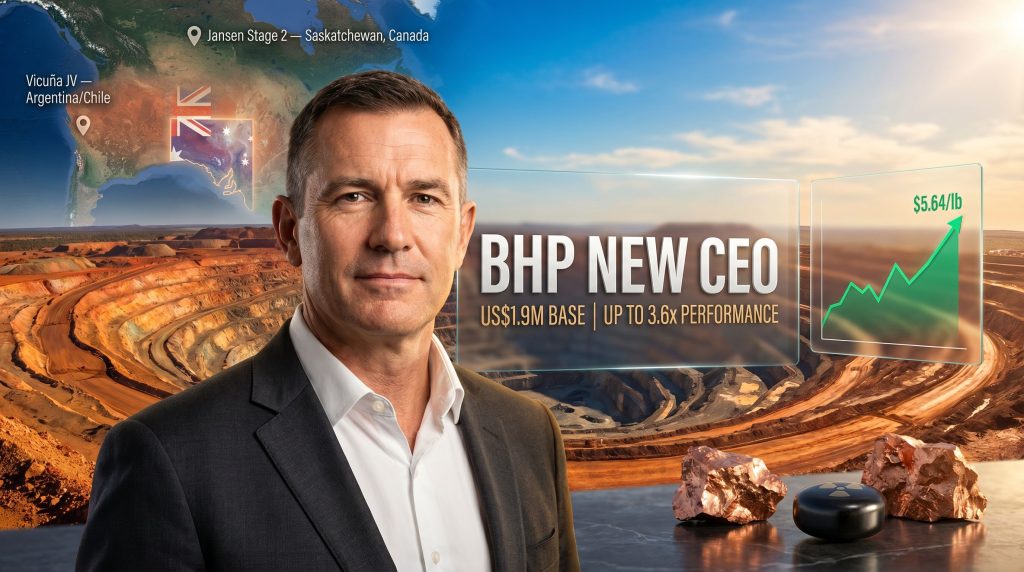
- Base salary: US$1.9 million per annum
- Total earnings potential: up to 3.6 times base salary through performance-linked incentive structures
- Age at appointment: 53, positioning him for a substantial tenure if performance metrics are met
Craig enters as an operator first. His instinct is execution discipline, not dealmaking. That distinction matters enormously when mapping the challenges that now sit on his desk.
Risk Domain One: The Jansen Cost Overrun and What It Means for Investor Trust
Perhaps no single issue frames the pressure on Craig's opening chapter more sharply than the Jansen Stage 2 potash project in Saskatchewan, Canada. In June 2026, BHP flagged a $2.3 billion charge attributable to cost overruns and schedule delays at the project, which fell directly under Craig's oversight as head of the Americas division.
The timing is uncomfortable. Cost discipline is already a central investor preoccupation across the mining sector, and the Jansen overshoot has amplified scrutiny across BHP's entire project pipeline. Elan Miller, a deputy portfolio manager at Blackwattle Investment Partners, which holds BHP shares, has noted publicly that cost control is a clear priority in the current inflationary environment, particularly in the aftermath of the Jansen situation.
Glyn Lawcock, head of resources research at Barrenjoey in Sydney, has reinforced this point, noting that capital expenditure increases are at the forefront of investor concern given the number of major BHP projects still in active development.
Table: BHP's Active Major Capital Projects and Key Risk Exposure
| Project | Location | Commodity | Status | Primary Risk |
|---|---|---|---|---|
| Jansen Stage 2 | Saskatchewan, Canada | Potash | Delayed / Cost overrun | $2.3B charge flagged June 2026 |
| Vicuña JV | Argentina / Chile | Copper | Development phase | Geopolitical and permitting risk |
| Copper South Australia | South Australia | Copper / Uranium | Decision due end-2026 | Smelter expansion capex scale |
| Olympic Dam | South Australia | Copper / Uranium | Under strategic review | Uranium byproduct scale constraints |
The Jansen episode is not merely a financial footnote. It has reset the baseline expectations investors hold for how Craig will govern capital allocation decisions across this entire portfolio. Consequently, his first major test is demonstrating that Jansen was an exception, not a symptom. This context also shapes how observers are interpreting BHP's BHP strategic pivot away from legacy commodities and toward future-facing resource streams.
Risk Domain Two: Industrial Action at Port Hedland and the Iron Ore Vulnerability
Iron ore remains BHP's highest-margin revenue stream, and the threat of coordinated industrial action at Port Hedland, Western Australia, represents one of the most time-sensitive operational risks Craig faces in his opening weeks. Unions have escalated tensions at BHP's Port Hedland export operations, with talks scheduled for July 7, 2026 carrying genuine consequences if they collapse.
The significance of this cannot be overstated. A coordinated strike at Port Hedland would represent one of the most disruptive labour events at the facility in decades, with direct implications for BHP's export throughput and near-term revenue profile.
Beyond the immediate timeline, Craig also faces broader labour relations pressures. Productivity concerns persist across both South American copper operations and Australian iron ore infrastructure, reflecting a structural tension that has been building for some time rather than emerging as an isolated flashpoint.
The iron ore business generates the cash that funds BHP's copper growth ambitions. Any sustained disruption to Port Hedland export capacity does not merely affect one revenue line. It constrains the financial capacity to execute the company's entire strategic agenda.
How Craig handles the July 7 negotiation will serve as an early signal of his leadership temperament under pressure.
Risk Domain Three: The China Relationship and the CMRG Pricing Standoff
BHP's largest single customer, China's Mineral Resources Group (CMRG), has restricted purchases of certain BHP products across its steel mill network as part of an ongoing pricing dispute. This is categorically different from normal commodity price negotiation. It reflects a deliberate procurement policy adjustment, signalling a willingness to use purchasing leverage as a strategic instrument.
Craig has committed to personally leading senior-level engagement with Chinese counterparts as an early CEO priority, recognising that restoring the commercial relationship requires face-to-face diplomacy rather than delegated correspondence. Furthermore, the broader dynamics of China steel and iron ore demand in 2025 and beyond add further complexity to this already delicate negotiation environment.
BHP vs. Rio Tinto: China Exposure Comparison
| Dimension | BHP | Rio Tinto |
|---|---|---|
| China revenue dependency | High (iron ore dominant) | High (iron ore dominant) |
| Active customer disputes | Yes (CMRG pricing standoff) | No active public dispute |
| CEO engagement posture | Direct visit commitment | Ongoing diplomatic engagement |
| Copper growth as diversification hedge | Vicuña JV and CSA expansion | Oyu Tolgoi ramp-up |
The China dependency paradox is one of the defining structural tensions in BHP's portfolio. The commodity that generates the most reliable cash flow is simultaneously the most geopolitically exposed. Building copper production is the long-term hedge, but that hedge takes years to materialise at scale.
The Organic vs. Inorganic Growth Debate: Where Craig Stands
Craig has been unambiguous in his stated preference hierarchy. In remarks at the Bank of America conference in May 2026, he indicated that acquisitions would need to be genuinely compelling to displace internal project investment, while also confirming openness to bolt-on acquisitions where they delivered clear value.
This framing reflects several layers of strategic logic:
- BHP's existing project pipeline, if executed with discipline, can deliver competitive returns without M&A integration risk.
- Bolt-on acquisitions in critical minerals offer a lower-risk growth mechanism during an inflationary capital cost environment.
- Large-cap M&A carries execution complexity that is particularly acute during periods of internal project stress.
BHP's pursuit of Anglo American across the preceding two years ultimately ended when Anglo opted to merge with Teck Resources instead. The combined Anglo-Teck entity may re-emerge as an acquisition consideration depending on post-merger valuations, according to analysts and investors familiar with the landscape. In addition, the broader trend of mining industry consolidation through joint ventures and asset sales is reshaping the competitive landscape in ways that Craig cannot afford to ignore.
CLSA analyst Baden Moore in Sydney has noted that BHP's valuation premium positions the company well to pursue M&A if compelling opportunities arise. The Glencore variable adds another dimension. Glencore's publicly stated ambitions to scale up, combined with its rebuffed approach to Rio Tinto and the associated six-month standstill, means the Swiss trader cannot entirely be ruled out as a future conversation partner for BHP.
A combined entity would create the world's largest diversified miner, though BHP's historical aversion to coal re-entry and Glencore's trading-house identity represent significant structural obstacles to any meaningful transaction.
The next major ASX story will hit our subscribers first
Uranium: Byproduct Today, Strategic Commodity Tomorrow?
Perhaps no commodity generates more strategic curiosity within BHP's portfolio than uranium. Olympic Dam already contributes approximately 5% of global uranium supply as a byproduct of copper smelting, making BHP one of the world's most significant uranium producers without ever having positioned uranium as a core strategic priority.
Craig has acknowledged this tension directly, telling at least one investor that he intends to conduct a thorough examination of uranium's role within BHP's portfolio, while also recognising that the market's relatively small scale creates genuine challenges in meeting BHP's return thresholds. The challenge is not geological. Olympic Dam sits atop one of the most extraordinary polymetallic deposits on earth, containing copper, gold, silver, and uranium in a configuration that makes it unlike virtually any other operating mine globally. The challenge is commercial scale and capital prioritisation.
Several structural demand shifts are now forcing a reassessment of that calculus:
- Data centre energy consumption is growing at an accelerating rate, creating new baseload power demand that nuclear is uniquely positioned to serve.
- Government energy diversification policies, accelerated by geopolitical instability including conflict in the Middle East, are increasing the strategic premium placed on domestic and allied nuclear fuel supply chains.
- BHP's own internal framing has shifted, with uranium increasingly described as a future-facing commodity with an improving demand profile.
These shifts closely mirror broader trends in uranium market dynamics that investors and strategists have been tracking with increasing interest throughout 2025 and into 2026.
CFO Vandita Pant confirmed in May 2026 that BHP regularly reviews its core commodity positioning and expressed comfort with the company's current uranium exposure at Olympic Dam. That language, notably, does not preclude expansion. It simply confirms that no expansion has been committed to.
Does BHP Produce Uranium?
Yes. BHP produces uranium as a byproduct of copper smelting at Olympic Dam in South Australia, accounting for roughly 5% of annual global supply. No significant standalone uranium expansion has been committed to, but the company is actively reconsidering uranium's strategic role under Craig's leadership.
The bolt-on acquisition pathway also deserves consideration. Smaller pure-play uranium assets could provide the critical mass needed to make standalone uranium economics work within BHP's return framework, particularly if uranium prices continue to strengthen on the back of nuclear energy's policy rehabilitation.
Executive Retention: The Leadership Continuity Risk Nobody Is Talking About Enough
CEO transitions at large organisations historically trigger approximately one-third of senior management departures within two to three years. BHP Chairman Ross McEwan acknowledged in March 2026 that executive attrition following competitive succession processes is a natural outcome of how leadership decisions unfold. That is an honest assessment. It is also a material operational risk.
CFO Vandita Pant and Australia President Geraldine Slattery were both considered credible CEO candidates before Craig's appointment. Retaining executives who competed for a role they did not receive requires deliberate relationship management and, typically, expanded mandates or responsibilities that provide a meaningful forward horizon.
The stakes are particularly high given the scale of active project execution. Capital projects of the complexity BHP is managing across Jansen, Vicuña, and Copper South Australia require institutional knowledge and relationship continuity that cannot be easily replaced mid-execution.
The Macro Tailwinds: Why BHP's Share Price Tells One Part of the Story
BHP shares were trading near record highs at the time of Craig's appointment, driven by investor conviction around copper's structural demand story. With copper trading at approximately $5.64/lb in late June 2026, the market is pricing in a durable demand thesis built on three reinforcing pillars:
- AI and data centre infrastructure requiring substantial copper for power transmission and cooling systems
- Energy transition electrification creating sustained copper intensity across grid, storage, and generation investment
- Defence spending acceleration across NATO and allied nations demanding copper-intensive manufacturing
BHP's Vicuña copper-gold joint venture in Argentina and Chile, representing an $18 billion copper investment, sits at the centre of this growth thesis as the flagship organic vehicle. However, Craig must also remain alert to how the Rio Tinto copper expansion strategy is evolving, given that competitive positioning across global copper supply will influence pricing dynamics and investor appetite over the medium term.
The Copper South Australia smelter expansion decision, due by the end of 2026, will serve as a near-term capital commitment signal that the market will scrutinise closely. Craig's strategic repositioning toward jurisdictions in Argentina, Chile, the United States, and Canada also reflects a deliberate pivot toward operating environments offering more predictable fiscal and regulatory frameworks.
Strategic Scorecard: Defining Success in Year One
| Priority Area | Key Action Required | Success Metric |
|---|---|---|
| Capital discipline | Stabilise Jansen Stage 2 costs; tighten project governance frameworks | No further unplanned charges |
| Labour relations | Resolve Port Hedland negotiations before strike deadline | Agreement reached by July 7 |
| China engagement | Senior leadership visit; reset CMRG pricing relationship | Purchasing restrictions lifted |
| Copper growth | Advance Vicuña JV and confirm CSA smelter decision | Final investment decision confirmed |
| Uranium strategy | Complete internal strategic review; define scale pathway | Clear public position by H1 2027 |
| M&A discipline | Evaluate bolt-on targets; avoid dilutive large-cap transactions | Shareholder value preserved |
| Executive retention | Retain CFO and key operational leadership | No unplanned senior departures |
The Operator's Mandate in an Era That Demands Both Execution and Vision
Brandon Craig arrives at BHP's leadership with a profile built for operational complexity. His 25-year institutional career has equipped him with the asset-level knowledge, relationship networks, and execution instincts that megaproject delivery demands. In the immediate term, that is precisely what BHP needs.
The BHP new CEO challenges are not abstract strategic puzzles. They are live, time-sensitive operational problems with financial consequences measured in billions of dollars and reputational consequences measured in investor confidence. The Jansen cost overrun, the Port Hedland strike threat, and the CMRG pricing dispute all require resolution, not strategy documents. As the AFR has noted, the new BHP boss has considerable work ahead to deliver on the copper-centric future the market is pricing in.
Yet there is a deeper tension that will eventually define Craig's legacy more than any single negotiation. The mining industry's next decade will be shaped by leaders who can balance operational rigour with genuine strategic boldness. At some point, BHP's copper-weighted growth thesis will require Craig to make a genuinely transformative call, whether on uranium scale, a major acquisition, or a geographic pivot that reshapes the company's asset mix.
How he navigates the distance between the operator he has always been and the visionary strategist the company may ultimately need is the question that will define the BHP new CEO challenges and the company's competitive position for years to come. Reuters has reported that Craig himself is acutely aware of the need to forge firm ties in a rapidly changing world, a task that is as much diplomatic as it is operational.
Disclaimer: This article contains forward-looking analysis, market commentary, and strategic assessments that involve inherent uncertainty. Nothing in this article constitutes financial advice. Readers should conduct their own due diligence before making investment decisions. All financial figures and timelines referenced reflect information available as of late June 2026.
Want to Identify the Next Major Mineral Discovery Before the Broader Market Does?
While BHP navigates copper growth ambitions and billion-dollar capital commitments, the real generational wealth in resources has historically been built by investors who recognised transformative discoveries early — Discovery Alert's proprietary Discovery IQ model delivers real-time ASX mineral discovery alerts, turning complex geological data into actionable opportunities the moment they are announced. Explore historic examples of exceptional discovery returns or begin your 14-day free trial today to position yourself ahead of the market.