June 25, 2026
Why Geology Alone Can No Longer Define Mining's Winners
The assumption that mineral wealth automatically translates into economic prosperity is one of the most persistent myths in the resources sector. History offers repeated examples of nations sitting atop vast geological endowments that failed to generate lasting industrial value, while leaner jurisdictions with sharper institutional frameworks consistently attracted capital and captured returns. This structural reality sits at the heart of the PwC global mining report policy capital and technology framework, presented in Mine 2026: Ambition to Action, which argues that the global mining industry has reached an inflection point where policy, capital, and technology are now the primary determinants of who wins and who gets left behind.
The report's core thesis reframes competitive advantage in mining. Geological abundance remains a prerequisite, but it is no longer sufficient. The new value equation demands that resource endowments be matched with policy stability, financing access, processing capability, and digital readiness. Nations and companies that fail to build across all four dimensions risk watching their mineral wealth remain permanently stranded beneath the surface.
When big ASX news breaks, our subscribers know first
What the PwC Mine 2026 Numbers Actually Reveal
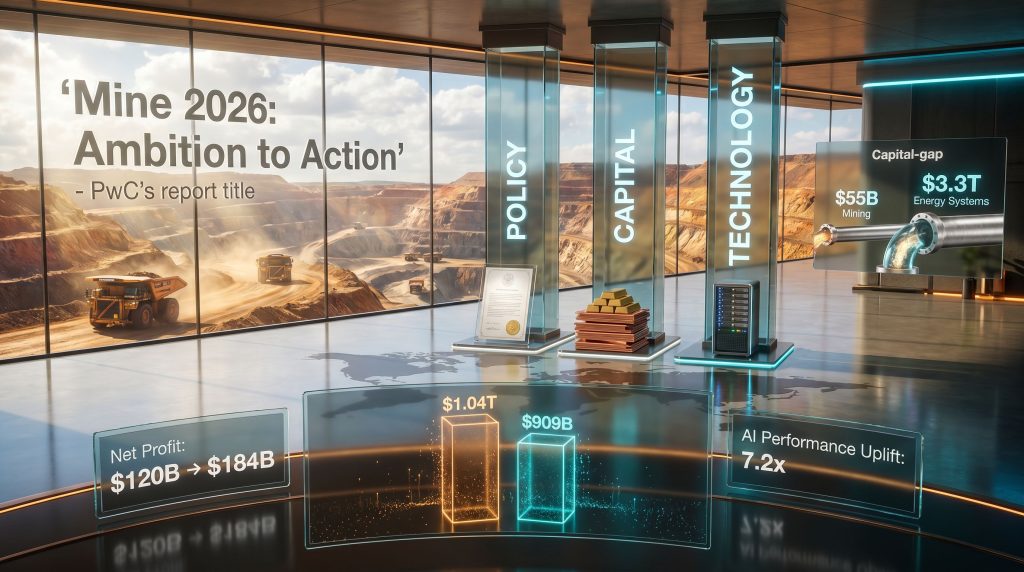
The financial performance of the world's top 40 mining companies in 2025 tells a story of genuine strength, but also of structural incompleteness. Combined revenues for the group climbed 3.3% to $909 billion, while net profits reached $120 billion, supported by higher commodity prices and disciplined cost management across the sector.
Looking forward, PwC projects the momentum will continue, with revenues forecast to reach $1.04 trillion in 2026 and net profit expanding to $184 billion. These are numbers that would have seemed extraordinary a decade ago, yet they exist alongside persistent warnings about the sector's long-term sustainability. The PwC Global Mine 2025 report provides useful context for understanding how dramatically conditions have shifted over just twelve months.
| Financial Metric | 2025 Result | 2026 Forecast |
|---|---|---|
| Combined revenue (Top 40) | $909 billion (+3.3%) | $1.04 trillion |
| Combined net profit (Top 40) | $120 billion | $184 billion |
| M&A deal values | Exceeding $70 billion | Focused on Cu and Li |
| Mining development capital | ~$55 billion | Rising to ~$128B by 2050 |
| Global energy system investment | $3.3 trillion annually | Sustained growth |
The contrast between near-record profitability and a persistent capital deficit is one of the report's most revealing tensions. The sector is generating substantial returns, yet the investment required to sustain future supply at the scale the energy transition demands remains structurally underfunded.
The Three Levers Reshaping the PwC Global Mining Report Policy Capital and Technology Framework
PwC's analytical framework for Mine 2026 organises its findings around three interconnected forces. Understanding each lever individually, and more importantly how they interact, is essential for anyone seeking to understand where value is being created and destroyed in modern mining.
Policy in Motion: Governments Becoming Co-Architects of Value Chains
The role of government in mining is undergoing a fundamental transformation. Regulators that once operated primarily as gatekeepers, issuing permits and setting royalty frameworks, are increasingly behaving as active participants in resource value chain design.
This shift is visible across multiple jurisdictions, but the strategic logic is consistent: policy clarity, permitting efficiency, and midstream processing capability are now the variables that determine whether a mineral deposit becomes a productive asset or remains an unexploited geological feature. Furthermore, the critical minerals demand trajectory makes this policy evolution increasingly urgent for resource-rich nations.
Canada provides a concrete illustration of how targeted public capital can reposition a jurisdiction's competitive standing. The establishment of a Critical Minerals Sovereign Fund valued at $2 billion, paired with a First and Last Mile Fund of $1.5 billion, demonstrates a deliberate attempt to de-risk projects sufficiently to catalyse private investment at scale. These mechanisms reduce the risk premium attached to early-stage development, making projects financeable under commercial terms that would otherwise be unworkable.
Key dimensions of effective mining policy frameworks include:
- Regulatory certainty across multi-decade project horizons
- Streamlined permitting processes that reduce development timelines
- Infrastructure investment that lowers logistical barriers for remote deposits
- Midstream processing incentives that capture more value domestically
- Investment protection mechanisms that reduce sovereign risk for foreign capital
Capital in Motion: The Investment Gap That Threatens Energy Transition Timelines
Perhaps the most striking statistical finding in PwC's report is the scale of the capital deficit facing the mining sector. Mining development capital stood at approximately $55 billion in 2024, which represents a small fraction of the $3.3 trillion deployed annually across global energy systems. This imbalance is particularly striking given that mining supplies the physical raw materials upon which those energy systems depend.
The gap is projected to narrow but not close. Annual investment in metals and mining infrastructure is expected to rise 39% between 2024 and 2050, reaching approximately $128 billion. However, renewable energy investment is forecast to grow at a faster pace of 52% over the same period, meaning the structural underfunding of mining relative to downstream energy infrastructure is likely to persist.
This creates a supply chain vulnerability that is rarely discussed openly. The energy transition cannot be delivered at the pace that climate commitments require if mining investment continues to lag behind deployment-side capital flows. Solar panels, battery cells, EV drivetrains, and grid infrastructure all depend on copper, lithium, cobalt, nickel, and rare earth elements. The extraction and processing of these materials requires capital investment years or even decades before those materials reach the market. Consequently, understanding the current mining investment landscape is essential for anyone assessing where capital allocation gaps are most acute.
Financing structures gaining traction to bridge this gap include:
- Public-private partnerships that share development risk between state and commercial capital
- Offtake agreements that provide revenue certainty to project financiers
- Price guarantee mechanisms that floor commodity price exposure for lenders
- Sovereign wealth fund co-investment that brings patient capital into long-duration projects
The mining sector generates hundreds of billions in annual profit, yet its development capital base represents less than 2% of global energy system investment. This is not a capital availability problem. It is a capital allocation problem driven by risk perception, project complexity, and jurisdictional uncertainty.
Productivity Through Technology: AI as Mining's Most Underdeveloped Asset
The third lever identified in the PwC framework is simultaneously the most promising and the most poorly executed within the sector. Productivity improvement through digital technology and artificial intelligence offers mining companies a pathway to sustained margin expansion that is not dependent on commodity price cycles. Yet mining currently ranks among the lowest of all major industries in AI readiness, according to PwC's analysis.
This is not a minor gap. The report estimates that companies leading in AI adoption can achieve performance outcomes up to 7.2 times greater than peers that have been slower to integrate digital capability into their operations. That differential, if it compounds over several years, represents a structural competitive divide that may become difficult or impossible to close for laggards. In addition, AI in mining is already demonstrating measurable gains in drilling precision and operational safety across leading operations.
The practical applications of AI in mining span an unusually wide range of operational domains:
- Predictive maintenance systems that reduce unplanned equipment downtime
- Autonomous and remotely operated drilling and haulage equipment
- Geological modelling tools that improve ore body definition and grade estimation
- Real-time processing optimisation that maximises recovery rates from ore feeds
- Energy management systems that reduce consumption per tonne of material processed
- Safety monitoring platforms that identify risk patterns before incidents occur
Workforce transformation is already underway in leading operations. Traditional on-site roles are being supplemented and in some cases reconfigured around remote operations centres staffed by data scientists, digital systems engineers, and AI specialists rather than conventional mining tradespeople.
Strategic Risk: Mining's AI readiness deficit is compounding. Every quarter that a mining company operates without a coherent digital integration strategy is a quarter in which the performance gap between itself and digitally advanced peers grows wider.
Commodity Performance: Why Not All Miners Are Winning Equally
One of the more nuanced findings in Mine 2026 is the significant divergence in performance across commodity segments. The aggregate revenue and profit numbers for the top 40 conceal meaningful variation at the commodity level.
Precious metals and copper were the primary drivers of earnings growth and market capitalisation gains in 2025. The copper supply trends underpinning this performance reflect electrification demand, grid infrastructure expansion, and EV manufacturing growth, all of which supported strong earnings and sustained investor attention. Gold's role as a geopolitical and monetary hedge maintained precious metal valuations through an environment of elevated uncertainty.
Coal presented a more complicated picture. Revenue declined year-on-year despite improved operating margins in certain sub-segments. The divergence between revenue trajectory and margin performance reflects both cyclical pricing dynamics and the structural shift underway in energy policy across key consumer markets in Asia and Europe.
Lithium and other future-facing commodities drove M&A activity, with deal values exceeding $70 billion across the top 40. Acquisitions concentrated on copper and lithium assets, consistent with a strategic intent to build exposure to energy transition demand before anticipated inflection points in consumption materialise. M&A in this context is functioning as a form of capital-efficient resource optionality, allowing companies to secure future production capacity without bearing the full cost and timeline risk of greenfield development.
South Africa and the Policy-Capital Nexus in Emerging Markets
South Africa's position in the global mining landscape illustrates the broader tension between geological potential and institutional readiness. The country holds significant endowments across platinum group metals, chrome, manganese, and a range of critical minerals with direct energy transition applications.
According to PwC's South Africa analysis, the government's current approach has been characterised as more diagnostic than demonstrative. This distinction matters enormously for investors. A diagnostic posture involves identifying mineral opportunities and articulating strategic ambitions. A demonstrative posture means operationalising the regulatory conditions, infrastructure commitments, and financing mechanisms that translate those ambitions into investable projects.
South Africa's strategic objective extends beyond raw extraction toward beneficiation, the addition of downstream processing value within the country rather than exporting unprocessed ore to be refined elsewhere. Achieving this ambition requires simultaneous progress across permitting efficiency, energy reliability, logistics infrastructure, and access to competitive financing. Each of these dimensions represents a significant challenge in isolation. Addressing them concurrently is the defining test of whether the country can convert resource advantage into lasting industrial value.
The Convergence Thesis: Why No Single Lever Works in Isolation
The PwC framework's most important intellectual contribution is its insistence on convergence. Policy without capital produces stranded approvals. Capital without technology produces inefficient operations that erode returns. Technology without policy produces regulatory exposure that undermines investor confidence. The interactions between these levers are not additive but multiplicative, meaning progress across all three dimensions simultaneously produces outcomes that far exceed what any single lever can deliver independently.
According to PwC South Africa's energy, utilities and resources leadership, achieving sustainable growth in the sector requires coordinated action across governments, investors, and mining companies working in genuine alignment rather than in parallel silos. The report frames this not as an aspiration but as an operational necessity. Moreover, mining's transformation through electrification and decarbonisation is adding further urgency to the convergence imperative.
Execution discipline, defined as the capacity to deploy capital efficiently, integrate technology systematically, and operate within stable policy environments, will determine which companies and jurisdictions capture disproportionate value through the next decade of the energy transition. The AusIMM bulletin on sustainable mining impact highlights how the industry's leading voices are already reframing success metrics accordingly.
Key performance dimensions for this transition include:
- Regulatory frameworks that provide investment certainty across multi-decade project horizons
- Capital structures that bridge the gap between public strategic objectives and private return thresholds
- Technology adoption roadmaps that move AI integration from pilot programmes to enterprise-wide deployment
- Workforce development strategies that build the human capital required for digitally intensive operations
- Beneficiation and downstream processing policies that capture more value within resource-rich jurisdictions
The next major ASX story will hit our subscribers first
Frequently Asked Questions: PwC Mine 2026 Report
What does the PwC Mine 2026 report cover?
Mine 2026: Ambition to Action is PwC's annual benchmarking analysis of the world's top 40 mining companies by revenue, profitability, and strategic positioning. The 2026 edition focuses on how the PwC global mining report policy capital and technology framework is reshaping competitive advantage and value creation across the global mining sector.
How did the top 40 mining companies perform financially in 2025?
Combined revenues increased 3.3% to $909 billion, with net profits reaching $120 billion. PwC forecasts revenues will rise to $1.04 trillion and net profits to $184 billion in 2026, driven by continued commodity demand and operational discipline.
Why is AI adoption considered critical for mining companies?
Mining ranks among the lowest sectors globally in AI readiness, yet PwC's analysis indicates that leaders in AI adoption achieve performance outcomes up to 7.2 times greater than lagging peers. The gap in digital capability is rapidly becoming a structural competitive liability rather than simply a missed efficiency opportunity.
What is the mining investment gap?
Mining development capital of approximately $55 billion in 2024 represents a fraction of the $3.3 trillion invested annually in global energy systems, despite mining's foundational role in supplying the materials those systems depend on. This deficit constrains the sector's ability to scale supply in line with energy transition demand timelines.
Which commodities are driving M&A activity?
Deal activity exceeding $70 billion in 2025 concentrated primarily on copper and lithium, as companies used acquisitions to build exposure to energy transition demand ahead of anticipated consumption inflection points. The PwC global mining report policy capital and technology analysis identifies this trend as a defining feature of strategic repositioning across the top 40.
Disclaimer: This article draws on published findings from PwC's Mine 2026 report as reported by Mining Weekly. Financial forecasts and performance projections referenced herein represent PwC's analytical estimates and should not be construed as investment advice. Forward-looking statements involve inherent uncertainty and actual outcomes may differ materially from projections. Readers should conduct independent due diligence before making any investment decisions.
Want to Know Which ASX Mining Companies Are Positioned to Capitalise on Major Mineral Discoveries?
As the PwC Mine 2026 report confirms, the gap between geological potential and realised value is widening — and timing is everything. Discovery Alert's proprietary Discovery IQ model scans ASX announcements in real time, instantly identifying significant mineral discoveries across copper, lithium, and beyond, so subscribers can act before the broader market catches on — explore historic discovery returns on Discovery Alert's discoveries page and begin a 14-day free trial to position ahead of the next major find.