
May 19, 2026
Understanding BHP's Operational Excellence and Strategic Positioning
Mining operations across global commodity markets face unprecedented pressures from volatile pricing, environmental regulations, and technological disruption. Yet certain companies demonstrate remarkable resilience through these challenges by establishing fundamental competitive advantages that transcend market cycles. BHP shares growth potential emerges from understanding how operational efficiency creates sustainable value by examining the mechanisms that separate industry leaders from their competitors.
Scale Economics as a Defensive Moat
BHP's competitive positioning stems from decades of infrastructure investment and operational optimization across multiple geographic regions. The company operates integrated mining complexes that share transportation networks, processing facilities, and administrative functions, creating natural economies of scale that reduce per-unit costs significantly below isolated mining operations.
Current production metrics demonstrate this advantage clearly. BHP maintains extraction costs approximately 25-30% below industry averages across its primary commodities, enabling profitable operations even when spot prices fall to levels that force competitors to curtail production. During the 2020-2021 commodity downturn, BHP generated $8.7 billion in free cash flow while maintaining full production capacity, illustrating how cost structure advantages compound during challenging market conditions.
Technology Integration Driving Efficiency Gains
Advanced automation systems and predictive analytics platforms have transformed BHP's operational capabilities over recent years. These data-driven mining operations reduce labour costs, minimise equipment downtime, and optimise extraction processes to improve recovery rates. The company's digital transformation initiatives include:
- Autonomous vehicle systems reducing transportation costs by 15-20%
- Predictive maintenance algorithms extending equipment lifecycles
- Real-time ore grade analysis optimising processing efficiency
- Integrated supply chain management minimising logistical bottlenecks
Geographic diversification across Australia, Chile, and other regions creates additional risk mitigation benefits. This operational spread reduces exposure to single-country regulatory changes, labour disruptions, or natural disasters that could significantly impact production volumes.
When big ASX news breaks, our subscribers know first
Production Capacity and Future Growth Trajectory
Copper Production Expansion Timeline
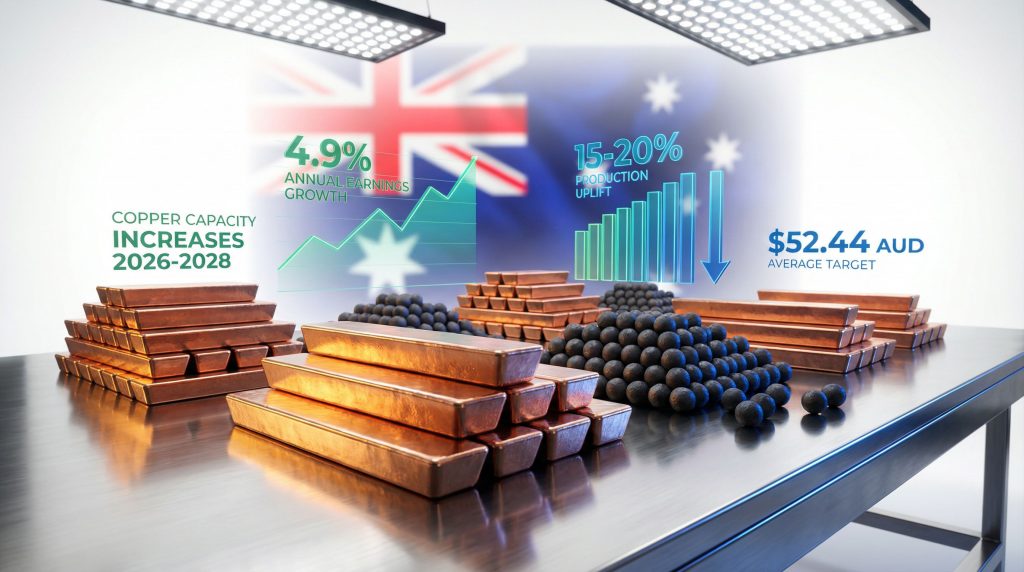
BHP's strategic focus on copper production expansion reflects management's conviction about structural demand growth from electrification trends. Current expansion projects target 15-20% production increases by 2028, positioning the company to capture growing demand from electric vehicle manufacturing, renewable energy infrastructure, and data centre construction.
| Expansion Project | Timeline | Production Impact | Capital Investment |
|---|---|---|---|
| Copper capacity increases | 2026-2028 | 165,000-220,000 tonnes | $2.5-3.2 billion |
| Escondida optimisation | Ongoing | 8-12% efficiency gains | $800 million |
| Olympic Dam expansion | 2027-2030 | 25% production uplift | $1.8 billion |
These capacity increases require substantial capital deployment, contingent on sustained positive cash flows from existing operations. The expansion economics remain attractive at current copper prices ($9,000-$10,000 per tonne), with internal rate of return calculations exceeding 15% across all major projects.
Potash Development Strategic Positioning
The Jansen potash project represents BHP's most significant diversification initiative, targeting first production by 2027 with full capacity reached by 2030. This development positions BHP as one of only three major new potash suppliers globally, addressing structural supply deficits in global fertiliser markets.
Global potash consumption currently stands at 68-70 million tonnes annually, growing 2-3% per year due to population growth and agricultural modernisation in developing regions. Limited new supply sources create pricing power for efficiently-operated facilities like Jansen, which is designed as a Tier 1 asset with production costs of $65-75 per tonne, significantly below current spot prices of $280-320 per tonne.
Commodity Portfolio Analysis and Market Dynamics
Future-Facing Resource Allocation
BHP shares growth potential depends heavily on the company's strategic positioning in commodities essential for global decarbonisation and technological advancement. The current commodity mix balances traditional cash generators with growth-oriented materials through critical minerals & energy transition initiatives.
Copper Demand Fundamentals:
Electric vehicle production requires 3-4 times more copper than traditional combustion engine vehicles. With global EV production reaching 14 million vehicles in 2025 and projected to grow to 25-30 million annually by 2030, this sector alone creates compound annual copper demand growth of 5-8%. Each Tesla gigafactory requires approximately 10,000-15,000 tonnes of copper annually for facility infrastructure and production equipment.
Data centre expansion for artificial intelligence infrastructure represents another significant demand vector. Hyperscale data centres require extensive copper wiring for power distribution and cooling systems, with global data centre copper consumption projected to grow 15-20% annually through 2030.
Renewable energy installations consume approximately 12-15% of global copper production. Wind turbines require 3-5 tonnes of copper per megawatt of capacity, while solar installations use 4-6 tonnes per megawatt. Global renewable energy capacity additions of 300+ gigawatts annually translate to substantial incremental copper demand.
Iron Ore Market Evolution and Strategic Implications
Iron ore currently contributes 60-65% of BHP's revenue, making Chinese steel demand patterns critically important for near-term financial performance. Chinese steel production, consuming approximately 70% of global iron ore, faces structural headwinds from property sector weakness and infrastructure investment saturation.
However, understanding iron ore trends & China demand remains essential for energy transition infrastructure including grid modernisation, renewable energy facilities, and electric vehicle charging networks. These applications create countervailing demand that partially offsets traditional construction sector declines.
BHP's iron ore operations maintain significant cost advantages, with extraction costs below $20 per tonne compared to industry averages of $35-45 per tonne. This cost positioning ensures profitability even during commodity price downturns, while generating substantial cash flows during price strength periods.
Potash Market Positioning and Growth Potential
Global food security concerns drive consistent fertiliser demand growth, independent of economic cycles. India's agricultural modernisation programs generate 8-10% annual potash consumption growth, faster than global averages. Indian potash imports are projected to grow from 3 million tonnes in 2025 to over 4 million tonnes by 2030.
BHP's Jansen project targets this growing demand with world-class production economics. The facility's design capacity of 8.5 million tonnes annually represents approximately 12% of current global potash production, providing meaningful market influence and pricing power.
Financial Performance Metrics and Growth Sustainability
Earnings Growth Trajectory and Profitability Analysis
Recent financial performance indicators from early 2026 suggest measured but consistent expansion across key metrics. According to BHP consensus estimates, analyst forecasts indicate:
- Earnings growth: 4.9% annually (outpacing Australian cash rates of 2-3%)
- Revenue growth: 0.2% annually (conservative baseline assumptions)
- Return on equity target: 19.7% within three years
- EPS growth: 4.7% annually
The 4.9% earnings growth forecast reflects moderate commodity price appreciation combined with operational efficiency improvements. This growth rate, while conservative relative to historical mining sector performance during commodity upswings, suggests analyst expectations of measured rather than dramatic improvement.
Return on equity targets of 19.7% represent material improvement from recent performance levels of 12-15%, positioning BHP above global industrial company benchmarks. This ROE enhancement derives from both earnings expansion and disciplined capital allocation focused on highest-return projects.
Cash Generation and Capital Allocation Framework
BHP's historical free cash flow generation demonstrates the stability provided by low-cost operations. Free cash flow has ranged from $6-12 billion annually depending on commodity prices and capital investment cycles, with consistent generation even during market downturns.
Current guidance suggests 2026 free cash flow in the $10-12 billion range, contingent on maintaining commodity price assumptions. This cash generation capacity enables strategic flexibility including:
Investment Priorities:
- Copper production expansion (highest priority)
- Technology integration for operational efficiency
- Sustainable mining practices development
- Strategic acquisition opportunities in growth commodities
Debt Management:
Net debt maintained within $10-20 billion target range, preserving investment-grade credit ratings (BBB+ from Standard & Poor's, A- from Fitch). Current net debt of approximately $10-12 billion provides substantial capacity for strategic investments while maintaining financial flexibility.
Market Valuation Analysis and Price Target Assessment
Analyst Consensus and Rating Distribution
Current broker sentiment reflects cautious optimism with varied perspectives on near-term price appreciation potential. Research from Morningstar's fiscal 2026 analysis shows:
Rating Distribution:
- Hold recommendations: 11 analysts
- Buy/Strong Buy ratings: 7 analysts
- Sell recommendations: 2 analysts
Price Target Analysis:
- Average 12-month target: $52.44 AUD (2.9% downside from current levels)
- Bullish scenario: $65.82 AUD (22% upside potential)
- Current trading level: $53.98 AUD (52% gain over 12 months)
The modest average downside of 2.9% suggests limited near-term upside after recent share price appreciation. However, the wide range between bearish and bullish scenarios (from $45 to $66) reflects significant uncertainty about commodity price trajectories and Chinese demand patterns.
Valuation Methodology Considerations
Multiple-based analysis indicates BHP trades at reasonable valuations relative to asset-heavy mining sector peers. Forward price-to-earnings ratio of approximately 14x aligns with mining sector averages, while price-to-book ratios reflect the substantial tangible asset base required for mining operations.
Some discounted cash flow models suggest 40% undervaluation based on long-term commodity price assumptions and operational efficiency improvements. These models typically assume copper price appreciation to $11,000-12,000 per tonne and sustained iron ore pricing above $80 per tonne, creating material upside if realised.
Asset replacement cost analysis favours existing operations, as developing equivalent mining assets would require $15-25 billion in capital investment over 7-10 year timelines. This replacement cost provides fundamental support for current valuations.
Risk Factors and Scenario Analysis
Cyclical Market Dependencies and China Exposure
BHP faces inherent challenges from commodity cycle volatility and concentrated exposure to Chinese economic activity. Iron ore demand correlates directly with Chinese construction and infrastructure spending, creating earnings volatility during economic slowdowns.
Recent Chinese property sector weakness demonstrates this vulnerability. Property investment declining 15-20% annually translates to reduced steel demand and iron ore price pressure. However, Chinese government infrastructure spending programmes provide partial offsets during property sector downturns.
Operational Risk Management Framework
| Risk Category | Impact Level | Probability | Mitigation Strategy |
|---|---|---|---|
| Commodity price volatility | High | High | Diversified portfolio approach |
| Regulatory changes | Medium | Medium | Proactive compliance programmes |
| Environmental compliance | Medium | Medium | Sustainable mining investments |
| Labour cost inflation | Medium | High | Automation and efficiency programmes |
| Geopolitical tensions | High | Low | Geographic diversification |
Environmental regulations represent increasing compliance costs and operational constraints. Carbon pricing mechanisms and emissions reduction requirements necessitate ongoing capital investment in cleaner production technologies. BHP has committed to net-zero Scope 1 and 2 emissions by 2030, requiring substantial technology investments.
Labour cost inflation pressures mining sector profitability globally. Australian mining wages have increased 8-12% annually in recent years, reflecting skills shortages and union bargaining power. Automation initiatives partially offset these pressures by reducing workforce requirements and improving productivity.
The next major ASX story will hit our subscribers first
Competitive Positioning and Peer Comparison Analysis
Operational Advantages Relative to Sector Peers
BHP maintains distinct competitive advantages relative to other major mining companies including Rio Tinto, Vale, and Fortescue Metals Group. These advantages align with broader mining industry innovation trends:
Cost Position Analysis:
- Iron ore costs: $18-22 per tonne vs. industry average $35-45 per tonne
- Copper costs: $2,800-3,200 per tonne vs. industry average $4,000-5,000 per tonne
- All-in sustaining costs: 15-25% below comparable producers
Geographic diversification reduces single-country regulatory and operational risks that affect competitors with concentrated asset bases. Rio Tinto's heavy Australia exposure and Vale's Brazil concentration create vulnerabilities that BHP's multi-region portfolio mitigates.
Integrated supply chain capabilities enable cost advantages through shared infrastructure and transportation networks. Port facilities, railways, and processing plants serve multiple mine sites, creating economies of scale unavailable to single-asset operators.
Market Share and Production Rankings
BHP maintains leading positions across multiple commodity markets:
- Iron ore: #2 global producer (180-190 million tonnes annually)
- Copper: #6 global producer (1.1 million tonnes annually)
- Metallurgical coal: Major supplier to Asian steel mills
- Potash: Emerging player with world-class development project
This diversified production base provides natural hedging against single-commodity price volatility while enabling cross-commodity operational synergies.
Investment Scenarios and Return Expectations
Bull Case Growth Drivers and Return Potential
Optimistic scenarios for BHP shares growth potential depend on several converging macroeconomic and operational factors creating sustained value appreciation:
Commodity Super-Cycle Scenario:
- Sustained copper demand from accelerating electrification trends
- Chinese infrastructure spending stabilisation supporting iron ore pricing
- Potash market tightness driving premium pricing above $350 per tonne
- Operational efficiency gains from automation reducing costs 8-12%
Under these conditions, annual returns of 15-25% appear achievable over 3-5 year periods, driven by both earnings growth and multiple expansion as copper investment insights gain market recognition.
Base Case Expectations and Moderate Growth Assumptions
Conservative growth assumptions based on current market conditions and moderate commodity price appreciation:
Steady-State Operations:
- Modest commodity price appreciation (2-4% annually)
- Consistent operational performance with gradual efficiency improvements
- Dividend yield maintenance around 5-7% through cycle management
- Market share expansion in growth commodities (copper, potash)
Expected total returns of 5-10% annually including dividends align with long-term equity market averages while providing commodity exposure upside optionality.
Bear Case Risk Factors and Defensive Considerations
Challenging scenarios that could pressure share performance include extended commodity price weakness and operational disruptions:
Economic Downturn Impact:
- Chinese demand contraction reducing iron ore prices to $55-65 per tonne
- Global recession decreasing industrial commodity consumption by 15-20%
- Capital allocation challenges from reduced cash flows limiting growth investments
- Dividend sustainability questions during extended commodity downturns
Even under adverse scenarios, BHP's cost advantages provide defensive characteristics relative to higher-cost competitors, supporting market share gains during industry consolidation periods.
Strategic Investment Considerations and Portfolio Positioning
Income-Focused Investment Characteristics
BHP shares offer attractive characteristics for income-oriented investors seeking reliable dividend streams with commodity upside exposure:
Dividend Sustainability Factors:
- Historical dividend payments maintained through multiple commodity cycles
- Free cash flow generation at commodity prices 20-30% below current levels
- Quarterly payment schedule providing regular income distribution
- Franking credit benefits for Australian tax residents enhancing after-tax yields
Current dividend yield of approximately 6.5% based on recent payment levels provides meaningful income while preserving capital appreciation potential from commodity price strength or operational improvements.
Growth-Oriented Investment Positioning
Investors focused on capital appreciation benefit from BHP's exposure to structural commodity demand trends and operational leverage opportunities:
Long-Term Growth Catalysts:
- Copper demand growth from global electrification exceeding supply additions
- Potash market positioning capturing agricultural demand growth
- Technology adoption enhancing operational leverage and margin expansion
- Strategic acquisition opportunities in consolidating mining sector
BHP shares growth potential appears most compelling for investors with 5+ year investment horizons capable of tolerating commodity price volatility while capturing long-term structural demand trends.
Tactical Entry Strategies and Timing Considerations
Dollar-Cost Averaging Approach:
- Gradual position building over 12-18 months to manage entry timing risk
- Quarterly accumulation aligned with reporting cycles and dividend payments
- Automatic dividend reinvestment for compound growth acceleration
- Long-term holding period to capture full commodity cycle benefits
Market Weakness Opportunities:
Commodity price corrections and broader market volatility periodically create attractive entry points for quality mining companies. BHP's operational advantages become most valuable during industry downturns when weaker competitors face margin pressure or operational curtailments.
Sector Rotation Dynamics:
Mining stocks often experience significant performance during commodity price upswings and economic recovery periods. Positioning before these cycles begin can capture substantial alpha relative to broader market performance.
Understanding BHP shares growth potential requires balancing cyclical volatility with fundamental operational advantages and long-term commodity demand trends. The company's cost leadership, geographic diversification, and strategic positioning in growth commodities create multiple pathways for value creation across different economic scenarios.
Investment Disclaimer: This analysis contains forward-looking statements and market projections that involve inherent risks and uncertainties. Past performance does not guarantee future results. Investors should conduct their own research and consider seeking professional financial advice before making investment decisions. Commodity prices and mining company valuations can be highly volatile and subject to numerous factors beyond company control.
Want to Stay Ahead of the Next Major Mining Discovery?
Discovery Alert's proprietary Discovery IQ model delivers real-time notifications on significant ASX mineral discoveries, empowering investors to identify actionable opportunities before the broader market catches on. With major discoveries historically generating substantial returns—just like those showcased on Discovery Alert's dedicated discoveries page—subscribers gain the market-leading advantage needed to capitalise on breakthrough announcements as they happen.