May 19, 2026
The Hidden Mechanics of Sovereign Oil Financing in Fragile Economies
Across sub-Saharan Africa, a quiet financial architecture has been expanding for decades, largely invisible to the public it affects most. Sovereign governments, unable or unwilling to navigate the slow machinery of multilateral lending, have increasingly turned to commodity traders and private financiers willing to exchange upfront cash for future barrels of crude oil. These arrangements, known as oil-backed prepayment deals, sit at the intersection of trade finance, sovereign debt, and resource governance — and when they unravel, the consequences reach far beyond any single contract.
The current South Sudan oil-backed loans dispute, now playing out simultaneously in a London High Court and before a regional African tribunal, offers one of the most instructive case studies in recent memory of how these instruments can evolve from liquidity solutions into systemic fiscal constraints.
When big ASX news breaks, our subscribers know first
Understanding Oil-Backed Prepayment Financing: The Mechanics Behind the Deal
Before examining the specifics of South Sudan's predicament, it is worth understanding precisely how these financing instruments work — because their structure contains the seeds of the problems that frequently follow.
In a standard oil-backed prepayment arrangement, a sovereign government or state-owned oil company receives an upfront cash payment from a commodity trader or lender. In return, the government commits to delivering a defined volume of crude oil over a future period, at agreed pricing terms. The oil cargo functions simultaneously as collateral and as the repayment vehicle.
What makes these instruments particularly attractive to resource-dependent states with limited institutional capacity is their accessibility. Unlike multilateral lending from institutions such as the International Monetary Fund or World Bank, oil-backed state financing typically requires no parliamentary approval, no credit rating threshold, and no compliance with fiscal transparency benchmarks. For a government facing an immediate cash shortfall, this is an almost irresistible feature.
The structural mechanics involve several interlocking components:
- Cargo allocation: Specific crude shipment schedules are agreed in advance, often covering months or years of future production
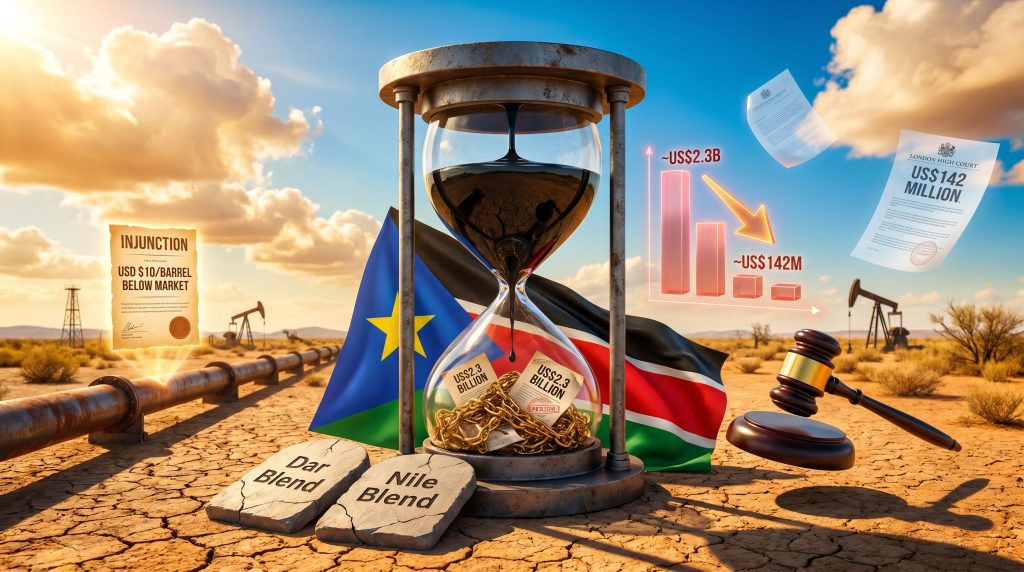
- Pricing discounts: Oil is frequently delivered at a discount to prevailing market prices, compensating the lender for risk — with reported discounts in some South Sudan arrangements reaching USD $10 per barrel below market
- Delivery schedules: Repayment occurs through physical oil delivery rather than cash transfer, meaning disruptions to production directly trigger default conditions
- Repayment timelines: Terms can extend over very long horizons — some South Sudan arrangements have reportedly included repayment periods of up to 20 years
The asymmetry embedded in these structures is significant. The lender holds legally enforceable commodity delivery claims backed by English commercial law. The sovereign borrower gains immediate liquidity but sacrifices future revenue flexibility, often for a generation.
Oil-backed financing is not inherently extractive, but in states where oversight is weak, contracting is opaque, and fiscal deficits are chronic, these instruments can evolve into binding constraints on sovereign decision-making that outlast the governments that created them.
South Sudan's Oil Economy: A Fiscal Architecture Built on a Single Commodity
To understand the depth of the current South Sudan oil-backed loans dispute, it is essential to appreciate how completely the country's public finances depend on crude exports. Oil revenues account for an estimated 90% or more of total government income, making the crude sector not just an economic pillar but the primary mechanism of state function.
South Sudan produces two main export grades: Dar Blend and Nile Blend, both produced from fields in the Upper Nile and Unity State regions. These are medium-gravity, relatively high-sulphur crude grades that trade at discounts to benchmark prices — a characteristic that further reduces the effective revenue the government captures per barrel, particularly when prepayment pricing discounts are layered on top.
The country's oil-backed debt burden has grown substantially over the years since independence in 2011, accelerating sharply during and after the civil conflict period spanning roughly 2013 to 2018. As institutional revenues collapsed and government operations required financing, oil-backed borrowing became the default liquidity mechanism. Estimates of the total outstanding oil-backed debt now stand at approximately US$2.3 billion — a figure representing a significant share of annual fiscal capacity for a country whose GDP has been severely constrained by conflict and production decline.
Furthermore, according to Reuters, South Sudan has actively sought $2.5 billion in new oil-backed loans from China and India, underscoring just how dependent the government remains on this financing mechanism. South Sudan's crude output has also been declining from earlier peak levels, compressing the physical volume available for cargo allocation. This matters enormously in the context of prepayment disputes: when multiple creditors hold prior claims on future cargoes, even modest production shortfalls create a cascading allocation failure where some obligations simply cannot be honoured simultaneously.
The BB Energy Dispute: A Timeline of Broken Commitments
The specific legal confrontation now defining the South Sudan oil-backed loans dispute centres on commodity trader BB Energy and a sequence of prepayment contracts covering 2024 and 2025.
The timeline of events reveals a pattern that will be familiar to observers of sovereign oil financing disputes:
- 2024–2025: BB Energy enters into prepayment contracts with South Sudan valued at approximately US$142 million, covering scheduled crude deliveries across both years
- November (prior year): BB Energy publicly signals imminent legal action unless deliveries resume, but allows an earlier injunction to lapse following what it described as good-faith negotiations with the Ministry of Petroleum
- February 2025: BB Energy successfully loads its first cargo under the 2025 prepayment arrangement — and receives no further oil allocations after that point
- May 2026: London's High Court grants an injunction barring South Sudan from entering any new oil-backed prepayment deals pending resolution of outstanding obligations or a further hearing
- June 5 (scheduled): A follow-up court hearing is set, with South Sudan expected to attend with legal representation — the initial proceedings proceeded without defence representation
What the Court Order Actually Restricts
| Restriction | Detail |
|---|---|
| New prepayment deals | Prohibited until debt is settled or court rules otherwise |
| Crude grades affected | Dar Blend and Nile Blend |
| Third-party facilitation | Third parties with knowledge of the order risk contempt charges |
| Penalties for breach | Fines, asset seizure, or imprisonment |
| Recovery target | Approximately US$100 million |
| Disputed cargo value | At least US$20 million |
The order's extension of contempt liability to third parties is a particularly significant legal development. Banks, shipping companies, and intermediary traders who knowingly assist South Sudan in structuring a new prepayment arrangement that breaches this order face the same punitive exposure as the primary parties. This effectively encircles the entire operational ecosystem around South Sudan's cargo monetisation. Indeed, BB Energy's actions to recover US$100mn by seizing a South Sudan oil cargo demonstrate just how far commercial creditors are prepared to go when diplomatic assurances fail.
The Opacity Problem: Why These Deals Escape Democratic Accountability
One of the most consequential features of the South Sudan oil-backed loans dispute is not the legal dispute itself, but the governance conditions that allowed the debt to accumulate in the first place.
Oil-backed prepayment arrangements are routinely structured outside the normal parliamentary budget approval process. They do not appear on standard government balance sheets in the same way as sovereign bonds or bilateral loans. Pricing terms, delivery schedules, and total obligation values are frequently not disclosed to the public or to legislative oversight bodies. This creates what researchers and civil society organisations have repeatedly characterised as a transparency deficit of systemic proportions.
The Platform for the Protection of Whistleblowers in Africa (PPLAAF) has documented patterns of oil market manipulation in South Sudan connected to these financing structures, including concerns about the systematic undervaluation of crude in prepayment contracts — a practice that, if widespread, would represent a long-term transfer of value away from the Sudanese public and toward private creditors.
The reported pricing discount of USD $10 per barrel below market on some arrangements is worth contextualising. At even modest production volumes, a sustained below-market pricing arrangement over a 20-year repayment horizon could translate into hundreds of millions of dollars in foregone sovereign revenue — revenue that would otherwise fund public services, infrastructure, and post-conflict reconstruction. These commodity supply chain risk dynamics, furthermore, do not exist in isolation; they interact with broader global pressures reshaping how resource flows are financed and monitored.
The Odious Debt Question and the East African Court of Justice
Perhaps the most legally consequential dimension of the broader dispute involves challenges mounted before the East African Court of Justice (EACJ) by civil society advocates, supported by organisations including the International Lawyers Project.
The central legal argument draws on the doctrine of odious debt — a concept in international law under which sovereign obligations may be deemed invalid if they were incurred without genuine public consent and without benefiting the population of the borrowing state. If certain oil-backed loans were negotiated without parliamentary approval, structured to primarily benefit private intermediaries, and entered into during a period of severe institutional fragility, advocates argue they may meet the threshold for odious debt classification.
The convergence of commercial enforcement proceedings in London and legitimacy challenges in Arusha creates an unprecedented dual-track legal pressure on South Sudan's oil financing architecture. One track asks whether the debts can be enforced; the other asks whether they were ever legitimate to begin with.
A favourable EACJ ruling on odious debt grounds would carry implications well beyond South Sudan. It would create regional legal precedent directly relevant to similar oil-backed financing arrangements in Angola, Chad, the Republic of Congo, and other resource-dependent African economies where comparable instruments have been used — though often with less visible governance failures. Consequently, the geopolitical resource risk dimension of such a ruling cannot be understated for investors with exposure across the continent.
The next major ASX story will hit our subscribers first
South Sudan Versus Peer Fragile States: A Comparative Debt Perspective
South Sudan's situation rhymes with other sub-Saharan oil economies that have navigated the consequences of commodity-backed sovereign borrowing, but several features make its position particularly acute.
| Country | Primary Creditor Type | Restructuring Path | Key Differentiator |
|---|---|---|---|
| Angola | Chinese state lenders | Bilateral renegotiation | State-to-state leverage |
| Chad | Glencore (commodity trader) | Extended repayment | Single dominant creditor |
| Republic of Congo | Chinese banks | IMF-supported restructuring | Multilateral backstop |
| South Sudan | Private commodity traders | Currently contested | Fragmented creditor base |
Unlike Angola, which benefited from bilateral debt renegotiation channels with Chinese state institutions, South Sudan faces a more fragmented creditor landscape composed largely of private commodity traders operating through international commercial courts. There is no single dominant counterpart with whom a government-to-government resolution can be structured.
This fragmentation is itself a risk multiplier. Each creditor holding cargo allocation rights has an incentive to secure their position before others do, creating a competitive dynamic that can accelerate cargo diversion and make coordinated restructuring more difficult to achieve.
What Commodity Traders Must Learn From This Case
For international commodity traders and lenders active in sovereign oil financing, the BB Energy proceedings represent more than a bilateral dispute — they offer a detailed map of the risk exposures inherent in these instruments.
The risks can be categorised across three dimensions:
- Delivery risk: The counterparty simply does not ship oil as contractually required, either due to production shortfalls or deliberate allocation decisions
- Allocation risk: Cargoes are redirected to competing creditors who hold prior or better-positioned claims in the sovereign allocation hierarchy
- Political risk: Government policy shifts, ministerial changes, or conflict-related disruptions interrupt delivery schedules without constituting a formal default under contract terms
The BB Energy case illustrates all three simultaneously. After loading a single cargo in February 2025, no further allocations were made — suggesting either that contracted volumes were not being produced or, more likely, that cargoes were being prioritised toward other claimants. These oil trading disruptions mirror patterns observed elsewhere when sovereign cargo allocation frameworks break down under competing creditor pressure.
Key lessons for market participants structuring similar arrangements include:
- Map the full allocation hierarchy before extending prepayments — understanding where contracted cargoes rank against existing claims is foundational due diligence
- Maintain legal protections continuously — the November lapse of the original injunction following diplomatic assurances demonstrates the risk of substituting goodwill for enforceable legal mechanisms
- Treat third-party contempt exposure as a structural deterrent — the court's warning to third parties is not incidental; it is a deliberate tool for restricting the counterparty's ability to circumvent the order
- Price political risk explicitly — standard trade finance risk models built on OECD counterparty assumptions are inadequate for fragile-state sovereign lending
Three Scenarios for Resolution and Their Fiscal Implications
The trajectory of the South Sudan oil-backed loans dispute over the coming months will depend heavily on political will, production volumes, and the legal positions adopted at the June 5 hearing. Three broad resolution pathways exist.
Scenario 1: Negotiated Settlement Before June 5
South Sudan reaches an agreement with BB Energy on a structured repayment or delivery schedule. The injunction is lifted. New prepayment arrangements become permissible. This outcome restores near-term liquidity but leaves the underlying debt burden of US$2.3 billion unaddressed.
Scenario 2: Contested Litigation Through London Courts
South Sudan contests the injunction with full legal representation at the June 5 hearing. Proceedings extend over months or longer. The prohibition on new prepayment deals remains in place throughout. This scenario carries reputational damage with the commodity trading community and creates sustained fiscal pressure through restricted cargo monetisation.
Scenario 3: EACJ Odious Debt Ruling Triggers Systemic Restructuring
The East African Court of Justice rules that certain oil-backed obligations meet the threshold for odious debt. This creates a legal basis for restructuring or repudiating a portion of the US$2.3 billion debt stack. While potentially providing the most comprehensive fiscal relief, this outcome would cause significant disruption to commodity trader risk models across the continent and likely trigger defensive legal restructuring of all similar instruments in the region.
Frequently Asked Questions: South Sudan Oil-Backed Loans Dispute
What is an oil-backed prepayment loan?
An oil-backed prepayment loan is a financing structure in which a government or state oil company receives upfront cash from a commodity trader or lender in exchange for a contractual commitment to deliver specified crude oil volumes over a future period. The physical oil serves simultaneously as collateral and as the mechanism of repayment.
How much does South Sudan owe in oil-backed debt?
Total oil-backed debt obligations are estimated at approximately US$2.3 billion. The specific BB Energy dispute involves prepayment contracts valued at around US$142 million covering 2024 and 2025 deliveries, with BB Energy seeking to recover approximately US$100 million in outstanding obligations.
What did the London court order prohibit?
The High Court order bars South Sudan from entering into any new oil-backed prepayment arrangements until outstanding obligations to BB Energy are resolved or a further court hearing takes place. The restriction covers Dar Blend and Nile Blend crude grades and extends contempt liability to third parties who knowingly facilitate a breach.
What is odious debt and why does it matter here?
Odious debt is an international law doctrine under which sovereign obligations may be considered unenforceable if they were incurred without the consent of the population and not in the public interest. Civil society advocates challenging certain South Sudan oil-backed loans before the East African Court of Justice argue that some arrangements may meet this definition, potentially making them invalid under domestic and regional legal frameworks.
Why are these disputes resolved in London courts?
Most international commodity financing agreements specify English law as the governing framework and designate London courts as the dispute resolution venue. This reflects the global dominance of English commercial law in trade finance and provides creditors with access to a highly developed and creditor-responsive enforcement system with the ability to grant injunctive relief against sovereign borrowers.
What happens if South Sudan cannot repay its oil-backed obligations?
Continued non-repayment risks asset seizure, sustained restrictions on cargo monetisation, progressive exclusion from international trade finance markets, and deepening fiscal crisis. The Brookings Institution has noted that disruptions to South Sudan's oil revenue streams have historically correlated with political instability — meaning the economic and security consequences of this dispute are deeply intertwined.
Rethinking the Architecture of Resource-Backed Lending Across Africa
The South Sudan oil-backed loans dispute is not an isolated failure of a single government or a single contract. It is the most visible expression of a structural problem that has been building across oil-dependent African economies for decades. In addition, the resource export pressures now visible in multiple commodity markets make understanding these financing failures all the more urgent for investors and policymakers alike.
Reform advocates, multilateral institutions, and civil society organisations have consistently identified the same set of structural remedies:
- Mandatory parliamentary disclosure of all oil-backed financing arrangements before they are executed
- Independent cargo allocation auditing to verify that contracted deliveries are being fulfilled and that pricing benchmarks reflect genuine market rates
- Standardised pricing benchmarks that prevent below-market discounts from systematically eroding sovereign revenue over multi-decade repayment horizons
- Regional treaty frameworks that establish minimum transparency and governance standards for resource-backed sovereign lending
The dual-track legal pressure now bearing on South Sudan, through commercial enforcement in London and legitimacy challenges in Arusha, may ultimately accomplish through litigation what policy advocacy has struggled to achieve through persuasion. The outcome of these proceedings will function as a stress test for the entire architecture of oil-backed sovereign lending in sub-Saharan Africa.
The result will shape how commodity traders price sovereign oil financing risk, how governments in fragile states access short-term liquidity, and whether international commercial courts become the primary accountability mechanism for a class of financial instruments that has, until now, largely escaped meaningful oversight.
For investors, policymakers, and market participants with exposure to resource-backed African sovereign finance, the South Sudan case is not a peripheral story. It is a preview of the structural reckoning that awaits wherever opaque commodity financing has substituted for transparent public debt management across the continent.
This article contains analysis of ongoing legal proceedings and sovereign debt dynamics. It should not be construed as legal or financial advice. Figures cited reflect available estimates and reported values; actual outcomes may differ materially depending on court rulings, production data, and negotiation outcomes.
Want To Position Yourself Ahead of the Next Major Mineral Discovery?
Discovery Alert's proprietary Discovery IQ model delivers real-time alerts on significant ASX mineral discoveries, transforming complex resource data into actionable investment insights for both short-term traders and long-term investors — explore historic examples of exceptional discovery returns and begin your 14-day free trial today to secure a market-leading edge.