June 15, 2026
When the Rupee Meets the Risk Premium: Understanding India's Crude Oil Crisis
Energy markets have long functioned as a barometer for geopolitical stress, and few instruments capture that relationship as vividly as India's domestic crude oil futures. When global tensions escalate, the repricing that follows is not simply a matter of supply and demand arithmetic. Understanding the current crude oil dynamics is essential for an economy as structurally exposed to imported hydrocarbons as India's.
The interaction between global crude benchmarks and domestic currency dynamics creates a compounding effect that can shift macroeconomic conditions faster than almost any other single variable. That compounding effect reached a critical threshold in May 2026, when MCX crude oil futures hit a record high in India, breaching levels that carry significant implications for inflation, fiscal policy, currency stability, and investor positioning.
When big ASX news breaks, our subscribers know first
How MCX Crude Oil Futures Work, and Why the Record Matters
India's Multi Commodity Exchange is the primary domestic platform for trading commodity futures, including crude oil. Contracts on MCX are denominated in Indian rupees and priced per barrel, with lot sizes of 100 barrels. Unlike the globally dominant benchmarks, WTI traded on NYMEX and Brent traded on ICE, MCX crude pricing incorporates not just the underlying global crude value but also the prevailing USD/INR exchange rate and domestic market conditions.
This dual-input pricing structure means that even a modest rise in Brent crude in dollar terms can translate into a disproportionately large rupee-denominated move if the currency is simultaneously weakening. Conversely, a strong rupee can partially cushion domestic futures from global price spikes. In the current environment, both forces are operating in the same direction, which is precisely why crude oil futures hit a record high in India at this juncture.
The Numbers Behind the Record
The scale of this milestone deserves close examination:
| Benchmark | Price | Session Change |
|---|---|---|
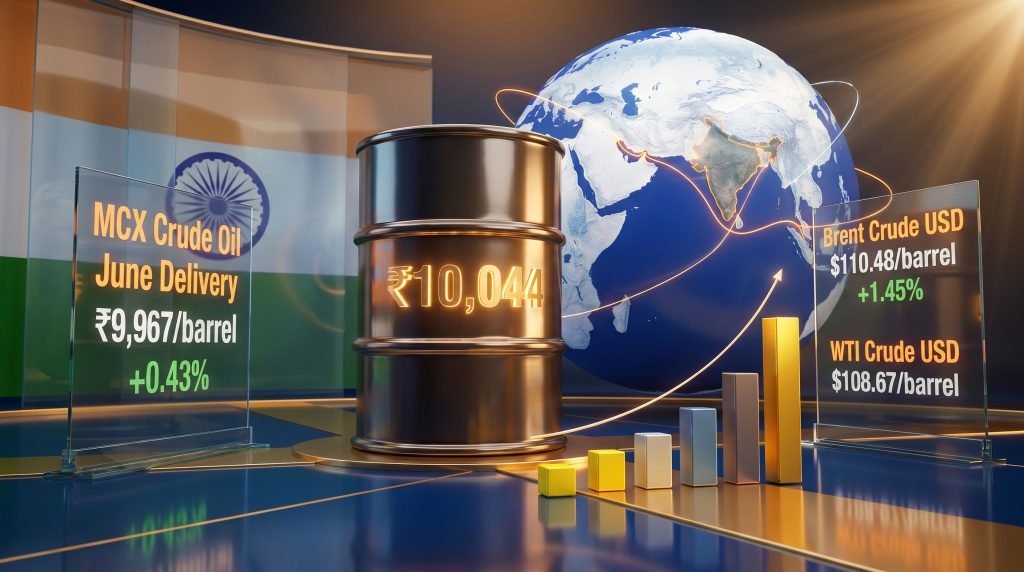
| MCX Crude Oil (June Delivery) | ₹9,967/barrel | +₹43 (+0.43%) |
| MCX Intraday Record High | ₹10,044/barrel | All-time high |
| WTI Crude (Global) | USD $108.67/barrel | +0.01% |
| Brent Crude (Global) | USD $110.48/barrel | +1.45% |
The June delivery contract closed the prior session at ₹9,967 per barrel, having touched an intraday peak of ₹10,044 per barrel — the highest level ever recorded on MCX. Trading volume of 8,508 lots indicated meaningful market participation, not a thin-market artefact.
A critical observation here is that WTI moved just 0.01% in that session, yet MCX futures rose 0.43%. The divergence points to Brent's outsized role in India's import pricing and the additional amplification provided by rupee weakness. It also highlights how domestic futures markets can overshoot global benchmarks during high-volatility sessions when currency dynamics align with geopolitical fear.
The West Asia Crisis and the Geopolitical Risk Premium
The catalyst behind this record is not a supply disruption that has already occurred. It is the market's pricing of the probability that one could occur. Furthermore, the geopolitical oil price tensions across the West Asia region have raised the speculative premium embedded in global crude contracts to levels not seen since the 2021–2022 post-pandemic energy squeeze.
The specific risk that traders are hedging against involves potential interference with or restrictions on shipping through the Strait of Hormuz, the narrow passage between Iran and Oman through which approximately 20% of the world's seaborne oil trade passes daily. This includes significant volumes of Persian Gulf crude destined for Asian markets, with India being one of the largest recipients.
What makes the current risk premium structurally different from historical spikes is that market participants appear to be treating this as a prolonged baseline condition rather than a short-term shock. The behaviour of Brent, which outpaced WTI significantly in the session where crude oil prices soared amid regional tensions, reflects this geographic specificity. Brent is the primary benchmark for Middle Eastern crude, and its outperformance signals that the market views supply geography, not just aggregate global volumes, as the core vulnerability.
The Role of Fresh Buying in Amplifying the Move
Beyond fundamental supply concerns, market structure also contributed to the record. Analysts noted that fresh buying — meaning new long positions being established rather than existing positions being maintained — added momentum to the upward move. This is a technically significant distinction.
When new participants enter the long side of a futures market during an already elevated pricing environment, it typically signals one of two things:
- Hedgers (refiners, importers, airlines) accelerating their coverage of forward input costs as prices approach psychologically significant thresholds.
- Speculative positioning by funds seeking to benefit from further upside if geopolitical conditions deteriorate.
Either way, fresh buying in a relatively thin session can exaggerate intraday moves, which explains why the MCX contract briefly touched ₹10,044 before settling somewhat lower at ₹9,967. This kind of intraday overshoot is common in commodity futures during periods of geopolitical uncertainty, and should not be read as a confirmed ceiling or floor.
India's Structural Vulnerability: Why This Record Hits Harder Here
India imports approximately 85 to 87% of its total crude oil requirements, a dependency ratio that places it among the most exposed major economies to global energy price shocks. To contextualise the scale of that exposure, analysts have estimated that every sustained $10 per barrel increase in Brent crude adds approximately $12 to $15 billion annually to India's crude import bill, all else being equal.
With Brent currently above $110 per barrel, the annual import burden is operating in territory that stretches fiscal and external account sustainability in ways that ripple across the broader economy. In addition, the oil price movements driven by ongoing trade tensions compound the pressure on India's already strained import economics.
Currency Feedback Loop: The Rupee's Role
The interaction between crude prices and the rupee creates a feedback loop that is often underappreciated. Higher oil prices widen India's current account deficit, which puts downward pressure on the rupee. A weaker rupee then raises the rupee cost of the same barrel of oil, which further widens the import bill and adds fresh depreciation pressure.
This cycle can be self-reinforcing until a circuit breaker — such as a sharp oil price correction, Reserve Bank of India intervention, or a policy response — interrupts the loop. Historically, this relationship has followed a recognisable pattern:
| Brent Crude Level | Approximate USD/INR Range | Current Account Pressure |
|---|---|---|
| Below $80/barrel | 82–84 | Manageable |
| $80–$95/barrel | 84–86 | Moderate |
| $95–$110/barrel | 86–88 | Elevated |
| Above $110/barrel | 88+ | High / Record Stress |
At current Brent levels above $110 per barrel, the exchange rate and current account dynamics are operating in the highest stress band of this historical framework.
Inflation Cascade: From Futures to the Checkout Counter
The transmission from crude oil futures to consumer prices in India follows a well-documented pathway, though the speed and magnitude depend heavily on government pricing decisions:
- Refinery input costs rise as crude import prices increase.
- Oil marketing companies (OMCs) face margin compression unless retail fuel prices are adjusted upward.
- If petrol and diesel prices rise, transportation costs across all logistics networks increase.
- Food prices, which are highly sensitive to transport cost changes in India's distributed supply chains, begin to rise.
- Input cost inflation spreads across manufacturing and services sectors that depend on petrochemical derivatives.
The government's dilemma is that absorbing these costs through subsidies protects consumers in the short term but widens the fiscal deficit. Conversely, passing them through controls inflation expectations but risks a visible cost-of-living shock. India navigated this exact tradeoff during the 2021–2022 oil price surge, ultimately opting for a phased pass-through combined with excise duty adjustments — a template that may well be revisited.
Sectoral and Investor Implications
Not all sectors respond uniformly to elevated crude prices. Investors seeking to navigate this environment should understand the divergent impacts. Moreover, understanding commodity volatility and hedging strategies is increasingly critical for businesses managing energy-related cost exposure.
Sectors most negatively exposed:
- Aviation (jet fuel comprises 30–40% of airline operating costs)
- Road logistics and freight operators
- Tyre manufacturers and paint companies (petrochemical input dependency)
- Polymer and plastics-based manufacturers
- Fast-moving consumer goods companies with distribution-heavy supply chains
Sectors with potential upside:
- Upstream domestic oil producers such as ONGC and Oil India, whose realised prices rise with global benchmarks
- Refining companies with advantageous crude procurement contracts or differential pricing access
- Energy infrastructure providers benefiting from higher throughput revenues
From an equity market perspective, sustained crude above $110 per barrel historically correlates with foreign portfolio investor outflows from Indian equities, as higher inflation expectations feed into interest rate uncertainty and compress valuation multiples across rate-sensitive sectors.
Three Scenarios: Where Crude Prices Go From Here
Disclaimer: The following scenarios are based on analytical frameworks and market conditions as understood at the time of writing. They involve inherent uncertainty and should not be interpreted as investment advice or price forecasts.
Scenario 1: Geopolitical De-escalation (Bearish for Crude)
A diplomatic resolution or meaningful ceasefire in the West Asia conflict zone would rapidly unwind the geopolitical risk premium. In this scenario, Brent could retreat toward the $90 to $95 per barrel range, with MCX futures normalising below ₹8,500 per barrel. This would provide significant relief to India's import bill, rupee, and inflation trajectory.
Scenario 2: Prolonged Conflict, No Physical Supply Disruption (Sideways)
The most likely near-term scenario involves continued hostilities without an actual blockage of Hormuz shipping lanes. Under these conditions, Brent is likely to range between $100 and $112 per barrel, with MCX futures oscillating between approximately ₹9,500 and ₹10,200. India would face ongoing fiscal and monetary pressure but without a catastrophic supply shock.
Scenario 3: Strait of Hormuz Disruption (Extreme Upside)
A physical disruption to tanker traffic through the Strait, even a partial one, would trigger an immediate and severe global supply shock. Brent could test the $130 to $150 per barrel range under this scenario, potentially pushing MCX crude futures above ₹12,000 to ₹13,000 per barrel. India's response toolkit would likely include emergency releases from strategic petroleum reserves, accelerated alternative supply sourcing, and significant RBI intervention.
Current market pricing appears to reflect a weighted combination of Scenarios 1 and 2, with Scenario 3 treated as a tail risk rather than a base case. The directional resolution of geopolitical tensions in the coming weeks will be the primary determinant of which path materialises.
The next major ASX story will hit our subscribers first
MCX vs. Global Benchmarks: Understanding the Structural Differences
A common misconception is that MCX crude oil futures are simply a rupee-converted version of Brent. The reality, however, is more layered:
| Feature | MCX Crude Oil Futures | WTI (NYMEX) | Brent (ICE) |
|---|---|---|---|
| Denomination | Indian Rupee (₹) | US Dollar (USD) | US Dollar (USD) |
| Contract Size | 100 barrels | 1,000 barrels | 1,000 barrels |
| Primary Benchmark Region | India (domestic) | North America | Global / Middle East |
| Key Pricing Drivers | Global crude + INR/USD rate | US supply/demand | Global supply/geopolitics |
| Relevance to India | Direct domestic hedging tool | Reference benchmark | Primary import pricing basis |
Additional pricing layers embedded in MCX contracts include currency hedging costs, forward exchange rate differentials, domestic refinery margin expectations, and import logistics costs. These factors, consequently, can cause MCX crude to diverge meaningfully from what a simple Brent-to-rupee conversion would imply — particularly during high-volatility sessions.
Key Indicators for the Road Ahead
For consumers, businesses, and investors tracking the consequences of this record, the following variables provide the most actionable signals. It is also worth monitoring the broader geopolitical crude trends shaping price direction in the months ahead.
- Brent crude relative to $115/barrel: A sustained breach of this level signals that the next phase of domestic price pressure is imminent.
- USD/INR exchange rate above 88: Rupee weakness beyond this level would amplify the import bill stress significantly beyond what crude prices alone would indicate.
- OMC retail fuel price announcements: Any upward revision to petrol or diesel prices is a leading indicator of fiscal stress crossing into visible consumer impact.
- RBI policy communications: Language around inflation expectations and rate trajectory will reflect the central bank's assessment of crude-driven price risks.
- Strategic Petroleum Reserve utilisation: Emergency deployment of SPR stocks by the government would be a strong signal that policymakers are treating current price levels as unsustainable.
The moment when crude oil futures hit a record high in India is not simply a data point. It is a threshold event that concentrates the intersection of global geopolitics, domestic monetary conditions, fiscal tradeoffs, and consumer welfare into a single number on a trading screen. Understanding the mechanisms behind that number — and the scenarios that could either normalise or extend it — is essential for every stakeholder navigating India's energy-exposed economy.
For ongoing coverage of India's oil market dynamics and related macroeconomic developments, ET EnergyWorld provides real-time data and analysis across India's oil and gas sector. Additionally, The Hindu Business offers in-depth reporting on commodity markets and the macroeconomic forces shaping India's energy landscape.
Want To Stay Ahead of the Next Major Commodity Market Move?
Discovery Alert's proprietary Discovery IQ model scans ASX announcements in real time, instantly identifying significant mineral discoveries across more than 30 commodities and translating complex data into clear, actionable insights — whether you're a short-term trader or a long-term investor. Explore how historic discoveries have generated substantial returns on Discovery Alert's discoveries page, and begin your 14-day free trial today to position yourself ahead of the broader market.