May 19, 2026
Why Western Australia's Under-Explored Interior Holds Asymmetric Discovery Potential
Geological prospectivity and exploration activity rarely move in lockstep. Across Western Australia's vast interior, scores of mineral fields carry geochemical signatures and structural characteristics that rival the world's most productive mining districts, yet systematic modern exploration has touched only a fraction of the available ground. This disconnect between known prospectivity and actual drill coverage defines what seasoned explorers call the discovery gap, and it is precisely this gap that is drawing a new wave of junior companies into WA's Murchison and Gascoyne regions during 2025 and 2026.
The forces driving renewed interest are not simply optimism. Gold spot prices have remained elevated well above historical averages, copper demand projections tied to global electrification continue to strengthen, and rare earth element supply chains remain uncomfortably concentrated in a single dominant producer nation. These intersecting pressures have reset the economics of early-stage exploration, making greenfields tenement acquisition in under-drilled corridors a more defensible capital allocation strategy than at any point in the previous decade.
It is within this context that Danakali's expanding Danakali exploration licences in Western Australia deserve careful examination, not merely as a corporate news event, but as a case study in how junior explorers are structuring diversified critical minerals portfolios in a rapidly evolving resource cycle.
When big ASX news breaks, our subscribers know first
What Danakali's WA Portfolio Looks Like at a Glance
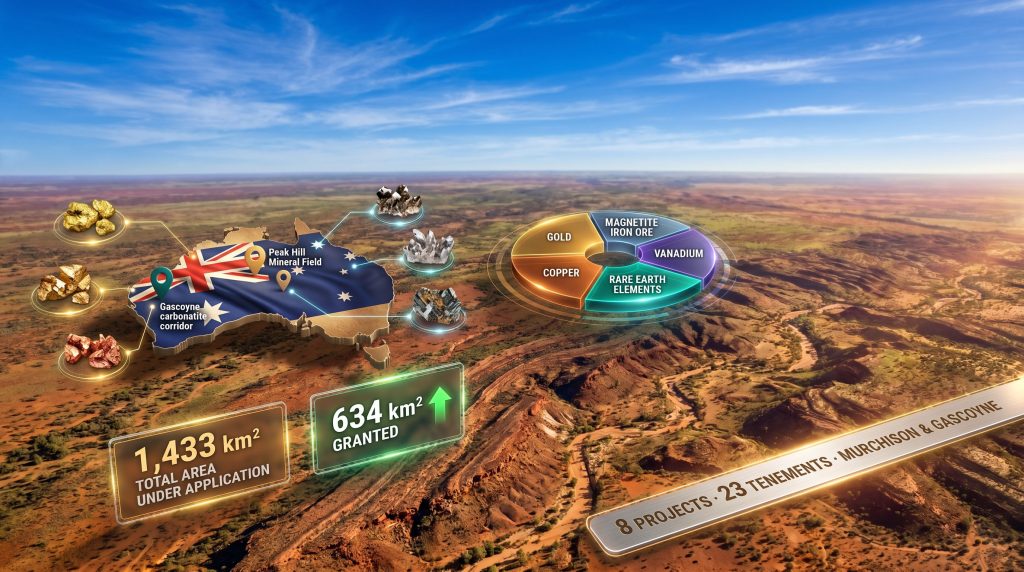
Danakali, listed on the National Stock Exchange of Australia (NSX), has assembled an exploration footprint of considerable scale across WA's premier interior mineral provinces. The numbers tell a compelling structural story.
| Portfolio Metric | Current Status |
|---|---|
| Total area under application | 1,433 km² |
| Number of discrete projects | 8 |
| Total tenement applications lodged | 23 |
| Tenements granted to date | 10 |
| Total granted area | 634 km² |
| Primary mineral fields | Murchison, Gascoyne |
| Target commodities | Gold, copper, zinc, rare earths, vanadium, titanium, iron ore |
What stands out in this data is not just the size of the footprint but the sequencing of its assembly. Tenement grants were recorded across October, November, and December of the preceding field season, suggesting a deliberate, phased approach to land tenure acquisition rather than a single bulk transaction. This distinction matters for investors attempting to assess management discipline, because staged acquisition typically reflects a more systematic evaluation process than opportunistic bulk dealing.
The three most recently confirmed granted tenements anchor two separate mineral field contexts:
- Errida Creek (E52/4503): Peak Hill Mineral Field, approximately 190 km northwest of Meekatharra
- Errabiddy (E52/4504): Peak Hill Mineral Field, same regional corridor as Errida Creek
- Bungar (E59/3027): Yalgoo Mineral Field, approximately 107 km southeast of Mount Magnet
Understanding WA Exploration Licences: The Legal and Operational Framework
For investors unfamiliar with Western Australia's mining tenure system, it is worth establishing what an exploration licence actually confers, and what it does not.
Under WA's Mining Act 1978, an exploration licence grants the holder the legal right to conduct systematic geological investigation within a defined boundary. Critically, it also permits the extraction of up to 1,000 tonnes of material for testing purposes without requiring a separate mining approval. Standard exploration licences are issued for an initial period of five years, subject to minimum expenditure commitments, annual reporting obligations, and compliance with environmental and Aboriginal heritage consultation requirements.
The table below illustrates where exploration licences sit within WA's broader tenure progression framework:
| Tenure Stage | Legal Status | Primary Activity Permitted |
|---|---|---|
| Tenement Application | Pending | Desktop review, historical data compilation |
| Granted Exploration Licence | Active | Field surveys, drilling, soil sampling |
| Mining Lease | Development-ready | Resource delineation, feasibility work |
| Mining Approval | Operational | Full-scale production and extraction |
Investor Clarity Point: A granted exploration licence confirms legal access and authorises systematic fieldwork. It does not imply the confirmed presence of an economic mineral deposit, nor does it signal imminent production. These are fundamentally different stages with different risk profiles and valuation frameworks.
An often-overlooked operational nuance is the minimum expenditure condition. WA exploration licences require licence holders to meet prescribed minimum spend thresholds on a per-hectare basis across the licence term. Failure to demonstrate this expenditure can result in licence forfeiture, which means that a large tenement portfolio also implies a capital commitment schedule that investors should factor into liquidity assessments.
The Geological Rationale: Murchison and Gascoyne as Tier-One Exploration Addresses
Western Australia's Murchison and Gascoyne regions sit atop some of the continent's most mineralogically diverse Archaean and Proterozoic geological terranes. Understanding why these regions carry genuine geological credibility, rather than being speculative frontier ground, requires a brief look at the deposit analogues already operating within or immediately adjacent to Danakali's project corridors.
Murchison Region: Five Projects Targeting Multiple Mineralisation Styles
Danakali's Murchison portfolio spans five discrete projects, each targeting a geologically distinct mineralisation style.
Volcanogenic Massive Sulphide (VMS) Systems at Golden Grove Prospects
VMS deposits form through hydrothermal circulation at or near ancient submarine volcanic centres. They are among the most prolific base metal deposit types known, typically hosting copper, zinc, lead, gold, and silver in varying proportions. The Golden Grove mine, located in WA's mid-west, is one of Australia's largest known VMS systems and has been in production for decades. Its geological architecture provides a compelling exploration template for the broader Murchison terrane.
Layered Intrusive Complex at Windimurra
The Windimurra prospect targets vanadium, titanium, and iron ore mineralisation hosted within a layered mafic intrusion. Layered intrusions can concentrate vanadium-bearing magnetite through magmatic differentiation processes over geological time. This style of mineralisation is attracting increasing investor attention given vanadium's emerging role in vanadium redox flow battery (VRFB) technology, which is increasingly deployed in large-scale grid energy storage applications.
Magnetite Iron Ore at Koolyanobing and Karara Analogues
The Karara magnetite project in WA's mid-west region is one of Australia's largest magnetite operations, validating the prospectivity of this mineralisation style across the broader Murchison geological setting. Magnetite iron ore, while lower grade than direct-shipping hematite, has gained renewed commercial relevance in the context of direct reduction iron (DRI) steelmaking, which is increasingly preferred in low-carbon steel production pathways.
Gascoyne Region: Carbonatite Complexes and the Rare Earth Corridor
The Gascoyne region represents arguably the most strategically significant component of Danakali's portfolio from a critical minerals standpoint. The region hosts the Yangibana/Gifford Creek carbonatite complex, a well-documented geological system known to contain substantial rare earth element resources. Established projects including Hastings and Dreadnought have already demonstrated the REE prospectivity of this carbonatite corridor.
Danakali's Gascoyne tenements, specifically the Orson, Chelios, and Turkish projects, are positioned within or in proximity to this carbonatite corridor. This is not coincidental proximity. Carbonatite-hosted REE deposits carry specific characteristics that distinguish them from other REE deposit styles:
- Carbonatite systems typically host light rare earth elements (LREEs) such as neodymium and praseodymium, which are the most commercially critical for permanent magnet manufacturing used in electric vehicle motors and wind turbines
- Carbonatite-hosted mineralisation generally yields more favourable processing characteristics compared to ionic clay-type REE deposits common in southern China, which often require significant acid leaching
- The Gascoyne carbonatite province has a geological age and structural framework consistent with economic REE concentration, providing a scientifically grounded basis for exploration rather than purely speculative targeting
Industry Context: Global rare earth supply chains remain heavily skewed toward Chinese production, which accounts for the substantial majority of global REE output and processing capacity. This concentration dynamic has driven sustained Western government interest in developing alternative REE sources, and has underpinned elevated investor attention toward REE projects in politically stable jurisdictions like Western Australia.
Current Field Programme: What Is Actually Happening on the Ground?
Danakali's field teams are currently mobilising to the Gascoyne region to conduct detailed geological inspection and systematic soil sampling across the Orson, Chelios, and Turkish project areas. RSC Mining and Exploration is supporting desktop studies and on-site assessment work across the granted tenement portfolio.
Soil geochemistry sampling is a first-pass exploration technique that involves collecting systematic surface soil samples across a grid pattern and analysing them for trace element anomalies. The technique is cost-effective, low-disturbance, and well-suited to identifying areas of potential buried mineralisation before committing capital to drilling. Following the Gascoyne reconnaissance programme, field activities are scheduled to transition to the Murchison region, with the Jonas project identified as the next priority target.
The full exploration progression from granted licence to drill target typically follows this sequence:
- Desktop review of historical geological data, geophysical compilations, and regional mapping
- Reconnaissance field survey involving visual geological inspection and structural mapping
- Soil and rock chip sampling to identify geochemical anomalies across priority zones
- Geophysical surveying using airborne or ground-based magnetic, gravity, or electromagnetic methods to detect subsurface structural features
- Target definition through integrated data analysis combining geochemistry and geophysics
- First-pass drilling via reverse circulation (RC) or diamond drilling to test priority targets at depth
Timeline Perspective: For well-resourced junior explorers operating in accessible WA terrain, the progression from granted licence to first drill results typically spans 12 to 24 months, depending on field access conditions, capital availability, and the complexity of regulatory and heritage consultation processes.
WA's Exploration Incentive Scheme: A Structural Tailwind for Junior Explorers
Western Australia's Exploration Incentive Scheme (EIS), administered by the Department of Energy, Mines, Industry Regulation and Safety (DEMIRS), provides co-funded drilling support to eligible junior explorers conducting greenfields programmes in underexplored areas. The scheme operates through a co-contribution model where approved applicants can receive partial reimbursement of eligible drilling costs, materially reducing the capital burden of transitioning from geochemical sampling to drill testing.
Greenfields mineral exploration in under-explored mineral corridors, precisely the category that describes Danakali's current WA portfolio, aligns well with EIS eligibility criteria. Access to EIS co-funding, if pursued and obtained, could meaningfully accelerate the pace at which specific targets progress from anomaly definition to drill testing. This is a structural feature of the WA regulatory environment that benefits the broader junior explorer cohort operating in the state's interior regions, not a project-specific entitlement.
The next major ASX story will hit our subscribers first
How Danakali's WA Strategy Compares Across the Commodity Matrix
One of the more distinctive features of Danakali's WA portfolio is its deliberate multi-commodity structure. Furthermore, rather than concentrating exposure in a single commodity, the portfolio spans the intersection of traditional mining stalwarts and emerging critical minerals demand drivers:
| Target Commodity | Primary Market Driver | Danakali Project Exposure |
|---|---|---|
| Gold | Safe-haven demand, elevated spot pricing | Golden Grove prospects, Murchison |
| Copper | Global electrification, energy transition | VMS targets, Murchison |
| Rare Earth Elements | EV supply chains, defence applications | Gascoyne carbonatite corridor |
| Vanadium | Grid-scale energy storage, VRFB technology | Windimurra prospect |
| Magnetite Iron Ore | DRI steelmaking, low-carbon steel | Koolyanobing and Karara analogues |
| Zinc | Base metals demand, infrastructure | VMS targets, Murchison |
This multi-commodity structure hedges against single-commodity price cycles while simultaneously maximising the portfolio's optionality across different market scenarios. If gold prices retreat but copper strengthens, different components of the same land package carry independent value propositions.
Key Risks Every Investor Should Understand
No examination of an early-stage exploration portfolio is complete without a frank assessment of the risks involved. Several are particularly relevant here:
- Geological risk is the most fundamental. The majority of exploration licences granted globally never progress to a defined mineral resource, and even fewer reach production. Proximity to known deposits provides geological credibility, but it does not transfer those deposits' economics to adjacent ground.
- Capital risk is significant for junior explorers managing multi-project portfolios. Running eight projects simultaneously requires sustained capital allocation. Investors should assess a company's cash position, burn rate, and near-term capital raising requirements relative to its stated exploration commitments.
- Regulatory and heritage risk in WA's interior includes the requirement for Aboriginal heritage consultation prior to ground disturbance. Heritage surveys and Section 18 consent processes under WA's Aboriginal Heritage Act can introduce meaningful timeline variability.
- Liquidity risk is amplified by Danakali's listing on the NSX rather than the ASX. NSX-listed securities generally carry lower trading volumes and narrower investor awareness compared to ASX equivalents, which can affect price discovery and capital raising efficiency.
Risk Callout: Exploration-stage companies carry compounded geological, financial, and regulatory uncertainty. The existence of established deposit analogues in a region provides a geologically sound basis for exploration, but it does not guarantee discovery, and investors should evaluate these assets within the full context of a company's financial position and management track record.
Near-Term Catalysts and the 12-Month Outlook
Looking across the next twelve to twenty-four months, several developments have the potential to serve as material information milestones for the Danakali exploration licences in Western Australia:
- Soil sampling results from the Gascoyne programme at Orson, Chelios, and Turkish are likely to be the next substantive technical disclosure, providing the first geochemical characterisation of ground prospectivity in this REE corridor
- Completion of the Jonas programme in the Murchison region will provide early geological context for that project's VMS and gold potential
- Further tenement grants from the remaining 13 pending applications could materially expand the portfolio's footprint and introduce new commodity or geological settings into the mix
- Target definition outcomes will determine whether any component of the portfolio advances toward drill targeting within the current field season
The combination of a favourable commodity pricing environment, WA's well-established exploration infrastructure, and the geological credibility of Danakali's selected mineral corridors creates a foundation for progressive news flow as field programmes advance. Whether that news flow translates into discovery outcomes remains, as always in exploration, the central and unresolved question.
Frequently Asked Questions: Danakali Exploration Licences in Western Australia
What exploration licences has Danakali been granted in Western Australia?
Danakali has been granted 10 of its 23 tenement applications, covering a combined area of 634 km² across the Murchison and Gascoyne regions. Specifically confirmed granted tenements include Errida Creek (E52/4503) and Errabiddy (E52/4504) in the Peak Hill Mineral Field, and Bungar (E59/3027) in the Yalgoo Mineral Field.
What minerals is Danakali targeting across its WA projects?
The portfolio targets gold, copper, zinc, rare earth elements, vanadium, titanium, and magnetite iron ore, reflecting the diverse geological settings across the Murchison and Gascoyne project areas. In addition, the critical minerals demand backdrop for several of these commodities remains structurally supportive heading into 2026.
How does Danakali's WA portfolio relate to its Colluli project?
Danakali's Colluli potash project is situated in Eritrea, East Africa, and represents the company's most advanced asset. The WA exploration portfolio is a geographically and commoditally separate early-stage initiative, representing a domestic diversification of the company's exploration pipeline rather than an extension of Colluli.
Is Danakali listed on the ASX?
Danakali is listed on the National Stock Exchange of Australia (NSX), not the ASX. This distinction carries implications for trading liquidity, investor visibility, and regulatory disclosure frameworks that investors should factor into their assessments.
How long does a WA exploration licence last?
Under WA's Mining Act, exploration licences are typically granted for an initial term of five years, subject to minimum expenditure conditions, annual reporting requirements, and compliance with environmental and heritage obligations. Consequently, the mineral exploration commitments implied by a large tenement portfolio should always be assessed alongside a company's available capital.
Disclaimer: This article is intended for informational purposes only and does not constitute financial or investment advice. Exploration-stage mining companies carry significant geological, financial, and regulatory risks. Past discovery outcomes in a region do not guarantee similar results from new exploration programmes. Readers should seek independent financial advice before making investment decisions. All financial figures, tenement data, and project details referenced in this article are sourced from publicly available company disclosures and should be verified against current company announcements prior to any investment decision.
Want to Spot the Next Major WA Mineral Discovery Before the Broader Market?
Discovery Alert's proprietary Discovery IQ model delivers real-time alerts on significant ASX mineral discoveries across gold, copper, rare earths, and beyond — instantly translating complex geological data into actionable investment insights for both short-term traders and long-term investors. Explore how historic mineral discoveries have generated substantial returns, then begin your 14-day free trial at Discovery Alert to position yourself ahead of the market.