May 19, 2026
The Structural Fault Line Beneath Australia's Energy Market
For decades, the architecture of Australia's east coast gas market has operated on a fundamentally different logic from its western counterpart. While Western Australia embedded a domestic reservation requirement into its LNG licensing framework from the outset, the east coast evolved as an export-oriented system with minimal structural protections for local consumers. The result is a market where Australia simultaneously became one of the world's top three LNG exporters while its own manufacturers, households, and utilities faced tightening supply and volatile pricing. Understanding why this happened, and what the newly announced 20% domestic gas reservation policy intends to fix, requires looking beyond the policy headline to the structural dynamics underneath.
When big ASX news breaks, our subscribers know first
Why the East Coast Gas Market Reached a Breaking Point
The east coast gas market is physically fragmented in ways that Western Australia's integrated pipeline network is not. Multiple interconnected basins, ageing infrastructure, and a production base that was partially redirected toward Queensland's LNG export terminals from the early 2010s onwards created the conditions for supply tightness. According to projections from the Australian Energy Market Operator (AEMO), the east coast faces a credible risk of running short of gas by the end of this decade if no structural intervention is made.
This supply gap risk has intensified the policy debate. For years, the federal government was reluctant to impose hard regulatory constraints on an export industry that generates significant trade revenue and supports bilateral energy security relationships across Asia. However, with AEMO's forward-looking assessments growing more urgent, and with domestic energy affordability becoming a live political issue, the calculus shifted.
Furthermore, Australia's energy exports face mounting structural challenges that have made domestic reservation increasingly difficult to avoid as a policy response. The policy response that emerged was the 20% domestic gas reservation requirement, applicable to east coast LNG exporters from July 2027. Critically, the government also ruled out a proposed 25% windfall profits tax on gas exports, signalling a deliberate preference for a supply-side intervention over a fiscal one.
Choosing Reservation Over Taxation: What the Policy Decision Reveals
The decision to pursue physical reservation rather than a windfall tax is more consequential than it might initially appear. A windfall tax would have captured value from existing export revenues, potentially affecting investor returns without materially changing domestic supply volumes. Reservation, by contrast, directly mandates that a portion of gas production remain available to domestic buyers.
From a political economy perspective, the reservation model also preserves Australia's positioning as an investment-friendly jurisdiction. A windfall tax on LNG exports would have sent a sharp negative signal to the same trading partners and investors whose confidence underpins Australia's long-term LNG export franchise. The reservation approach threads a narrower needle: it increases domestic supply without imposing a financial penalty that could trigger sovereign risk concerns.
The choice between reservation and taxation is not simply a technical preference. It reflects a government's view of whether its primary obligation is to redistribute export profits or to physically restructure how resources flow through a domestic market. Australia chose the latter.
What the 20% Reservation Rule Actually Requires
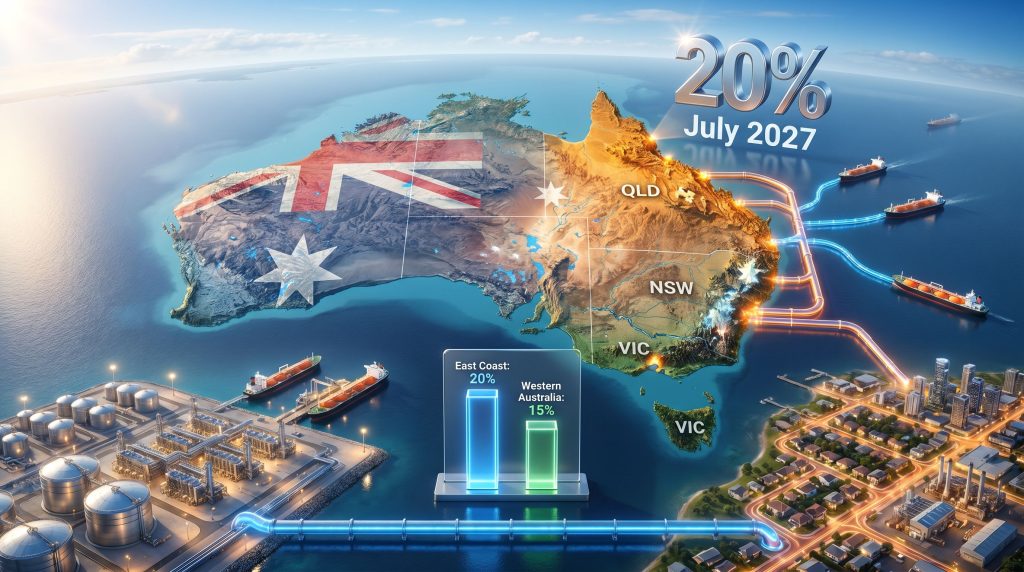
At its core, the Australia gas reservation policy requires that LNG exporters operating on the east coast set aside one-fifth of their natural gas production for the domestic market rather than directing it to export terminals. The policy commences in July 2027 and will not disturb gas supply contracts that are already in place at the time of implementation.
Several important implementation questions remain unresolved, as acknowledged during the Australian Energy Producers (AEP) conference in Adelaide where the policy response was debated. These include:
- Whether gas markets not physically connected to the east coast pipeline network fall within the reservation scheme's scope
- How the Northern Territory's gas production fits into the broader framework, given its partial connectivity to east coast infrastructure
- How compliance will be measured and enforced across different producer types and ownership structures
- Whether the reserved volumes represent genuinely additional domestic supply or simply redirect gas that was already flowing domestically
The government has committed to consulting with industry in the weeks following the announcement, with the July 2027 commencement date providing a roughly 14-month window to finalise these critical details. For further context on the formal policy framework, the government's domestic gas reservation announcement outlines the foundational objectives behind the scheme.
Benchmarking Against Western Australia: A Comparison That Cuts Both Ways
Western Australia's 15% domestic reservation policy is frequently cited as the east coast's policy predecessor. In practice, the comparison is instructive but imperfect.
| Feature | East Coast Policy (New) | Western Australia Policy (Existing) |
|---|---|---|
| Reservation Rate | 20% | 15% |
| Geographic Scope | East coast domestic market | WA domestic market |
| Commencement | July 2027 | Long-established |
| Applies to Existing Contracts | No | Phased in historically |
| Federal vs. State Authority | Commonwealth-led | State-led |
The WA model benefits from a highly integrated pipeline network that physically connects gas production to population centres with relative efficiency. The east coast does not have equivalent infrastructure coherence, meaning that even if reservation volumes are mandated, the ability to route that gas to consumers in Victoria, New South Wales, or South Australia depends on infrastructure investment that is separate from the reservation rule itself.
At a 20% reservation rate, the east coast policy is actually more stringent than the WA benchmark. Whether this produces better domestic pricing outcomes will depend not on the reservation rate alone, but on the infrastructure and market design reforms that accompany it.
The Investment Paradox: Could Reservation Reduce Future Supply?
The most substantive concern raised by the industry, including voices from all three Queensland LNG exporters, centres on a paradox embedded within the reservation framework itself.
The investment disincentive mechanism works as follows:
- Reservation increases the volume of gas available in the domestic market
- Greater domestic supply exerts downward pressure on wholesale gas prices
- Lower wholesale prices compress the returns available from new gas exploration and field development
- Reduced financial returns cause upstream developers to defer or abandon final investment decisions
- Over a five-to-seven year horizon, the pipeline of new supply additions shrinks
- Long-term domestic supply tightens again, potentially erasing the short-term gains from reservation
At the AEP conference, industry participants made clear that this is not a hypothetical concern. The AEP chairperson, who is also the country chair of Shell Australia, articulated that all producers shared concern that reservation-driven price compression could ultimately discourage the very investment needed to close the supply gap AEMO has identified. Santos's chief executive, whose company operates the Gladstone LNG project and is the only one of Queensland's three LNG exporters that sources gas from third-party supply agreements, raised particular concern about price compression in a market structure where margins are already constrained.
Critical insight: The third-party gas sourcing model used by certain operators creates an asymmetric exposure to reservation-driven price compression. Companies that produce their own gas absorb price changes differently from those that purchase gas at market rates and resell it into LNG supply chains. This structural distinction matters enormously for how the policy lands across different business models.
In addition, the broader LNG supply outlook for 2025 and beyond suggests that global market pressures will compound the domestic investment disincentive risk if not carefully managed through well-designed policy frameworks.
The next major ASX story will hit our subscribers first
The Geopolitical Layer: LNG Partnerships and Regional Trust
Australia's east coast gas policy does not exist in a vacuum. Australia has deepened its bilateral energy security arrangements with major LNG import partners across Asia, including Japan, South Korea, China, and Southeast Asian nations, many of which rely on Australian LNG as a cornerstone of their domestic energy security strategies.
Concerns raised at the AEP conference highlighted the reputational dimension of the reservation policy. The worry expressed by industry is that mandatory diversion of gas away from export commitments, or uncertainty about future supply availability, could erode the confidence of regional partners who have entered long-term offtake agreements based on Australia's positioning as a stable, reliable supplier.
Asian LNG buyers are, consequently, navigating their own pressures from US tariff dynamics, making Australia's reliability as a supplier an increasingly strategic consideration for regional energy planners. This concern has gained additional weight following Australia's moves to secure its own supply chains for refined petroleum products and crude oil in the context of Middle East supply disruption scenarios, including risks associated with the Strait of Hormuz. The broader strategic picture is one in which energy security is becoming a shared priority across the Indo-Pacific, making Australia's reliability as a supplier a geopolitical as well as a commercial question.
Global Comparisons: What Australia Can Learn From Other Reservation Models
Australia is not the first resource-exporting nation to grapple with the tension between domestic affordability and export revenue. The international track record of reservation-style policies offers both encouragement and caution.
| Country/Region | Reservation Mechanism | Rate/Threshold | Key Outcomes |
|---|---|---|---|
| Western Australia | Mandatory domestic reservation | 15% of LNG project output | Relatively stable domestic prices |
| Indonesia | Domestic Market Obligation (DMO) | 25% of production | Mixed; compliance challenges noted |
| Algeria | State-controlled allocation | Variable | Domestic consumption prioritised |
| Norway | Market-based with state participation | N/A (Equinor model) | Export-focused; domestic prices market-linked |
| East Coast Australia (new) | Mandatory reservation | 20% | Commencing July 2027 |
Indonesia's Domestic Market Obligation is often cited as a cautionary example. The 25% DMO has faced persistent compliance challenges, and the price caps attached to domestic supply obligations have at times created parallel market distortions. Norway's model, anchored by state ownership through Equinor, produces different dynamics because the government participates in the upside as a shareholder rather than regulating it away as a policymaker.
The WA model remains the most directly applicable reference point for Australia, but two decades of experience in that market also reveal a limitation: reservation is most effective when complemented by robust infrastructure investment and wholesale market design reforms that ensure reserved gas can physically reach end users at transparent prices. The North West Shelf extension debate, for instance, illustrates precisely how infrastructure continuity shapes the long-term effectiveness of any reservation framework.
Will Households Actually See Lower Energy Bills?
This is the question that most Australians care about, and the honest answer is: it depends.
Factors that could support lower prices:
- Reserved volumes genuinely adding to domestic supply rather than redirecting gas already destined for local buyers
- Sufficient east coast pipeline capacity to route gas to high-demand regions
- Wholesale market rules that allow price reductions to pass through to retail contracts
Factors that could limit or offset price benefits:
- Infrastructure bottlenecks preventing reserved gas from reaching consumers
- Retailer margins absorbing wholesale savings before they reach households
- Investment decline reducing new supply additions over the medium term
- Compliance ambiguities allowing producers to satisfy reservation requirements through creative accounting of existing domestic volumes
The Institute for Energy Economics and Financial Analysis (IEEFA) has emphasised that reservation policy design is critical to actual price outcomes. A poorly designed scheme can mandate reservation volumes without delivering affordability, particularly in a fragmented market where infrastructure gaps and contract structures insulate retail prices from wholesale changes. Moreover, energy transition demand dynamics are reshaping how domestic gas consumption patterns evolve alongside renewables, adding further complexity to forecasting genuine household price outcomes. Detailed independent analysis of the scheme's design is available through legal commentary on the reservation framework, which examines the regulatory architecture in depth.
Five Questions the Policy Must Answer Before July 2027
The government's commitment to industry consultation before the July 2027 commencement is an important acknowledgement that the Australia gas reservation policy framework remains incomplete. Five questions are particularly consequential:
- Scope clarity: Which producers and which gas markets are definitively captured under the scheme, including markets not physically connected to the east coast network?
- Volume methodology: How will the 20% reservation threshold be calculated, and will it be reviewed periodically against changing market conditions?
- Infrastructure alignment: Will the reservation policy be accompanied by complementary investment in east coast gas transport and storage infrastructure?
- Enforcement mechanisms: What penalties apply for non-compliance, and who has authority to monitor and enforce reservation obligations?
- Investment incentive framework: How will the government address the upstream investment disincentive risk identified by industry, particularly for third-party gas sourcing models?
Disclaimer: This article is intended for informational purposes only and does not constitute financial or investment advice. Projections regarding energy supply, pricing, and investment outcomes are subject to significant uncertainty. Readers should conduct their own research and consult qualified advisers before making investment or business decisions.
Want to Stay Ahead of the Next Major Resource Opportunity on the ASX?
Australia's shifting gas reservation landscape is reshaping the broader resources sector, and significant mineral discoveries can emerge from the very companies navigating these structural changes. Discovery Alert's proprietary Discovery IQ model delivers real-time alerts on significant ASX mineral discoveries, transforming complex resource data into actionable insights — explore the historic returns major discoveries have generated and begin a 14-day free trial to ensure you're positioned ahead of the market.