
May 19, 2026
When Silver Becomes a Financing Tool: The Hidden Logic Behind Large Copper Project Development
The economics of building a copper mine have always been more complex than digging up metal and selling it. In the mid-2020s, that complexity has intensified dramatically. Construction cost inflation, tighter credit markets, and heightened lender scrutiny of single-asset developers have forced project teams to think creatively about how they assemble the capital required to get shovels in the ground. Within this environment, precious metal by-products have evolved from a secondary consideration into a genuine strategic lever, sometimes making the difference between a project that gets built and one that stalls indefinitely.
Understanding this dynamic is essential context for evaluating the Pampa Medina silver and Marimaca Copper financing strategy. The significance of the emerging silver story at Pampa Medina is not simply geological. It sits at the intersection of exploration optionality, district-scale development theory, and the practical mechanics of raising half a billion dollars in a challenging capital environment.
When big ASX news breaks, our subscribers know first
The Financing Paradox Facing Mid-Tier Copper Developers
Copper's long-term demand story is broadly understood across institutional investment circles. Electrification, grid buildout, and energy transition demand all require copper at scales that current mine supply pipelines appear structurally insufficient to meet through the late 2020s and beyond. Yet despite this widely accepted demand thesis, the gap between copper's long-term appeal and the near-term difficulty of financing individual copper development projects remains stubbornly wide.
Several factors converge to create this tension:
- Construction cost inflation has materially increased the capital required to build projects of equivalent capacity compared to pre-2021 estimates
- Senior lenders now apply more conservative loan-to-value ratios to single-asset mine developers, particularly those without an existing revenue base
- Equity markets have become more selective, with investors in the junior and mid-tier mining space demanding clearer paths to non-dilutive capital before committing fresh equity
- The sheer scale of pre-production capital required for a tier-one copper project can exceed the entire market capitalisation of the developer several times over
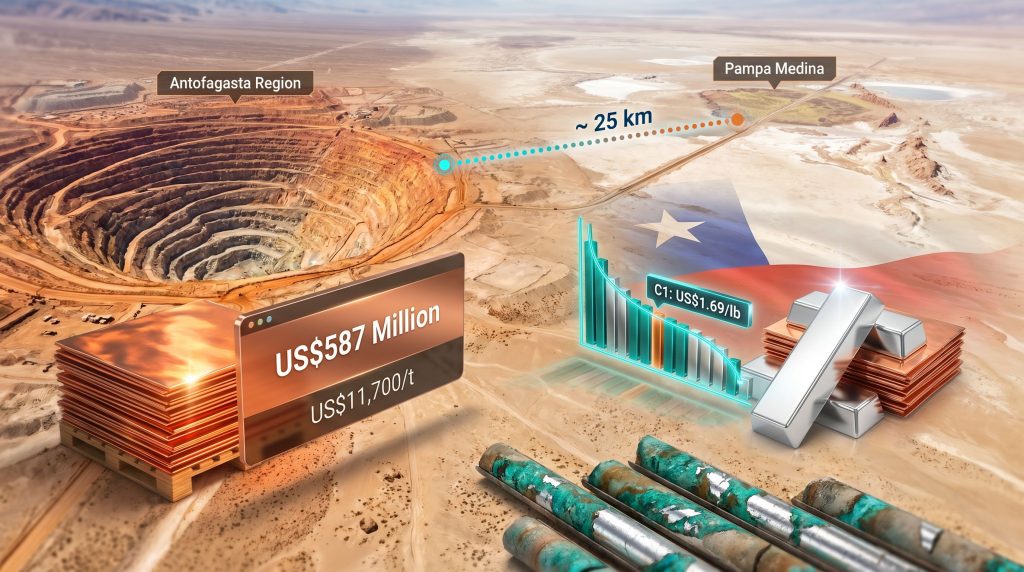
Within this context, the Marimaca Oxide Deposit (MOD), a permitted copper project in Chile's Antofagasta Region with a definitive feasibility study (DFS) outlining US$587 million in pre-production capital expenditure, sits in a particularly demanding position. Its DFS-modelled metrics are genuinely competitive by global standards, yet the absolute funding requirement remains formidable.
MOD Project Economics at a Glance
| Metric | MOD (DFS) |
|---|---|
| Pre-production capex | US$587 million |
| Annual copper cathode output (steady state) | ~50,000 tonnes |
| Capital intensity | US$11,700 per tonne of capacity |
| C1 cash cost (steady state) | US$1.69/lb copper |
| AISC (steady state) | US$2.09/lb copper |
At US$11,700 per tonne of annual production capacity, the MOD ranks among the more capital-efficient copper developments globally. However, capital efficiency on a per-tonne basis does not reduce the absolute funding requirement, which still exceeds half a billion dollars for a company without an operating revenue stream.
Pampa Medina: Geology First, Financing Second
Pampa Medina is a sediment-hosted copper-silver exploration target located approximately 25 kilometres from the planned processing infrastructure serving the MOD. These are two geologically distinct systems. The MOD is an oxide copper deposit already underpinned by a completed DFS, while Pampa Medina remains in active exploration with no formal resource estimate, no completed metallurgical testwork for silver recovery, and no economic study incorporating its mineralisation.
The distinction matters because conflating the two stages of development creates misleading expectations. Pampa Medina is not a producing asset, nor is it yet a financeable one. What it represents at this stage is a technically interesting exploration target with some characteristics that could eventually be relevant to financing decisions, subject to several technical milestones being achieved first.
What the Drill Results Are Actually Indicating
The ongoing drill program of 30,000 metres at Pampa Medina has returned results that stand out for two reasons: the consistency of copper grades across broad intercepts, and the persistent association of silver mineralisation with those copper zones. Key intercepts reported to date include:
- 100 metres at 1.28% copper and 6.9 g/t silver from 580 metres depth
- Internal high-grade interval: 6 metres at 12% copper and 82 g/t silver
- Broader envelope: 198 metres at 0.65% copper and 5.1 g/t silver from 460 metres
Step-out drilling completed in early 2026 extended high-grade copper-silver mineralisation west of previously defined boundaries, suggesting the system may be larger than earlier geological models anticipated.
One technically significant observation from the drill data is that the silver mineralisation does not appear to be confined to narrow vein structures. Its broad spatial correlation with copper grades across wide intercepts suggests that bulk-scale mining could yield a relatively predictable precious metals stream alongside copper cathode output. This is a materially different characteristic from episodic high-grade silver occurrences, and financiers evaluate the two scenarios very differently when structuring by-product transactions.
Geological note: Sediment-hosted copper systems, sometimes referred to as SHMS or stratiform copper deposits, are known for broad lateral continuity and relatively predictable grade distribution. When silver is co-genetic with copper in these systems, it tends to track spatial copper distribution rather than concentrate in isolated structural zones, which supports the hypothesis of a consistent by-product stream.
How Silver By-Product Credits Actually Work in Copper Mine Economics
For investors unfamiliar with copper mine accounting conventions, understanding how silver credits influence reported costs requires a brief explanation of industry-standard cost metrics.
C1 cash cost represents the direct cost of producing one pound of copper, including mining, processing, and site general and administrative expenses. By-product revenues from metals produced alongside copper, such as silver, gold, or molybdenum, are deducted from this total, reducing the reported cost per pound.
AISC (all-in sustaining cost) takes C1 as its foundation and adds sustaining capital expenditure, royalties, and other charges required to maintain steady-state production.
The MOD's current DFS models a C1 of US$1.69/lb and an AISC of US$2.09/lb, both computed without any silver by-product contribution from Pampa Medina. If Pampa Medina were eventually integrated into a broader production scenario and silver were recovered at meaningful volumes, those revenues would be credited against operating costs, compressing the effective cost per pound below the current DFS figures. The Chile copper outlook suggests supportive pricing conditions could further enhance these economics.
Illustrative Silver Credit Scenario
Analytical framework, not published guidance: At a silver price of US$30/oz and conservative recovery assumptions, even modest silver output from a future integrated Pampa Medina scenario could generate tens of millions of dollars annually in by-product credit. Depending on silver production volumes, the effective C1 cost could shift by approximately US$0.05 to US$0.15 per pound of copper. This is an illustrative range based on publicly observable silver streaming transaction economics, not a figure published by the company.
The Non-Dilutive Financing Toolkit: How Silver Unlocks Alternative Capital
Beyond operating cost improvements, confirmed precious metal by-products in copper-dominant deposits open access to specific financing structures that are not available to projects with copper-only mineralisation. For a developer seeking to minimise equity issuance, these alternatives carry significant strategic value.
The most commonly evaluated non-dilutive structures in copper-silver districts include:
- Silver streaming agreements – An upfront cash payment from a streaming counterparty in exchange for the right to purchase a defined percentage of future silver production at a fixed, below-market price. In precedent transactions across Chilean and Peruvian copper districts, upfront streaming payments have historically represented between 10% and 20% of total project capex, effectively functioning as low-cost project debt without requiring share issuance.
- Net smelter return royalties – A percentage of gross revenue from silver output paid to a royalty holder, sometimes exchanged for upfront capital during project development phases.
- By-product-enhanced senior debt – Lending structures where the lender's collateral comfort is augmented by quantified precious metal revenue streams, potentially improving available loan-to-value ratios and reducing the interest margin on debt.
- Hybrid structures – Combinations of streaming, royalty, and debt instruments, commonly deployed in multi-asset districts where different mineralised zones exist at different development stages.
What Must Happen Before Any of These Structures Are Accessible?
Pampa Medina is not yet at the stage where any of these instruments could be formally structured. The technical prerequisites are sequential and non-negotiable for any credible streaming or royalty counterparty:
| Milestone | Current Status |
|---|---|
| Formal resource estimate | Not yet completed |
| Phase I silver metallurgical testwork | Not yet completed |
| Economic scoping incorporating silver | Not yet published |
| Integration into MOD mine plan | Conceptual only |
What to watch: The sequencing of these milestones will determine how quickly Pampa Medina transitions from a geological observation into a financeable asset class. Resource definition and Phase I metallurgy are the most proximate catalysts.
Capital Discipline as a Competitive Advantage
One aspect of Marimaca Copper's development approach that is sometimes underappreciated by investors focused on near-term catalysts is the deliberate decision to dedicate 2026 to detailed design and engineering rather than accelerating toward an immediate construction start. This reflects a specific philosophy: that immature project designs entering construction are among the most reliable predictors of cost overruns, and that the financing window gained by rushing construction is typically offset by the capital destruction that follows.
CEO Hayden Locke has articulated the company's position on capex reduction clearly. Any design change that lowers upfront capital must be evaluated holistically against its impact on operational risk and long-term project reliability. The company is not pursuing cost reduction for its own sake; it is pursuing cost reduction that does not compromise operability.
This philosophy also applies to financing structure decisions. The company has raised A$80 million through a placement directed at detailed engineering for the MOD, continued exploration at Pampa Medina, and corporate purposes, signalling that the current phase is explicitly about building the technical and commercial foundation needed to access the most competitive financing terms available at the time of the final investment decision (FID). Furthermore, copper investment strategies at this stage of the cycle increasingly reward developers who demonstrate this kind of disciplined capital allocation.
The next major ASX story will hit our subscribers first
A Two-Track Strategy: Engineering Discipline Meets District Exploration
The strategic architecture at Marimaca Copper is best understood as two parallel tracks that interact without being dependent on each other for near-term progress:
| Strategic Track | Focus | Financing Relevance |
|---|---|---|
| MOD (Oxide Deposit) | Detailed engineering, FID preparation | Primary debt and equity target |
| Pampa Medina (Exploration) | 30,000m drill program, silver assay completion | Future streaming or royalty optionality |
| Silver by-product credit | Subject to future resource and metallurgy | Potential incremental C1 reduction |
| District integration | Conceptual, conditional on resource definition | Long-term capital structure enhancement |
The proximity of Pampa Medina to planned MOD processing infrastructure is a recurring feature of the district development narrative. At approximately 25 kilometres, future satellite integration is technically plausible in a way that would not apply to a standalone greenfield discovery located far from existing infrastructure. This proximity reduces the incremental capital required to incorporate Pampa Medina into a larger production scenario, which matters both for future mine planning and for how streaming counterparties assess residual value in any transaction.
Key Milestones for Investors to Track Through 2026-2027
For investors monitoring the Pampa Medina silver and Marimaca Copper financing strategy, the following milestones represent the most material near-term signposts:
- Ongoing Pampa Medina drill results – particularly step-out drilling results testing western and depth extensions of the copper-silver system
- Phase I silver metallurgical testwork completion – the first formal assessment of silver recovery potential and a prerequisite for any financing discussion
- Initial resource estimate for Pampa Medina – the technical foundation required before streaming or royalty counterparties would engage formally
- MOD financing structure updates – clarification on the composition of debt, equity, and alternative capital in the final stack
- Long-lead equipment procurement announcements – a concrete signal of construction schedule commitment and FID proximity
- FID announcement – the definitive trigger for construction commencement and full financing close
The Broader Lesson: Why By-Product Diversity Is Reshaping Copper Project Valuation
The Pampa Medina silver story is a specific instance of a broader shift occurring across the copper development sector. As capital markets become more sophisticated in their analysis of mining projects, the presence of credible by-product narratives is increasingly embedded into project valuations at earlier stages of development than was historically the case.
Streaming companies and royalty firms have expanded their evaluation criteria beyond producing assets, actively monitoring exploration-stage discoveries adjacent to permitted copper infrastructure precisely because the option value of a future by-product transaction can be assessed even before a resource is formally defined. For developers, this creates an incentive to communicate the geological characteristics of by-product mineralisation clearly and consistently, even when it remains technically premature to assign economic value to it.
However, the broader copper supply crunch context adds urgency to the development timeline. For the Pampa Medina silver narrative to evolve from exploration observation into a genuine component of the Pampa Medina silver and Marimaca Copper financing strategy, the technical pathway is clear: resource definition, metallurgical confirmation, and economic integration. The trajectory of the 2026 drill program suggests directional progress toward those milestones, but the timeline remains subject to the outcomes of work not yet completed.
Strategic takeaway for investors: Pampa Medina silver represents a financing option in development, not a financing event. Its value to the broader Marimaca Copper capital stack will be determined by the technical milestones achieved over the next 12 to 24 months. The base case for the MOD remains compelling on its own merits, and any silver optionality that crystallises from Pampa Medina should be understood as incremental upside to an already competitive project rather than a prerequisite for the primary development.
This article contains forward-looking analysis and illustrative financial scenarios. It does not constitute financial advice. Readers should conduct their own due diligence and consult a licensed financial adviser before making investment decisions. Project economics referenced are drawn from publicly available company disclosures including the MOD definitive feasibility study.
Want to Catch the Next Major Copper or Silver Discovery the Moment It Hits the ASX?
Discovery Alert's proprietary Discovery IQ model scans ASX announcements in real time, instantly identifying significant mineral discoveries across copper, silver, and 30+ other commodities — turning complex data into actionable investment insights before the broader market reacts. Explore how major discoveries have historically generated substantial returns on Discovery Alert's dedicated discoveries page, and begin your 14-day free trial today to position yourself ahead of the market.