June 11, 2026
When Specialist Workers Stop, the Whole Supply Chain Listens
Most industrial disputes in the mining sector are measured in headlines and share price dips that last a few trading sessions. However, a small number of disputes carry systemic weight that extends far beyond the immediate parties involved. Understanding why requires looking not at the volume of workers on strike, but at the operational irreplaceability of those workers and the infrastructure they maintain.
The emerging BHP Pilbara strike situation at Port Hedland is precisely this kind of dispute. The workforce segment at its centre is tiny by headcount. Its leverage, however, is enormous.
When big ASX news breaks, our subscribers know first
The Workers at the Heart of the BHP Pilbara Strike
The electrical tradespeople employed at BHP's Port Hedland bulk port terminal occupy one of the most operationally sensitive positions in Australia's entire resources export infrastructure. These are not generalist site workers. They are licensed specialists responsible for maintaining and operating the high-voltage electrical network that powers the port's critical systems, including conveyor belts, ore car dumpers, ship loaders, and port lighting.
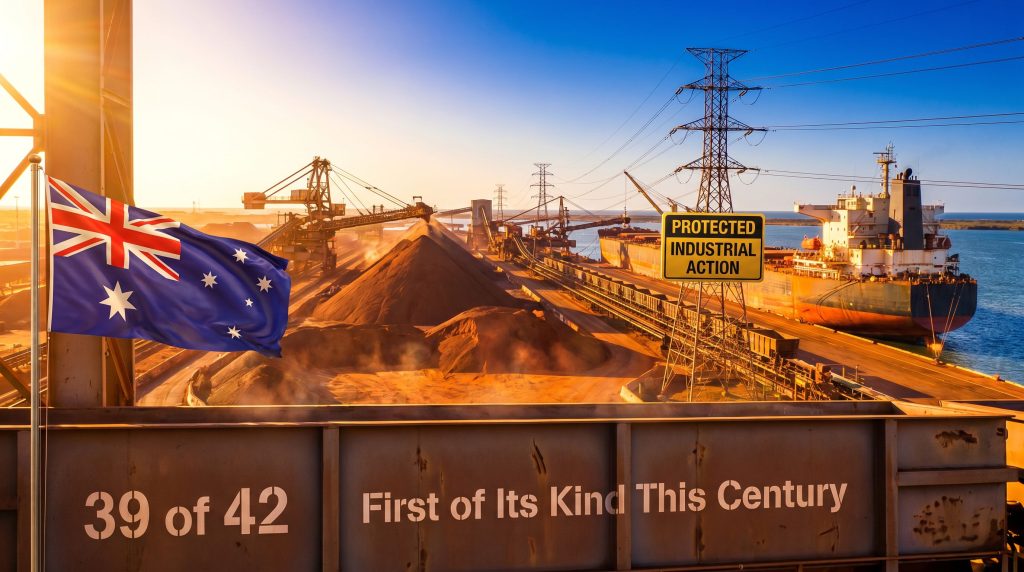
Approximately 60 workers fall within the enterprise agreement being contested. Of the 42 employees eligible to participate in the protected action ballot, 39 voted in favour of endorsing work stoppages. That near-unanimous result is not a statistical quirk. In industrial relations, a vote of that magnitude signals something much harder to negotiate away: a workforce that has exhausted its patience through legitimate channels.
The Electrical Trades Union is leading the campaign on behalf of these workers, and the demands being pursued are telling in their specificity:
- Nightshift penalty rates for employees working outside standard daytime hours
- Hot-weather allowances that reflect the Pilbara's extreme thermal environment, where summer temperatures regularly exceed 45 degrees Celsius
- Overtime and public holiday penalty rates benchmarked against industry standards
- Restructured overall remuneration to better reflect the hazardous and highly specialised nature of high-voltage electrical maintenance work
The dispute is fundamentally not about base wages. It centres on the conditions and allowances that acknowledge the physical and operational realities of working inside one of the most demanding industrial environments on earth.
This distinction matters because it reframes the negotiating dynamic. When workers seek penalty rate corrections rather than headline wage increases, they are appealing to structural fairness within the enterprise agreement framework, not simply demanding more money. That makes resolution both more principled and, often, more difficult.
Why This Ballot Is Historically Significant
Industrial peace in the Pilbara has been the defining feature of Western Australia's iron ore sector for decades. Since the early 2000s, the combination of strong enterprise agreements, high wages relative to national benchmarks, and the remote-area premium built into most resource sector packages has kept organised industrial action at bay. The BHP Pilbara strike ballot breaks that pattern in a way that demands attention.
| Historical Marker | Detail |
|---|---|
| Last major Pilbara mine strike | Several decades prior to current dispute |
| BHP Pilbara protected action this century | First of its kind |
| Negotiation duration before ballot | Approximately six months |
| Number of strike ballots endorsed | Second ballot, indicating sustained escalation |
| Required notice before action | Five business days |
| Potential stoppage durations | 15-minute increments up to 48-hour shutdowns |
The fact that this is the second ballot endorsed by the same workforce cohort deepens the significance. A first ballot can sometimes be read as a negotiating signal, a formal communication of intent designed to accelerate talks. A second ballot is a different message entirely. It indicates that the initial signal was either not received or not acted upon with sufficient seriousness, and that the workforce has made a collective decision to follow through.
Furthermore, as the electrical union's historic industrial action coverage has highlighted, this moment represents a watershed in Pilbara labour relations that industry observers have not seen in a generation.
Port Hedland: Understanding the Chokepoint Effect
Port Hedland is not simply a large Australian port. It is the world's largest bulk export port by annual tonnage, channelling the vast majority of Australia's iron ore production into Asian steel markets, principally China, Japan, and South Korea. The port's operational continuity sits at the intersection of Australian export revenue, global steel supply chains, and the financial performance of the country's largest mining companies.
BHP's infrastructure at Port Hedland is deeply integrated into this system. When the electrical network that powers the port's loading and unloading systems is subject to even partial disruption, the downstream effects can cascade quickly:
- Vessel scheduling delays that affect shipping contracts and demurrage costs
- Spot market sensitivity in Asian steel markets responding to supply-side uncertainty
- Reputational risk to BHP's status as a reliable long-term supply partner for Asian steelmakers
- Cascading infrastructure risk where deferred electrical maintenance compounds over time into larger system vulnerabilities
The skill specificity of the workers involved amplifies this risk profile considerably. High-voltage electrical certification in Western Australia requires licensed qualifications that cannot be acquired overnight. Replacement workers with the appropriate licensing, site familiarity, and safety clearances cannot simply be sourced from a labour pool and deployed within the five-day notice window. This is a structural constraint that no contingency plan fully resolves.
BHP has publicly confirmed it holds contingency arrangements designed to maintain safety and operational continuity during any industrial action, and remains committed to reaching a negotiated outcome that protects both productivity and workforce standards. However, the nature of the work involved means that contingency capacity is inherently limited relative to the technical requirements of high-voltage infrastructure maintenance.
In addition, the broader context of onslow iron haulage operations demonstrates how quickly disruption to specialist roles can ripple through connected supply chains, reinforcing why this dispute extends well beyond Port Hedland alone.
Escalation Scenarios and Operational Risk Assessment
The protected action framework provides a graduated escalation pathway. Understanding how that pathway functions is important for anyone assessing the potential impact of the BHP Pilbara strike on production volumes and market dynamics.
| Escalation Stage | Likely Operational Impact |
|---|---|
| Rolling 15-minute stoppages | Minimal immediate volume impact; scheduling disruption and reputational risk |
| 4-8 hour targeted stoppages | Potential vessel loading delays; demurrage cost exposure begins |
| 24-48 hour shutdowns (sustained) | Measurable export volume reduction; spot price sensitivity in Asian markets |
| Multi-week extended action | Material quarterly production impact; potential force majeure considerations |
Importantly, the union retains full discretion over which form of action to initiate following the five-day notice period. The graduated structure means negotiations can continue right up to the point of action, creating both an incentive and a pressure mechanism for BHP to move on the outstanding demands before escalation reaches operationally damaging territory.
Short-duration stoppages are unlikely to shift global iron ore benchmark pricing in isolation. But sustained disruption at the world's largest bulk export port introduces supply-side uncertainty that Asian steel market participants would need to price into procurement planning.
The Contagion Question: What This Dispute Means for the Broader Pilbara Workforce
One of the least discussed but most consequential dimensions of the BHP Pilbara strike dispute is its potential signalling effect across the broader resources workforce in Western Australia. Enterprise bargaining outcomes at flagship operations tend to establish reference points that other unions and employer groups monitor closely.
Consequently, the global iron ore tariff impact on already-sensitive supply dynamics means that any sustained domestic disruption could compound external pricing pressures already weighing on Australian exporters.
If the ETU achieves a favourable resolution, including penalty rate structures that genuinely reflect the conditions of Pilbara work, several downstream effects become plausible:
- Other trade unions with membership across Pilbara mine sites may pursue comparable claims in their next bargaining rounds
- Rio Tinto and Fortescue, which operate similarly complex port and mine infrastructure in the same region, may face analogous pressure from their own specialist workforces
- The precedent for hot-weather allowances specifically could become a template argument for workers across multiple commodity sectors in the Northern and Western Australian regions
- The broader enterprise bargaining dynamic across the resources sector, which has favoured employers during periods of softened commodity demand, may begin to rebalance
Other major unions operating in the WA resources sector have been watching this dispute carefully. A resolved outcome that meaningfully improves conditions for ETU members will not go unnoticed in the planning cycles of labour organisations representing workers across underground mining, processing, and transport operations.
Furthermore, the China steel and iron ore market remains the principal demand driver for Pilbara exports, meaning any sustained supply disruption from industrial action intersects directly with the pricing tensions already present in that market.
The next major ASX story will hit our subscribers first
BHP's Corporate Context in Mid-2026
The timing of this industrial dispute adds an additional layer of institutional complexity to BHP's management challenge. The company is navigating a significant leadership transition, with long-serving chief executive Mike Henry having stepped down, and Brandon Craig assuming the chief executive role from July 2026. Leadership transitions in large organisations can create temporary ambiguity around decision-making authority and negotiating mandates, particularly on sensitive workforce matters.
Simultaneously, BHP's earnings profile has shifted materially. Copper now contributes more than 50% of the company's half-year earnings, reflecting a deliberate strategic pivot toward energy transition metals. Yet iron ore remains the foundational revenue pillar that funds BHP's capital allocation across its entire portfolio. Any sustained disruption to Pilbara export volumes would register directly in near-term earnings guidance and, by extension, in shareholder distributions.
This creates a financial incentive structure that should, in theory, motivate a relatively prompt resolution. The cost of conceding improved penalty rates and allowances to 60 specialist workers is trivially small relative to the earnings risk posed by extended industrial action at Port Hedland. Indeed, iron ore price trends already reflect fragile demand conditions, making any avoidable supply-side disruption a risk BHP can ill afford in the current environment.
A Historical Note on the Term Pilbara Strike
Any serious discussion of industrial action in the Pilbara should acknowledge the region's most significant labour history. The 1946-1949 Pilbara Aboriginal pastoral workers' strike stands as one of the most important acts of collective resistance in Australian history. Led by Don McLeod alongside Clancy McKenna and Dooley Bin Bin, approximately 800 Aboriginal pastoral workers walked off sheep and cattle stations across the Pilbara to protest deeply exploitative conditions and demand recognition of their basic rights as workers.
That historical event and the current BHP dispute are entirely separate in character, cause, and context. They share only geography and vocabulary. Researchers and readers encountering the phrase "Pilbara strike" should be aware of this dual historical meaning to ensure appropriate contextual understanding.
Frequently Asked Questions: BHP Pilbara Strike 2026
What triggered the BHP Pilbara strike ballot?
Six months of unresolved enterprise bargaining between BHP and the Electrical Trades Union over penalty rates, hot-weather allowances, and overtime entitlements for high-voltage electrical workers at Port Hedland led to the formal protected action ballot.
How many workers are involved?
Around 60 electrical workers are covered by the dispute. Of the 42 who were eligible to vote, 39 endorsed protected action, a near-unanimous mandate.
What forms of industrial action could occur?
Work stoppages ranging from 15-minute increments through to 48-hour shutdowns. Five business days notice is required before any action commences.
Is this the first strike at BHP's Pilbara operations?
It is reported to be the first protected industrial action at BHP's Pilbara operations this century, making it a historically significant moment in Australian mining labour relations. As the Chamber of Minerals and Energy WA has noted, the growing threat of Pilbara strikes risks WA jobs and living standards more broadly, underscoring the stakes for the wider regional economy.
Could the strike affect global iron ore prices?
Brief stoppages are unlikely to materially move benchmark pricing. Sustained or escalating action at Port Hedland, the world's largest bulk export port, introduces supply-side risk that Asian steel market participants would monitor closely. The Onslow transhipper expansion at MinRes demonstrates, however, that the broader WA iron ore export infrastructure is gradually diversifying, which may offer some buffer to market sensitivity over time.
Key Takeaways
- The near-unanimous second ballot reflects deep, sustained workforce dissatisfaction that extended negotiations have not resolved
- The dispute centres on penalty rates and conditions rather than base wages, making it a structural issue within the enterprise agreement framework
- Port Hedland's position as the world's largest bulk export port amplifies the systemic risk of even limited disruption
- The skill specificity of the workers involved means contingency capacity is structurally constrained
- A favourable outcome for the ETU is likely to establish precedent for comparable claims across the broader Pilbara resources workforce
- BHP's leadership transition and shifting earnings mix create both complexity and financial incentive for prompt resolution
For broader context on Australian mining workforce dynamics and industrial relations in the resources sector, the Australian Mining Review's People and Workforce coverage provides ongoing analysis at australianminingreview.com.au.
Disclaimer: This article contains forward-looking assessments and scenario analysis relating to potential industrial action and market impacts. These represent analytical perspectives informed by publicly available information and should not be construed as financial advice. Actual outcomes may differ materially from scenarios described.
Want to Stay Ahead of Major Shifts in Australia's Mining Sector?
Discovery Alert's proprietary Discovery IQ model delivers real-time alerts on significant ASX mineral discoveries, instantly transforming complex mineral data into actionable investment insights for both short-term traders and long-term investors. Explore how historic discoveries have generated substantial returns on Discovery Alert's dedicated discoveries page, and begin your 14-day free trial today to secure your market-leading advantage before the next major opportunity emerges.