
June 11, 2026
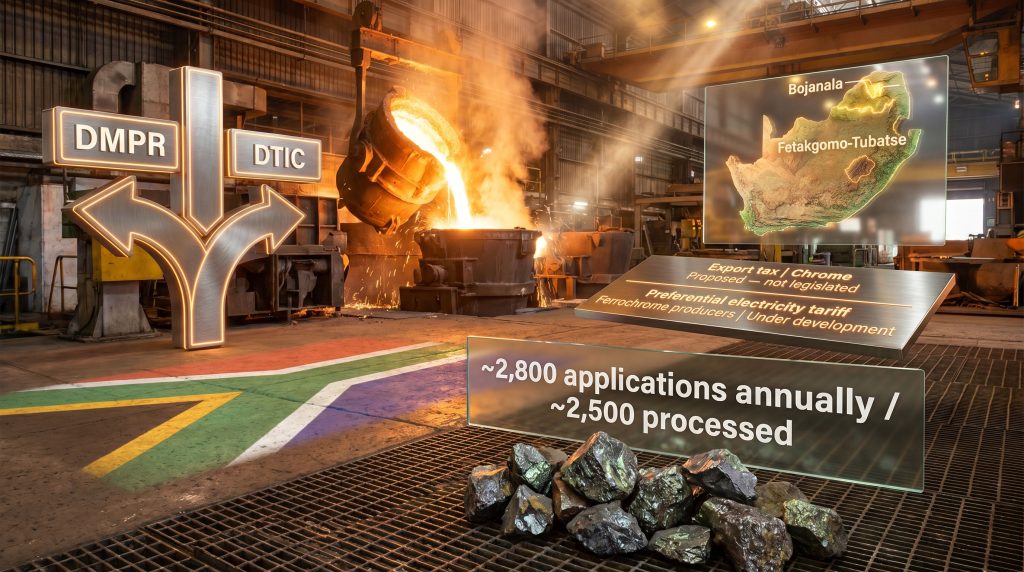
When Industrial Ambition Collides With Regulatory Reality
Resource nationalism in its many forms has cycled through commodity-rich economies for decades. Export restrictions, mandatory processing requirements, and preferential licensing for domestically oriented producers are not new inventions. What changes from cycle to cycle is the mechanism, the political context, and the degree to which policy ambition is matched by institutional capacity to execute. South Africa's current debate over a forced mining beneficiation plan fits squarely within this historical pattern, but it carries a distinctive twist: the sharpest resistance to the proposal is coming not from the mining industry itself, but from within government.
At the Junior Mining Indaba in June 2026, Jacob Mbele, the Director-General of the Department of Mineral and Petroleum Resources (DMPR), was asked directly whether attaching beneficiation conditions to mining licences falls within the domain of the Department of Trade, Industry and Competition (DTIC). His answer was carefully constructed but unambiguous in its implications. The DTIC's Industrial Development Strategy (IDS), approved by cabinet the previous week, proposes a review of mining legislation to enable the state to embed beneficiation objectives in the allocation of mineral rights. Mbele's response was that this remained a proposal, not policy, and that what ultimately governs the sector is what enters the legislation, not what appears in a strategy document.
That exchange defined the terms of a much broader governance debate that investors, explorers, and policymakers cannot afford to ignore.
When big ASX news breaks, our subscribers know first
What a Forced Mining Beneficiation Plan Actually Involves
Beneficiation, in its most straightforward form, means processing a raw mineral into a higher-value product before it leaves the country. This might mean converting chrome ore into ferrochrome, platinum concentrate into refined platinum, or iron ore into steel. The economic logic is intuitive: a country that exports raw materials captures only a fraction of the value chain compared to one that exports finished or semi-finished goods. For further context, South Africa's ferroalloys sector illustrates precisely how this value-chain tension plays out in practice.
The distinction that makes the current South African proposal significant is the word forced. Previous iterations of beneficiation policy in South Africa relied on tax incentives, grant funding, and voluntary processing targets embedded in the Broad-Based Black Economic Empowerment (BBBEE) mining charter framework. What the DTIC's IDS now proposes is fundamentally different: using the allocation of mineral rights as the lever. Under this model, a company seeking a mining right could be required to demonstrate a commitment to domestic processing as a condition of receiving that right in the first place.
This is not merely a policy nuance. It transforms the legal character of a mineral right from a property interest governed by transparent statutory criteria into a discretionary instrument of industrial policy. The legal authority to allocate mineral rights in South Africa resides with the DMPR under the Mineral and Petroleum Resources Development Act (MPRDA). Embedding beneficiation conditions into that process would require formal legislative amendment, not merely a cabinet-approved strategy document.
The Global Precedent Context
Other resource-rich nations have attempted versions of this approach with mixed results:
-
Indonesia imposed a ban on unprocessed nickel ore exports in 2020, successfully stimulating domestic smelter construction but also triggering World Trade Organization (WTO) disputes with the European Union.
-
Democratic Republic of Congo introduced cobalt and copper export restrictions that generated short-term revenue increases but also elevated the sovereign risk premium attached to Congolese mining assets.
-
Botswana negotiated diamond beneficiation requirements through its partnership arrangements with De Beers, achieving a degree of downstream processing without unilateral legislative imposition.
The South African situation more closely resembles the Indonesian model than the Botswanan one, but with an additional layer of institutional complexity created by the jurisdictional boundary between two government departments. Furthermore, broader mining geopolitical risk across the global metals landscape adds another dimension to how these domestic policy choices are perceived by international capital.
The Regulatory Architecture: Two Departments, One Policy Problem
Understanding the tension at the heart of this debate requires appreciating how South Africa's mineral governance is actually structured. The DMPR holds the legal mandate over mineral rights allocation, prospecting licences, and mining permits. The DTIC holds the mandate over industrial development, export policy, and trade instruments. Under normal circumstances, these mandates are complementary rather than competing.
The IDS proposal disrupts that complementarity. By seeking to attach industrialisation objectives to licensing decisions, the DTIC is effectively proposing to extend its industrial policy reach into the DMPR's core legal domain. Consequently, understanding the existing mining rights framework helps contextualise why such jurisdictional overreach carries significant legal and operational consequences.
The DMPR's measured public response to a cabinet-approved industrial strategy document is itself a signal. When the department responsible for implementing a policy signals distance from that policy before it enters legislation, investors should interpret this as an indicator that the pathway from proposal to law remains long, contested, and procedurally uncertain.
Mbele's formulation at the Indaba, that the law is what enters the legislation, carries strategic weight. It simultaneously acknowledges the DTIC's policy ambitions, reasserts the DMPR's legal primacy over mineral rights, and signals to the industry that no regulatory change is imminent without a formal legislative process. Former Harmony Gold CEO Bernard Swanepoel, who chaired the Indaba session, drew an explicit comparison to the pre-release anxiety the industry experienced before the first leaked Mining Charter, describing the IDS document as giving him a similarly uncomfortable feeling. That reference is historically loaded: the Mining Charter process generated years of legal uncertainty, court challenges, and suppressed investment in South African mining assets.
The Chrome Question: Solving the Right Problem?
Chrome has become the primary test case for the forced mining beneficiation plan, and for understandable reasons. South Africa holds some of the world's largest chromite deposits, concentrated in the Bushveld Igneous Complex, yet the country's ferrochrome industry, which processes chrome ore into the alloy used in stainless steel production, has been under sustained pressure for years. Shifts in global steel market dynamics have only intensified this pressure, making the domestic viability of ferrochrome smelting more precarious.
The IDS proposes a layered intervention for the chrome sector:
| Policy Instrument | Target | Proposed Mechanism | Legislative Status |
|---|---|---|---|
| Export tax | Chrome ore | Levy on unprocessed exports | Proposed, not legislated |
| Export quota | Chrome ore | Volume cap on raw exports | Proposed, not legislated |
| Preferential electricity tariff | Ferrochrome producers | Below-market power pricing | Under development |
| Special Economic Zones | Chrome processing | Bojanala and Fetakgomo-Tubatse | Designated, not operational |
| Licensing conditions | Broad minerals | Beneficiation tied to rights | Proposed, requires legislative change |
The political appeal of this package is clear. The policy question is whether it targets the actual constraint on domestic ferrochrome production. In addition, special economic zones have historically struggled to deliver transformative industrial outcomes without resolving underlying input cost problems first.
Minerals Council South Africa CEO Mzila Mthenjane stated at the Indaba that discussions with the DTIC have been constructive, and that the industry's primary concern has always been the electricity problem underlying ferrochrome viability. This framing is critical: the industry's argument is not that chrome ore is unavailable to domestic smelters. There is no shortage of raw material. The problem is that smelting has become economically irrational in South Africa because electricity prices have risen sharply and supply reliability has deteriorated significantly.
An export tax on chrome ore, applied in isolation, would not reduce electricity costs. It would lower the return on raw ore exports, theoretically making domestic processing relatively more attractive, but it would not resolve the fundamental unit economics of running an electric arc furnace in South Africa versus operating a comparable facility in a market with lower and more reliable power costs.
The government's response to this critique is that the chrome interventions are no longer proposed in isolation. The preferential electricity tariff for ferrochrome producers changes the policy calculus by allowing the state to argue that the export tax is part of a coherent industrial package rather than a blunt fiscal instrument. Whether the tariff mechanism is technically and commercially viable at the required scale remains an open question. For a broader perspective on how beneficiation is understood internationally, the South African government's beneficiation strategy provides useful historical context on the policy's origins and intent.
Investment Risk and the Discretionary Licensing Problem
For the mining investment community, the specific mechanism through which beneficiation conditions would be imposed matters enormously. There is a critical difference between a predictable statutory requirement, applied uniformly and transparently, and a discretionary licensing condition, applied at ministerial judgement.
Fred Arendse, founder and president of the Junior Mining Council, made this distinction explicit at the Indaba. His argument was that junior miners require rule-based, predictable outcomes from the licensing process. If an applicant follows the prescribed steps, the result should be deterministic, not subject to a minister's interpretation of whether the application adequately addresses beneficiation objectives.
This concern is especially acute for exploration-stage companies, where the investment thesis is constructed before significant capital is committed. A junior explorer seeking to raise funds for a chrome prospecting programme in the Bushveld Igneous Complex must present investors with a coherent risk profile. If the regulatory framework introduces the possibility that a future mining right might carry unknown beneficiation compliance costs, the investor cannot price that risk at the time of committing capital.
The asymmetry between major producers and junior miners on this issue is structural:
-
Major producers maintain dedicated regulatory affairs teams capable of navigating complex licensing negotiations.
-
Major producers can absorb compliance infrastructure costs across diversified project portfolios.
-
Junior explorers typically operate with limited working capital and cannot sustain prolonged licensing uncertainty.
-
Exploration capital is specifically sensitive to rule-change risk because return expectations are built on long-lead assumptions about regulatory stability.
-
Investors in junior miners require clarity about the rules before committing funds, not promises of administrative discretion exercised reasonably.
Administrative Failure as the More Immediate Constraint
Before any forced mining beneficiation plan can operate coherently, the basic mechanics of South Africa's mineral licensing system need to function reliably. Mbele acknowledged directly at the Indaba that the department faces genuine administrative failures that are unacceptable. The specifics are sobering.
The DMPR receives approximately 2,800 mining applications per year but processes around 2,500, creating a structural rolling backlog of roughly 300 applications annually. Applicants sometimes receive documents containing errors that require months of further engagement to correct. Regional offices interpret the same rules differently from the national office, creating what the industry experiences as de facto policy uncertainty even when the written regulations are ostensibly clear.
| Administrative Challenge | Industry Impact | Reform Status |
|---|---|---|
| Processing backlog (~300 per year) | Capital tied up; project pipelines stalled | Cadastre rollout intended to address |
| Document errors requiring extended correction | Operational and financial disruption | Acknowledged as unacceptable |
| Inconsistent regional office interpretation | Experienced as policy uncertainty by investors | Requires systemic structural reform |
| Multi-department approval sequencing | Coordination failures across minerals, water, environment | No unified process yet in place |
| Defective application processing | Wastes departmental capacity; delays valid applications | Automated rejection under new cadastre |
Mthenjane offered a nuanced reframing of the policy certainty debate at the Indaba. The problem, he argued, is not always visible at the level of political rhetoric or high-level strategy. It manifests at the operational level: an investor interacts with one office that reads the rules one way and another office that reads them differently. That inconsistency, experienced repeatedly across a project lifecycle, accumulates into the same investment hesitancy that formal policy uncertainty produces.
The next major ASX story will hit our subscribers first
The Cadastre Rollout: Foundation Before Framework
The mining cadastre, a digital system for managing and tracking mineral rights applications, is foundational infrastructure that South Africa has been attempting to modernise for years. The existing Samrad system has long been criticised as opaque, prone to processing errors, and inadequate for managing the volume of applications the department receives.
Mbele confirmed at the Indaba that the Western Cape has fully migrated to the new cadastral system, with the first unassisted applications already submitted successfully. The department's planned rollout sequence is:
-
Western Cape (complete): First province fully migrated; unassisted applications operational.
-
Free State, KwaZulu-Natal, Eastern Cape (next phase): Lower administrative complexity provinces targeted for near-term migration.
-
Mpumalanga, Limpopo, North West (final phase): Higher complexity provinces with greater application volumes and more intricate tenure histories.
-
Target completion: All nine provinces by 31 March of the next financial year.
The significance of this timeline extends beyond administrative efficiency. A functioning cadastre reduces the backlog by automatically rejecting defective or incomplete applications rather than allowing them to consume departmental processing capacity. It also provides investors with transparent visibility over which mineral ground is available, under application, or encumbered, reducing the information asymmetry that currently creates friction in early-stage exploration decisions.
The cadastre is not merely a bureaucratic upgrade. It is the prerequisite infrastructure without which any credible forced mining beneficiation plan framework becomes operationally incoherent. You cannot attach sophisticated processing conditions to mineral rights allocations that the system cannot reliably administer in the first place.
Geoscience Data and the Exploration Supply Side
Council for Geoscience CEO Mosa Mabuza provided a counterpoint at the Indaba by drawing attention to the foundational work being done to stimulate a new generation of exploration activity. Geoscience infrastructure, specifically the quality and accessibility of publicly available geological mapping data, is a long-lead enabler of mineral discovery that frequently receives insufficient attention in beneficiation policy discussions.
The Council for Geoscience has completed higher-resolution mapping of approximately 260,000 km² of South Africa's onshore geology, representing around 20% of the country's landmass. The council has also launched a public data portal and a virtual core library, making geological information more accessible to smaller explorers who lack the resources to conduct their own extensive geophysical programmes.
This matters for the beneficiation debate in a supply-chain sense. A credible domestic processing industry requires a robust upstream exploration and development pipeline. If South Africa's junior exploration sector remains capital-constrained and administratively frustrated, the long-term supply of feedstock for domestic beneficiation facilities becomes uncertain, regardless of what tax or licensing conditions are attached to current producers. Industry analysts at Mining MX have noted scepticism about whether the DTIC's approach adequately accounts for these upstream supply-side vulnerabilities.
Three Scenarios for How This Resolves
The forced mining beneficiation plan debate does not have a predetermined outcome. Based on the institutional dynamics currently visible, three plausible resolution pathways exist:
Scenario 1: Legislative Integration. The DTIC's IDS proposals enter a formal parliamentary review process under the MPRDA framework. Industry consultation shapes the final design, producing clear, appealable, and time-bound beneficiation conditions with statutory force. This scenario produces the most policy certainty but requires the highest degree of inter-departmental coordination and political will.
Scenario 2: Industrial Package Absorption. The beneficiation objectives are pursued through existing industrial policy levers, particularly the preferential electricity tariff for ferrochrome producers, SEZ incentive structures, and negotiated pricing arrangements. The export tax proposal is deferred or dropped. The MPRDA licensing framework remains unchanged. This scenario avoids jurisdictional conflict but relies on the effectiveness of demand-side instruments rather than supply-side mandates.
Scenario 3: Jurisdictional Stalemate. Inter-departmental disagreement prevents either coherent legislative reform or coordinated industrial action. The IDS proposals remain in limbo, neither enacted nor formally withdrawn. Investment in both mining and beneficiation infrastructure remains subdued as investors await clarity that does not arrive on any defined timeline.
The Indaba exchange suggests the current trajectory leans toward Scenario 2 or 3, with Scenario 1 requiring a significant shift in both institutional relationships and legislative priority.
Frequently Asked Questions
Is the forced beneficiation plan already law in South Africa?
No. The DTIC's Industrial Development Strategy, approved by cabinet in June 2026, proposes reviewing mining legislation to enable beneficiation conditions to be attached to mineral rights allocations. The DMPR has confirmed this remains a proposal requiring formal legislative process, not an enforceable regulatory obligation.
Why is chrome the primary focus of this policy debate?
South Africa holds some of the world's largest chromite deposits but has seen its domestic ferrochrome processing industry weakened by electricity cost escalation and supply unreliability. The government has longstanding ambitions to capture more ferrochrome value domestically, making chrome the most politically and economically visible test case for a broader beneficiation licensing framework.
How does an export tax differ from a licensing condition for beneficiation purposes?
A chrome export tax is a fiscal instrument that raises the cost of exporting raw ore, theoretically improving the relative economics of domestic processing. A beneficiation licensing condition is a regulatory instrument that makes domestic processing a legal requirement for obtaining or retaining a mining right. The two mechanisms operate through entirely different legal frameworks, with different enforcement pathways and investment risk profiles.
What does this mean for junior mining companies specifically?
Junior explorers face disproportionate exposure to any expansion of ministerial discretion in the licensing process. Unlike major producers, junior companies typically cannot absorb unknown compliance costs at the capital-raising stage. Any increase in licensing discretion, regardless of intention, raises the risk premium investors attach to South African exploration assets.
Key Takeaways for Investors and Industry Participants
-
The DTIC's IDS represents a material escalation in forced mining beneficiation policy ambition, but its legal pathway remains unresolved and contested within government.
-
The DMPR's public positioning signals that the department prioritises administrative competence and legal process over accommodating industrial policy through the licensing mechanism.
-
Chrome is the immediate battleground, but the licensing-condition framework, if enacted, would affect the entire mineral rights system, not just chrome producers.
-
A functional cadastre is a necessary precondition for any credible beneficiation licensing regime, and its rollout is still in progress with completion targeted for March 2027.
-
The electricity cost structure for ferrochrome production remains the decisive economic variable. No export tax or licensing condition resolves the fundamental uncompetitiveness of South African smelting without concurrent, credible improvements in power availability and pricing.
-
Investors evaluating South African mining exposure should map departmental jurisdiction and assess administrative execution risk, not only commodity fundamentals and high-level political signals.
This article is informational in nature and does not constitute financial or investment advice. Readers should conduct independent due diligence before making investment decisions. Policy proposals referenced are subject to change through ongoing legislative and administrative processes.
Want To Stay Ahead of Significant ASX Mineral Discoveries As They Happen?
Discovery Alert's proprietary Discovery IQ model delivers real-time alerts on significant ASX mineral discoveries, transforming complex data across more than 30 commodities into clear, actionable insights for both short-term traders and long-term investors — explore how historic discoveries have generated substantial returns and begin your 14-day free trial at Discovery Alert to position yourself ahead of the broader market.