June 11, 2026
Why Egypt's Petroleum Arrears Became a Structural Problem, Not Just a Balance Sheet Issue
The accumulation of sovereign payment arrears in hydrocarbon-producing economies rarely begins as a deliberate policy choice. It typically emerges from the intersection of structural foreign currency constraints, contractual obligations denominated in hard currencies, and the compounding dynamics of delayed settlement. Egypt oil debt cleared to foreign companies represents the resolution of precisely this kind of structural problem, and understanding how the debt grew, stagnated, and was ultimately extinguished provides a critical lens for assessing what the sector's future may look like.
When an oil-producing government operates petroleum contracts denominated in US dollars while simultaneously facing domestic foreign currency shortages, the payment pipeline is the first casualty. Egypt's broader macroeconomic stress during this period, characterised by exchange rate pressures, inflationary dynamics, and constrained dollar liquidity, fed directly into the petroleum sector's inability to honour contractual obligations to international oil companies (IOCs). The consequences were not merely financial. Each month that payments were deferred, the trust relationship between the Egyptian state and its upstream investment partners deteriorated further, and the risk calculus for deploying fresh exploration capital shifted unfavourably.
The Foreign Currency Squeeze That Triggered the Arrears Spiral
The critical mechanism at play was a feedback loop that analysts of resource-dependent sovereign finance will recognise from other contexts. When IOCs operating in Egypt were not receiving timely payment for their production entitlements, their willingness to commit incremental capital to new wells, workovers, or development drilling diminished in proportion to the outstanding debt. This is not simply a matter of commercial caution.
It reflects a fundamental principle in upstream investment: sovereign counterparty risk is priced into every capital allocation decision, and when that risk exceeds acceptable thresholds, capital migrates to competing jurisdictions. Similar arrears dynamics have historically suppressed exploration activity in hydrocarbon-dependent economies for years following initial debt buildups, with production consequences that outlast the financial resolution by a significant margin. Furthermore, the broader geopolitical risk landscape in the region compounded Egypt's challenge of retaining investor confidence during this period.
From $6.1 Billion to Zero: A Timeline of Debt Reduction
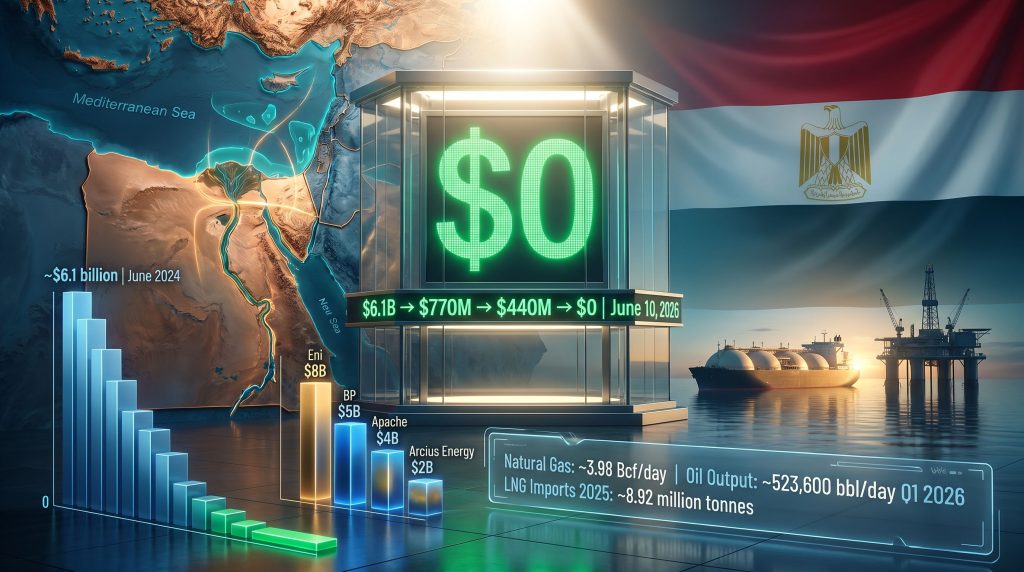
The scale of Egypt's accumulated petroleum arrears was considerable. At their peak as of June 30, 2024, outstanding obligations to foreign oil and gas companies stood at approximately $6.1 billion, making this one of the largest sovereign petroleum sector debt burdens in the MENA region at that time. What followed was a structured and ultimately accelerated repayment programme that unfolded over nearly two years, driven by improving foreign currency liquidity and a clear political commitment to restoring investor confidence.
The progression of that repayment effort is captured in the table below:
| Milestone | Date | Outstanding Balance |
|---|---|---|
| Peak arrears recorded | June 30, 2024 | ~$6.1 billion |
| Initial repayment target | Mid-2025 planning | ~$1.2 billion remaining |
| Near-final balance | April 2026 | ~$770 million |
| Final reduction | May 2026 | ~$440 million |
| Full clearance achieved | June 10, 2026 | $0 |
What is particularly notable about this timeline is the acceleration that occurred in the final phase. The original planning assumption placed a residual balance of approximately $1.2 billion outstanding at the June 2026 target date. Instead, the balance fell to $770 million in April 2026, then to $440 million in May, and was fully extinguished by June 10, well ahead of the June 30 deadline. The pace of that final clearance reflects the degree to which improved foreign currency availability allowed Egypt to move faster than its own schedule anticipated.
The Ministry of Petroleum and Mineral Resources confirmed the full settlement on June 10, 2026, characterising the outcome as the opening of a new chapter for the sector. The framing is deliberate: the clearance is positioned not as the conclusion of a remediation exercise, but as a precondition for an entirely new phase of upstream activity.
When big ASX news breaks, our subscribers know first
How Unpaid Arrears Reshaped Upstream Investment Behaviour
The financial dimension of the arrears problem, while significant, was ultimately secondary to its operational consequences. The more damaging effect was the behavioural response of international energy companies operating in Egypt, who systematically scaled back their exploration drilling, field development commitments, and capital allocation as the outstanding balance grew. Understanding why this happened, and how deep those behavioural shifts ran, is essential for gauging whether a financial resolution can actually reverse the production trajectory.
The Investment Withdrawal Pattern and What Drives It
IOCs operating in sovereign joint venture structures face a specific type of risk that differs from standard commercial counterparty exposure. When the state entity responsible for paying the company's cost recovery and profit oil entitlements falls behind on settlement, the effective return on deployed capital falls. In extreme cases, the net present value of ongoing operations turns negative on a cash basis, even when the underlying field economics remain sound. At that point, the rational response is to minimise incremental capital exposure until payment reliability is restored.
This pattern played out across Egypt's upstream sector during the arrears accumulation period. Exploration drilling programmes were deferred, appraisal wells on prospective structures were postponed, and development decisions on discovered resources were delayed pending clarity on the payment environment. The consequence was not merely a short-term reduction in activity. Deferred exploration translates into deferred discoveries, and deferred development decisions extend the timeline to production by years. The production decline that Egypt is now experiencing in its gas sector is, in part, a lagged consequence of investment decisions that were not made during the arrears period.
Production Consequences: Oil Stabilisation vs. Gas Decline
Egypt's oil and gas sectors have followed divergent trajectories through this period, and that divergence carries important implications for the recovery outlook. Crude oil output has shown signs of stabilisation and modest recovery, averaging approximately 523,600 barrels per day in the first quarter of 2026, with activity in the Gulf of Suez providing meaningful support to that figure. The relative resilience of oil production reflects the mix of mature fields, onshore activity, and the operational continuity maintained by certain operators despite the challenging payment environment.
Gas production, however, tells a different story. Output has declined to approximately 3.98 billion cubic feet per day, the lowest recorded level in approximately a decade, driven primarily by the weakening performance of offshore Mediterranean fields. This is not simply natural field decline. It reflects the investment starvation that accompanied the arrears period, where the complex and capital-intensive maintenance and development work required to sustain offshore gas production was deferred or curtailed as IOCs managed their Egypt exposure conservatively.
The Energy Mix Vulnerability: Natural Gas at 81% of Power Generation
The structural vulnerability created by declining gas production is amplified by the composition of Egypt's power generation mix. According to data cited by Enerdata, natural gas accounts for approximately 81% of Egypt's electricity generation. Running a power system with that degree of dependence on a single fuel source is inherently exposed to supply disruption, and when the domestic production of that fuel is declining while demand continues to grow, the pressure on the national energy balance becomes acute.
The measurable consequence of this imbalance is Egypt's LNG import dependency. According to data from Kpler, cited by the Middle East Economic Survey, Egypt imported approximately 8.92 million tonnes of LNG in 2025, a record annual volume that underscores the scale of the domestic supply gap. The LNG supply outlook for the region suggests that import competition is likely to intensify, placing further pressure on Egypt's energy budget and its foreign currency reserves. Resolving the payment crisis without addressing the underlying production decline would simply shift the foreign currency pressure from one channel to another.
What Egypt's $19 Billion Investment Pipeline Actually Signals
The announcement of over $19 billion in investment commitments from international energy companies over the coming three years is the headline number that has captured the most attention following Egypt oil debt cleared to foreign companies. However, the significance of this capital lies not simply in its aggregate size. The composition, concentration, and strategic logic of those commitments reveal important information about how sophisticated energy investors are actually pricing Egypt's restored credibility.
Breaking Down the Committed Capital
The investment pipeline is dominated by a small number of major commitments from companies with deep existing exposure to Egypt's upstream sector:
| Company | Committed Investment | Strategic Focus |
|---|---|---|
| Eni | $8 billion | Deepwater Mediterranean, upstream development |
| BP | $5 billion | Exploration and production expansion |
| Apache | $4 billion | Western Desert and existing field development |
| Arcius Energy | $2 billion | Emerging upstream opportunities |
| Total Pipeline | $19 billion | Across exploration, development, and infrastructure |
Eni's outsized commitment of $8 billion reflects its existing Mediterranean deepwater exposure through the Zohr field and adjacent acreage, as well as its strategic interest in building Egypt into a significant node in its broader Mediterranean gas strategy. BP's $5 billion pledge carries a different signal: it represents a re-engagement by a company that had managed its Egypt exposure cautiously during the arrears period and is now choosing to scale up, which functions as an institutional endorsement of Egypt's restored contractual reliability.
Apache's $4 billion commitment is concentrated in the Western Desert, where the company has operated for decades and maintains a well-understood asset base. This capital is likely to be deployed in the nearer term than the deepwater Mediterranean commitments, as Western Desert drilling carries lower technical complexity and shorter lead times from commitment to production. Arcius Energy's $2 billion represents newer capital entering the Egyptian market, which itself signals that the restoration of credibility is attracting participants beyond the established incumbents.
New Contractual Models and Structural Reforms
The Ministry of Petroleum's May 2026 announcement of revised contractual frameworks represents an attempt to address not just the arrears legacy but the structural attractiveness of Egypt's upstream fiscal terms. Contractual model innovation is a well-established mechanism in MENA petroleum sectors for resetting the investment relationship between host governments and IOCs after periods of friction. The precise terms of Egypt's new frameworks have not been fully disclosed, but the direction is clearly toward reducing risk-adjusted costs for international operators and accelerating final investment decisions on prospects held in suspension during the arrears period.
Confidence Restoration vs. Actual Production Growth
It is critical for investors and energy analysts to maintain clarity on the distinction between financial credibility restoration and physical production growth. Clearing arrears removes a constraint. It does not, by itself, reverse a production decline or accelerate the development of complex deepwater resources. The translation of $19 billion in investment commitments into measurable output requires project sanctioning, equipment procurement, drilling campaigns, well completions, and, in the case of new offshore developments, the construction or expansion of gathering and processing infrastructure.
In deepwater Mediterranean environments, the timeline from exploration commitment to first production routinely extends to five years or longer. Even in the more immediately deployable Western Desert context, the lag between capital commitment and incremental production is measured in months to years, not weeks. This temporal gap is not a reason for pessimism, but it is an essential calibration for expectations about when Egypt's production trajectory will visibly inflect.
Technical and Commercial Challenges Facing Egypt's Mediterranean Gas Frontier
The Mediterranean offshore represents both the greatest opportunity and the most formidable challenge in Egypt's gas sector recovery. Understanding why these projects are simultaneously so consequential and so difficult to execute is essential for any serious assessment of the medium-term production outlook.
Deepwater Development Complexity
Deepwater field development in the Eastern Mediterranean operates at a fundamentally different cost and complexity tier than the onshore or shallow-water upstream activity that characterises much of Egypt's existing production base. Water depths in the relevant acreage range from hundreds to thousands of metres, requiring specialised drilling vessels, sophisticated blowout preventer systems, and subsea completions technology that is both expensive and subject to long lead times for equipment procurement and mobilisation. The Ministry of Petroleum has acknowledged that these developments require advanced technologies and costly drilling campaigns before production can begin.
The capital intensity of deepwater Mediterranean development means that project economics are highly sensitive to gas price assumptions and development cost estimates. Consequently, when IOCs are already managing sovereign counterparty risk exposure, the combination of high capital intensity and payment uncertainty creates a particularly challenging investment case. The clearance of arrears removes one variable from that equation, but the underlying cost structure of deepwater development remains unchanged.
Infrastructure Gaps as a Bottleneck
A less frequently discussed constraint on Egypt's Mediterranean gas development is the adequacy of midstream infrastructure to gather, process, and transport gas from new offshore fields to domestic consumers or export terminals. Existing pipeline and processing infrastructure was sized for the production profiles of fields that are now maturing and declining. New discoveries in frontier acreage may require dedicated infrastructure solutions that add significantly to project development costs and timelines.
This infrastructure requirement is not a theoretical future problem. The Ministry of Petroleum has explicitly identified major investments in gas gathering and transportation infrastructure as prerequisites for the commercialisation of new Mediterranean discoveries. Investors assessing the Egyptian upstream opportunity need to account for this midstream capital requirement as part of the total investment needed to convert discoveries into production.
Scenario Analysis: Three Pathways for Egypt's Gas Production
The trajectory of Egypt's gas production over the coming decade will be determined by the speed and effectiveness of capital deployment across the upstream and midstream sectors. Three broad scenarios frame the range of plausible outcomes:
Scenario 1: Accelerated Recovery. Committed IOC capital is deployed rapidly, Mediterranean projects reach final investment decisions within 18 to 24 months, and new production begins contributing meaningfully to offset field decline by 2028 to 2029. Under this scenario, Egypt's LNG import dependency begins declining from its 2025 record and the country moves toward a more balanced domestic supply position by the early 2030s.
Scenario 2: Moderate Rebound. Investment flows are sustained but project timelines extend due to technical complexity, equipment procurement constraints, and the time required to build out supporting infrastructure. Gas production stabilises but does not grow materially until the early 2030s, and Egypt maintains elevated LNG import dependency through the late 2020s. This scenario represents the most likely base case given the structural realities of deepwater development.
Scenario 3: Stalled Momentum. Contractual or fiscal disputes re-emerge, capital deployment slows, Mediterranean field decline accelerates, and Egypt's import dependency deepens. This scenario would place significant pressure on Egypt's foreign currency position and energy budget, potentially recreating the conditions that generated the original arrears problem. It represents a tail risk rather than a central case, but it is a scenario that disciplined risk management requires investors to hold in view.
How Egypt's Debt Clearance Repositions Its Energy Sector Regionally
Egypt does not compete for upstream capital in a vacuum. The country sits within a competitive regional landscape that includes North African neighbours, East Mediterranean rivals, and Gulf producers, all of whom are simultaneously seeking to attract IOC investment for exploration and development programmes. Understanding how Egypt's restored credibility changes its competitive position within that landscape is as important as understanding the domestic production outlook.
Egypt vs. Competing Mediterranean and North African Destinations
During the arrears accumulation period, Egypt's comparative attractiveness as an upstream destination shifted unfavourably relative to several peer jurisdictions. Libya, despite its persistent political risk, offered some operators a payment environment that was more predictable on a contractual basis for specific blocks. Algeria, with its extensive existing infrastructure and large resource base, continued to attract technical service relationships with major IOCs. Cyprus and Israel, as East Mediterranean frontier jurisdictions with active deepwater programmes and no comparable sovereign payment risk, became increasingly visible as alternative destinations for Mediterranean-focused exploration capital.
The clearance of arrears materially changes this competitive calculus. Egypt's combination of proven basin geology, existing infrastructure scale, geographic proximity to European markets, LNG export capacity, and now restored contractual reliability creates a uniquely compelling upstream proposition. No other North African jurisdiction can currently offer the full combination of those attributes. In addition, the broader commodity price outlook for energy resources reinforces the strategic timing of Egypt's re-engagement with international capital.
The Role of Egypt's LNG Export Infrastructure
Egypt possesses two LNG liquefaction facilities — the Idku terminal operated by the Egyptian LNG consortium and the Damietta terminal — representing significant installed export capacity that has been underutilised in recent years as domestic production fell and import requirements grew. The strategic irony of Egypt's current energy position is that it operates world-class export infrastructure while simultaneously importing record volumes of LNG to meet domestic demand.
The restoration of domestic gas production to levels that can support both demand and export is therefore the central objective of the new investment cycle. If Mediterranean deepwater projects deliver on their production potential, Egypt is positioned to resume meaningful LNG exports through existing infrastructure, potentially reestablishing its role as a net gas exporter to European and regional markets. The elevated importance of diversified gas supply to European buyers following geopolitical disruptions has raised the strategic value of that potential contribution, though the timeline for realisation depends entirely on the pace of upstream development.
Sovereign Credibility as a Geopolitical Asset
The full and early clearance of petroleum sector arrears carries significance that extends beyond the energy industry. The repayment of a $6.1 billion debt to international companies, completed ahead of schedule, constitutes a demonstrable signal of improved sovereign payment discipline that will be noted by foreign direct investors across all sectors, as well as by multilateral lenders and development finance institutions assessing Egypt's broader creditworthiness. The relationship between energy sector credibility and a country's standing with international capital markets is not linear, but it is real.
Key Indicators and Risk Factors to Monitor
For investors and energy analysts tracking Egypt's sector recovery, the following metrics will provide the most meaningful leading signals of whether the investment cycle is translating into physical output improvement:
- Monthly gas production data: Any reversal of the declining trend in Mediterranean offshore output will be the most critical leading indicator of whether new capital is affecting the supply base.
- Active rig counts and drilling completions: Increases in deployed drilling activity will confirm that committed capital is being mobilised rather than held in reserve.
- LNG import volumes: A reduction from the 2025 record of 8.92 million tonnes would provide the clearest evidence of domestic supply improvement.
- New contract awards: The pace at which the Ministry of Petroleum converts investment commitments into executed development agreements will indicate the speed of the commercial transition.
- Final investment decisions on deepwater projects: FID announcements on Mediterranean developments will define the production outlook for the 2029 to 2033 window.
Against those positive indicators, several risk factors warrant continued monitoring:
- Renewed foreign currency pressure that could limit Egypt's capacity to sustain payment schedules and prevent arrears from rebuilding.
- Global hydrocarbon price volatility, which directly affects the viability of high-cost deepwater developments and can cause IOCs to revise capital allocation priorities. Monitoring natural gas price trends will therefore be particularly relevant for Egypt's upstream investment outlook.
- Geopolitical dynamics in the Eastern Mediterranean, where maritime boundary disputes and regional tensions have historically complicated offshore operations.
- Execution risk in delivering contractual reforms that genuinely improve IOC economics rather than simply repackaging existing fiscal terms.
- Supply chain disruptions affecting the procurement of deepwater drilling equipment and subsea technology, which could extend project timelines beyond current estimates.
The next major ASX story will hit our subscribers first
Frequently Asked Questions: Egypt Oil Debt Cleared to Foreign Companies
How much did Egypt owe to foreign oil companies at its peak?
Egypt's outstanding arrears to international oil and gas companies reached approximately $6.1 billion at their peak, recorded as of June 30, 2024. This represented one of the largest sovereign petroleum sector debt burdens in the MENA region at that time, and resulted primarily from the country's foreign currency constraints limiting its ability to meet USD-denominated contractual obligations to upstream operators.
When did Egypt fully clear its oil sector debt?
Egypt achieved full settlement of all outstanding arrears to foreign oil and gas companies on June 10, 2026, completing the repayment programme approximately three weeks ahead of the original June 30, 2026 target date. The acceleration was enabled by improved foreign currency availability during the final months of the repayment period. Earlier progress reports had confirmed the steady momentum building toward that final settlement.
What impact did the debt have on Egypt's oil and gas production?
The arrears led multiple international energy companies to reduce exploration drilling and development investment, contributing to a sustained decline in gas output to approximately 3.98 billion cubic feet per day, a decade-low figure. Crude oil production showed more resilience, averaging around 523,600 barrels per day in the first quarter of 2026, partly supported by Gulf of Suez activity.
How much has Egypt committed in new energy investment following the debt clearance?
Egypt has secured over $19 billion in investment commitments from international companies for the next three years. The major contributors include Eni at $8 billion, BP at $5 billion, Apache at $4 billion, and Arcius Energy at $2 billion, spanning exploration, development, and infrastructure across the country's key producing regions.
Is Egypt currently self-sufficient in natural gas?
No. Domestic gas consumption currently exceeds national production, requiring Egypt to import LNG to bridge the supply gap. Egypt imported approximately 8.92 million tonnes of LNG in 2025, a record annual volume according to data from Kpler cited by the Middle East Economic Survey. This import dependency is the primary production challenge that new upstream investment is intended to address.
The Strategic Verdict: Debt Clearance as a Launchpad, Not a Landing Point
The fact that Egypt oil debt cleared to foreign companies is a genuine and significant policy achievement. The reduction of a $6.1 billion arrears burden to zero, completed ahead of schedule through a sustained repayment programme, demonstrates a meaningful improvement in fiscal discipline and sovereign payment reliability. The restoration of that credibility was a necessary precondition for the investment cycle that Egypt's energy sector urgently requires.
However, necessary conditions are not sufficient conditions. The country's energy security outlook will ultimately be determined by what happens next: whether $19 billion in investment commitments translates into drilled wells, completed fields, and incremental production; whether contractual reforms genuinely reduce the risk-adjusted cost of operating in Egypt; and whether Mediterranean deepwater projects can move from commitment to final investment decision within a timeframe that allows new production to offset the continuing decline of existing fields.
With natural gas powering approximately 81% of Egypt's electricity generation, and domestic production at a decade low, the stakes of this execution challenge are not confined to the energy sector. Industrial competitiveness, household energy costs, and the fiscal sustainability of Egypt's energy balance all depend on the upstream investment cycle delivering results within a reasonable horizon.
The window for converting restored investor confidence into measurable output growth is now open. The speed and discipline with which Egypt and its international partners move through that window will determine whether the debt clearance of June 2026 is remembered as the beginning of a genuine production recovery or as a financial correction that did not fully resolve the underlying structural challenge.
This article is intended for informational purposes only and does not constitute financial or investment advice. Forward-looking scenarios and production projections involve inherent uncertainty and should not be relied upon as forecasts. Readers should conduct independent research and seek professional advice before making investment decisions.
Want to Stay Ahead of the Next Major Mineral Discovery on the ASX?
While Egypt's energy sector navigates its investment recovery, Discovery Alert's proprietary Discovery IQ model is scanning ASX announcements in real time — delivering instant alerts on significant mineral discoveries across more than 30 commodities before the broader market reacts. Start your 14-day free trial today and explore how major discoveries have historically generated substantial returns for early-positioned investors.