June 11, 2026
The Quiet Revolution Happening Inside Iron Ore's Most Established Operations
For decades, the dominant assumption in large-scale mining has been that meaningful output growth requires meaningful capital expenditure on new infrastructure. Build a new mine, sink a new shaft, commission a new processing line. The logic seemed unbreakable. Yet the Vale AI-powered plant in Minas Gerais boosts productivity by 25%, challenging that assumption with hard data and demonstrating that significant gains are already locked inside existing facilities, waiting to be unlocked by the right combination of data intelligence and automation.
The results emerging from Vale's Conceição 2 processing unit in Minas Gerais represent more than an operational milestone. They offer a replicable blueprint for how the global iron ore sector can grow output, improve product quality, and reduce operational risk without the multi-year lead times and capital intensity that new greenfield development demands.
When big ASX news breaks, our subscribers know first
What Makes the Conceição 2 Unit Strategically Significant
The Conceição 2 plant sits within the Itabira complex, a site that carries deep significance within Vale's corporate history. Itabira is where the company was founded, and the Conceição operations have long been central to Vale's Minas Gerais production base, one of the most important iron ore-producing regions anywhere on earth.
Before the modernisation programme began, the Conceição 2 unit was producing approximately 9 million metric tons of iron ore per year. That figure was not the result of underinvestment or neglect; it reflected the practical ceiling of what conventional beneficiation management approaches could achieve within the existing physical infrastructure.
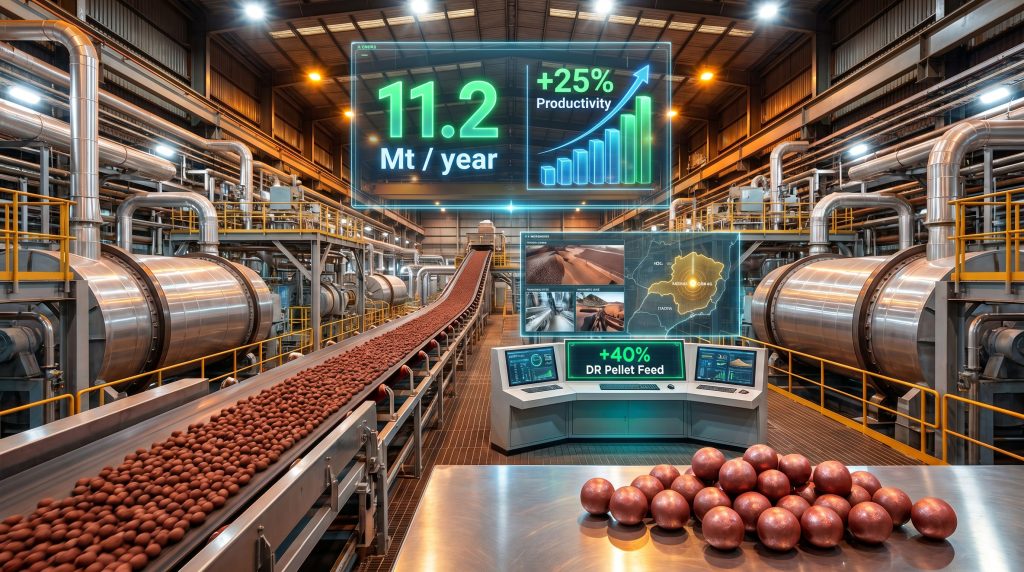
Following the AI-driven upgrade, annual capacity climbed to 11.2 million metric tons, a gain of 2.2 million metric tons per year delivered in under two years. Expressed as a percentage, that is a 25% productivity improvement achieved without constructing new processing capacity. For context, 2.2 million additional tons per year represents meaningful incremental supply at a scale that would take years and billions of dollars to replicate through greenfield development.
The Technical Architecture Behind a 25% Gain
Understanding why the Vale AI-powered plant in Minas Gerais achieved such a significant productivity boost requires a working understanding of what iron ore beneficiation actually involves, and where conventional approaches hit their limits. Furthermore, the broader iron ore market types and deposit structures play a role in shaping what beneficiation strategies are viable at scale.
Why 400+ Variables Cannot Be Managed by Human Operators Alone
Iron ore beneficiation is the process of separating valuable iron-bearing minerals from gangue material (the unwanted rock and silica that surrounds them). This involves a series of interdependent unit operations including crushing, screening, wet classification, magnetic separation, flotation, and filtration. At each stage, dozens of variables interact: feed rate, particle size distribution, water-to-solids ratios, reagent dosing, magnetic field intensity, and equipment wear states, among others.
The challenge is not that individual operators lack skill. The challenge is one of complexity at scale. When a single plant involves more than 400 interdependent process variables, the number of possible interaction combinations exceeds what any team of human operators can simultaneously monitor and respond to in real time. Consequently, in conventionally managed plants, operators make conservative adjustments to avoid risk, which means the plant rarely operates at its true performance ceiling.
AI-driven process optimisation addresses this directly by:
- Continuously ingesting real-time data from sensor networks distributed across the entire processing circuit
- Identifying correlations between variables that would not be apparent to human observers analysing data sequentially
- Making micro-adjustments to feed rates, separation parameters, and water usage on timescales far shorter than human reaction allows
- Shifting the operational mode from reactive (respond to problems after they occur) to predictive (anticipate and prevent suboptimal states before they develop)
The integration at Conceição 2 combined advanced automation, centralised monitoring infrastructure, and data intelligence systems into a single operational loop, creating what Vale has described as a new model for how processing plants should be run.
Centralised Monitoring and Remote Equipment Operation
A critical but underappreciated element of the Conceição 2 upgrade is the shift to remote equipment operation and centralised plant monitoring. In conventional processing facilities, operators are physically distributed across the plant floor, each responsible for a section of the process circuit. This creates information silos and introduces latency between observation and action.
Centralising monitoring into a unified control environment gives operators a complete, real-time picture of the entire circuit simultaneously. Remote operation protocols eliminate the need for manual intervention at individual equipment points, which historically created throughput bottlenecks whenever a piece of equipment required adjustment, inspection, or minor maintenance.
This structural change delivers two benefits simultaneously: higher throughput efficiency and improved worker safety, since fewer personnel need to be physically present near operating equipment under load.
The 40% DR Pellet Feed Increase: Why Product Quality Matters as Much as Volume
The volume gain at Conceição 2 is notable, but arguably the more strategically significant outcome of the modernisation is the 40% increase in the share of direct reduction (DR) pellet feed produced by the plant.
| Metric | Pre-Modernisation | Post-AI Upgrade |
|---|---|---|
| Annual Iron Ore Output | ~9 Mt/year | ~11.2 Mt/year |
| Productivity Improvement | Baseline | +25% |
| DR Pellet Feed Share | Baseline | +40% increase |
| Process Variables Optimised | Manual/Limited | 400+ variables |
| Timeline to Results | Baseline | Under 2 years |
Understanding Direct Reduction Iron and Its Role in Green Steel
Direct reduction is a steelmaking pathway that does not rely on a conventional blast furnace. Instead of smelting iron ore with metallurgical coal, direct reduction uses natural gas (or increasingly hydrogen) to chemically reduce iron ore pellets into direct reduced iron (DRI), also known as sponge iron. DRI is then charged into an electric arc furnace (EAF) to produce steel.
The carbon footprint of the DRI-EAF route is substantially lower than that of the traditional blast furnace-basic oxygen furnace (BF-BOF) pathway, particularly when hydrogen replaces natural gas as the reductant. Advances in hydrogen iron ore reduction technology are accelerating this transition, making high-quality DR-grade feedstock increasingly essential to steelmakers pursuing decarbonisation targets.
The critical constraint is feedstock quality. DR processes require iron ore pellets with very high iron content, typically above 67% Fe, and tightly controlled levels of silica, alumina, and other gangue minerals. Standard blast furnace feed does not meet this specification. Producing DR-grade pellet feed therefore requires superior mineral recovery and beneficiation precision, which is precisely what AI-driven process optimisation enables.
By increasing DR pellet feed share by 40%, Vale is not merely boosting volume. It is repositioning Conceição 2's output mix toward the higher-value, structurally growing segment of the market. DR-grade material commands meaningful price premiums over standard blast furnace pellets, and demand for this product category is expected to accelerate as global steel decarbonisation investments compound through the late 2020s and into the 2030s.
The Model Plant Concept: Scaling a Blueprint Across a Global Portfolio
Vale's leadership has framed the Conceição 2 outcome as more than a single project success. According to Carlos Medeiros, Vale's Vice President of Operations, the model plant concept represents a fundamentally new operational philosophy rather than a one-off engineering achievement. The intention is explicit: Conceição 2 becomes a reference architecture for upgrades across Vale's broader processing portfolio.
What a Reference Plant Model Actually Means in Practice
In large-scale mining, a reference or model plant is a proven operational template from which performance benchmarks, technology configurations, and process control frameworks can be extracted and adapted to other facilities. The key distinction from a pilot project is scale and repeatability.
A pilot validates that a technology works under controlled conditions. A model plant, however, demonstrates that the technology works at full commercial scale, within the operational complexity of a real production environment, and that the performance gains are measurable, sustained, and transferable.
The Conceição 2 result — 25% productivity growth in under 24 months — is exactly the kind of validated proof that justifies portfolio-wide rollout. For Vale, which operates multiple processing facilities across Minas Gerais and beyond, the compounding effect of applying the Conceição 2 framework to even a fraction of its asset base could translate into tens of millions of additional tons of annual production capacity without proportionate capital expenditure.
Capital Efficiency: The Investment Case for AI-Led Modernisation
The sub-two-year timeline to measurable results at Conceição 2 is a critical variable in the investment calculus. Greenfield mine development in iron ore typically involves lead times of five to ten years from discovery to first production, with capital requirements that can reach several billion dollars for large-scale operations.
AI-driven modernisation of existing infrastructure operates on an entirely different capital and time curve:
- Lower upfront capital relative to new mine or plant construction
- Faster time to incremental production with measurable returns within two years
- Lower execution risk because the physical infrastructure, workforce, and logistics already exist
- Immediate integration with existing supply chain and customer relationships
- Compounding returns as the AI system continues to learn and optimise over time
This profile makes the Conceição 2 model particularly compelling from an investor perspective, as the risk-adjusted return on capital from technology-led brownfield modernisation compares favourably to the risk and timeline profile of new development.
Safety, Workforce, and Environmental Dimensions
Remote Operation as a Safety Multiplier
The safety implications of AI-driven plant modernisation extend beyond headline productivity figures. By reducing the frequency and necessity of manual intervention at equipment-level throughout the processing circuit, remote operation protocols materially reduce worker exposure to the mechanical hazards associated with operating crushers, screens, conveyors, and separation equipment.
Centralised monitoring also creates a unified safety management environment where anomalies are detected and flagged automatically, rather than depending on individual operators to notice and report irregularities across a distributed plant floor.
Environmental Efficiency: More Iron Per Ton of Ore Processed
Improved mineral recovery — one of the stated outcomes of the Conceição 2 upgrade — has a direct environmental dimension that is often overlooked. When beneficiation processes extract a higher percentage of iron from each ton of ore processed, the volume of tailings generated per ton of saleable product decreases.
In a region like Minas Gerais, where tailings dam management has historically been a critical environmental and safety issue for the Brazilian iron ore industry, any technology that meaningfully reduces tailings generation per unit of production carries significant regulatory and social value. This environmental efficiency also complements broader efforts around green iron production, which depends in part on upstream processing improvements to reach its full sustainability potential.
The next major ASX story will hit our subscribers first
Frequently Asked Questions: Vale's AI-Powered Plant in Minas Gerais
What technology did Vale use to achieve the 25% productivity increase at Conceição 2?
The upgrade integrated advanced automation, real-time sensor networks, centralised monitoring infrastructure, and AI-driven data intelligence systems capable of simultaneously optimising more than 400 process variables across the iron ore beneficiation circuit.
How much iron ore can the Conceição 2 plant now produce annually?
Following the modernisation, the plant is capable of producing up to 11.2 million metric tons per year, compared to approximately 9 million metric tons before the upgrade.
What is direct reduction pellet feed and why did Vale prioritise increasing its share?
DR pellet feed is a high-grade iron ore product, typically exceeding 67% Fe, used in direct reduction ironmaking processes that produce steel with a significantly lower carbon footprint than conventional blast furnace routes. Demand for DR-grade material is growing as steelmakers invest in decarbonisation, and advances in green steelmaking technology are further driving this shift.
Will Vale apply the same AI model to other processing facilities?
Vale has indicated its intention to use the Conceição 2 framework as a reference architecture for other units within its processing portfolio.
How long did the modernisation take to deliver measurable results?
Measurable productivity gains were achieved in under two years from the commencement of the modernisation programme.
What safety improvements resulted from the upgrade?
Remote equipment operation and centralised monitoring reduced the need for manual intervention across the plant, lowering worker exposure to mechanical hazards and improving the consistency of safety oversight.
Five Strategic Signals From Conceição 2 for the Iron Ore Sector
- Existing assets contain more capacity than conventional management can extract — AI process optimisation reveals and captures latent throughput that traditional approaches leave on the table.
- Product mix optimisation is as valuable as volume growth — the 40% DR pellet feed increase reflects a deliberate strategy to align output with structurally growing, premium-priced demand categories. The evolving China steel and iron ore market is central to understanding why this shift carries such commercial weight.
- Sub-two-year return timelines reframe the brownfield investment case — rapid, measurable returns on AI modernisation challenge the default preference for greenfield expansion among large mining operators.
- Safety and productivity are not competing priorities — remote operation and centralised monitoring simultaneously improve both dimensions, undermining the conventional trade-off assumption.
- Scalable blueprints are among the most valuable assets in large-scale mining — a validated model plant that can be replicated across dozens of facilities represents a compounding productivity resource. According to PwC's 2025 Global AI Jobs Barometer, AI adoption is linked to a fourfold productivity growth advantage across industries, a finding that reinforces what Conceição 2 has demonstrated in practice.
Disclaimer: This article is intended for informational purposes only and does not constitute financial advice. Forward-looking statements regarding production targets, market trends, and technology applications involve inherent uncertainty. Readers should conduct independent research before making investment decisions.
Want to Spot the Next Major ASX Mineral Discovery Before the Broader Market Does?
Discovery Alert's proprietary Discovery IQ model delivers real-time alerts on significant ASX mineral discoveries, transforming complex data across 30+ commodities into clear, actionable insights for investors at every experience level — explore historic discovery returns to understand the scale of opportunity, and begin your 14-day free trial today to position yourself ahead of the market.