
July 31, 2026
The Chokepoint Economy: Why Labour Tensions at Port Hedland Reverberate Across Global Steel Markets
The global iron ore trade operates through a surprisingly small number of critical nodes. Remove one of those nodes, even temporarily, and the ripple effects extend thousands of kilometres to steel mills in China, Japan, and South Korea. This is the defining characteristic of what economists sometimes call chokepoint infrastructure: facilities where the concentration of throughput is so extreme that even minor disruptions carry outsized market consequences. The BHP Port Hedland iron ore strike has brought this reality into sharp focus. Understanding why industrial action there matters requires understanding the mechanics of how the global steel supply chain actually functions.
When big ASX news breaks, our subscribers know first
Why Port Hedland Occupies a Singular Position in Global Iron Ore Trade
Port Hedland is not simply one of several large iron ore ports. It is the dominant loading gateway for Pilbara iron ore, and the Pilbara is the world's most prolific iron ore producing region. The port simultaneously serves BHP, Fortescue, and Hancock Prospecting, meaning its operational continuity underpins the export programmes of multiple major producers at once.
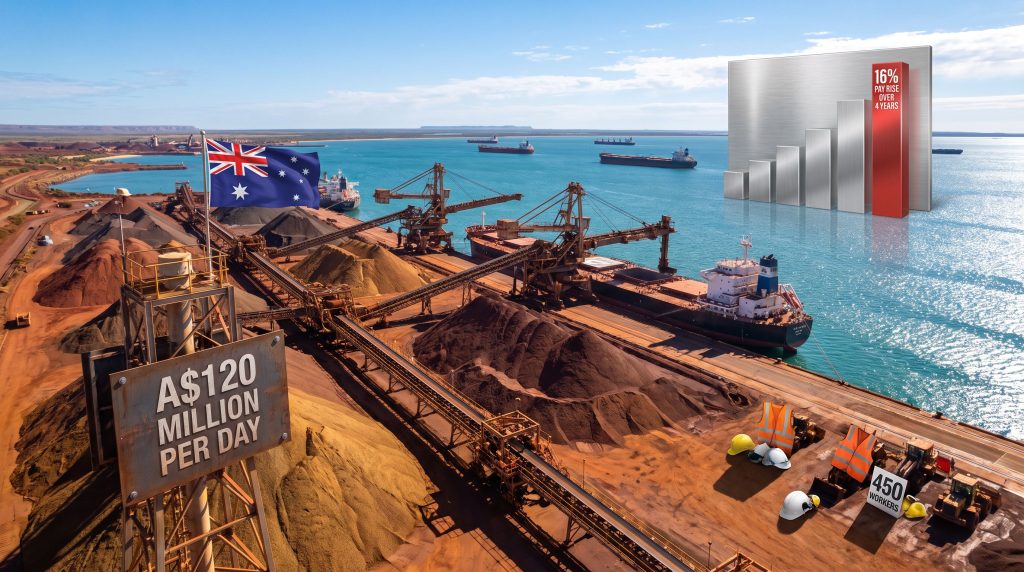
The financial scale of activity transiting this single facility is staggering. According to reporting from Mining Weekly, approximately A$80 million worth of BHP's products alone moves through Port Hedland each day. When the broader throughput of all users is considered, the daily revenue exposure during any stoppage climbs significantly higher, with industry estimates placing the combined figure closer to A$120 million per day across all operators using the terminal.
This concentration creates a structural asymmetry that shapes every labour negotiation conducted at the port. A relatively small workforce, around 450 operators and maintenance workers in BHP's case, controls access to a facility that underpins the export revenues of one of the world's largest mining companies. From a bargaining theory perspective, this is a near-ideal leverage position for organised labour.
The Multi-Operator Risk Factor
A dimension of Port Hedland's vulnerability that receives less attention than it deserves is its shared-use nature. Because Fortescue and Hancock Prospecting also export through the same port precinct, prolonged disruption at BHP's terminal infrastructure introduces uncertainty across the entire Pilbara export ecosystem. Port logistics, tug services, pilotage, and berth scheduling are all interconnected. Even targeted industrial action at one operator's facilities can generate scheduling congestion and vessel queuing that affects loading timelines for neighbouring operators. Furthermore, Australia's iron ore advantages are built on the reliable throughput of precisely these shared facilities, making any sustained disruption a systemic concern.
Anatomy of the BHP Port Hedland Iron Ore Strike Dispute
The BHP Port Hedland iron ore strike did not emerge suddenly. It was the product of more than seven months of enterprise agreement negotiations that repeatedly failed to bridge the gap between what workers sought and what BHP was prepared to offer. The most recent bargaining session before industrial action was announced took place on July 28, 2026, ending without resolution.
The dispute centres on a proposed four-year enterprise agreement. BHP reportedly put forward a wage increase of 16% over four years for most employees, a figure the Combined BHP Ports Unions and its member bodies characterised as insufficient given broader concerns about conditions, job classifications, and career progression pathways. Hundreds of BHP workers subsequently walked off the job at one of the world's largest iron ore ports, marking a significant escalation in the standoff.
What the Dispute Is Really About: Beyond the Headline Wage Number
Experienced labour relations observers note that wage percentage figures in enterprise agreement disputes often obscure the more complex underlying tensions. The structure of how wages are applied across different job classifications, the enforceability of career progression commitments, and the treatment of workers employed under individual contract arrangements rather than collective agreements are frequently the issues that prevent settlement even when headline numbers appear reasonable.
In the Port Hedland case, unions representing the workforce specifically emphasised the need for enforceable wage and condition protections, a phrasing that signals concern not just about the quantum of any offer but about the mechanisms that would guarantee those protections over the life of an agreement.
The Phased Industrial Action Strategy
The Combined BHP Ports Unions deployed a deliberately staged escalation approach, a tactical choice with strategic logic:
- August 8, 2026 – A 24-hour ban on loading ships, targeting the terminal's primary revenue-generating function without a complete shutdown of all port activity.
- August 9, 2026 (from 05:30 AWST) – A 24-hour full work stoppage at the Port Hedland Bulk Export Terminal, escalating from targeted disruption to comprehensive stoppage.
- August 9, 2026 (concurrent) – A separate 12-hour stoppage by high-voltage and power workers negotiating their own enterprise agreement, introducing a second layer of operational pressure at critical electrical infrastructure.
This sequence followed an earlier stoppage on July 16, 2026, which was characterised at the time as the first major mining strike in the Pilbara in decades. That eight-hour stoppage, running from 2pm to 10pm local time, established the precedent and tested BHP's contingency response before unions escalated to the longer August actions. Notably, BHP's record iron ore production figures made the timing of the strike particularly consequential for the company's commercial position.
The July 2026 Pilbara stoppage represented a threshold moment in Australian mining labour history, occurring against the backdrop of the most significant union push into the resources sector in approximately 30 years.
Australia's 2022 Industrial Relations Reform: The Legislative Engine Behind the Dispute
To understand why this dispute is unfolding with the intensity it is, the 2022 legislative reforms introduced by Australia's Labor government are essential context. The changes fundamentally restructured the bargaining architecture in the resources sector by granting unions the capacity to negotiate multi-employer wage agreements. Rather than being confined to negotiating with a single company at a single site, unions can now pursue agreements that span multiple employers simultaneously.
This reform altered the strategic calculus for union organising in significant ways:
- Expanded coverage: A successful agreement at one major operator can be leveraged as a template across competitor firms.
- Increased strike scope: Industry-wide strike action became a legally accessible tool rather than an exceptional measure requiring extraordinary circumstances.
- Reduced fragmentation: Previously, the site-by-site bargaining model meant unions had to win dozens of individual negotiations. Multi-employer agreements allow resources to be concentrated for maximum impact.
The Port Hedland dispute is widely regarded in Australian industrial relations circles as a live test of how far this reformed framework can be pushed against large, well-resourced mining companies with sophisticated contingency planning capabilities. Consequently, iron ore miners surging in output and profitability may paradoxically face greater labour pressure precisely because of their financial strength.
Why the Pilbara Has Historically Resisted Union Penetration
The Pilbara's relatively low historical union membership compared to other Australian industrial sectors reflects several structural factors. The remote geography of operations creates workforce management challenges for unions. The high wages that major iron ore producers pay tend to reduce the financial grievance gap that typically drives union recruitment. And the capital intensity of Pilbara operations means producers invest heavily in maintaining operational continuity, including maintaining non-union labour pathways.
A successful organising campaign at BHP's Port Hedland facilities would therefore carry precedent-setting weight across the broader Pilbara, potentially affecting how Rio Tinto, Fortescue, and other operators structure their own enterprise agreements going forward.
Financial and Market Implications for Investors
For investors tracking BHP and the broader iron ore sector, the following dimensions of the dispute warrant careful consideration:
| Factor | Significance for Investors |
|---|---|
| Daily revenue at risk | ~A$120M across Port Hedland operators |
| Strike duration (August actions) | Up to 48 hours of combined disruption |
| BHP's recent production backdrop | Record iron ore output and higher realised prices reported before the dispute |
| Contingency planning | BHP indicated plans to maintain operational continuity |
| Precedent risk | Outcome may influence labour relations across Pilbara operators |
| Iron ore futures sensitivity | Short stoppages at Port Hedland historically sufficient to move spot and futures prices |
BHP's position entering these negotiations is financially strong, having recently reported record iron ore output alongside improved realised prices. Paradoxically, this strength complicates the company's negotiating position. It is considerably harder to argue financial constraint when production and price metrics are simultaneously at or near historic highs. Unions are acutely aware of this dynamic and have clearly incorporated it into their bargaining calculus. In addition, iron ore price trends indicate that sustained demand from Asian steel mills amplifies the stakes of any supply disruption at this scale.
Iron Ore Grade, Quality, and Why Asian Steel Mills Pay Attention
A less commonly discussed dimension of the Port Hedland dispute is the quality profile of the iron ore it exports. Pilbara iron ore is predominantly high-grade hematite, typically assaying between 57% and 62% Fe (iron content), with relatively low impurity levels. Chinese and other Asian steel mills have built blast furnace charge blends around the consistent quality characteristics of Pilbara ore.
Supply disruptions do not simply reduce volume; they force procurement teams to adjust blend recipes, potentially increasing dependence on lower-grade or higher-impurity alternatives that affect furnace efficiency and steel output quality. Furthermore, the China steel and iron ore outlook suggests that even short-term supply gaps from Port Hedland can have an outsized effect on purchasing decisions at major Chinese mills.
This quality dependency is part of why commodity traders and steel producers track Port Hedland shipping schedules with unusual precision. The concern is not only about tonnes but about the specific metallurgical characteristics of the tonnes in question.
A Global Pattern: Why Mining Labour at Export Chokepoints Is Intensifying
The Port Hedland situation reflects a broader global phenomenon. Workers at critical logistics and export infrastructure have increasingly recognised that the leverage available to a relatively small group of strategically positioned employees far exceeds what traditional headcount-based bargaining models would suggest.
Similar dynamics have played out at copper concentrate loading facilities in South America, coal export terminals in Colombia, and LNG processing facilities across multiple jurisdictions. In each case, the pattern is consistent: a small workforce controlling access to a high-throughput export node uses targeted, time-limited industrial action to generate financial pressure disproportionate to its size.
The Australian resources sector is experiencing its own version of this global trend, amplified by the 2022 legislative reforms that provided unions with expanded tools and increased legal protection for coordinated action. However, understanding the trade impacts on iron ore reveals that domestic labour tensions are just one layer of a more complex set of market pressures facing producers.
The next major ASX story will hit our subscribers first
Key Takeaways for Industry Watchers and Market Participants
- The BHP Port Hedland iron ore strike is structurally significant, not merely as a one-off labour dispute but as a potential inflection point in Australian mining industrial relations.
- Short-duration stoppages carry real financial weight at a facility processing A$80 million of BHP product daily, and considerably more when all port users are included.
- The outcome of this negotiation will be studied carefully by other major Pilbara operators assessing their own enterprise agreement exposure.
- Iron ore futures markets remain sensitive to Port Hedland disruptions given the port's dominance in seaborne supply to Asian steel producers.
- Australia's reformed labour laws have permanently expanded union capability in the resources sector, meaning the structural conditions that enabled this dispute will persist regardless of how the current negotiation resolves.
This article is intended for informational purposes only and does not constitute financial advice. Iron ore price movements, production outcomes, and enterprise agreement results involve uncertainty and may differ materially from expectations. Investors should conduct their own due diligence before making investment decisions.
Want to Stay Ahead of the Next Major ASX Mineral Discovery?
Discovery Alert's proprietary Discovery IQ model delivers real-time alerts on significant ASX mineral discoveries, cutting through complex data to surface actionable opportunities the moment they are announced — explore historic discoveries and their extraordinary returns, then start your 14-day free trial at Discovery Alert to position yourself ahead of the broader market.