August 5, 2026
When a Single Port Holds the World's Iron Ore to Ransom
Few supply chain vulnerabilities are as concentrated as the global seaborne iron ore trade. A single coastal facility in the remote northwest of Western Australia handles more bulk commodity volume than most nations export in a year. When labour relations deteriorate at that facility, the consequences ripple outward through steel mills in Jiangsu, futures markets in Singapore, and government revenue accounts in Perth. The BHP Port Hedland strike unfolding across August 2025 is not merely a wage dispute between a mining giant and its workforce. It is a stress test of how tightly wound the global iron ore supply chain has become, and how little redundancy exists when the world's largest export hub goes offline, even briefly.
When big ASX news breaks, our subscribers know first
The Anatomy of a Dispute Seven Months in the Making
Why Enterprise Agreement Negotiations Broke Down
Australia's enterprise bargaining system, governed by the Fair Work Act, requires employers and unions to negotiate in good faith toward a collective agreement that sets wages, conditions, and employment classifications for a defined period. At Port Hedland, BHP and unions representing approximately 450 operators and maintenance workers have been locked in that process for more than seven months without resolution as of August 2025.
The breakdown is not reducible to a single sticking point. Workers have articulated a layered set of demands that go well beyond headline pay increases:
- Enforceable wage protections: Workers want binding commitments written into the enterprise agreement rather than informal assurances that carry no legal enforceability.
- Pay parity with urban counterparts: The central argument is that the physical and personal cost of Pilbara work — including extreme heat, extended roster cycles, and prolonged separation from families — should attract wage rates that at minimum match those available in metropolitan settings.
- Job classification clarity: Structured career pathways and transparent classification criteria are a core non-wage demand, reflecting frustration with subjective progression decisions.
- Working condition protections: Formal recognition of occupational hazards specific to bulk export terminal operations.
The Fair Work Commission has been actively facilitating dialogue, but under Australia's protected industrial action framework, the Commission cannot compel either party to accept specific terms. Its role is mediation, not arbitration, which means the ultimate resolution depends on commercial and reputational pressure rather than regulatory mandate.
The Cost-of-Living Dimension
The timing of this dispute carries particular weight. Western Australia's cost of living has risen sharply in the post-pandemic period, compressing the real purchasing power of wages that may have appeared adequate several years ago. For workers housed in remote Pilbara accommodation, the calculus is straightforward: if the financial premium for working in harsh, isolated conditions is eroded by inflation, the incentive to remain in that workforce weakens. This labour market dynamic has shifted bargaining leverage perceptibly toward skilled trade workers across the Australian resources sector, not just at BHP.
Adding a layer of complexity, BHP has simultaneously delivered a record share price performance, making it Australia's largest listed company by market capitalisation. The contrast between shareholder returns at the top and wage stagnation at the operational level has, furthermore, become a focal point in public discourse around the dispute.
BHP Port Hedland Strike: A Timeline of Escalating Industrial Action
| Date | Action | Key Detail |
|---|---|---|
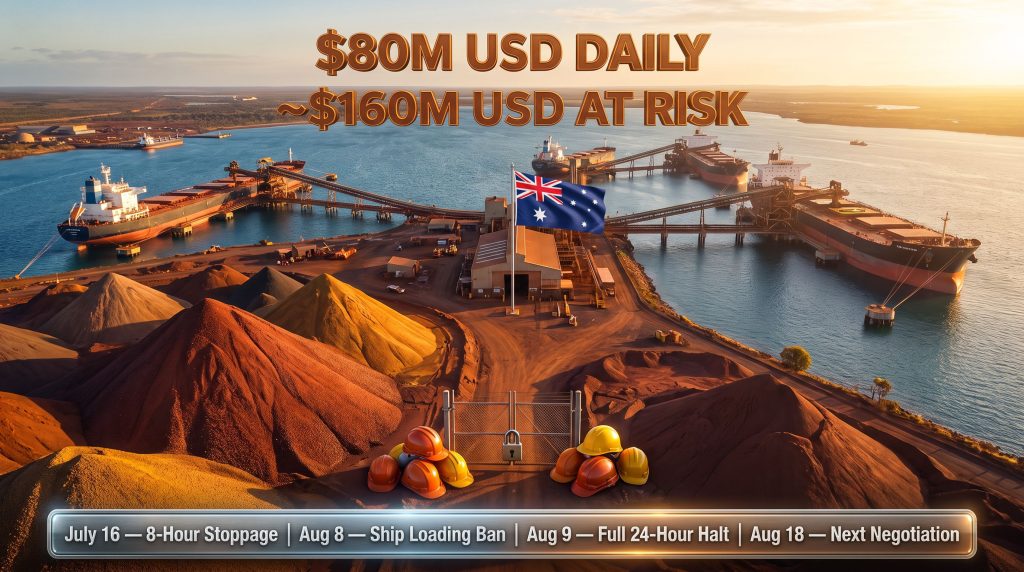
| July 16, 2025 | Initial eight-hour strike | First Pilbara iron ore strike in over 25 years |
| August 4, 2025 | Negotiations resume | Talks described as productive but unresolved |
| August 8, 2025 | 24-hour ship loading ban | Vessels barred from loading at Port Hedland |
| August 9, 2025 | Full 24-hour work stoppage | Halt at Port Hedland Bulk Export Terminal from 05:30 AWST |
| August 18, 2025 | Next scheduled negotiation | BHP to present updated enterprise agreement proposal |
The July stoppage carried symbolic weight that went beyond its eight-hour duration. It represented the first significant industrial action in the Pilbara iron ore sector in more than a quarter century, signalling that the workforce was prepared to escalate. Participation numbers became themselves a point of contention, with union figures citing over 100 workers and BHP-linked figures reporting 63. According to reporting from the ABC, BHP maintained that vessel loading continued during the July action, but the partial nature of that stoppage did not address the structural demands driving the dispute.
The August action is qualitatively different. A 24-hour ship loading ban followed by a full terminal stoppage represents a coordinated two-phase escalation designed to maximise economic pressure while maintaining legal protection under the Fair Work framework.
Port Hedland: The Single Point That Moves Global Steel Markets
Scale That Makes Disruption Systemically Significant
Port Hedland is not simply Australia's largest port. It is the world's highest-volume bulk commodity export terminal, and its operational continuity underpins a supply chain that feeds Chinese blast furnaces responsible for producing more than half of the world's steel output. Understanding the broader China steel and iron ore market dynamics helps contextualise why disruption here reverberates so widely.
The numbers define the stakes:
- Port Hedland handles 75% of total iron ore exports from the Pilbara region, covering the year to June 2025.
- BHP ships approximately $80 million USD worth of iron ore daily through the facility.
- A two-day stoppage therefore places roughly $160 million USD in gross revenue at risk before any operational continuity measures are applied.
- The August action is projected to delay approximately 16 iron ore shipments over the two-day window.
- Western Australian state government royalty revenues are calculated on iron ore export volumes, creating a direct fiscal link between port throughput and public finances.
Who Else Operates at Port Hedland?
The port infrastructure is shared among multiple miners. Fortescue and Hancock Prospecting both export iron ore through Port Hedland's facilities. However, the August 2025 industrial action is specific to BHP's operations and workforce. Neither Fortescue nor Hancock Prospecting operations are expected to be affected by the current dispute, which limits the scope of immediate supply disruption but also concentrates the reputational and financial pressure squarely on BHP.
This shared-infrastructure dynamic is worth understanding. During a targeted stoppage at one operator's facilities within a common-user port, other tenants may continue loading normally, meaning the port as a whole does not cease functioning. However, BHP's throughput volumes are large enough that its absence from operations creates a measurable reduction in total port output.
Quantifying the Financial and Operational Exposure
Revenue at Risk and State Fiscal Implications
BHP holds the position of the world's third-largest iron ore producer, behind Vale and Rio Tinto. Iron ore royalties, largely derived from Pilbara exports, constitute a material component of the Western Australian state budget. Every tonne delayed at Port Hedland represents both lost revenue for BHP and deferred royalty income for the state government.
One industry estimate has placed the single-day revenue exposure for BHP at Port Hedland at between tens of millions and approximately A$120 million, accounting for daily throughput rates and prevailing iron ore prices. Across a 48-hour action:
- ~16 vessel loadings expected to be postponed.
- Gross revenue exposure approaching $160 million USD at reported daily throughput rates.
- Downstream royalty receipts to the Western Australian government proportionally reduced.
- Around 150 of the 450 covered workers are expected to participate in the August action.
BHP's Contingency Positioning
BHP has publicly stated it has contingency arrangements in place to maintain some level of operations during the stoppage. In practice, the effectiveness of such plans at a bulk export terminal is constrained by the nature of the operation itself. Ship loading requires specialised equipment operators, and a legally notified ban on vessel loading cannot be circumvented through managerial substitution. The July action demonstrated that partial continuity is possible, but the August escalation to a full 24-hour terminal halt creates a harder operational boundary.
Notably, reporting from Argus Media has highlighted how the earlier strike failed to fully halt iron ore exports — however, the August escalation represents a significantly more structured and coordinated disruption.
Three Scenarios for Resolution or Escalation
Scenario 1: Negotiated Resolution Before or at August 18
For this outcome, BHP's updated proposal would need to address the core structural demands around enforceable wage protections and classification frameworks, not just offer headline pay increases. Pressure drivers include the Fair Work Commission's active involvement, the reputational cost of visible industrial conflict, and the convergence of the negotiation deadline with BHP's annual results announcement on the same date.
Market impact: Short-term iron ore price movement reverses quickly. Supply disruption is contained and does not translate into structural price support.
Scenario 2: Partial Agreement with Continued Rolling Action
BHP offers meaningful wage concessions but defers resolution of classification and career pathway demands to a later stage. Unions secure enough to justify partial wins to their members but maintain leverage for ongoing action. This scenario produces periodic supply uncertainty and moderate upward pressure on iron ore spot pricing, which in turn affects iron ore price trends globally.
Scenario 3: Prolonged Dispute with Escalating Stoppages
August 18 talks collapse or fail to produce an acceptable proposal. Unions escalate to indefinite work bans or rotating stoppages across multiple shifts. This scenario introduces sustained supply disruption at a scale that Chinese steel mills cannot fully absorb through inventory drawdowns alone. Furthermore, compounding iron ore surplus concerns could amplify the downward pressure on prices if demand signals from China simultaneously weaken.
Market impact: Iron ore futures experience meaningful volatility. Chinese mills face elevated input cost pressure. BHP's dividend capacity, which relies heavily on iron ore cash generation, becomes a subject of investor scrutiny.
The August 18 date carries compounded significance. BHP presenting its annual financial results on the same day it is scheduled to table a new enterprise agreement proposal means that analysts, investors, and union representatives will be scrutinising the same set of numbers through very different lenses simultaneously.
The next major ASX story will hit our subscribers first
Iron Ore Price Sensitivity and Supply Shock Mechanics
How Markets Absorb Short-Duration Disruptions
Iron ore pricing in the seaborne market is driven by the interplay between Pilbara export volumes, Chinese port inventory levels, and steel mill production schedules. Chinese buyers typically maintain port-side stockpiles as a buffer against exactly this type of short-duration supply disruption. A two-day stoppage, while commercially significant for BHP, is unlikely on its own to trigger sustained price dislocation in the spot market.
The historical pattern from shorter Pilbara disruptions suggests an initial price bump driven by sentiment rather than physical scarcity, followed by normalisation once export loading resumes. The variable that changes this calculus is duration. If the dispute extends beyond the August 18 negotiation and rolling stoppages continue through September, Chinese inventory buffers that typically cover 30 to 40 days of consumption begin to look less comfortable.
BHP's Systemic Importance to Iron Ore Markets
As Australia's largest listed company and the world's third-largest iron ore producer, BHP's operational status carries index-level significance for both commodity benchmarks and equity markets. Iron ore revenue is the primary driver of BHP's free cash flow generation, its capacity to sustain shareholder returns, and its ability to fund capital expenditure at its suite of Pilbara assets. The broader global iron ore market impact of concurrent geopolitical pressures adds yet another layer of uncertainty for investors monitoring this situation.
Prolonged industrial action at Port Hedland, consequently, does not sit in isolation as a labour relations issue. It intersects with BHP's dividend policy, its capital return program, and the earnings expectations that institutional investors have priced into one of the world's most widely held mining stocks.
What This Dispute Signals for Australian Mining Labour Relations
The BHP Port Hedland strike is unlikely to be the last major enterprise agreement dispute in the Pilbara. Several structural forces are converging to make industrial relations in remote Australian mining more contested, and the iron ore tariff pressures weighing on the sector are compounding the sense of urgency on all sides:
- The real wage erosion caused by persistent inflation is making static or incremental pay rises feel like reductions in purchasing power.
- A tighter post-pandemic labour market for skilled trades has given workers confidence that walking off the job carries less personal financial risk than it once did.
- The growing emphasis on enforceable protections rather than informal arrangements reflects a generational shift in how workers approach employment security, particularly in physically demanding remote settings.
- Enterprise agreements in the resources sector are increasingly viewed as institutional frameworks rather than simple pay schedules, encompassing classification, safety, and career architecture.
The outcome of the August 2025 negotiations will be observed closely by unions and employers across the Pilbara. Whatever terms BHP ultimately agrees to, or refuses, will establish a reference point for the next wave of enterprise agreement negotiations across the broader Western Australian resources sector.
Frequently Asked Questions: BHP Port Hedland Strike 2025
How many workers are participating in the August strike action?
Approximately 150 workers are expected to take part in the August 8 to 9 action. They are drawn from a broader pool of around 450 operators and maintenance workers whose employment conditions are covered by the enterprise agreement currently under negotiation.
How long have BHP and the unions been negotiating?
Negotiations have been ongoing for more than seven months as of August 2025, covering pay rates, working conditions, classification structures, and enforceable wage protections for Pilbara port workers.
Will Fortescue or Hancock Prospecting be affected?
No. The industrial action is targeted specifically at BHP's Port Hedland operations. Both Fortescue and Hancock Prospecting, which also use Port Hedland infrastructure, are not expected to experience disruption as a result of the current dispute.
What is BHP's daily revenue exposure at Port Hedland?
BHP ships approximately $80 million USD worth of iron ore daily through Port Hedland. A full 48-hour stoppage represents a potential gross revenue exposure of approximately $160 million USD, subject to the effectiveness of any operational continuity measures.
What role does the Fair Work Commission play?
The Fair Work Commission is actively facilitating negotiations between BHP and the Combined Ports Unions. However, under Australia's enterprise bargaining framework, the Commission cannot compel either party to accept specific terms. Its authority extends to mediation and procedural oversight, not binding determination.
When is the next scheduled negotiation meeting?
The next formal negotiation session is set for August 18, 2025, at which BHP has committed to presenting an updated enterprise agreement proposal. This date coincides with BHP's scheduled annual results announcement.
Disclaimer: This article is intended for informational purposes only and does not constitute financial or investment advice. Forward-looking statements, scenario projections, and financial estimates contained herein involve inherent uncertainty and should not be relied upon as predictions of actual outcomes. Readers should conduct their own research and consult qualified financial advisers before making investment decisions.
Want to Stay Ahead of ASX Mineral Discoveries Linked to Major Commodity Moves?
When supply disruptions at critical export hubs like Port Hedland send commodity markets into flux, the flow-on effects can surface significant opportunities across ASX-listed resource stocks — and Discovery Alert's proprietary Discovery IQ model ensures subscribers receive real-time alerts the moment a significant mineral discovery hits the ASX, transforming complex data across more than 30 commodities into clear, actionable insights. Explore how historic discoveries have delivered extraordinary returns on Discovery Alert's dedicated discoveries page, and begin your 14-day free trial today to position yourself ahead of the broader market.