
June 19, 2026
When One Port Holds the World's Steel Supply Hostage
Every tonne of steel poured into Asia's skyscrapers, bridges, and manufacturing plants begins its journey somewhere. For a staggering share of that output, that journey begins at a single loading facility on Australia's northwest coast. Understanding how deeply global steel production depends on one geographic chokepoint is the essential starting point for grasping why the BHP Port Hedland strike threat has reverberated far beyond a routine enterprise bargaining dispute.
Port Hedland is not merely an important port. It is the world's single largest bulk iron ore export terminal, and its operational continuity underpins steel production schedules across China, Japan, South Korea, and beyond. When labour tension builds at this facility, the consequences are felt in blast furnace procurement rooms thousands of kilometres away.
When big ASX news breaks, our subscribers know first
Why Port Hedland Is Structurally Irreplaceable in Global Iron Ore Trade
The Numbers Behind the Chokepoint
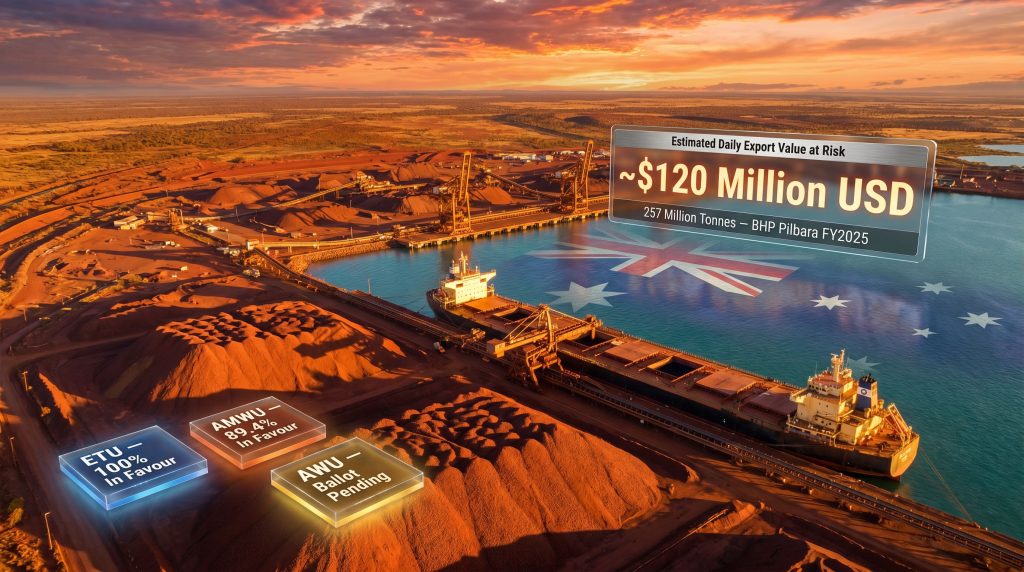
BHP's Pilbara operations produced approximately 257 million tonnes of iron ore in the fiscal year ending 30 June 2025, a volume that makes the company one of the most consequential single suppliers in the seaborne iron ore market. The daily export value flowing through Port Hedland is estimated at roughly $120 million USD, a figure that illustrates just how much economic activity is compressed into a single operational node.
What makes Port Hedland uniquely vulnerable is the combination of volume concentration and geographic isolation. Unlike ports serving multiple commodities or multiple producers, Port Hedland's throughput is dominated by a small number of high-volume iron ore exporters operating in a remote region where logistics alternatives are severely constrained. There is no nearby substitute port capable of absorbing meaningful overflow volume on short notice.
For Western Australia's state government, the financial exposure is direct and quantifiable. A complete shutdown of BHP's port operations would cost the state an estimated A$6.85 million (approximately $4.82 million USD) per day in lost iron ore royalties alone, according to figures provided by BHP. At that rate, a two-week disruption would erase more than A$95 million in state royalty revenue, a figure significant enough to register in budget planning cycles.
Furthermore, Australia's iron ore dominance in global trade means disruptions at Port Hedland carry consequences well beyond domestic markets, influencing pricing benchmarks and procurement strategies worldwide.
The Pilbara's Iron Ore Grades and Why Buyers Cannot Easily Substitute
A less commonly understood dimension of this dispute involves the specific ore chemistry that Pilbara producers supply to Asian steel mills. BHP's Pilbara blends, including the widely traded Newman, Jimblebar, and Yandi products, are characterised by their relatively consistent iron content typically ranging between 57% and 62% Fe, combined with manageable alumina and phosphorus levels that suit the blast furnace operating parameters of most Asian integrated steelmakers.
Substituting Pilbara ore on short notice is not a simple logistics exercise. Brazilian ore from Vale's Carajas system carries higher iron grades (often above 65% Fe) but requires blast furnace operators to recalibrate burden compositions and potentially adjust coke rates. South African and Indian alternative sources carry their own grade variability and shipping time penalties for Pacific Basin buyers. The result is that even a temporary Pilbara supply disruption forces procurement teams into decisions that carry real operational risk, not just price risk.
Consequently, China iron ore demand patterns amplify the sensitivity of any Port Hedland disruption, given that Chinese steel mills represent the dominant buyer of Pilbara ore and have limited short-term flexibility in adjusting their feedstock mix.
This grade-matching complexity is frequently underappreciated in financial coverage of iron ore supply disruptions. The true cost of substitution extends well beyond the spot price differential and includes blast furnace efficiency losses, quality rejects, and logistics costs that take weeks to fully surface in mill operating data.
The BHP Port Hedland Strike: What Is Actually Happening
Three Unions, One Port, Escalating Pressure
The BHP Port Hedland strike action involves three separate unions representing a combined pool of approximately 250 of BHP's roughly 450 port employees (excluding contractors). Each union has either completed or is pursuing an authorisation ballot through the Fair Work Commission, Australia's independent workplace tribunal.
| Union | Approximate Members | Ballot Date | Result |
|---|---|---|---|
| Electrical Trades Union (ETU) | ~100 workers | 11 June 2026 | 100% in favour |
| Australian Manufacturing Workers' Union (AMWU) | ~100+ workers | 11 June 2026 | 89.4% in favour |
| Australian Workers Union (AWU) | 100+ workers | Pending (weeks) | Not yet held |
The ETU's unanimous vote is particularly striking from a labour relations perspective. A 100% ballot result in any workplace vote is statistically unusual and signals a level of collective grievance that goes beyond typical wage negotiation positioning. The AMWU's 89.4% majority reinforces the same conclusion: this vote confirms this is not a dispute manufactured by union leadership in the absence of genuine member support.
The Legal Mechanics of Protected Industrial Action in Australia
Under Australian industrial law, the pathway from ballot authorisation to actual strike action involves several procedural steps that market participants should understand when assessing timing risk.
- Ballot authorisation must be obtained from the Fair Work Commission before any protected action can legally proceed.
- A mandatory five-business-day notice must be provided to the employer before any work stoppage commences.
- Rolling stoppages are legally permissible, ranging from 30-minute partial disruptions to full 24-hour shutdowns, allowing unions to apply sustained operational pressure without committing to a single extended closure.
- FWC conciliation can be requested by either party at any stage, potentially pausing or redirecting the dispute.
For the ETU and AMWU, whose members voted on 11 June, the earliest legally permissible strike commencement was estimated around 22–23 June, subject to the five-day notice requirement. The AWU's ballot application, lodged on 18 June, adds a further tranche of over 100 workers to the potential strike pool within weeks.
What Workers Are Demanding and Why Negotiations Have Broken Down
Enterprise Agreements and the FIFO Cost-of-Living Premium
BHP has been in enterprise agreement negotiations with its Port Hedland workforce since October 2025, a process now exceeding seven months without a concluded outcome. Enterprise agreements in Australia are legally binding workplace instruments that set wages, conditions, and allowances for a defined period, typically covering multi-year terms.
The central grievances articulated by union representatives centre on wage equity and the failure of remuneration to keep pace with cost-of-living pressures. This is not a generic claim. Workers at Port Hedland predominantly operate under fly-in, fly-out (FIFO) rosters, a labour model that carries genuine financial burdens not reflected in base wage comparisons with metropolitan workers.
FIFO workers in the Pilbara typically absorb costs including:
- Higher personal insurance and income protection premiums given remote work risk profiles
- Greater reliance on paid childcare and family support services during roster absences
- Reduced access to employer-provided housing subsidies compared to earlier resource boom periods
- Lifestyle costs associated with the psychological demands of extended remote rosters
When unions describe existing pay arrangements as producing significant income inequality among workers performing comparable roles, they are pointing to a structural feature of individual contract arrangements that has allowed remuneration divergence to accumulate over time. Enterprise agreements exist precisely to resolve this kind of disparity by establishing consistent classifications and pay scales.
A Breakdown of Bargaining Trust
Unions representing ETU and AMWU members publicly characterised BHP's conduct at the bargaining table as non-collaborative, with representatives indicating they had effectively lost confidence that a negotiating partner was genuinely present. This framing matters because it signals that the dispute has moved beyond a disagreement over numbers into a breakdown of procedural trust, which is structurally harder to resolve quickly.
The parallel nature of negotiations at three separate BHP Pilbara sites simultaneously — Port Hedland port, Mining Area C, and South Flank — suggests a broader enterprise-wide labour relations challenge rather than a site-specific anomaly.
| BHP Pilbara Operation | Enterprise Agreement Status |
|---|---|
| Port Hedland Port | Under negotiation since October 2025 |
| Mining Area C | Under negotiation |
| South Flank | Under negotiation |
Economic Impact Analysis: Modelling the Cost of Disruption
Daily Financial Exposure at Scale
| Metric | Estimated Daily Impact |
|---|---|
| Iron ore export revenue at risk | ~$120 million USD |
| WA state royalty losses | |
| BHP annual iron ore production base (FY2025) | 257 million tonnes |
Short vs. Extended Disruption Scenarios
Scenario A: Brief Rolling Stoppages (1–5 days)
This scenario represents the highest probability opening move if unions proceed. BHP maintains iron ore stockpiles at port that provide a buffer against short-duration operational interruptions. The primary impact would be reputational and tactical, functioning as a signal to management rather than a material volume reduction.
- Shipped volume impact: minimal given stockpile buffers
- Iron ore spot price movement: marginal, likely less than 1–2%
- Investor response: monitoring mode, not panic
Scenario B: Extended Shutdown (2–4 weeks)
An extended disruption would move beyond stockpile coverage and begin directly affecting BHP's quarterly shipment volumes. This scenario carries material consequences across multiple dimensions:
- Measurable reduction in BHP's quarterly iron ore shipment guidance
- Significant WA government royalty shortfall accumulating daily
- Upward pressure on seaborne iron ore spot prices as buyers accelerate alternative procurement
- Tightening of Capesize vessel availability in the Pacific Basin, introducing freight rate volatility
- Heightened investor scrutiny of BHP's operational risk management and its implications for dividend sustainability
In addition, the China steel and iron ore market would experience pronounced tightening under an extended shutdown scenario, given China's structural reliance on high-volume Pilbara supply to sustain blast furnace utilisation rates.
The Capesize freight market is particularly sensitive to Pilbara supply signals. These vessels, which typically carry 150,000–180,000 tonnes of iron ore per voyage, operate on thin utilisation margins. Any sustained reduction in loading schedules at Port Hedland reduces Pacific Basin Capesize demand abruptly, creating freight rate volatility that cascades through shipping cost structures for all iron ore buyers, not just those purchasing BHP product.
How BHP Has Responded and What It Signals
BHP's public response has emphasised its commitment to constructive bargaining and its priority of maintaining safe port operations. The company has confirmed contingency plans exist to partially mitigate disruption, though operational specifics have not been disclosed.
Reading between the lines of BHP's positioning, several dynamics are worth noting for market participants:
- The company's emphasis on maintaining industry-leading remuneration standards suggests it is sensitive to the reputational dimension of this dispute, not just the financial one.
- Simultaneous negotiations at three Pilbara sites limit BHP's flexibility to offer generous Port Hedland terms without creating precedent pressure at Mining Area C and South Flank.
- Contingency plans in the context of a port operation are inherently limited. Unlike mine sites where processing rates can sometimes be adjusted, port throughput depends on the availability of specialised maritime and mechanical trades that are not easily substituted by non-union labour or contract workers at short notice.
However, the global iron ore market impact of a prolonged BHP Port Hedland strike would compound pressures already present from broader trade and geopolitical dynamics, further complicating the risk calculus for buyers and producers alike.
The next major ASX story will hit our subscribers first
Government Positioning and the Fair Work Commission's Role
Federal Resources Minister Madeleine King acknowledged workers' legal entitlement to pursue industrial action while expressing a preference for a negotiated resolution through existing bargaining frameworks. WA Premier Roger Cook adopted a comparable position, recognising union rights while expressing hope that both parties would reach an agreement before operational disruptions materialised.
Neither position constitutes government intervention or support for either party. Both statements reflect the standard posture of Australian governments toward protected industrial action: acknowledge the legal framework, encourage resolution, and avoid direct interference in enterprise bargaining.
The Fair Work Commission's role becomes increasingly central as the dispute progresses. Its functions in this context include:
- Overseeing and validating ballot authorisation processes for each union
- Receiving and processing the five-day strike notices when submitted
- Facilitating conciliation between BHP and unions if either party requests intervention
- Potentially suspending or terminating protected action if the FWC determines the action threatens significant damage to the Australian economy or a part of it
That final power, rarely exercised but legally available, represents the outer boundary of regulatory intervention in this dispute.
Historical Context: Why This Dispute Is Structurally Significant
Industrial action of this scale at Port Hedland is historically uncommon. The convergence of three unions simultaneously pursuing strike authorisation at the world's largest bulk iron ore export port has few direct precedents in the modern era of Australian enterprise bargaining.
Several structural factors have contributed to the current environment:
- Tight Pilbara labour markets have incrementally shifted bargaining power toward workers with specialised trades qualifications, particularly electricians and mechanical tradespeople who are portable across multiple resource sector employers.
- Cost-of-living inflation since 2022 has materially eroded real wage growth for workers on fixed-term enterprise agreements, creating accumulated dissatisfaction that is now surfacing in bargaining rounds.
- Increased union coordination across multiple worker classifications at a single site is a more sophisticated organising approach than single-union disputes, making it harder for employers to manage the action through targeted concessions.
The outcome of this dispute will be closely observed by unions operating across competing iron ore producers, coal operations, and base metals mining companies. A successful wage outcome for Port Hedland workers would establish a new reference point for enterprise agreement negotiations across the broader resources sector. Furthermore, WA iron logistics update developments across the region suggest infrastructure and labour pressures are converging simultaneously, adding further complexity to Western Australia's resource export outlook.
Senior Labor figures have also publicly backed the striking workers, a political dimension that adds further weight to union bargaining positions and raises the reputational stakes for BHP should the dispute remain unresolved.
What Investors and Market Participants Should Monitor
For those tracking BHP directly or monitoring iron ore market dynamics, the following indicators carry the most actionable signal value:
- AWU ballot approval timing from the FWC, which will determine the full scope of worker participation in any strike and significantly increase operational pressure on BHP
- Five-day strike notices lodged with BHP by ETU and AMWU members, which provide the clearest short-term timing signal for any operational disruption
- BHP's quarterly iron ore shipment guidance for any downward revision linked to Port Hedland throughput reductions
- Seaborne iron ore spot price benchmarks for any supply-risk premium emerging as buyers begin contingency procurement from Brazilian or South African alternative sources
- Capesize spot freight rates in the Pacific Basin as a real-time proxy for Port Hedland loading activity
- Enterprise agreement outcomes at Mining Area C and South Flank, which will indicate whether BHP is managing the Pilbara labour situation as three separate negotiations or moving toward a coordinated resolution
Disclaimer: This article is intended for informational purposes only and does not constitute financial advice. All economic impact figures, scenario projections, and timeline estimates involve inherent uncertainty and should not be relied upon as predictions of actual outcomes. Readers should conduct their own due diligence before making any investment or commercial decisions related to the matters discussed.
Want to Stay Ahead of ASX Opportunities Emerging From Iron Ore Market Disruptions?
Discovery Alert's proprietary Discovery IQ model delivers real-time alerts on significant ASX mineral discoveries, instantly transforming complex resource sector data into actionable investment insights — explore historic discovery returns to understand the potential magnitude of major finds. Begin your 14-day free trial at Discovery Alert and position yourself ahead of the market before the next major opportunity surfaces.