June 19, 2026
The Quiet Obsolescence of the Fuel-Dependent Refiner
There is a structural problem building inside every major refining economy that processes crude oil primarily into transport fuels. As electric vehicle adoption accelerates, as efficiency standards tighten across commercial fleets, and as energy transition trends capital flows toward alternatives at record pace, the long-term demand trajectory for petrol and diesel is no longer a simple upward curve. For refiners still deriving the majority of their revenues from fuel margins, this is not a distant theoretical risk. It is already compressing earnings in markets where the transition is furthest advanced.
The more instructive question for investors and industry analysts is not whether refining margins will face structural pressure, but rather which companies are already engineering their escape from fuel dependency. The answer, increasingly, points to the Reliance crude to carbon fibre and green chemicals strategy as one of the most ambitious industrial pivots currently underway in the Asia-Pacific region.
When big ASX news breaks, our subscribers know first
Rethinking What a Refinery Actually Produces
From Fuel Output to Feedstock Conversion
The conventional mental model of a refinery is a facility that takes crude oil in one end and produces petrol, diesel, jet fuel, and fuel oil out the other. This model is not wrong, but it is increasingly incomplete. The more sophisticated framing treats a refinery as a molecular conversion platform capable of directing hydrocarbon feedstocks toward an enormous range of derivative products, of which transport fuels are merely the lowest-complexity output.
Reliance Industries has operated with this more expansive understanding for decades at its Jamnagar complex in Gujarat, one of the world's largest and most integrated single-site refining facilities. What is changing now is the deliberate acceleration of that conversion logic: a formal commitment, articulated at the company's 49th annual general meeting, to move all crude oil processed toward advanced materials, specialty chemicals, and green chemical products rather than defaulting to fuel production wherever margin incentives allow.
Mukesh Ambani, Reliance's chairman, stated at the June 2026 AGM that the company intends to utilise every barrel of crude it processes to manufacture products with higher margins, converting its oil-to-chemicals pipeline into a platform for carbon fibre, specialty materials, and green chemicals. This was not framed as a marginal adjustment. It was presented as a fundamental reinvention of what the O2C business is for.
The Jamnagar Baseline: Competitive Moat Through Scale
Understanding the scale of what Reliance is working with is essential context. Jamnagar is not a mid-tier refinery with modest ambitions. It processes crude oil on a scale that gives the company feedstock cost advantages that no greenfield competitor could replicate within a realistic investment timeline.
| Metric | Detail |
|---|---|
| Domestic Refinery Output | Approximately 33 million tonnes per annum |
| SEZ Refinery Focus | Export markets and premium international customers |
| Refinery Classification | Among the world's largest single-site refining complexes |
| O2C Transformation Direction | Full crude conversion toward advanced materials and chemicals |
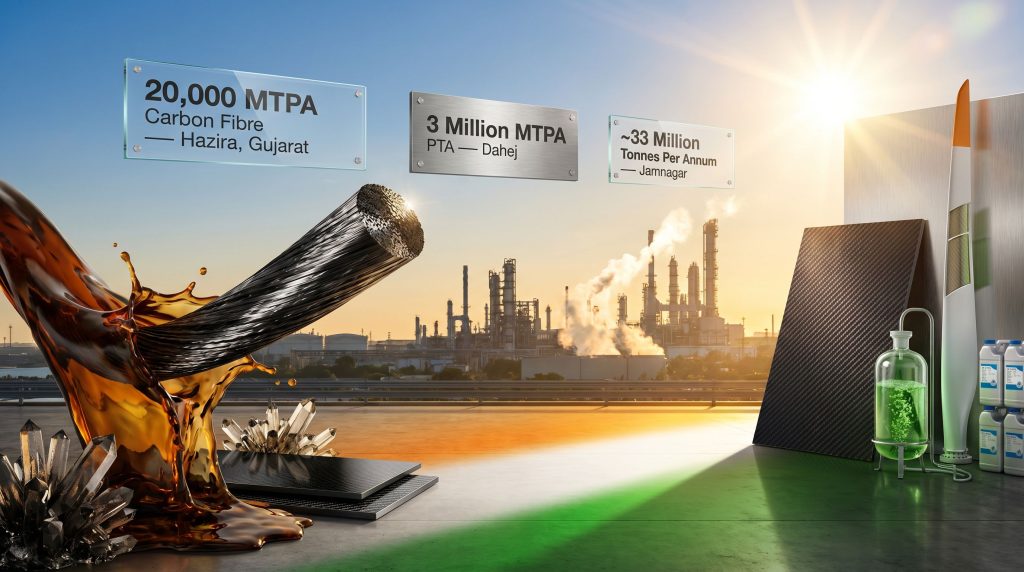
| Carbon Fibre Plant (Hazira) | 20,000 MTPA targeted Phase 1 capacity |
| PTA Plant (Dahej) | 3 million MTPA planned capacity |
| PET Plant (Dahej) | 1 million MTPA planned capacity |
Approximately half of Jamnagar's output, around 33 million tonnes per annum, currently serves India's domestic fuel requirements. The balance flows through the complex's Special Economic Zone refinery, which serves export markets and higher-value international customers. Both streams now sit within the scope of the O2C reinvention.
The Carbon Fibre Ambition: A Materials Science Bet on the Future
Why Carbon Fibre Is the Flagship of the O2C Transformation
Of all the products targeted under Reliance's O2C overhaul, carbon fibre carries the most symbolic and commercial weight. It represents the sharpest possible departure from commodity fuel production: a material that commands per-tonne pricing orders of magnitude above diesel or petrol, serves structurally growing end markets, and requires sophisticated manufacturing capability that creates genuine competitive barriers.
Reliance is constructing a 20,000 MTPA carbon fibre manufacturing facility at Hazira, Gujarat, with Phase 1 targeted for 2025. The applications for this material span multiple high-growth sectors:
- Aerospace and defence: Carbon fibre composites are critical to next-generation aircraft structures, reducing weight while maintaining structural integrity
- Electric vehicle lightweighting: As EV manufacturers compete on range per charge, reducing vehicle mass through carbon fibre body components becomes a primary engineering priority
- Wind turbine blades: Larger, more efficient turbine blades increasingly rely on carbon fibre to maintain structural rigidity while minimising blade weight
- Civil infrastructure: Carbon fibre reinforced polymers are replacing steel reinforcement in bridges, building facades, and marine structures
The strategic logic extends beyond raw fibre output. Reliance's roadmap includes downstream integration into carbon fibre composite manufacturing, which is where the true margin premium is captured. Raw carbon fibre is already high-value; processed composites shaped for specific structural applications command even higher pricing with longer customer relationships and less commoditised pricing dynamics.
What Most Analysis Misses About Carbon Fibre Economics
A less commonly understood dimension of the carbon fibre market is the degree to which it remains supply-constrained rather than demand-constrained. Unlike conventional petrochemical products where oversupply cycles regularly compress margins, the global carbon fibre industry has historically struggled to expand capacity fast enough to meet demand growth from aerospace and renewable energy sectors. This supply-side tightness creates a structural pricing floor that does not exist in commodity petrochemical markets.
For a company with Reliance's feedstock integration depth and manufacturing scale, entering the carbon fibre market at 20,000 MTPA represents a meaningful supply addition to a market where scale players have historically been few and geographically concentrated in Japan, the United States, and Germany.
India currently imports the vast majority of its carbon fibre requirements. Reliance's Hazira plant, if it achieves its stated capacity targets, would represent a significant import-substitution asset for Indian aerospace, defence, wind energy, and automotive manufacturers. The downstream composites manufacturing capability Reliance intends to build alongside the fibre plant could catalyse an entirely new advanced manufacturing ecosystem that currently does not exist at industrial scale within India.
Green Chemicals: The Decarbonisation Layer of the O2C Strategy
Green Hydrogen and Green Ammonia as Industrial Anchors
The green chemicals component of Reliance's O2C transformation operates on a different timeline and technology basis than the carbon fibre programme, but is no less strategically significant. The core outputs targeted are green hydrogen and green ammonia, both produced using renewable energy solutions rather than fossil fuel combustion.
Green hydrogen is generated through electrolysis, splitting water molecules into hydrogen and oxygen using electricity sourced from solar or wind generation. Its industrial applications are broad:
- Green steel production: Replacing coking coal in the steelmaking process with hydrogen-based iron reduction technologies
- Industrial decarbonisation: Providing high-temperature process heat without fossil fuel combustion
- Fuel cell applications: Power generation and transportation applications where battery solutions are weight-prohibitive
- Fertiliser feedstock: Replacing natural gas-derived hydrogen in ammonia synthesis
Green ammonia, synthesised from green hydrogen and nitrogen, serves as a critical input for sustainable fertiliser production and is emerging as a potential zero-carbon shipping fuel, a market with substantial long-term demand given the shipping industry's 2050 decarbonisation commitments.
Green Polyolefins and the Circular Plastics Economy
Beyond hydrogen and ammonia, Reliance's green chemicals programme includes development of green polyolefins: plastics produced through lower-carbon or bio-based feedstock pathways. This is coupled with a commitment to scaling recycling infrastructure that converts post-consumer plastic waste back into chemical building blocks.
The circular economy dimension here is financially interesting. Furthermore, recycled feedstock, when processed at sufficient scale, can provide a cost-competitive alternative to virgin petrochemical inputs while simultaneously generating revenue from waste collection and processing. For a company of Reliance's domestic market scale and retail reach in India, feedstock recovery from consumer waste streams is a realistic industrial proposition rather than a peripheral sustainability gesture. This approach also aligns closely with the broader battery recycling outlook emerging across Asia's advanced manufacturing sector.
Polyester Chain Expansion: The Near-Term Capital Deployment Anchor
Dahej: Scaling the Downstream Value Chain
While carbon fibre and green chemicals represent the longer-term transformation thesis, Reliance's polyester chain expansion at Dahej, Gujarat, represents the near-term capital deployment that is already underway and closer to commercialisation:
| Plant | Location | Capacity | Primary Applications |
|---|---|---|---|
| PTA Plant | Dahej, Gujarat | 3 million MTPA | Polyester fibre and film feedstock |
| PET Plant | Dahej, Gujarat | 1 million MTPA | Packaging, textiles, industrial uses |
| Carbon Fibre Plant | Hazira, Gujarat | 20,000 MTPA | Mobility, infrastructure, renewables |
Purified Terephthalic Acid (PTA) is a critical intermediate chemical in polyester production. A 3 million MTPA PTA plant is a large-scale investment by any global standard, reflecting Reliance's intent to capture the full margin from crude-derived feedstocks through to finished polyester products rather than exporting intermediates for others to process.
Polyethylene Terephthalate (PET) at 1 million MTPA targets the packaging and textile sectors, both of which are experiencing strong domestic demand growth in India driven by consumer market expansion, food processing industry development, and apparel export growth.
Geopolitical Resilience as a Business Design Principle
The West Asia Disruption as a Stress Test
The strategic context behind Reliance's O2C transformation is not solely about margin optimisation. It is also about building a business architecture that is less brittle under geopolitical stress. The West Asia conflict period provided a live stress test of traditional refining operations, with disruptions in the Strait of Hormuz generating elevated freight rates and insurance costs that compressed margins across the region.
Anant Ambani, Reliance's Executive Director, noted at the same AGM that the company navigated the disruption by diversifying crude sourcing routes and maintaining near-full refinery throughput. Reliance also quadrupled LPG supplies to domestic markets and redirected domestic natural gas to priority sectors including city gas distribution, fertilisers, and power generation when LNG import availability was constrained.
This operational agility reflects Jamnagar's multi-grade crude processing capability: the ability to substitute different crude types when specific supply routes become cost-prohibitive is a genuine competitive advantage that single-grade refineries cannot replicate. It is also a preview of the systemic importance Reliance's energy infrastructure carries for India's broader economy.
India's dependence on external sources for more than 70% of its total energy requirements makes geopolitical supply disruptions a national economic risk, not merely a corporate financial risk. Reliance's capacity to manage crude sourcing flexibility and redirect energy flows to priority sectors during disruption periods positions it as infrastructure of national significance.
From Price-Taker to Pricing Power: The Structural Upgrade
The most important long-term consequence of the Reliance crude to carbon fibre and green chemicals strategy is the shift in market positioning it enables. Commodity fuel producers and bulk petrochemical manufacturers are fundamentally price-takers in global markets: their revenues fluctuate with crude cycles, refining margins, and global supply-demand dynamics that no single company can influence.
Advanced materials producers and specialty chemical manufacturers exercise meaningfully greater pricing power. Carbon fibre composites are specified into aerospace programmes that run for decades. Green hydrogen supply agreements are structured as long-term contracts tied to industrial decarbonisation commitments. Specialty polyesters command brand premiums in high-performance textile applications.
This transition mirrors the strategic evolution already achieved by global chemical majors including BASF, Dow, and Toray Industries, all of which have progressively shifted revenue mix toward higher-value specialty portfolios over the past two to three decades. The difference for Reliance is that it is attempting this transition from a base of extraordinary feedstock integration at Jamnagar, providing a structural cost advantage that its global peers did not necessarily possess at comparable stages of their transformation journeys.
The next major ASX story will hit our subscribers first
How Reliance Compares to Global O2C Transformation Leaders
| Company | Core O2C Focus | Key Advanced Materials | Green Chemicals Programme |
|---|---|---|---|
| Reliance Industries | Carbon fibre, specialty materials, green polyolefins | Carbon fibre composites, PTA, PET | Green hydrogen, green ammonia |
| Saudi Aramco | Crude-to-chemicals at Yanbu and Jubail | Petrochemical derivatives | Blue hydrogen, carbon capture |
| BASF | Specialty chemicals and engineered materials | Engineering plastics, catalysts | Green hydrogen, bio-based chemicals |
| Toray Industries | Carbon fibre and advanced composites | Aerospace and automotive carbon fibre | Recyclable composite programmes |
| ExxonMobil | Chemical integration alongside refining | Performance polymers | Blue hydrogen, carbon capture |
What differentiates Reliance's approach within this peer group is the vertical integration depth being pursued under a single corporate structure: from crude processing through finished composites, green fuels, and circular plastics. International peers tend to execute these strategies across separate business units, joint ventures, or partially divested entities. Reliance's structure, if execution meets ambition, could allow margin capture across a wider range of value chain stages than most global comparators have achieved. Consequently, the implications for green steel pricing and related downstream markets may also be considerable as green hydrogen availability scales.
What Investors and Industry Observers Should Watch
Several execution milestones will determine whether this transformation delivers on its strategic ambition. In addition, each of these metrics offers a meaningful signal about whether the Reliance crude to carbon fibre and green chemicals pivot is advancing at pace:
- Hazira Phase 1 delivery: Whether the 20,000 MTPA carbon fibre plant achieves commercial production within its targeted timeline and at competitive quality standards for aerospace and EV applications
- Dahej ramp-up: The pace at which the PTA and PET plants reach nameplate capacity and achieve targeted integration with downstream polyester product markets
- Green hydrogen cost trajectory: Whether Reliance's O2C investment plans reduce green hydrogen production costs to levels competitive with fossil fuel-derived hydrogen
- Composite manufacturing development: The speed at which downstream carbon fibre composite capability is built, since this is where the highest margin capture occurs
- Recycling infrastructure scale: The commercialisation timeline for post-consumer plastic waste valorisation as a feedstock source
Disclaimer: This article is intended for informational purposes only and does not constitute financial advice. Forecasts, timelines, and strategic projections referenced herein involve inherent uncertainty. Readers should conduct independent research and seek qualified financial advice before making any investment decisions.
Want to Identify the Next Major Materials or Resources Discovery Before the Market Does?
Discovery Alert's proprietary Discovery IQ model delivers real-time alerts on significant ASX mineral discoveries — from critical minerals powering carbon fibre and green hydrogen supply chains to the commodities underpinning the global energy transition — instantly translating complex data into actionable investment insights. Explore how historic mineral discoveries have generated substantial returns and begin your 14-day free trial today to position yourself ahead of the broader market.