July 21, 2026
The Hidden Fragility in the World's Most Important Iron Ore Corridor
Every tonne of steel produced anywhere on Earth traces its origins to a relatively small number of export terminals. Of these, none carries more systemic weight than the port complex at Port Hedland in Western Australia's Pilbara region. When the logistics machinery underpinning this facility operates smoothly, global steel supply chains function with quiet efficiency. When it doesn't, the consequences ripple outward to blast furnaces in Hebei, shipyards in Ulsan, and construction sites across Southeast Asia. Understanding what is currently unfolding in the BHP Port Hedland union talks requires stepping back from the immediate wage dispute and recognising that what is at stake is far larger than a pay packet.
When big ASX news breaks, our subscribers know first
Port Hedland's Position in the Global Iron Ore Architecture
Port Hedland is not merely a large port. It is the single highest-volume iron ore export terminal on the planet, and it functions as the primary logistics gateway for BHP's vast Pilbara mining operations. On any given day, approximately $80 million worth of BHP's iron ore products move through the facility. Annualised, this figure represents a throughput value that few individual infrastructure assets anywhere in the world can match.
Australia as a whole supplies roughly 53% of global seaborne iron ore, with the Pilbara region accounting for the overwhelming majority of that volume. Australia's iron ore leadership stems from this concentration of supply through a single geographic corridor, which creates a structural vulnerability that is well understood by commodity traders, steel procurement teams, and sovereign resource planners in consuming nations. A disruption at Port Hedland is not a regional logistics problem. It is a global supply event.
The downstream sensitivity is particularly acute for Asian steelmakers. Chinese mills absorb the majority of Australian iron ore exports, and their blast furnace operations are calibrated around the specific chemical and physical properties of Pilbara ore, including its characteristic iron grades, alumina content, and lump-to-fines ratios. Substituting Brazilian ore from Vale, while theoretically possible, involves longer shipping lead times and can require furnace chemistry adjustments, adding cost and operational friction at scale. Furthermore, the China steel and iron ore outlook for 2025 and beyond makes any sustained supply disruption particularly consequential.
Seven Months of Stalled Talks: The Enterprise Agreement at the Centre of the BHP Port Hedland Union Talks
The current dispute involves approximately 450 operators and maintenance workers across BHP's Port Hedland iron ore operations. Negotiations for a new four-year enterprise agreement have been underway for more than seven months, conducted between BHP and three unions operating collectively as the Combined Ports Unions:
- The Electrical Trades Union (ETU)
- The Australian Manufacturing Workers Union (AMWU)
- The Australian Workers Union (AWU)
Eight formal bargaining meetings had taken place before the most recent round of talks, with BHP having already tabled a draft agreement. The company's offer centres on annual pay increases of approximately 4%, equating to roughly 16% over the four-year term.
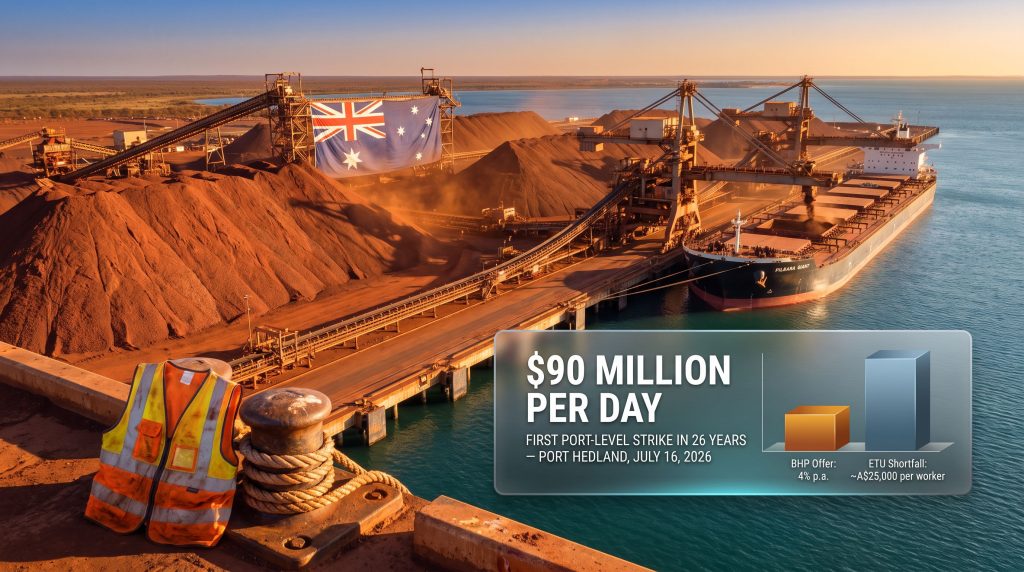
The unions, however, have characterised this offer as materially insufficient. The ETU estimates that the gap between BHP's tabled position and worker expectations amounts to approximately A$25,000 per worker, which at prevailing exchange rates translates to roughly US$17,510 per person. Across the 450-strong workforce, this implies an aggregate wage shortfall in the vicinity of A$11.25 million.
| Metric | Detail |
|---|---|
| Workforce Covered | ~450 operators and maintenance workers |
| BHP's Offered Pay Rise | |
| ETU Estimated Shortfall Per Worker | ~A$25,000 |
| Estimated Aggregate Wage Gap | ~A$11.25 million |
| Duration of Negotiations | 7+ months |
| Agreement Term | 4 years |
| Bargaining Meetings Held | 8 (prior to July 21 talks) |
The Two-Tier Workforce Problem: A Structural Issue Beyond Wage Percentages
The headline wage gap figure, while significant, does not fully capture the depth of the workforce grievance driving the BHP Port Hedland union talks. Embedded within the dispute is a structural inequity that has developed gradually over the past five to six years.
Union analysis indicates that wages for long-tenured employees across BHP's Pilbara iron ore operations have remained largely stagnant during a period characterised by sustained corporate earnings growth and rising cost-of-living pressures in remote Western Australia. Simultaneously, BHP and other Pilbara operators have been offering elevated starting rates to attract new talent to remote sites, creating a pay inversion where experienced workers are effectively financially penalised for their tenure.
This dynamic has particular resonance in the fly-in-fly-out (FIFO) labour market. Historically, FIFO roles in the Pilbara commanded wages that could approach double the equivalent metropolitan earnings in Perth, compensating workers for the social and personal costs of remote roster systems, typically two weeks on and one week off, or similar arrangements. Union representatives argue that this premium has materially eroded, fundamentally undermining the value proposition of remote work.
The erosion of the Pilbara wage premium is not just a union grievance. It represents a medium-term structural challenge for the Australian mining industry's ability to attract and retain skilled trades in increasingly remote and technically demanding environments.
This problem is most acute for electrical tradespeople. Electricians holding relevant high-voltage certifications now face a genuinely competitive employment market, with the rapid expansion of renewable energy infrastructure in both metropolitan and regional Australia creating alternative career pathways that do not require fortnightly separation from family. If mining's remote work premium continues to compress, the industry faces a growing talent retention challenge that no enterprise agreement can fully address in isolation.
A 26-Year Milestone: The July 16 Strike and What It Signals
On 16 July 2026, workers at BHP's Port Hedland operations participated in an eight-hour work stoppage, marking the first port-level industrial action at BHP in approximately 26 years. This historical context matters. A quarter-century gap between strikes at a single facility is not a sign of harmonious industrial relations so much as an indicator of how deeply unusual the current impasse is.
Union estimates placed participation at between 150 and 200 workers, though the Combined Ports Unions had previously balloted approximately 236 employees for industrial action. The variance between the ballot number and participation reflects the complex dynamics of industrial action in essential-services environments, where individual workers weigh personal financial exposure against collective bargaining leverage.
The financial exposure from a complete operational shutdown is substantial. A full stoppage at Port Hedland's BHP operations could translate to revenue losses of up to $90 million per day, based on the daily throughput value of products transiting the terminal. Even partial disruptions carry compounding consequences through contractual delivery obligations with long-term offtake partners. The global iron ore market impact of such disruptions extends well beyond BHP's balance sheet.
Andy Forster, a portfolio manager at Argo Investments, which holds BHP shares, assessed the immediate operational impact as contained at the time of the stoppage, noting that throughput had not been materially disrupted. This assessment reflects a base case, not a forecast, and the investor community is calibrating its exposure to the scenario where the 28 July talks fail to produce a framework agreement.
Separately, electricians responsible for maintaining BHP's high-voltage power network across the Pilbara voted overwhelmingly in favour of strike action, introducing a second and potentially more operationally disruptive front to the dispute. High-voltage infrastructure maintenance is not a function that can be easily performed by replacement workers or contractors on short notice, making this particular group of workers disproportionately powerful as a bargaining unit.
The Fair Work Commission: Australia's Industrial Relations Circuit-Breaker
BHP has formally sought the involvement of the Fair Work Commission (FWC) in the Port Hedland bargaining process. The FWC is an independent statutory body empowered to facilitate enterprise bargaining, provide mediation services, and, in cases of irreconcilable deadlock, issue binding determinations that supersede bilateral negotiation outcomes.
BHP's characterisation of FWC involvement as the most constructive path forward reflects a strategic preference for structured, process-governed resolution. There are practical reasons for this beyond the immediate dispute. FWC-mediated agreements tend to produce more durable outcomes with lower rates of subsequent disputation, and the Commission's involvement can function as a legal constraint on further unprotected industrial action during an active facilitation period.
For investors, the Commission's involvement reduces, though does not eliminate, the tail risk of prolonged unresolved conflict. The scheduling of the next bargaining session for 28 July 2026 suggests both parties are operating within a compressed negotiation window, with the implicit understanding that unresolved matters may ultimately be referred to the Commission for determination.
The next major ASX story will hit our subscribers first
Where the Parties Stand: Points of Convergence and Divergence
Following talks on 21 July 2026, the Combined Ports Unions confirmed that some progress had been made but no agreement had been reached. Both parties confirmed continuation of negotiations on 28 July. The table below maps the current positions:
| Dimension | BHP Position | Union Position |
|---|---|---|
| Pay Offer | Seeking higher base + allowances (~A$25k/worker gap) | |
| Agreement Term | 4-year enterprise agreement | Aligned on 4-year term |
| Process Preference | FWC involvement preferred | Continuing direct negotiations; open to FWC |
| Operational Posture | Claims constructive engagement across 8 meetings | Previously characterised talks as making limited progress |
| Structural Pay Equity | Not publicly addressed | Resolution of two-tier workforce inequity required |
| Next Meeting | Confirmed for 28 July 2026 | Confirmed attendance |
Reaching resolution would require addressing not just the headline wage gap, but the allowances structure for remote and high-voltage electrical work, the catch-up mechanism for long-tenured employees, and the formalisation of any agreement through the FWC ratification process. In addition, the iron ore tariff impacts reshaping global trade flows add further urgency to restoring supply chain certainty at Port Hedland.
Three Scenarios for the 28 July Talks
The outcome of the next round of BHP Port Hedland union talks will have meaningful implications for iron ore supply, BHP's shareholder value, and the broader FIFO labour market. Three scenarios frame the range of likely outcomes:
Scenario 1: Framework Agreement Reached
Both parties agree on a wage structure combining enhanced base rates, improved allowances, and a structured pay equity mechanism for long-tenured workers. The FWC formally endorses the agreement. Industrial action is suspended and Port Hedland throughput normalises. Market impact: neutral to mildly positive for BHP.
Scenario 2: Partial Agreement with Ongoing Mediation
Parties reach agreement on core provisions but refer unresolved wage and allowance items to the FWC. Further protected action is constrained during the mediation period. Uncertainty persists but tail risk is materially reduced.
Scenario 3: Talks Collapse and Industrial Escalation
Negotiations break down. Unions ballot for extended or rolling stoppages. Electrical workers join port operators in coordinated action, creating exposure across BHP's high-voltage Pilbara infrastructure. Market impact: significant negative pressure on BHP's near-term shipment volumes, potential volatility in seaborne iron ore spot pricing, and heightened scrutiny from Asian steel customers monitoring supply reliability. Consequently, the China demand prospects that currently underpin iron ore valuations would come under additional strain.
Investor Considerations and the Broader Industry Signal
For BHP shareholders, the immediate financial exposure from the current dispute is measurable. Daily throughput value at risk, potential offtake contract penalties, and customer relationship consequences all factor into the calculus. However, the more consequential signal is structural.
If Australia's major iron ore producers cannot maintain competitive FIFO wage premiums relative to metropolitan employment, the industry faces a compounding talent challenge that will affect operational efficiency, maintenance quality, and ultimately production reliability at some of the most capital-intensive assets on earth. Skilled trades shortages in remote mining environments are not a theoretical risk. They are an operational reality that is already being priced into project development timelines across the Pilbara.
The BHP Port Hedland union talks are therefore not merely a negotiation between one company and its workforce. They are a proxy contest over the economic model that has underpinned Australia's iron ore dominance for decades, and the outcome will be watched closely by every major producer, every Asian steelmaker, and every investor with exposure to seaborne iron ore markets.
This article is intended for informational purposes only and does not constitute financial advice. Forward-looking scenarios involve inherent uncertainty and actual outcomes may differ materially from those described. Readers should conduct their own research before making investment decisions.
Want to Stay Ahead of Major ASX Mineral Discoveries Before the Broader Market Does?
Discovery Alert's proprietary Discovery IQ model delivers real-time alerts on significant ASX mineral discoveries, transforming complex mineral data into clear, actionable insights for investors at every experience level — start your 14-day free trial today and gain a market-leading edge, or explore Discovery Alert's dedicated discoveries page to understand how historic mineral discoveries have generated substantial returns.