June 27, 2026
The Hardest Problem in Mining Decarbonisation
Across the global extractive industry, no operational challenge has proven more resistant to clean energy solutions than heavy haulage. While solar panels can power processing facilities, hydrogen is being tested in locomotives, and electric light vehicles are already standard in underground operations, the 300-tonne diesel haul truck remains stubbornly irreplaceable at scale. The physics are unforgiving: moving hundreds of tonnes of ore across kilometres of steep, unpaved gradient demands energy densities that current battery technology can only begin to approximate. Yet the pressure to solve this problem has never been greater, and the BHP Rio Tinto Caterpillar electric haul truck trial in the Pilbara represents one of the most significant real-world attempts to close this gap.
Understanding why this trial matters requires stepping back from the individual machines and examining what diesel actually represents inside the world's largest iron ore operations, what it would take to replace it, and what the early data from Western Australia's Pilbara region is beginning to tell us.
When big ASX news breaks, our subscribers know first
The Diesel Problem Is Bigger Than Most People Realise
Open-cut mining at Pilbara scale is, at its core, an energy-intensive logistics operation. Haul trucks run around the clock across vast pit networks, climbing laden and descending empty in continuous cycles. The fuel consumption involved is staggering. According to BHP's own climate disclosures, diesel combustion accounted for approximately 40% of the company's combined Scope 1 and 2 greenhouse gas emissions using 2020 as a baseline year.
For Rio Tinto, diesel consumed across its mining equipment and rail fleet represented roughly 12% of its equivalent Scope 1 and 2 emissions footprint in 2023, as noted in the companies' May 2024 collaboration announcement. These figures reveal a structural tension at the heart of both companies' decarbonisation strategies. Neither BHP nor Rio Tinto can credibly claim a pathway to net-zero without addressing the haul truck fleet, yet the fleet is also the operational backbone of their most profitable assets.
What makes diesel so difficult to displace in this context is not simply energy volume but the way that energy is delivered. A diesel-powered 793-class haul truck carries its fuel onboard, refuels in minutes, and returns to cycle without meaningful downtime. An equivalent battery-electric system must solve for energy storage weight, charging duration, thermal management in extreme heat, and infrastructure integration across a mine site that may span tens of square kilometres.
These are not incremental engineering problems; they require foundational rethinking of how power is delivered at scale, under continuous load, in temperatures that regularly exceed 40 degrees Celsius. Furthermore, broader mining electrification trends confirm that this challenge is being confronted across the entire sector, not just in the Pilbara.
What the Cat 793 XE Early Learner Program Actually Involves
Defining the Early Learner Concept
The term Early Learner carries specific technical and commercial meaning within Caterpillar's product development framework. An Early Learner unit is not a prototype in the traditional R&D sense, nor is it a commercially available product. It occupies a deliberate middle stage: sufficiently developed to operate under genuine field conditions, but instrumentally designed to generate the performance data needed to validate engineering assumptions before full production commitment is made.
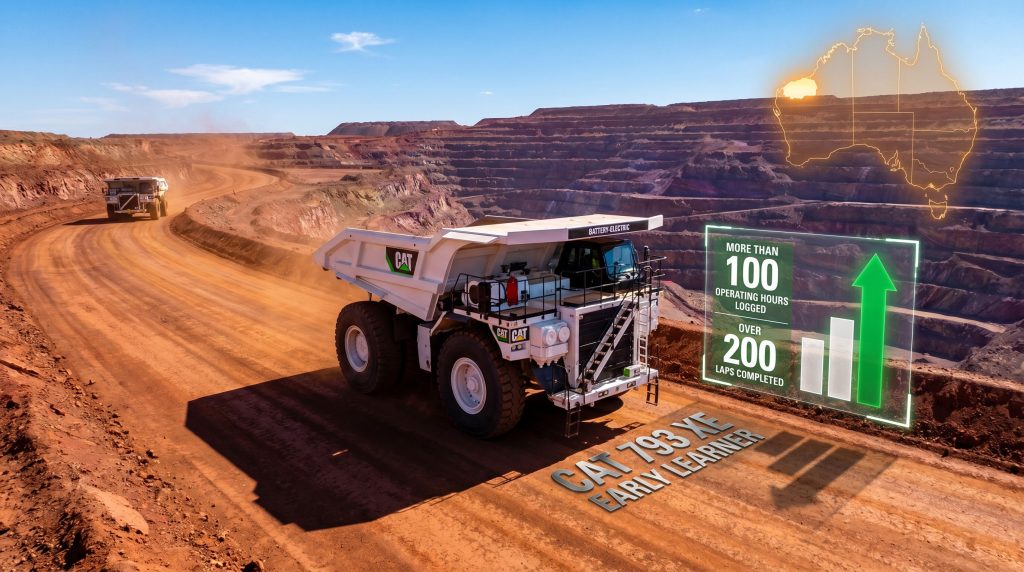
The Cat 793 XE platform is engineered for zero exhaust emissions at point of operation, targeting the same payload class as its diesel counterpart. Before any unit reached an active mine site, each truck underwent rigorous safety evaluation and controlled performance testing at Caterpillar's proving ground facility in Tucson, Arizona. The two units deployed to Jimblebar were delivered to site in December 2025, making the three-month operational milestone reached in mid-2026 a meaningful early checkpoint in the commercialisation timeline.
Crucially, only seven Cat 793 XE Early Learner units are currently in field trials across the entire world. Jimblebar hosts two of those seven, making BHP's Western Australian operation one of only two global sites where this technology is being evaluated under real mining conditions. The concentration of units in the Pilbara is not coincidental; it reflects a deliberate strategy to expose the platform to some of the most operationally demanding conditions available anywhere on earth.
Jimblebar's Role in Caterpillar's Global Roadmap
From Caterpillar's perspective, each Early Learner deployment functions as a data collection node feeding back into product refinement. The feedback loop works in both directions: mine operators learn what is required to integrate electric haulage into existing infrastructure, while Caterpillar engineers receive granular performance data across variables that cannot be replicated in a controlled facility.
These variables include actual haul cycle energy consumption, real-world thermal stress on battery management systems, and maintenance patterns under sustained operational load. Having two units operating simultaneously at a single site introduces a comparative dimension that single-unit trials cannot achieve. Variations in performance between the two trucks can be isolated and analysed in ways that accelerate the reliability modelling process.
In addition, BHP and Rio Tinto's announcement of welcoming the first Caterpillar battery-electric haul trucks to the Pilbara underscores how significant this deployment milestone is within the broader industry context.
Why the Pilbara Is the World's Most Demanding Proving Ground
The selection of Jimblebar as a primary testing environment was driven by a combination of operational extremity and strategic relevance. Summer ambient temperatures in the Pilbara regularly breach 45 degrees Celsius, creating thermal management challenges for battery systems that simply do not arise in temperate testing environments. Battery cells lose efficiency and longevity when subjected to repeated thermal stress, and the Pilbara climate stress-tests these systems in ways that no controlled facility in North America or Europe can fully replicate.
Beyond temperature, Pilbara iron ore market challenges mean that operators must also contend with demanding haul cycle profiles. Loaded trucks traverse extended distances across gradient-heavy pit ramps, placing sustained power demands on drivetrain and battery systems. Empty return cycles, while less power-intensive, provide regenerative braking opportunities that electric drivetrains can exploit to recover energy, but the efficiency of this recovery under real-world Pilbara conditions was precisely one of the unknowns the trial was designed to quantify.
Jimblebar also operates as an integrated autonomous haulage environment, meaning the electric trucks must function alongside existing fleet management and control systems. Testing technology integration in this context is qualitatively different from a standalone performance trial; it evaluates whether electric haulage can slot into the operational architecture of a modern, highly automated mine without disrupting productivity or safety protocols.
Three Months of Data: What the Trial Has Revealed
| Metric | Status at Three-Month Mark |
|---|---|
| Total operating hours logged | More than 100 hours |
| Test laps completed | Over 200 laps |
| Trial phase completed | Static charging and baseline performance |
| Next evaluation phase | Dynamic (in-motion) charging |
| Global Early Learner units deployed | 7 worldwide |
| Jimblebar's share of global fleet | 2 of 7 units |
The early data from the trial has been used primarily to validate three categories of assumption: safety system performance under genuine haul conditions, maintenance interval requirements and their implications for total cost of ownership, and the degree to which the trucks can be integrated into existing fleet management infrastructure without operational disruption.
Safety system behaviour in a working mine environment involves interactions that no proving ground can fully simulate. Active haul roads involve interactions with light vehicles, personnel, and unpredictable terrain conditions that require the truck's onboard safety systems to respond dynamically. Early indications suggest the platform's safety architecture is functioning as intended, though the trial is designed to gather extended data before any commercial conclusions are drawn.
On maintenance, the shift from diesel to electric drivetrains fundamentally changes the maintenance profile of a haul truck. Diesel engines involve hundreds of moving components subject to wear, lubrication requirements, and thermal fatigue. Battery-electric drivetrains eliminate many of these failure modes but introduce new considerations around high-voltage system management, battery state-of-health monitoring, and the workforce capability required to service these systems safely.
The trial is generating baseline data on how frequently maintenance interventions are needed and what skill sets they require — information that will be critical for operators planning the workforce transition that electrification demands. Consequently, mining efficiency technologies are playing an increasingly important role in helping companies model and manage this transition.
BHP Australia President Geraldine Slattery has indicated that the trial is simultaneously advancing understanding across multiple dimensions, from charging infrastructure and energy management through to safe and productive operational integration, reflecting the breadth of unknowns that must be resolved before scaled deployment becomes viable. (Source: BHP/Rio Tinto/Caterpillar joint news release, June 23, 2026)
Dynamic Charging: The Technology That Could Change Everything
How Static and Dynamic Charging Differ
The current phase of the Jimblebar trial centres on static charging, where trucks park at designated charging bays during shift changes or scheduled breaks to replenish battery capacity. This approach is operationally analogous to refuelling stops for diesel trucks and is the closer-to-ready option in commercial terms. However, it introduces a constraint that has no equivalent in diesel operations: charging duration.
Even high-powered static charging systems require significantly more time than diesel refuelling, and in continuous-cycle operations, this translates directly into reduced truck utilisation rates. Dynamic charging addresses this constraint by transferring electrical energy to the truck while it is in motion, using road-integrated energy transfer systems such as overhead catenary wires or embedded track systems.
The concept is not new in rail and light vehicle contexts, but applying it to a 300-plus tonne haul truck on an active mine haul road represents an engineering challenge of an entirely different order.
| Charging Method | Operational Impact | Infrastructure Complexity | Commercial Readiness |
|---|---|---|---|
| Static (parked) charging | Requires scheduled downtime | Moderate, using fixed charging bays | Closer to near-term deployment |
| Dynamic (in-motion) charging | Enables continuous operation cycle | High, requiring road-integrated systems | Longer development horizon |
Why Dynamic Charging Matters for Mining Economics
The economic case for electric haul trucks at scale depends critically on truck utilisation rates. If battery-electric trucks achieve equivalent or superior energy cost per tonne-kilometre but operate at meaningfully lower utilisation due to charging downtime, the total cost of ownership calculation shifts unfavourably. Dynamic charging, if it can be made to work reliably at haul truck scale, would eliminate this disadvantage by enabling continuous cycle operation analogous to diesel.
The next phase of the Jimblebar trial will evaluate dynamic charging under real operational conditions, generating data on technical performance, infrastructure requirements, and commercial feasibility. This data will be among the most consequential produced by the entire trial programme, as it directly addresses the question of whether battery-electric haulage can match diesel's operational continuity.
The next major ASX story will hit our subscribers first
Corporate Targets and the Haulage Gap
Both BHP and Rio Tinto have published ambitious near-term emissions reduction commitments:
- BHP is targeting a minimum 30% reduction in operational greenhouse gas emissions by 2030, measured against a 2020 baseline.
- Rio Tinto is pursuing a 50% reduction in Scope 1 and 2 emissions by 2030, with a long-term net-zero target by 2050.
Neither target is achievable without a credible pathway to diesel displacement across haul fleets. Diesel represents such a dominant share of both companies' operational emissions that other decarbonisation measures — including renewable energy in mining, processing efficiency improvements, and electrification of ancillary equipment — cannot mathematically close the gap without haul truck electrification contributing a substantial share of the reductions.
This is the structural logic underlying the Jimblebar trial. It is not primarily a technology demonstration exercise; it is a necessary step in building the operational knowledge base required to make fleet-level investment decisions at a scale that could materially shift the emissions trajectories of two of the world's largest mining companies.
Why Two Competitors Are Running Trials Together
The collaborative architecture of the current trial programme is one of its most strategically significant features. Under the framework announced in May 2024, BHP committed to trialling two Cat 793 XE battery-electric trucks while Rio Tinto simultaneously trialled two Komatsu 930 battery-electric haul trucks, also in the Pilbara. Both companies are working with their respective OEM partners independently while sharing broader learnings about operating conditions, infrastructure requirements, and integration challenges.
Running parallel trials with competing OEM platforms simultaneously serves multiple strategic purposes:
- It generates comparative performance data across different technology approaches, reducing the risk of committing to a single platform prematurely.
- It distributes the substantial cost and operational risk of pre-commercial technology trials across multiple organisations.
- It creates market pressure on OEMs to accelerate development timelines and improve commercial terms.
- It establishes a shared knowledge base about Pilbara-specific operating requirements that benefits the entire industry, including smaller operators who lack the resources to conduct independent trials at this scale.
Rio Tinto Iron Ore CEO Matthew Holcz has noted that the Pilbara's scale and operational intensity make it uniquely appropriate for stress-testing this technology before broader deployment decisions are made, capturing the dual logic of the site selection: it is both the most demanding available environment and the location where the technology most urgently needs to work. (Source: BHP/Rio Tinto/Caterpillar joint news release, June 23, 2026)
Furthermore, the BHP Rio Tinto Caterpillar battery-electric haul truck trial in the Pilbara has attracted significant global attention, with industry observers closely watching the trial outcomes for signals about the broader commercial trajectory of electric haulage.
The Remaining Barriers to Full Commercial Deployment
Technical and Operational Hurdles
Despite the progress represented by the Jimblebar trial, significant barriers remain between the current Early Learner stage and full commercial fleet deployment:
- Energy density limitations: Diesel carries approximately 35 times more energy per kilogram than current lithium-ion battery chemistries. Closing this gap, or compensating for it through dynamic charging and regenerative recovery, remains the central engineering challenge.
- Charging infrastructure capital expenditure: Equipping a Pilbara-scale mine site with sufficient high-powered charging infrastructure represents a capital outlay that is separate from and additional to the truck acquisition cost.
- Fleet transition economics: At current technology maturity, battery-electric haul trucks carry a significant acquisition cost premium over diesel equivalents. This gap is expected to narrow as production volumes increase, but the timeline is uncertain.
- Workforce capability: High-voltage system maintenance requires qualifications and safety protocols that do not exist in current diesel-focused mine maintenance workforces. Building this capability at scale requires lead time measured in years.
Scenarios for Scaled Deployment
Analysts and industry observers have proposed several plausible trajectories for the commercial rollout of electric haul fleets in the Pilbara:
- Conservative scenario: Electric haul trucks reach commercial parity with diesel by the mid-2030s, with Pilbara fleet transition beginning in earnest after 2030 as technology matures and infrastructure is progressively installed.
- Accelerated scenario: Dynamic charging breakthroughs, combined with continued battery cost reductions driven by electric vehicle manufacturing scale globally, compress the timeline to partial deployment in the late 2020s.
- Hybrid transition scenario: Mixed diesel-electric fleets operate in parallel through a decade-long transition period, with electric trucks initially assigned to haul cycles best suited to current battery range and charging constraints.
Note: These scenarios are speculative projections based on current technology trajectories and should not be treated as forecasts by any of the companies involved. Actual deployment timelines will depend on trial outcomes, technology development, and capital allocation decisions that have not yet been made.
Frequently Asked Questions
What is the Cat 793 XE Early Learner truck?
The Cat 793 XE is a battery-electric haul truck engineered by Caterpillar to produce zero exhaust emissions while targeting the payload capacity and performance benchmarks of large-scale open-cut mining operations. The Early Learner designation identifies pre-commercial units deployed specifically to generate real-world operational data that informs product development and commercialisation planning.
Where is the BHP Rio Tinto Caterpillar electric haul truck trial taking place?
The trial is being conducted at BHP's Jimblebar iron ore mine in the Pilbara region of Western Australia. Two Cat 793 XE units are operating at this site, representing two of only seven such trucks currently in global field deployment.
How does the Jimblebar trial connect to Rio Tinto's separate Komatsu trial?
Under the May 2024 collaboration framework, BHP is trialling Caterpillar's platform while Rio Tinto concurrently trials the Komatsu 930 battery-electric haul truck, also in the Pilbara. The parallel structure allows both companies to gather comparative data across competing OEM platforms while sharing broader operational learnings about Pilbara-specific integration requirements.
What is dynamic charging and why is it important for mining?
Dynamic charging refers to energy transfer systems that replenish a truck's battery while the vehicle is in motion, eliminating the need for scheduled stationary charging breaks. For continuous-cycle mining operations, this capability is considered essential for matching the operational utilisation rates achieved by diesel trucks. However, it is worth noting that hydrogen-powered mine trucks represent a parallel technological pathway also being explored for heavy haulage decarbonisation.
Why does diesel represent such a large share of mining emissions?
In large open-cut operations, diesel-powered haul trucks run continuously across extended haul distances under heavy loads. The cumulative fuel consumption across a large fleet operating around the clock produces a substantial emissions footprint that dominates the overall Scope 1 emissions profile of operations like those in the Pilbara.
What This Trial Means for the Future of Mining Electrification
The significance of the BHP Rio Tinto Caterpillar electric haul truck trial in the Pilbara extends well beyond iron ore. The operational conditions, payload requirements, and haul cycle characteristics of Pilbara iron ore mining closely parallel those of large-scale copper, gold, and other bulk commodity operations globally. Technology validated in this environment carries meaningful transfer potential to mining operations on multiple continents.
For battery technology developers, charging infrastructure providers, and grid operators in Western Australia, a successful pathway to scaled electric haulage would represent a demand signal of considerable magnitude. A single large Pilbara iron ore operation can run dozens of haul trucks continuously; a full fleet transition would require an energy supply and storage infrastructure buildout that creates substantial downstream investment opportunity.
From an investor perspective, the competitive positioning implications are also worth tracking. Mining companies that successfully commercialise electric haulage earlier than peers gain a structural cost and regulatory advantage as carbon pricing mechanisms, emissions reporting obligations, and ESG-linked financing conditions continue to tighten globally. The Jimblebar trial is, among other things, an investment in optionality: the ability to make well-informed fleet transition decisions before the commercial window closes.
The broader lesson of what BHP, Rio Tinto, and Caterpillar are doing in the Pilbara is that the hardest problems in industrial decarbonisation require both competition and collaboration simultaneously. Neither company will share proprietary operational data or commercial negotiating positions with the other. But both recognise that the technology development challenge they face is too large, too costly, and too consequential to be solved in isolation. The structure of the current trial reflects that understanding, and it may well become the model for how the global mining industry approaches the next generation of its deepest operational challenges.
Want to Know Which ASX Mining Companies Are Leading the Electrification Revolution?
Discovery Alert's proprietary Discovery IQ model delivers real-time alerts on significant ASX mineral discoveries — including those driving the next wave of mining innovation — ensuring subscribers can identify actionable opportunities ahead of the broader market. Explore historic discoveries and their extraordinary returns on Discovery Alert's dedicated discoveries page, and begin your 14-day free trial today to position yourself at the forefront of the market.