July 28, 2026
When Buyers Become Gatekeepers: Understanding the CMRG Power Shift in Global Iron Ore
The global iron ore trade has long been shaped by a simple dynamic: a handful of massive producers selling to hundreds of fragmented buyers across China's steel industry. That structural imbalance historically favoured the sellers. However, over the past few years, Beijing has been quietly dismantling that advantage, and the current standoff in which Fortescue iron ore cargoes held up by CMRG talks is one of the clearest demonstrations yet of how completely the leverage equation has shifted.
When big ASX news breaks, our subscribers know first
What Is CMRG and Why Does It Change Everything?
China Mineral Resources Group (CMRG) was established in 2022 as a state-backed entity designed to centralise iron ore procurement across China's fragmented steel sector. Before CMRG's creation, Chinese steel mills negotiated independently with miners, which diluted collective bargaining power and allowed producers like Fortescue, BHP, and Rio Tinto to secure pricing on largely their own terms.
CMRG fundamentally alters this by aggregating demand from hundreds of steel mills into a single procurement channel. The result is a buyer-side entity with the scale to credibly threaten supply disruption, demand currency concessions, and control the conditions under which new iron ore products enter the Chinese market.
To understand the magnitude of this shift, consider the structure of the China steel and iron ore market:
- China produces roughly 50% of the world's steel, requiring enormous and consistent iron ore imports.
- Prior to CMRG, no single Chinese buyer controlled enough volume to pressure the world's largest miners.
- CMRG now acts as the central counterparty in long-term supply negotiations, replacing the bilateral deal-making that defined the trade for decades.
This is not a minor administrative change. It represents one of the most consequential structural shifts in bulk commodity procurement in modern trade history.
Fortescue Iron Ore Cargoes Held Up: What Is Actually Happening?
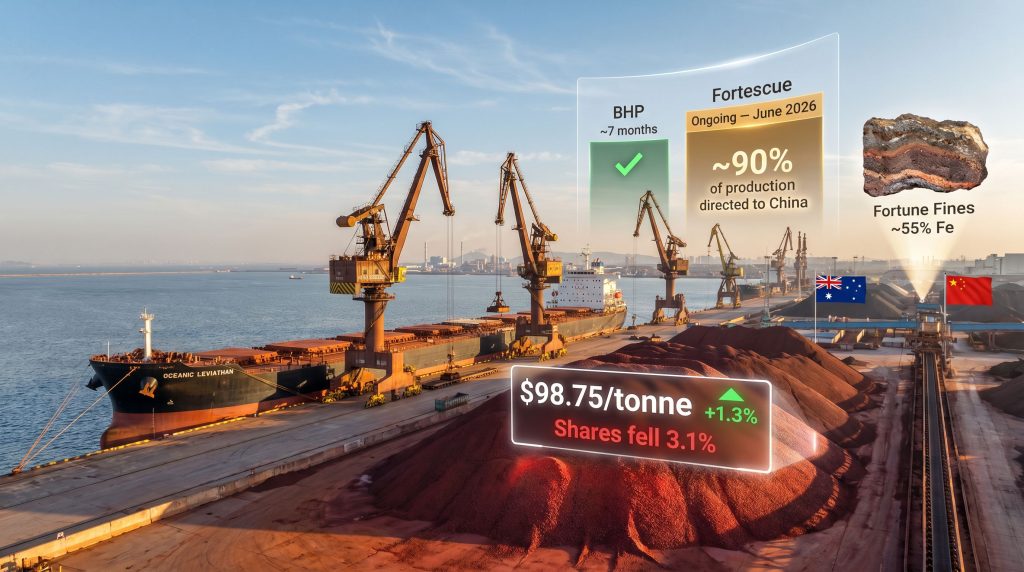
According to Bloomberg reporting, some Fortescue iron ore shipments destined for China in July are effectively in limbo. Chinese steelmakers are currently unable to schedule delivery of these cargoes, and some buyers moved on the same day to seek alternative ore supplies, which pushed Singapore iron ore futures up 1.3% to $98.75 per tonne.
The official explanation for delays at Caofeidian port in northern China centres on solid waste inspection protocols. However, the timing and context of these inspections has led many market observers to interpret them less as routine regulatory procedure and more as a calculated pressure mechanism deployed at a critical juncture in contract negotiations.
The key data points from this event are summarised below:
| Event | Detail |
|---|---|
| Cargoes affected | Fortescue shipments at Caofeidian port, northern China |
| Official reason cited | Solid waste inspection protocols |
| Market response | Singapore iron ore futures rose 1.3% to $98.75/tonne |
| Fortescue share impact | Shares fell approximately 3.1% on the news |
| Short-term contract status | Extensions due to expire end of June 2026 |
Fortescue is currently operating under short-term placeholder agreements rather than finalised long-term contracts. Those interim arrangements expire at the end of June 2026, and there is no confirmed indication they will be extended while negotiations remain at an impasse.
Fortune Fines: The Product at the Heart of the Dispute
To understand why CMRG has taken such a firm posture, it is necessary to understand what Fortescue is trying to bring to market. The miner is preparing to launch a product called Fortune Fines, a lower-grade iron ore product with an iron content of approximately 55% Fe.
This grade sits notably below the benchmark 62% Fe iron ore used in standard pricing indices, and also below higher-grade products such as the 65% Fe pellets preferred by more efficient blast furnaces. Fortune Fines is designed to occupy a cost-competitive niche in the market, targeting steel mills that blend lower-grade fines with higher-grade feed to optimise sintering efficiency and production economics.
The significance of the product launch cannot be overstated in the context of the current standoff. CMRG reportedly instructed steelmakers not to conduct private negotiations with Fortescue regarding Fortune Fines before the product has been formally launched and priced through CMRG's centralised framework. This directive signals that the dispute is not primarily about product quality. Instead, it is about who controls the pricing and commercial conditions under which new iron ore products enter the Chinese market.
The July 2026 target launch window for Fortune Fines creates maximum negotiating pressure. Fortescue needs Chinese buyers to be ready to receive and process a new product at scale. CMRG knows this, and the timing of the cargo delays and the instruction to steelmakers appears carefully calibrated to extract concessions before that launch window opens.
Why Iron Ore Grade Matters More Than Most Investors Realise
Iron ore grade and its commercial implications are frequently misunderstood outside the industry. Furthermore, a few critical points are worth understanding in relation to iron ore price trends:
- Grade premiums and discounts are non-linear. A move from 58% Fe to 62% Fe does not yield a 4-percentage-point value increase; the blast furnace productivity gains and reduced slag volumes create an outsized premium.
- Lower-grade fines like those in the ~55% Fe range require more energy to process and can increase slag production, which affects furnace efficiency and emissions intensity.
- Chinese steel mills are not homogeneous buyers. Larger, more capital-intensive mills with modern blast furnaces tend to prefer higher-grade ore. Smaller, older mills are more price-sensitive and willing to blend lower-grade material.
- Fortune Fines, positioned at ~55% Fe, targets this second tier of buyer, but CMRG's centralised structure means even these buyers cannot move independently.
Monitoring iron ore price trends closely remains essential for understanding how prolonged negotiations may reshape the broader pricing landscape.
The BHP Precedent: What It Reveals About CMRG's Playbook
The Fortescue situation does not exist in isolation. BHP Group experienced a comparable standoff with CMRG that stretched for approximately seven months before reaching a resolution in April 2026. The BHP settlement notably included an agreement to move toward yuan-denominated pricing, a significant concession that reduces currency risk for Chinese buyers but introduces new exposure for Australian miners whose costs are denominated in Australian dollars.
Comparing the two situations highlights both the consistency of CMRG's approach and the unique complexities of Fortescue's position:
| Factor | BHP Standoff | Fortescue Standoff (Current) |
|---|---|---|
| Duration | Approximately 7 months | Ongoing as of June 2026 |
| Resolution mechanism | Yuan-denominated pricing agreement (April 2026) | Unresolved |
| Product at issue | Existing product range | New product (Fortune Fines, ~55% Fe) |
| Market disruption | Significant during standoff period | Futures up 1.3%; alternatives sought |
| China revenue exposure | High | Approximately 90% of production |
The BHP resolution provides a template of sorts. Yuan-denominated pricing is likely on CMRG's agenda for Fortescue as well. This matters enormously for Fortescue's financial structure: revenues denominated in yuan while capital expenditure and debt servicing remain in Australian dollars introduces a currency mismatch that could compress margins, particularly during periods of yuan depreciation. In addition, the growing China iron ore surplus further weakens Fortescue's negotiating hand, as Chinese buyers face less urgency to secure supply at any cost.
Three Scenarios for Resolution
The current stalemate is unlikely to persist indefinitely. Below are three plausible resolution pathways, each carrying different implications for Fortescue's revenue outlook and market positioning:
Scenario 1: Negotiated Settlement With Currency Concessions
Fortescue accepts yuan-denominated pricing, mirroring the BHP resolution. CMRG secures its structural objective, cargo flows resume, and Fortune Fines launches under CMRG-approved terms. This is likely the path of least resistance but comes with long-term margin implications.
Scenario 2: Prolonged Standoff With Incremental Concessions
Both parties hold firm beyond the June contract expiry. Fortescue redirects modest volumes toward alternative markets such as Japan, South Korea, or India while maintaining pressure. CMRG allows limited cargo releases to prevent genuine supply disruption to domestic mills. This scenario could extend for months with neither party achieving a clean outcome.
Scenario 3: Partial Market Displacement
If negotiations collapse entirely, some Chinese steel mills accelerate their shift toward Brazilian iron ore from Vale, West African sources, or higher-grade alternatives. This scenario would be most damaging for Fortescue given that approximately 90% of its iron ore production is directed toward Chinese buyers, leaving minimal volume available for rerouting at equivalent margins.
The concentration risk embedded in Fortescue's revenue base is a critical variable in any scenario analysis. With nine-tenths of production reliant on a single buyer nation that is now negotiating through a centralised procurement entity, the traditional concept of bilateral pricing power has effectively been retired.
The next major ASX story will hit our subscribers first
Is CMRG Operating as a Cartel? The Legal and Geopolitical Dimension
Fortescue's leadership has publicly characterised CMRG's behaviour using language that invokes cartel-like conduct. In trade law terms, a cartel involves coordinated suppression of competition among buyers to artificially depress prices, which is precisely what centralised demand aggregation achieves when scaled to CMRG's level.
However, CMRG operates in a legal grey zone. As a state-owned enterprise acting under Chinese government direction, it is effectively immune from the international competition law frameworks that would apply to private sector buyer coalitions in Western jurisdictions. The World Trade Organization's rulebook is not well-equipped to address state-backed monopsony behaviour in commodity procurement, particularly when the buying entity controls access to the world's largest steel market.
The geopolitical dimension adds further complexity. Australia's iron ore industry contributes approximately AUD $124 billion annually to export revenues, with China absorbing the overwhelming majority of that output. Consequently, this dependency creates an asymmetric vulnerability: Australia needs China to buy its ore far more urgently than China needs any single Australian miner to supply it, given Brazil, West Africa, and domestic Chinese sources as partial alternatives. The broader iron ore tariff impacts and trade policy pressures compound this challenge further.
What the Iron Ore Market Is Telling Investors
The immediate market reaction to the Fortescue cargo delays was instructive. The 1.3% rise in Singapore iron ore futures reflects the market's recognition that supply disruption risk is real, not merely theoretical. At the same time, Fortescue's share price decline of approximately 3.1% reveals the company-specific risk premium the market is now applying.
Several dynamics are worth tracking closely in relation to the global iron ore market impact:
- Short-term contract expiry risk: The end-of-June 2026 deadline for Fortescue's placeholder agreements creates a hard catalyst. Markets will reprice sharply if no rollover is confirmed.
- Alternative supplier positioning: Any prolonged disruption will benefit Brazilian producers and higher-grade ore exporters, at least in the short term.
- Yuan pricing precedent: If Fortescue ultimately accepts yuan-denominated contracts, the market implications extend well beyond this single negotiation, potentially resetting the pricing framework for all Australian iron ore exports.
- Fortune Fines market reception: The commercial success of a ~55% Fe product in a market where CMRG controls access is far from guaranteed under current conditions.
Frequently Asked Questions
What is causing Fortescue's iron ore cargoes to be delayed in China?
Fortescue iron ore cargoes held up by CMRG talks reflect a combination of stalled contract negotiations and cargo inspections at Caofeidian port in northern China. The official rationale involves solid waste inspection protocols, though the timing aligns directly with the breakdown in long-term supply talks.
What is CMRG and what role does it play in iron ore purchasing?
China Mineral Resources Group is a state-backed entity created to centralise iron ore procurement across China's steel industry. It consolidates the buying power of hundreds of individual mills into a single negotiating body, fundamentally altering the balance of power in iron ore trade.
What is Fortune Fines and why is it significant?
Fortune Fines is a new Fortescue iron ore product with an iron content of approximately 55% Fe. CMRG has directed Chinese steelmakers not to negotiate privately with Fortescue about this product before its formal launch, indicating that control over market entry conditions is a central issue in the standoff.
How does this compare to the BHP situation?
BHP endured a roughly seven-month standoff with CMRG before reaching an agreement in April 2026 that involved yuan-denominated pricing. The Fortescue situation mirrors the BHP experience but is complicated by the simultaneous introduction of a new product.
How much of Fortescue's production goes to China?
Approximately 90% of Fortescue's iron ore production is directed toward Chinese buyers, creating significant concentration risk in a now-politicised trade environment.
The Emerging New Normal in Iron Ore Trade
The standoff involving Fortescue iron ore cargoes held up by CMRG talks is not an isolated commercial dispute. It is a visible symptom of a structural realignment that has been underway since CMRG's formation in 2022. The era of simple bilateral contracts between Australian miners and Chinese steel mills is being replaced by a centralised procurement model in which a state-backed buyer sets the terms, controls product market access, and can deploy regulatory mechanisms as negotiating tools.
Every major Australian iron ore exporter is watching this negotiation with acute attention. The outcome will define not just Fortescue's revenue trajectory for years ahead, but the commercial framework within which all future iron ore supply agreements between Australian producers and Chinese buyers will be negotiated.
Disclaimer: This article is for informational purposes only and does not constitute financial advice. All figures, timelines, and market data referenced are based on reporting current as of late June 2026. Investors should conduct independent due diligence before making any investment decisions. Forward-looking statements and scenario projections involve inherent uncertainty and should not be treated as predictions of actual outcomes.
Want to Stay Ahead of Major ASX Mineral Discoveries Before the Broader Market Reacts?
While the iron ore power shift between Australian miners and CMRG reshapes commodity trade dynamics, Discovery Alert's proprietary Discovery IQ model is scanning ASX announcements in real time to surface high-potential mineral discoveries — from iron ore to over 30 other commodities — delivering actionable insights directly to subscribers. Explore how historic discoveries have generated extraordinary returns and begin your 14-day free trial today to position yourself ahead of the next major market-moving announcement.