July 28, 2026
The Supply Chain Arithmetic Driving Chinese Capital Into Australian Bauxite
Global aluminium production is a numbers game rooted in geology. Every tonne of primary aluminium requires roughly four to five tonnes of bauxite to produce, and China's aluminium industry, the largest in the world by a substantial margin, cannot feed that equation from domestic resources alone. Chinese bauxite reserves are increasingly lower grade, higher in reactive silica, and more costly to process than what can be sourced offshore. That structural mismatch between domestic supply quality and industrial demand has made Australian bauxite, particularly the low-silica variety found in northern Western Australia, one of the more strategically compelling commodities in global trade.
It is within this context that the VBX Wuudagu Bauxite Project Chinese funding and offtake agreement becomes worth examining closely, not simply as a corporate milestone for a junior ASX developer, but as a window into the supply chain logic reshaping how Chinese aluminium producers are positioning themselves for the next decade of production. Understanding bauxite production dynamics helps situate this deal within the broader strategic picture.
When big ASX news breaks, our subscribers know first
Why Silica Content Is the Hidden Variable in Bauxite Trade
The Chemistry Behind Refinery Preferences
Most bauxite commentary focuses on available alumina content, but reactive silica concentration is often the more decisive variable in Chinese refinery purchasing decisions. In the Bayer process, which is the dominant global method for refining bauxite into alumina, reactive silica consumes caustic soda at a roughly 1:1 weight ratio. Since caustic soda is one of the most significant operating cost inputs in alumina refining, high-silica bauxite directly inflates the cost of production.
Chinese refineries that were historically built around Guinea or Indonesian feedstock have progressively recalibrated their procurement preferences. Guinea's bauxite, while abundant, can carry silica levels that impose measurable cost premiums at scale. Australian bauxite from northern deposits, by contrast, has demonstrated consistently low reactive silica profiles, making it disproportionately attractive relative to its shipping distance from Chinese ports.
Low reactive silica in bauxite is not merely a quality preference. At refinery scale, the difference between 3% and 7% reactive silica can translate into tens of millions of dollars in annual caustic soda expenditure. For high-volume Chinese refinery operators, this calculus makes Australian bauxite grade a commercial priority, not simply a technical specification.
Northern Australia's Logistical Position
The North Kimberley region of Western Australia sits closer to Chinese alumina refineries than most investors intuitively assume. Shipping routes from the northern Kimberley coast to key Chinese refining hubs in Shandong and Guangxi are meaningfully shorter than routes from Guinea's west African ports. For bulk commodity trade where freight costs are calculated per tonne and multiplied across millions of tonnes annually, that geographic advantage compounds into significant delivered-cost benefits over the life of a long-term supply contract.
The Wuudagu Project: Asset Characteristics and Commercial Significance
Geology, Location, and Grade Profile
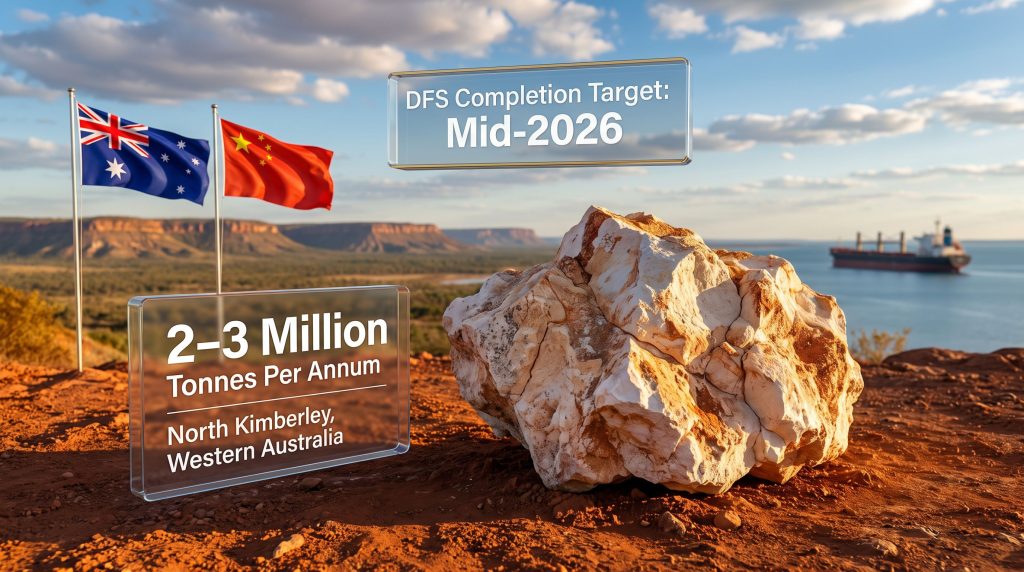
VBX's Wuudagu Bauxite Project is situated in the North Kimberley region of Western Australia, a bauxite-bearing geological province that has attracted increasing exploration interest over the past decade. The deposit's defining characteristic, from a commercial standpoint, is its low-silica bauxite profile, which aligns precisely with the refinery preference structure described above.
Key Project Snapshot
| Attribute | Detail |
|---|---|
| Project Location | North Kimberley, Western Australia |
| Bauxite Type | Low-silica |
| Proposed Annual Offtake | 2 to 3 million tonnes per annum |
| DFS Completion Target | Mid-2026 |
| Definitive Agreement Timeline | Within 90 days of DFS completion |
| Framework Agreement Structure | Non-exclusive |
The project's management has emphasised that the combination of the deposit's grade characteristics, its expanding resource base, and its logistical positioning in northern Australia collectively underpin the asset's appeal to offshore buyers. An expanding resource base at this stage of development is commercially important because it provides the scale optionality that large-volume offtake counterparties require before committing to multi-decade supply arrangements.
What an Expanding Resource Base Signals to Project Financiers
In mining finance, a growing resource is not simply a geological achievement. It is a risk-reduction signal. Project lenders and offtake counterparties assess resource scale as a proxy for mine life certainty. A resource base that is still growing at the framework agreement stage suggests that the eventual DFS will have a larger inventory to optimise against, potentially supporting longer contract durations or higher annual shipment volumes than the current 2 to 3 million tonne per annum headline figure implies. For further context on how comparable projects are structured, the Niagara bauxite project offers a useful reference point within the Australian development landscape.
Decoding the Framework Agreement Structure
Non-Exclusive Agreements as Pre-DFS Commercial Architecture
The framework agreement between VBX and the Hong Kong subsidiary of a major Chinese aluminium producer is structured as a non-exclusive arrangement. This is a technically important distinction that is often underappreciated in market commentary.
Non-exclusive framework agreements in the resources sector are typically used to preserve optionality for both parties while establishing commercial goodwill ahead of a Definitive Feasibility Study. They signal serious intent without locking either party into binding obligations prematurely.
For VBX, the non-exclusive structure preserves the ability to continue negotiating with other potential offtake and funding partners in parallel. This is not a weakness in the arrangement; it is a deliberate commercial strategy. By maintaining multiple active conversations ahead of the DFS, the developer retains leverage in the eventual definitive agreement negotiations, which are targeted for completion within 90 days of the study's mid-2026 scheduled finalisation.
Investment Scope: What Construction Funding Actually Covers
The proposed investment component is intended to cover a significant portion of the Wuudagu project's construction and commissioning costs. In practical terms, this typically encompasses infrastructure such as crushing and screening facilities, port loading infrastructure, haul roads, and related site establishment costs. For a greenfield bauxite project in a remote northern Australian location, these capital items represent the dominant execution risk that project financiers scrutinise most carefully.
The precise funding quantum will only be established following DFS completion, when capital cost estimates reach the accuracy threshold required to support binding commercial commitments. This sequencing is standard in mining project finance but creates an important investor consideration: the current framework agreement is a pathway, not a funding guarantee.
How Bauxite Pricing Is Expected to Work Under the Arrangement
Pricing under the proposed offtake arrangement is expected to reference an agreed bauxite price index, with quality adjustments applied to reflect Wuudagu's specific grade characteristics. This structure mirrors the approach used in most large-scale Australian bauxite supply contracts.
Index-referenced pricing with quality adjustments serves both parties. The buyer gains price transparency relative to market benchmarks, while the seller benefits from automatic upward adjustment when grade metrics, such as available alumina content or low silica levels, outperform the index baseline. For a low-silica deposit like Wuudagu, quality adjustment provisions can meaningfully improve the effective price per tonne relative to the headline index price.
Contextualising the Offtake Volume Against Global Benchmarks
China's Bauxite Import Dependency at Scale
Global Bauxite Trade Context
| Metric | Approximate Scale |
|---|---|
| China's Annual Bauxite Imports | Approximately 100 to 110 million tonnes in recent years |
| Wuudagu Proposed Offtake | 2 to 3 million tonnes per annum |
| Australia's Share of Global Bauxite Exports | Among the top three globally |
| Typical Chinese Refinery Grade Preference | Low-silica, high available alumina |
At 2 to 3 million tonnes per annum, Wuudagu's proposed offtake volume represents a relatively small fraction of China's total bauxite import requirement. However, this framing misses an important nuance. Chinese aluminium producers do not procure bauxite from a single source. They manage portfolios of supply agreements across multiple geographies precisely to reduce concentration risk. Within that portfolio logic, a reliable, quality-assured Australian source providing 2 to 3 million tonnes annually is a meaningful diversification addition, not an insignificant volume. Furthermore, analysis of leading global bauxite mines illustrates just how competitive the supply landscape has become.
Why Long-Term Offtake Structures Are Preferred Over Spot Markets
Chinese refinery operators have historically shown a strong preference for long-term, structured supply agreements over spot market procurement. The operational rationale is straightforward: alumina refineries are capital-intensive assets with decades-long investment horizons. Feedstock price and supply unpredictability creates planning risk that translates directly into refinery operating cost volatility. Long-term offtake agreements effectively function as feedstock cost hedges, which is why major Chinese aluminium groups are willing to invest in project development, not merely purchase the output.
The Takapinga Project and Multi-Asset Platform Value
Why a Second Project Strengthens the Negotiating Position
Beyond Wuudagu, the framework agreement also encompasses exploratory provisions for VBX's Takapinga Bauxite Project in northern Australia. This is commercially significant for reasons that extend beyond simply having two assets under discussion.
A multi-project framework creates negotiating leverage that a single-asset developer cannot replicate. When a counterparty is evaluating not just one project but a potential platform relationship covering multiple supply sources, the switching cost of walking away from negotiations rises substantially. The inclusion of advance payment arrangement provisions for Takapinga also introduces a potential non-dilutive funding mechanism that could accelerate development timelines at that asset independently of the Wuudagu DFS process.
Understanding Advance Payment Structures in Bauxite Development
Advance payment or prepayment arrangements in resource development involve an offtake counterparty providing upfront capital in exchange for discounted or priority access to future production volumes. These structures are used when a buyer has strong conviction in an asset's future output but the project has not yet reached the capital commitment stage required for conventional project finance. For junior developers, they represent a mechanism to fund exploration or early development activities without equity dilution, though they do create repayment obligations that need to be carefully structured against projected cash flows.
The next major ASX story will hit our subscribers first
Comparing Capital Pathways for Junior Bauxite Developers
Funding Mechanism Trade-Offs at the Development Stage
| Funding Mechanism | Advantages | Risks |
|---|---|---|
| Chinese Offtake-Linked Investment | Large volume commitments, construction cost coverage | Pricing dependency, geopolitical exposure |
| Prepayment / Advance Payment Arrangements | Non-dilutive, tied to production milestones | Repayment obligations, cash flow pressure |
| ASX Equity Capital Markets | Retains ownership flexibility | Dilution risk, market sentiment dependency |
| Strategic Joint Venture | Shared capital burden | Potential loss of operational control |
VBX has publicly indicated that it has been deliberately pursuing multiple capital and offtake pathways simultaneously. This parallel-track approach is strategically important because it prevents any single counterparty from gaining excessive pricing leverage in the eventual definitive agreement negotiations. When a developer can credibly demonstrate competing interest from multiple parties, the commercial terms achievable in any individual negotiation improve materially.
The decision to retain ownership of future production rights at Wuudagu while seeking external construction funding is an increasingly common approach among junior developers who have learned from earlier industry cycles that selling production rights too cheaply at the pre-DFS stage destroys long-term asset value disproportionately. Consequently, top aluminium mining companies have increasingly adopted similar frameworks when acquiring development-stage assets.
Regulatory and Sovereign Considerations for Foreign Investment
The FIRB Framework and Resource Sector Scrutiny
Australia's Foreign Investment Review Board scrutinises investments in critical minerals and resource projects by foreign state-linked entities. Framework agreements of this nature typically require regulatory assessment before binding investment commitments can be executed.
Framework agreements of the kind signed by VBX do not themselves constitute a foreign investment requiring FIRB approval. However, the progression from framework agreement to definitive investment commitment, particularly where a foreign state-linked entity is taking an equity or debt position in an Australian resource project, does trigger FIRB notification obligations. The 90-day post-DFS negotiation window provides a timeframe within which regulatory assessment processes would need to be incorporated.
It is worth noting that bauxite's classification within Australia's broader critical minerals framework reflects the mineral's strategic importance to aluminium production supply chains. However, this classification does not itself constitute project-specific support or accelerated approval for any individual development. The regulatory environment applicable to foreign investment in the sector is governed by standard FIRB processes, which apply to all projects based on investment thresholds and sectoral sensitivity.
Frequently Asked Questions: VBX Wuudagu Bauxite Project and Chinese Funding
What Has VBX Signed With the Chinese Aluminium Group?
VBX has entered into a non-exclusive framework agreement with the Hong Kong subsidiary of a major Chinese aluminium producer. The VBX Wuudagu Bauxite Project Chinese funding and offtake agreement establishes a negotiation pathway for project investment intended to cover a significant share of construction and commissioning costs, alongside a long-term bauxite offtake arrangement targeting between 2 and 3 million tonnes per annum from the Wuudagu project.
When Will Binding Agreements Be Finalised?
Definitive commercial agreements are targeted for completion within 90 days of the Wuudagu Definitive Feasibility Study, which is scheduled for finalisation in mid-2026.
How Is Bauxite Pricing Structured Under the Proposed Arrangement?
Pricing is expected to reference an agreed bauxite price index, with quality-based adjustments applied to reflect the specific grade characteristics of Wuudagu's product, particularly its low reactive silica profile.
Does the Agreement Cover Other VBX Projects?
The framework also includes exploratory provisions for potential investment, offtake, and advance payment arrangements related to VBX's Takapinga Bauxite Project in northern Australia.
Is VBX Pursuing Other Funding Options in Parallel?
VBX has been actively exploring multiple capital and offtake pathways simultaneously, consistent with a strategy of retaining commercial optionality ahead of the DFS completion and final investment decision. This approach reflects broader trends discussed in bauxite and alumina market insights from recent industry conferences.
Key Takeaways: What the Wuudagu Agreement Signals for Australia's Bauxite Pipeline
-
Chinese demand for long-term, quality-assured bauxite supply continues to drive offshore investment interest, with low-silica Australian assets in northern proximity to Asian shipping lanes attracting particular attention from Chinese refinery operators seeking to manage caustic soda cost exposure.
-
Framework agreements are increasingly being used as pre-DFS commercial anchors, allowing developers to demonstrate market validation without prematurely committing to pricing or capital terms that may not reflect full asset value.
-
The 2 to 3 million tonne per annum offtake volume represents a commercially meaningful scale for a development-stage project, providing a credible demand signal for project financiers without requiring the counterparty to absorb excessive supply concentration risk.
-
Retaining production rights while securing external construction funding is an emerging best-practice strategy among junior developers seeking to preserve long-term asset value against premature price concessions.
-
The 90-day post-DFS negotiation window creates a defined commercial catalyst that investors and market participants should monitor closely as mid-2026 approaches.
-
The non-exclusive agreement structure should be read as a commercial strength rather than a limitation, preserving VBX's ability to maximise competitive tension in the final agreement negotiations.
Furthermore, reporting from mining.com.au confirms that the VBX Wuudagu Bauxite Project Chinese funding and offtake agreement represents a significant step forward for the company's broader development strategy, with the Chinese funding pathway now formally established ahead of the DFS milestone.
Readers seeking broader context on global bauxite and alumina supply-demand dynamics may find additional perspective in the AL Circle report Global Bauxite and Alumina Market Forecast to 2036: Supply-Demand, Trade Flows and Price Outlook, which covers production forecasts, trade flow projections, and pricing outlooks through to 2036.
This article contains forward-looking statements and analysis based on publicly available information. It does not constitute financial advice. Readers should conduct their own due diligence before making investment decisions. Framework agreements do not represent binding commitments, and all investment decisions are subject to DFS outcomes, regulatory approvals, and mutual commercial agreement between the parties.
Want to Catch the Next Major ASX Mineral Discovery Before the Broader Market Does?
Discovery Alert's proprietary Discovery IQ model scans ASX announcements in real time, transforming complex mineral data into actionable insights across more than 30 commodities — so investors can identify significant opportunities the moment they emerge. Start a 14-day free trial with Discovery Alert today, or explore how historic mineral discoveries have generated substantial returns for those positioned early.