July 28, 2026
Why the Royalty Model Quietly Outperforms in a Volatile Commodity World
Most investors instinctively reach for miners when they want commodity exposure. The logic seems straightforward: find the producer closest to the ore, and capture the most upside when prices rise. However, this conventional thinking overlooks a structural reality that has become increasingly apparent across commodity cycles: the royalty model consistently captures margin where traditional miners bleed it.
Royalty companies sit at a unique position in the resource extraction value chain. They provide capital or land access in exchange for a perpetual slice of revenue from whatever is produced. They carry no operational risk, no exposure to cost blowouts, no labour disputes, and no capital expenditure surprises. When volumes rise or prices firm, the royalty holder captures that benefit almost in its entirety.
This structural elegance is precisely why the Deterra Royalties quarterly royalty revenue lift on record iron ore volumes deserves closer analysis than a simple headline number suggests.
When big ASX news breaks, our subscribers know first
Breaking Down How Deterra's Revenue Engine Actually Works
The Mechanics of a Pure-Play Royalty Structure
Deterra Royalties Ltd (ASX: DRR) generates its income through a deceptively simple formula: volume multiplied by price, multiplied by the royalty rate. There are no processing costs to subtract, no logistics bills to absorb, and no mine rehabilitation provisions eroding the bottom line.
The company holds a 1.232% ad valorem royalty over Mining Area C (MAC), one of the largest iron ore operations in the Pilbara region of Western Australia. This royalty was carved out when South32 demerged the asset and ultimately listed Deterra as a standalone royalty vehicle in 2020. BHP Group Ltd (ASX: BHP), through its Pilbara iron ore division, operates MAC and pays the royalty on all wet metric tonnes (WMT) shipped.
What makes this arrangement particularly powerful from an investor perspective is that Deterra does not need to worry about BHP's cost efficiency or capital allocation decisions at MAC. Whether BHP chooses to invest in new infrastructure or tighten operational spending, Deterra's revenue line remains a direct function of what leaves the port.
What Is Mining Area C and Why It Dominates the Revenue Picture
MAC is not simply one mine. It is an integrated iron ore hub that has been dramatically expanded through the South Flank development, a major BHP capital project that reached full production capacity in recent years. South Flank added approximately 80 million tonnes per annum of nameplate capacity to the broader hub, replacing the ageing Yandi deposit and significantly upgrading the average iron ore grade of material being shipped.
This grade upgrade matters for royalty investors in a way that is rarely discussed. Higher-grade iron ore, typically above 60% Fe content, attracts price premiums in Asian steel markets, particularly in China. Furthermore, when average realised prices at MAC improve, it is not purely a function of benchmark movements. Grade mix and product quality play a role, meaning Deterra benefits from a structurally higher-quality product compared to the lower-grade Yandi tonnes it effectively replaced. Understanding iron ore price trends is therefore central to appreciating the full revenue dynamics at play here.
June 2026 Quarter: Unpacking the Numbers Behind the 12% Revenue Lift
Headline Financials at a Glance
| Metric | June 2026 Quarter | March 2026 Quarter | Change |
|---|---|---|---|
| Total Quarterly Royalty Revenue | A$64.1 million | ~A$57.2 million | +12% |
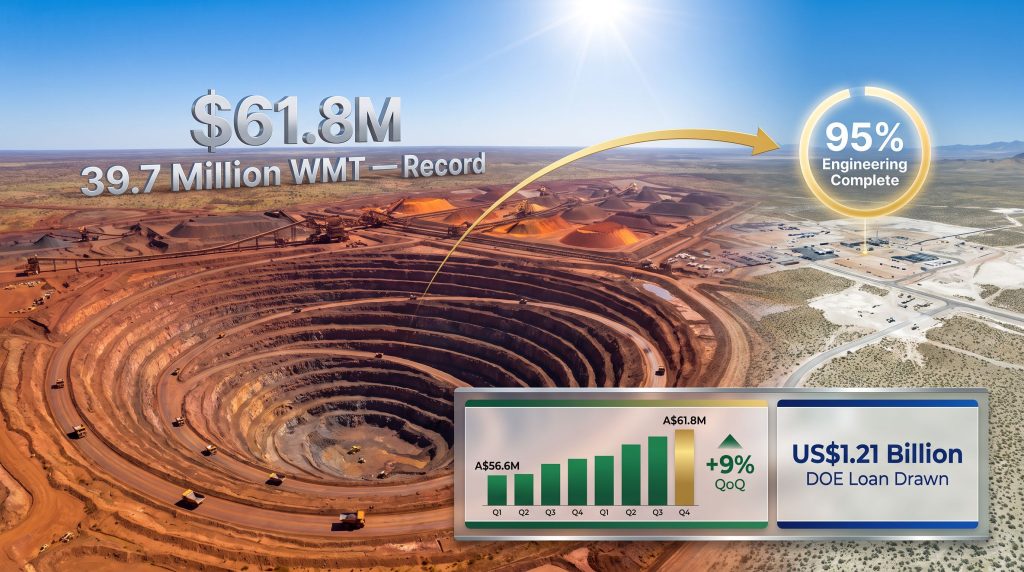
| MAC Royalty Revenue | A$61.8 million | A$56.6 million | +9% |
| MAC Iron Ore Production | 39.7 million WMT | 39.5 million WMT | Record |
| MAC Capacity Payments | A$2.0 million | Not disclosed | New item |
| Other Royalties Revenue | A$0.3 million | Not disclosed | Incremental |
| Average Realised Iron Ore Price | ~A$134/tonne | ~A$131/tonne | +2% |
The June 2026 quarter delivered 39.7 million wet metric tonnes of iron ore production at MAC, representing a new record for the operation. Iron ore sales volumes climbed 7% quarter-on-quarter, and average realised pricing firmed by approximately 2% to A$134 per tonne.
Why This Quarter Was Structurally Different from Previous Records
A critical detail that deserves attention is the simultaneous occurrence of both a volume record and price improvement. Looking back across recent quarterly history, this combination has been uncommon.
| Quarter | MAC Royalty Revenue | Key Driver | Pricing Trend |
|---|---|---|---|
| June 2024 | Declined ~7.5% QoQ | +15.5% volume (South Flank ramp) | Lower realised prices offset gains |
| June 2025 | A$60.0 million (+8% QoQ) | Record sales volumes | -8% realised pricing |
| March 2026 | A$56.6 million | Record production (39.5M WMT) | -8% implied average price |
| June 2026 | A$61.8 million (+9% QoQ) | Record sales + stable pricing | +2% to ~A$134/tonne |
The March 2026 quarter illustrates the other side of this dynamic particularly well. Despite MAC posting what was then a production record of 39.5 million WMT, royalty revenue came in lower than the prior comparable period because average pricing had deteriorated by approximately 8%. Volume records are impressive, but they do not automatically translate into revenue records when prices are declining.
The June 2026 quarter achieved something rare in Deterra's recent history: volume expansion and price appreciation at the same time, creating a compounding effect on royalty revenue that explains the outsized 12% total revenue increase.
Capacity Payments: The Revenue Stream Most Investors Overlook
Beyond the primary ad valorem royalty, Deterra also receives capacity payments from BHP linked to the MAC infrastructure. The A$2.0 million received in the June quarter represents compensation tied to the expanded throughput capacity created by the South Flank development.
While relatively modest in absolute terms, capacity payments provide a degree of revenue floor that partially insulates Deterra during softer pricing environments. They also represent a structural feature of the royalty agreement that many investors do not factor into their revenue modelling. For broader context, Australia's iron ore advantage in global supply chains underpins why assets like MAC continue to command this kind of royalty premium.
Thacker Pass: The Battery Metals Wildcard in Deterra's Portfolio
From a Single-Asset Story to a Diversified Royalty Platform
While MAC generates the overwhelming majority of current revenue, the investment narrative around Deterra is increasingly shaped by what happens next at the Thacker Pass lithium project in Nevada, United States. Deterra holds a royalty over this asset, which is being developed by Lithium Americas Corp in a joint venture structure.
Thacker Pass is significant for reasons that extend beyond its scale. The deposit sits within the McDermitt Caldera, a volcanic formation that hosts one of the largest known lithium clay deposits in the world. Unlike the hard-rock spodumene lithium deposits that dominate Australian production, or the lithium brine operations of the South American lithium triangle, Thacker Pass involves the processing of lithium-bearing smectite clay using a sulphuric acid leach process. This is a less commercially proven extraction pathway at scale, which has historically been a source of investor caution.
Construction Milestones as of June 2026
- More than 95% of detailed engineering has been finalised
- Over 70% of procurement activity is now complete
- First lithium carbonate production is targeted for late calendar year 2027
- The US Department of Energy loan facility totalling US$1.21 billion has been fully drawn
- The DOE has taken equity positions in both Lithium Americas and the joint venture entity
The drawing of the full US$1.21 billion DOE loan is a meaningful construction financing milestone. It confirms that the project has met the technical and commercial conditions required to access that capital. In addition, Lithium Americas at Thacker Pass has demonstrated consistent construction progress, which provides Deterra's royalty stream a clearer pathway toward activation.
What a Lithium Royalty Would Mean for Deterra's Revenue Profile
The structural impact of Thacker Pass on Deterra's revenue profile is worth modelling conceptually. Currently, close to 97% of Deterra's royalty revenue originates from a single iron ore asset. When Thacker Pass reaches commercial production, the company gains exposure to lithium carbonate pricing, which operates in an entirely different supply-demand cycle to iron ore.
This creates genuine commodity diversification at the revenue level, reducing the correlation of Deterra's earnings to any single commodity market. From a pure royalty economics perspective, lithium carbonate prices are significantly more volatile than iron ore over short cycles, which cuts both ways. For long-term royalty holders, what matters more than short-term price levels is the volumetric royalty base, meaning total tonnes produced over the life of the mine.
Assessing the Risk-Return Profile: What Could Go Wrong?
Iron Ore Price Sensitivity Remains the Primary Variable
Given the royalty formula's simplicity, iron ore pricing is the single greatest external risk to Deterra's near-term revenue. The company's exposure to the China steel and iron ore market is almost entirely unhedged, which is both a feature and a risk. When Chinese property construction activity or steel export volumes weaken, iron ore benchmarks typically fall, and Deterra's revenue follows proportionally.
One important nuance for investors is that Deterra's royalty is calculated on an Australian dollar revenue basis, which means AUD/USD movements act as a natural partial hedge. When global iron ore prices fall in USD terms, a weaker Australian dollar often partially offsets the impact by inflating the AUD equivalent of those revenues.
Comparing Deterra's Model to Traditional ASX Iron Ore Exposure
| Feature | Deterra Royalties (DRR) | Traditional Iron Ore Miner |
|---|---|---|
| Operational cost exposure | None | High (mining, processing, logistics) |
| Revenue sensitivity | Volume x Price only | Revenue minus full cost stack |
| Capital expenditure risk | Minimal | Significant and ongoing |
| Commodity diversification | Iron ore + lithium royalty | Typically single-commodity |
| Dividend income profile | High payout, pass-through structure | Variable, capex-dependent |
| Share price leverage to iron ore | Moderate | High (both up and down) |
The CEO Transition: Context for Investors
Deterra is currently operating under interim leadership, with Jason Neal serving as Interim Managing Director and CEO while the board conducts a search for a permanent appointment. Management transitions at royalty companies tend to carry lower operational risk than at producing miners, given the relatively limited internal decision-making required to maintain revenue.
However, investors should note that the strategic direction around new royalty acquisitions and portfolio expansion is an area where permanent leadership continuity would be beneficial. Interim management has signalled active interest in expanding the royalty portfolio across bulk commodities, base metals, and battery metals, suggesting the company is pursuing a deliberately multi-commodity future rather than remaining dependent on a single iron ore royalty. Deterra's latest quarterly revenue update further reinforces this strategic direction.
Frequently Asked Questions: Deterra Royalties and the June 2026 Quarter
What was Deterra Royalties' total royalty revenue for the June 2026 quarter?
Total quarterly royalty revenue reached A$64.1 million, representing a 12% increase from the prior quarter. MAC royalty revenue contributed A$61.8 million of that total.
What drove the quarterly revenue increase?
The increase reflected record MAC iron ore sales volumes, up 7% quarter-on-quarter, combined with a 2% improvement in average realised pricing to approximately A$134 per tonne. The simultaneous improvement in both volume and price was the primary driver of the outsized revenue result.
What is Mining Area C and who operates it?
MAC is a large-scale iron ore mining and processing hub in Western Australia's Pilbara region, operated by BHP. The South Flank mine forms the centrepiece of the operation following a major capacity expansion.
When is Thacker Pass expected to begin lithium carbonate production?
The project is targeting first production of lithium carbonate in late calendar year 2027, with construction progressing well against that timeline as of the June 2026 quarter update.
Is Deterra Royalties a dividend stock?
Deterra operates with a high payout ratio structure, distributing the majority of its royalty revenue as dividends. This makes it attractive to income-focused investors, though dividends will fluctuate in line with MAC production volumes and iron ore pricing. A detailed analysis of Deterra's half-yearly performance offers additional context around the consistency of the company's distribution history.
The next major ASX story will hit our subscribers first
Key Takeaways: What the June 2026 Quarter Reveals About the Investment Thesis
Five Structural Observations for Long-Term Investors
-
Volume records at MAC are becoming a structural baseline, not episodic events. The South Flank ramp-up has permanently elevated the production ceiling at the MAC hub, creating a higher floor for royalty revenue regardless of short-term price fluctuations.
-
Pricing remains the swing factor that amplifies or dampens the volume effect. The June 2026 quarter demonstrated that even a modest 2% price improvement, layered onto a high-volume base, generates a disproportionate revenue lift.
-
Thacker Pass is transitioning from a development narrative to a construction execution story. With 95% engineering completion and the full DOE loan drawn, project uncertainty has materially reduced.
-
The royalty model's cost-insulated structure means near-full margin conversion from any volume or price improvement, a characteristic that no producing miner can replicate.
-
Portfolio diversification is an active management priority, with new royalty investments being evaluated across multiple commodity categories, suggesting the single-asset concentration risk is being actively managed.
This article contains general information only and does not constitute financial advice. Past performance is not indicative of future results. Investors should consider their own circumstances and seek independent financial advice before making investment decisions. Forecasts and projections referenced in this article are subject to significant uncertainty and should not be relied upon as guarantees of future performance.
Want to Know When the Next Major ASX Mineral Discovery Hits the Market?
Discovery Alert's proprietary Discovery IQ model scans ASX announcements in real time, instantly identifying significant mineral discoveries and turning complex data into actionable investment insights — so subscribers can position themselves ahead of the broader market. Explore historic discoveries and their returns, then begin your 14-day free trial to secure your market-leading edge.