August 6, 2026
BHP shares analysis requires a comprehensive understanding of commodity market dynamics and company-specific factors that influence investment outcomes. Global mining markets have experienced unprecedented volatility throughout 2026, as shifting geopolitical landscapes and evolving commodity demand patterns reshape investment dynamics across the sector. The Australian resources industry finds itself at the epicenter of these transformations, where traditional valuation frameworks encounter new variables ranging from energy transition requirements to supply chain restructuring.
For equity investors navigating this complex environment, understanding the fundamental drivers behind major mining operations becomes essential for portfolio construction and risk management strategies. Furthermore, iron ore price trends significantly impact BHP shares analysis, particularly given iron ore's substantial contribution to the company's revenue base.
The intersection of commodity cycles, technological innovation, and macroeconomic policy creates a multilayered investment landscape that rewards detailed analysis over simplistic trend following. Mining giants operating across diversified portfolios face unique challenges in capital allocation, operational efficiency, and stakeholder value creation during periods of heightened market uncertainty. These dynamics particularly influence how institutional and retail investors approach position sizing and timing decisions within the resources sector.
What Makes BHP Group a Strategic Investment Consideration in Today's Market?
Market Capitalisation and Blue-Chip Status Analysis
BHP Group maintains its position as one of Australia's largest publicly traded companies by market value, trading at $49.97 per share as of March 31, 2026. This substantial market capitalisation reflects the company's operational scale and institutional significance within the ASX 200 framework. The designation as a premier blue-chip stock carries implications beyond simple size metrics, encompassing operational history, dividend reliability, and index inclusion benefits that drive systematic capital inflows.
The company's cyclical characteristics distinguish it from defensive alternatives within blue-chip categories. Unlike utilities or consumer staples that provide steady cash flows regardless of economic conditions, BHP's performance correlates directly with industrial commodity demand cycles and macroeconomic expansion phases. This positioning creates both opportunity and risk for investors seeking exposure to economic recovery narratives.
Institutional ownership patterns for large-cap mining companies typically reflect a combination of passive index mandates and active allocation decisions. The substantial weighting within major Australian equity indices ensures consistent demand from exchange-traded funds and pension systems, providing a foundation of price support during periods of sector weakness. However, this same institutional presence can amplify volatility when sentiment shifts across the resources sector.
Cyclical vs Defensive Investment Characteristics
The fundamental distinction between cyclical and defensive investments becomes particularly relevant for BHP shares analysis given the company's pronounced sensitivity to commodity price movements. Cyclical stocks demonstrate high earnings volatility that correlates with economic expansion and contraction phases, creating periods of exceptional outperformance followed by significant underperformance.
Historical data supports the cyclical classification, with BHP shares advancing 31% year-over-year as of March 31, 2026, while posting 9.2% gains year-to-date. This performance pattern reflects typical cyclical stock behavior during commodity price strength, where valuations expand rapidly as earnings multiply through operational leverage effects.
Key Performance Metrics:
• Year-to-date returns: +9.2%
• Twelve-month returns: +31.0%
• All-time high reached: $59.25 (March 2026)
• Current trading level: $49.97
The operational gearing inherent in mining operations amplifies both positive and negative earnings impacts from commodity price movements. Fixed cost structures mean that incremental revenue from higher commodity prices flows directly to profit margins, creating substantial earnings leverage during favorable cycles. Conversely, price declines can rapidly erode profitability when operating costs remain elevated.
Risk-adjusted return analysis requires consideration of volatility patterns unique to cyclical mining stocks. Unlike defensive alternatives that provide steady but modest returns, cyclical investments offer higher potential returns accompanied by significantly greater downside risk. Portfolio construction strategies must account for this asymmetric risk profile when determining appropriate position sizes.
When big ASX news breaks, our subscribers know first
How Does BHP's Dividend Strategy Compare to ASX Income Investments?
Dividend Yield Analysis and Sustainability Metrics
BHP's dividend strategy centers on providing shareholders with regular income through a combination of interim and final distributions, typically yielding between 4% and 6% on an annual basis. The fully franked status of these dividends enhances their attractiveness for Australian taxpayers, particularly those in pension phase who can claim franking credit refunds.
BHP Dividend Performance vs ASX Comparisons
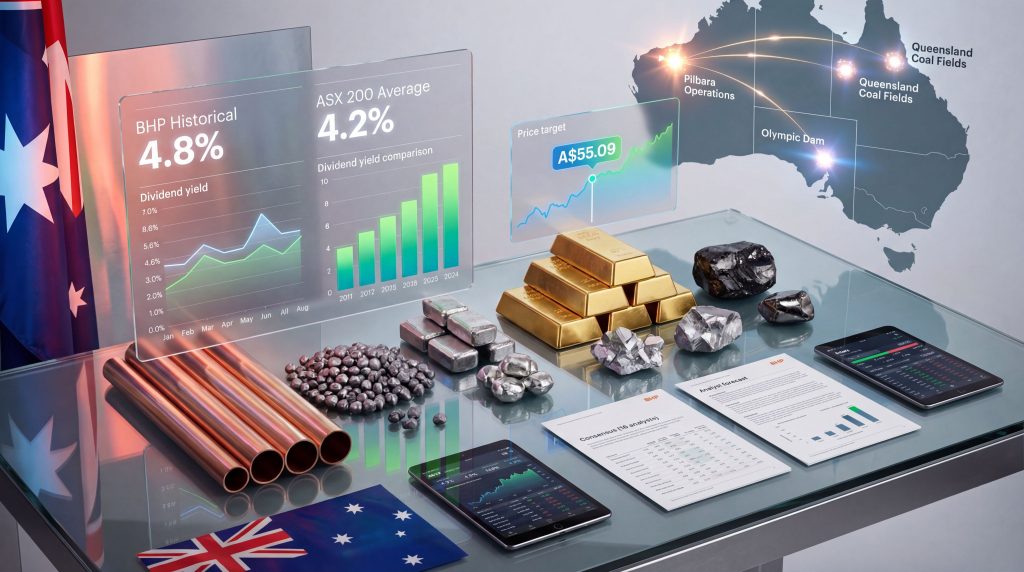
| Metric | BHP Historical | ASX 200 Average | Mining Sector |
|---|---|---|---|
| 5-Year Average Yield | 4.8% | 4.2% | 5.1% |
| Franking Credit Value | 100% | 85% | 95% |
| Payout Ratio Stability | Variable | Stable | Volatile |
The variability in BHP's payout ratios reflects the inherent cyclicality of mining cash flows. During periods of elevated commodity prices, the company generates substantial free cash flow that supports higher dividend payments and special distributions. Conversely, commodity price weakness can pressure cash generation and force dividend adjustments to maintain balance sheet strength.
Dividend sustainability analysis for mining companies requires examination of underlying cost structures and operational efficiency metrics. BHP's characterisation as a low-cost operator suggests that cash generation remains positive even during commodity price downturns, providing a foundation for continued dividend payments through various market cycles.
Franking Credit Optimisation for Tax-Effective Income
The full franking status of BHP dividends creates significant tax advantages for Australian investors across different income brackets. For pension-phase superannuation members, the ability to claim franking credit refunds effectively increases the dividend yield by approximately 43% of the franking credit value.
Franking Credit Benefits by Tax Bracket:
• Zero tax rate (pension phase): Full franking credit refund available
• Low income earners: Partial refund potential depending on total tax liability
• Medium income earners: Franking credits offset other tax obligations
• High income earners: Credits reduce net tax payable but no refunds
The timing of franking credit benefits varies based on individual tax circumstances and the Australian Tax Office processing schedules. For self-managed superannuation fund members, franking credits can be particularly valuable when combined with other tax-planning strategies during pension phase drawdowns.
Quarterly versus semi-annual distribution patterns affect cash flow timing for income-focused investors. BHP typically follows a semi-annual distribution schedule with interim dividends declared alongside half-year results and final dividends announced with full-year earnings. This pattern requires income investors to plan for irregular cash flow timing compared to monthly or quarterly distribution alternatives.
Dividend Continuity Track Record Since 2006
BHP's dividend payment history demonstrates consistency spanning two decades, with regular distributions maintained since 2006 according to available records. This track record encompasses multiple commodity cycles, including the Global Financial Crisis, European debt crisis, and recent pandemic-related economic disruptions.
The maintenance of dividend payments during commodity price volatility reflects several factors:
• Low-cost operational positioning relative to industry peers
• Diversified commodity exposure reducing single-product dependency
• Conservative financial management during peak earning periods
• Flexible capital expenditure programs that can adjust to market conditions
However, investors should note that past dividend continuity does not guarantee future payments, particularly given the cyclical nature of mining cash flows. The company's ability to maintain distributions depends on ongoing operational performance, commodity price environments, and capital allocation priorities that may shift based on growth opportunities or market conditions.
Critical factors affecting dividend sustainability include:
• Iron ore and copper price stability
• Operating cost inflation pressures
• Capital expenditure requirements for growth projects
• Acquisition opportunities and strategic investments
• Debt servicing obligations and balance sheet management
What Are the Primary Growth Catalysts Supporting BHP's Investment Case?
Commodity Diversification and Future Metals Exposure
BHP's diversified commodity portfolio provides exposure to multiple demand drivers across traditional and emerging industrial applications. The company's strategic positioning spans iron ore for steel production, copper for electrical infrastructure, and developing exposure to battery metals including nickel and lithium for energy storage applications.
Iron ore operations represent the largest component of BHP's revenue base, primarily serving steel production in China and other industrial economies. The correlation between Chinese steel demand and iron ore prices creates both opportunity and concentration risk, as economic growth patterns in China directly influence cash flow generation from these operations.
Copper positioning benefits from multiple demand drivers including traditional construction and manufacturing applications alongside emerging electrification trends. Furthermore, copper and uranium insights highlight the strategic importance of these metals in energy transition portfolios, particularly given their role in renewable energy infrastructure and grid modernisation projects.
The strategic focus on battery metals reflects management's recognition of energy transition investment requirements. Nickel and lithium exposure through acquisitions and organic development projects positions BHP to participate in electric vehicle supply chain growth, though these operations currently represent smaller revenue contributions compared to traditional commodities.
Operational Excellence and Cost Leadership Analysis
BHP's characterisation as a low-cost operator enables dividend maintenance and competitive positioning during commodity price downturns. This cost leadership stems from several operational factors including scale advantages, technology adoption, and geographic positioning of key assets.
Scale benefits emerge from large, long-life mining operations that spread fixed infrastructure costs across substantial production volumes. Major iron ore mines in Western Australia and copper operations in Chile benefit from economies of scale that reduce per-unit production costs compared to smaller competitors.
Technology investments focus on automation, data analytics, and operational efficiency improvements that reduce labour intensity and improve safety outcomes. These investments typically require substantial upfront capital but generate sustained cost savings and productivity improvements over extended periods.
Operational excellence indicators include:
• All-in sustaining cost positioning within industry cost curves
• Safety performance metrics and regulatory compliance records
• Environmental management and social licence maintenance
• Technology adoption rates and productivity improvement trends
The maintenance of cost leadership requires ongoing capital investment and operational discipline. Inflationary pressures on labour, energy, and materials costs challenge all mining operations, making relative cost positioning as important as absolute cost levels for competitive advantage.
Capital Allocation Strategy and Shareholder Value Creation
BHP's approach to capital allocation balances growth investments, shareholder returns, and balance sheet management across commodity cycles. The framework prioritises high-return projects while maintaining financial flexibility to navigate commodity price volatility.
Disciplined capital expenditure policies focus on projects meeting minimum return thresholds regardless of commodity price environments. This approach prevents value-destructive investments during peak pricing periods while maintaining investment capacity for attractive opportunities during market downturns.
Share buyback programs provide additional flexibility for returning capital to shareholders when organic growth opportunities fail to meet return criteria. The timing and scale of buybacks typically correlate with cash flow generation and management's assessment of share price value relative to intrinsic value estimates.
Merger and acquisition activities follow strategic criteria emphasising long-life, low-cost assets in politically stable jurisdictions. Recent acquisition focus on battery metals reflects portfolio diversification objectives while maintaining adherence to financial return requirements.
Which Risk Factors Could Impact BHP's Share Price Performance?
Geopolitical Exposure and Supply Chain Vulnerabilities
Global geopolitical tensions significantly influence commodity markets and mining company valuations through multiple transmission mechanisms. The ongoing conflict involving Iran and regional allies has created substantial uncertainty around commodity supply chains and industrial demand patterns.
"Geopolitical Risk Assessment: Current tensions involving Iran and regional conflicts have created commodity market volatility, with industrial metals experiencing price swings of 15-25% during recent geopolitical escalations."
China's role as both a major customer for iron ore and a key industrial commodity consumer creates concentration risk for BHP's revenue base. Trade relationship evolution, industrial policy changes, and economic growth patterns in China directly impact demand for the company's primary products. Additionally, the us-china trade war impact continues to influence bilateral trade flows and commodity market dynamics.
Supply chain vulnerabilities extend beyond direct operations to include shipping routes, port facilities, and processing infrastructure. Maritime chokepoints including the Strait of Hormuz and South China Sea shipping lanes represent potential disruption sources that could affect commodity deliveries and pricing.
Regulatory changes in operating jurisdictions including Australia, Chile, and Canada create ongoing compliance costs and operational uncertainties. Environmental regulations, taxation policies, and resource royalty frameworks can materially impact project economics and cash flow generation.
Key geopolitical risk factors:
• Chinese steel demand patterns and economic policy shifts
• Middle East conflict escalation affecting commodity logistics
• Australian trade relationship stability with major customers
• Chilean political stability and mining taxation policies
• International sanctions affecting commodity trade flows
Project-Level Investment Returns and Capital Efficiency
Recent reports indicate challenges at BHP's Queensland coal operations, where management has communicated to workers that these mines struggle to compete for investment capital within the company's portfolio. This development highlights the importance of project-level returns for overall company performance.
The inability to generate adequate returns from Queensland coal operations raises questions about stranded asset risks within the thermal coal portfolio. Energy transition policies and declining demand for thermal coal create long-term viability concerns for these assets, potentially requiring asset write-downs or divestiture strategies.
Return on invested capital (ROIC) analysis across BHP's business segments reveals varying performance levels that influence capital allocation decisions. Higher-returning operations in iron ore and copper typically receive priority investment while lower-returning segments face scrutiny and potential portfolio optimisation.
Capital efficiency metrics become particularly important during periods of elevated capital costs and competing investment opportunities. Projects must demonstrate attractive risk-adjusted returns that exceed corporate hurdle rates while providing strategic value through resource base expansion or operational synergies.
Leadership Transition and Strategic Continuity
BHP announced in mid-March that CEO Mike Henry will step down after six and a half years in the role, with Brandon Craig appointed as the new CEO and Director effective July 1, 2026. Leadership transitions at major corporations typically create uncertainty periods that can influence share price volatility.
The three-month transition period between announcement and effective date provides time for strategic continuity planning but may also create market uncertainty about potential strategic direction changes. Investor confidence often depends on clear communication about strategic priorities and capital allocation frameworks during leadership transitions.
Management track records and strategic vision alignment become critical factors for market acceptance of new leadership. Brandon Craig's background and previous experience within BHP's operations provide some continuity, though markets often require time to assess new leadership effectiveness.
Leadership transition considerations:
• Strategic plan continuity and potential modifications
• Market confidence in new management capabilities
• Investor relations approach and communication strategies
• Capital allocation philosophy and shareholder return priorities
• Operational focus areas and growth strategy implementation
How Do Current Analyst Forecasts Compare to Historical Accuracy?
Price Target Analysis and Methodology Comparison
Current analyst consensus suggests BHP shares could climb 9.3% to reach $55.09 over the next twelve months, based on aggregated forecasts from sixteen research analysts. This target represents a modest upside from current trading levels, reflecting cautious optimism tempered by market uncertainties. For additional context, BHP Group analysis from Morningstar provides detailed fundamental insights that complement these price targets.
Analyst Price Target Summary (12-Month Horizon)
| Source | Average Target | Upside/Downside | Methodology Focus |
|---|---|---|---|
| Consensus (16 analysts) | A$55.09 | +9.3% | DCF/Commodity Price Models |
| Investment Banks | A$52-58 range | +4% to +16% | Peer Multiple Analysis |
| Independent Research | A$48-62 range | -4% to +24% | Sum-of-Parts Valuation |
The variation in price targets reflects different analytical approaches and commodity price assumptions underlying valuation models. Discounted cash flow models typically incorporate long-term commodity price forecasts, while peer multiple analysis focuses on relative valuation metrics compared to other mining companies.
Sum-of-parts valuation methodologies attempt to value each business segment independently, then aggregate results to determine total enterprise value. This approach can reveal value disparities between different commodity exposures and operational segments within BHP's diversified portfolio.
Earnings Forecast Reliability and Commodity Price Sensitivity
Earnings forecast accuracy for mining companies faces inherent challenges due to commodity price volatility and operational variables including weather, equipment reliability, and regulatory changes. Historical analysis of analyst forecast accuracy provides context for current estimate reliability.
Commodity price assumptions represent the most significant variable in earnings models for diversified miners. Iron ore price forecasts particularly influence BHP earnings estimates given the material contribution of Western Australian iron ore operations to overall cash flow generation.
Scenario analysis considerations:
• Base case: Current commodity price levels maintained through forecast period
• Bull case: Continued Chinese infrastructure demand supporting higher iron ore prices
• Bear case: Global economic slowdown reducing industrial commodity demand
Copper price sensitivity reflects both traditional demand drivers and emerging electrification trends that could support sustained price premiums. Analyst models typically incorporate assumptions about electric vehicle adoption rates and renewable energy infrastructure investment that directly influence copper demand projections.
The wide range of earnings estimates across different analysts reflects uncertainty about these key variables and their impact on BHP's financial performance. Investors should consider multiple scenarios when evaluating investment decisions based on analyst recommendations.
What Technical and Fundamental Factors Drive Share Price Volatility?
Recent Price Action Analysis: All-Time High to Current Levels
BHP shares experienced dramatic volatility during March 2026, spiking 18% to an all-time high of $59.25 following impressive half-year earnings results before retreating approximately 15% to current levels around $49.97. This price action demonstrates the substantial volatility characteristic of cyclical mining stocks.
The rapid ascent to all-time highs reflected investor enthusiasm about earnings quality and commodity price outlooks embedded in the half-year results. Strong cash flow generation and dividend sustainability appeared to justify premium valuations during the initial market response.
However, the subsequent retreat suggests that peak earnings expectations and geopolitical uncertainty created selling pressure from investors taking profits at elevated price levels. Volume analysis during both the ascent and decline phases can provide insights into institutional versus retail investor behaviour during these volatile periods. Moreover, understanding bull vs bear perspectives helps contextualise these dramatic price movements within broader market cycles.
Key technical levels:
• All-time high: $59.25 (March 2026)
• Current level: $49.97 (March 31, 2026)
• Support levels: $47.00-48.00 range
• Resistance levels: $52.00-54.00 range
Commodity Price Correlation and Beta Analysis
BHP's share price demonstrates strong correlation with underlying commodity prices, particularly iron ore benchmarks that represent the largest revenue contributor. The 62% Fe iron ore price serves as a key correlation metric for short-term price movements and volatility patterns.
Copper price correlations reflect both the direct revenue impact from copper operations and broader industrial demand indicators that influence investor sentiment toward cyclical stocks. Rising copper prices typically support BHP share price performance through both fundamental and technical factors.
Beta analysis measures BHP's price sensitivity relative to broader market movements, with mining stocks typically exhibiting beta coefficients above 1.0 due to their cyclical characteristics. High beta indicates that BHP shares tend to amplify broader market movements in both directions.
Currency hedging strategies can influence the relationship between commodity prices and share price performance. Australian dollar strength or weakness affects the local currency value of commodity revenues, creating additional complexity in correlation analysis.
Institutional Flow Patterns and Retail Investor Sentiment
Institutional investor positioning changes often precede or accompany significant share price movements for large-cap stocks like BHP. Fund manager allocation decisions reflect both quantitative analysis and qualitative assessments of cyclical positioning within diversified portfolios.
Retail investor participation in BHP shares typically increases during periods of strong performance and media coverage, potentially contributing to momentum effects in both upward and downward price movements. The accessibility of BHP shares through various investment platforms facilitates retail investor participation.
Options market activity provides insights into investor sentiment and expected volatility levels. Elevated implied volatility often accompanies earnings announcements, commodity price shocks, or geopolitical events that create uncertainty about future performance.
Sentiment indicators:
• Institutional ownership changes during quarterly reporting
• Retail investor trading volumes relative to total volume
• Options put/call ratios and implied volatility levels
• Analyst upgrade/downgrade patterns and timing
The next major ASX story will hit our subscribers first
How Should Investors Position BHP Within a Diversified Portfolio?
Sector Allocation and Portfolio Construction Considerations
Resources sector allocation within balanced portfolios requires consideration of both diversification benefits and concentration risks associated with commodity exposure. BHP's size and liquidity make it a natural choice for resources sector representation, though appropriate weighting depends on overall portfolio objectives.
Correlation analysis with other ASX 200 sectors reveals that mining stocks often exhibit low or negative correlations with defensive sectors including utilities, healthcare, and consumer staples. This characteristic can provide diversification benefits during certain market conditions while creating volatility during others.
International diversification considerations recognise that BHP's global operations provide some geographic revenue diversification, though Australian dollar exposure remains significant for local investors. The company's exposure to Chinese demand patterns also creates indirect correlation with other China-dependent Australian stocks.
Portfolio construction factors:
• Target resources sector allocation (typically 5-15% for balanced portfolios)
• Correlation with existing holdings and sector concentrations
• Risk tolerance and investment timeline considerations
• Income versus growth portfolio objectives
Risk Management and Position Sizing Strategies
Volatility-adjusted position sizing methodologies help investors manage the elevated risk characteristics of cyclical mining stocks. These approaches typically reduce position sizes for higher-volatility holdings to maintain overall portfolio risk levels consistent with investor objectives.
Stop-loss strategies for cyclical stocks require consideration of typical volatility ranges and cyclical patterns that may trigger premature exits during normal market fluctuations. Wide stop-loss levels may be necessary to avoid whipsaws, while tight stops may result in frequent trading and transaction costs.
Dollar-cost averaging approaches can be particularly effective for cyclical investments, allowing investors to accumulate positions across different points in commodity cycles. This strategy may help reduce the impact of timing decisions on overall investment returns.
Risk management tools:
• Position sizing based on volatility metrics (Kelly criterion, risk parity)
• Stop-loss orders with consideration for typical volatility ranges
• Dollar-cost averaging during accumulation phases
• Profit-taking strategies during peak valuation periods
Tax-Efficient Investment Structures for BHP Exposure
Direct shareholding in BHP provides access to franking credits that enhance after-tax returns for Australian taxpayers. This benefit is particularly valuable for investors in pension phase or those with tax liabilities that can be offset by franking credits.
Self-managed superannuation fund (SMSF) investment in BHP shares combines franking credit benefits with superannuation taxation advantages. The ability to claim franking credit refunds during pension phase can substantially enhance effective dividend yields for SMSF members.
Managed fund exposure through actively managed or index funds may dilute franking credit benefits depending on fund structure and investor taxation circumstances. However, professional management and diversification benefits may outweigh franking credit dilution for some investors.
Tax considerations across life stages:
• Accumulation phase: Franking credits offset other income tax liabilities
• Pre-retirement: Tax planning opportunities through superannuation contributions
• Pension phase: Maximum franking credit benefit through refund eligibility
• Estate planning: Capital gains tax implications and succession strategies
What Alternative Investment Approaches Provide Similar Exposure?
ETF and Managed Fund Options for Resources Exposure
Exchange-traded funds focused on Australian resources provide diversified exposure to the mining sector while reducing single-stock concentration risk. These funds typically hold BHP as a significant weighting alongside other major miners including Rio Tinto and Fortescue Metals.
Sector-specific ETFs versus broad market index inclusion creates different risk-return characteristics for investors seeking mining exposure. Resources-focused funds provide higher sector concentration while broad market indices offer reduced volatility through cross-sector diversification.
Active versus passive management approaches in the resources sector reflect different philosophies about market efficiency and manager skill in timing cyclical investments. Active managers may attempt to time commodity cycles and individual stock selection, while passive approaches provide consistent market exposure.
Fund comparison considerations:
• Management expense ratios and total cost of ownership
• Tracking error for passive funds relative to benchmark indices
• Active manager performance history and investment process
• Franking credit pass-through efficiency for Australian funds
International Mining Stock Comparisons
Global mining companies including Rio Tinto, Vale, and Glencore offer alternative exposure to similar commodity markets with different operational footprints and strategic focuses. These comparisons help investors evaluate BHP's relative positioning within the global mining sector.
American Depositary Receipts (ADRs) provide access to international mining companies through Australian brokerage platforms, though currency hedging considerations become important for risk management. Unhedged international exposure creates both opportunity and risk from currency movements.
Regulatory and tax implications vary significantly between direct Australian shareholding and international mining investments. Capital gains tax treatment, dividend withholding taxes, and foreign investment reporting requirements add complexity to international comparisons. Additionally, BHP technical analysis can provide valuable insights for timing entry and exit points across different mining stock investments.
International investment considerations:
• Currency hedging strategies and costs
• Withholding tax rates on international dividends
• Regulatory compliance and reporting requirements
• Liquidity differences and trading hours
Strategic Investment Framework for BHP Analysis
Investment Thesis Summary and Key Decision Factors
The investment case for BHP shares analysis centers on three primary scenarios that encompass different commodity cycle and economic growth assumptions. The bull case assumes continued commodity supercycle dynamics driven by infrastructure investment and energy transition demand, supporting sustained pricing power and cash flow generation.
Bull Case Scenario:
• Commodity supercycle continuation supporting elevated pricing
• Operational excellence maintaining cost leadership advantages
• Energy transition creating sustained demand for copper and battery metals
• Chinese infrastructure demand stabilising iron ore markets
Bear Case Scenario:
• Chinese economic slowdown reducing steel and commodity demand
• Energy transition accelerating thermal coal demand decline
• Geopolitical tensions disrupting supply chains and market access
• Inflationary pressures eroding operational cost advantages
Base Case Scenario:
• Steady dividend income through commodity cycle management
• Moderate capital appreciation aligned with long-term commodity demand
• Portfolio diversification benefits from global operations
• Conservative financial management supporting dividend continuity
The choice between these scenarios depends on individual investor assessments of macroeconomic trends, commodity market dynamics, and company-specific execution capabilities. Risk tolerance and investment timeline significantly influence which scenario assumptions align with portfolio objectives.
Monitoring Framework for Ongoing Investment Decisions
Effective BHP investment monitoring requires systematic tracking of both company-specific metrics and broader commodity market indicators that influence performance. Quarterly earnings results provide opportunities to assess operational execution and strategic progress against management guidance.
Key Performance Indicators for Regular Assessment:
• Production volumes and cost metrics across major commodity segments
• Capital expenditure allocation and project development progress
• Dividend sustainability metrics and payout ratio trends
• Debt levels and balance sheet strength indicators
Commodity price threshold monitoring helps investors identify potential inflection points that could materially impact BHP's financial performance. Iron ore prices below $80 per tonne or copper prices below $3.50 per pound may signal challenging operating environments requiring strategy adjustments.
Management commentary during quarterly earnings calls offers insights into strategic priorities, operational challenges, and market outlook assessments that supplement quantitative performance metrics. Changes in tone or emphasis may signal strategic shifts before they appear in financial results. Furthermore, tracking australia lithium innovations provides additional context for BHP's battery metals strategy and energy transition positioning.
The combination of fundamental analysis, technical indicators, and broader market context provides a comprehensive framework for ongoing investment decision making. Regular review and adjustment of investment theses ensures alignment with evolving market conditions and company performance trends.
Investment decisions should consider individual financial circumstances, risk tolerance, and investment objectives. Past performance does not guarantee future results, and commodity investments involve substantial volatility and risk. Investors should consult qualified financial advisers before making investment decisions based on this analysis.
Ready to Capitalise on the Next Major Mining Discovery?
While comprehensive BHP shares analysis provides valuable insights into blue-chip mining investments, significant wealth creation often occurs through early-stage mineral discoveries that major mining companies may eventually acquire. Discovery Alert's proprietary Discovery IQ model instantly identifies these breakthrough ASX announcements, transforming complex geological data into actionable investment opportunities. Explore how historic discoveries have generated exceptional returns and begin your 14-day free trial to position yourself ahead of the market when the next major discovery hits the ASX.