June 29, 2026
When Mega-Projects Meet Market Reality: The Forces Behind Mining's Costliest Miscalculations
Large-scale resource development has always carried an uncomfortable truth that the industry rarely advertises upfront: the bigger the project, the wider the gap tends to be between the number on the approval slide and the final invoice. This is not a new phenomenon. It traces back decades, through the oil sands expansions of Alberta, the LNG buildouts of Western Australia, and the deepwater platforms of the Gulf of Mexico. In every cycle, optimism bias, remote labour markets, and engineering complexity conspire to stretch budgets far beyond their original boundaries.
Against that historical backdrop, the current turbulence surrounding BHP shares Jansen project cost blowout is better understood not as an isolated corporate failure, but as the latest expression of a structural challenge that has repeatedly humbled the world's largest mining companies.
When big ASX news breaks, our subscribers know first
The Strategic Logic Behind BHP's Potash Ambition
Why Saskatchewan and Why Potash
BHP's strategic pivot to develop the Jansen project in Saskatchewan, Canada, was rooted in a deliberate effort to reduce its dependence on iron ore and position itself for agricultural megatrends expected to intensify over the coming decades. Saskatchewan sits atop one of the world's most significant potash-bearing geological formations, the Elk Point Basin, a Devonian-age evaporite sequence that extends across the Canadian prairies. The deposit at Jansen is located at depths of roughly 1,000 metres below surface, making it a conventional underground room-and-pillar operation, but at a scale and depth that introduces meaningful geotechnical complexity.
Potash, chemically potassium chloride (KCl), is a non-substitutable nutrient in crop production. Unlike nitrogen fertilisers, which can be synthesised from atmospheric sources, potassium must be mined. Global supply is heavily concentrated, with Canada and Russia historically accounting for the majority of traded volumes. This oligopolistic structure means supply disruptions, sanctions, or geopolitical realignments have outsized pricing effects, a dynamic that became visible when potash prices spiked sharply following Russia's invasion of Ukraine in 2022.
The Agricultural Demand Thesis
The long-run demand case for potash rests on several converging pressures:
- Global population growth toward a projected 9 to 10 billion people by 2050, increasing caloric demand.
- Declining arable land per capita in key agricultural regions, forcing intensification through higher fertiliser application rates.
- Rising protein consumption in developing economies, particularly across Southeast Asia and Sub-Saharan Africa, which places disproportionate demand on grain and oilseed production and, by extension, fertiliser inputs.
- Soil nutrient depletion in intensively farmed regions, requiring ongoing potassium replenishment to maintain yields.
BHP's investment thesis was that securing a low-cost position in this market before the demand wave arrived would deliver generational value, even if the upfront capital commitment was substantial.
Dissecting the Jansen Cost Blowout: Numbers That Demand Scrutiny
Capital Expenditure Escalation in Full
The financial deterioration of the Jansen project, particularly Stage 2, represents one of the more significant cost blowouts in BHP's modern history. The figures below capture the scale of the revision:
| Project Component | Original Estimate | Revised Estimate | Change |
|---|---|---|---|
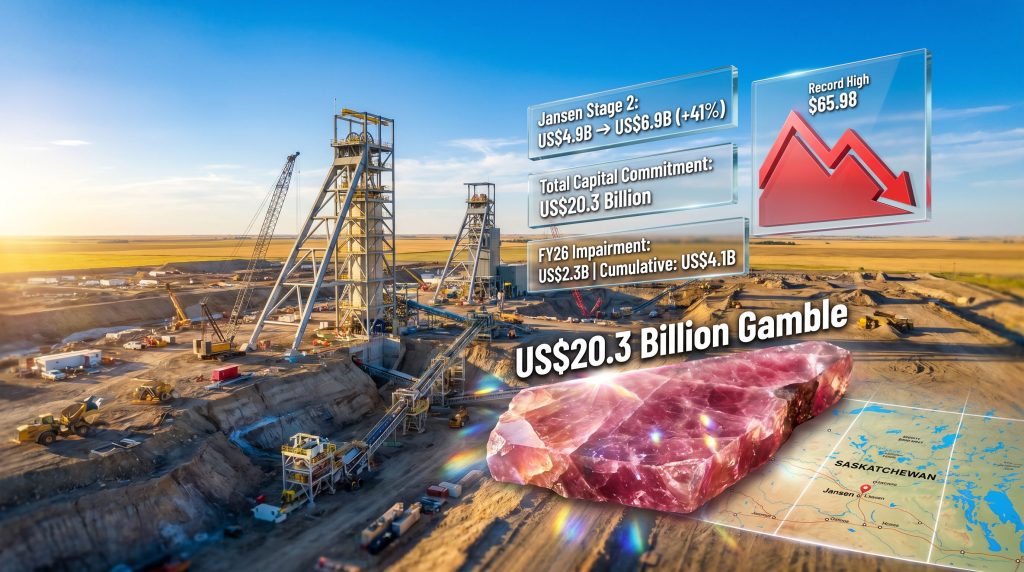
| Jansen Stage 2 | US$4.9 billion | US$6.9 billion | +41% / +US$2.0B |
| Additional capex disclosed above prior estimates | Nil | US$4.9B to US$5.4B | Significant |
| FY26 impairment charge | Nil | US$2.3 billion | New charge |
| Cumulative project impairments | Nil | US$4.1 billion total | Compounding |
| Combined Stage 1 and Stage 2 total deployment | Nil | US$20.3 billion | Full scope |
Stage 1 first production remains targeted for FY2027, though its own cost trajectory has drifted upward since initial approval. Stage 2 first production has been pushed from FY2029 to FY2031, a two-year delay that meaningfully extends the period before the project begins contributing cash flow.
What Is Actually Driving the Overrun
Understanding the mechanics of why Jansen costs escalated matters as much as knowing by how much. Furthermore, the drivers are consistent with patterns seen across major greenfield mining developments globally:
- Construction inflation: Input costs for steel, cement, and specialised equipment remained elevated well beyond the initial modelling window.
- Engineering scope revisions: Design changes required mid-construction are exponentially more expensive than alterations made at the feasibility stage.
- Labour productivity shortfalls: The number of workforce hours required on-site exceeded original projections, a common outcome in remote or specialised construction environments where crew turnover is high and skilled trades are scarce.
- Optimism bias in feasibility modelling: Academic literature on megaproject economics, including work by Oxford professor Bent Flyvbjerg, consistently demonstrates that large infrastructure and resource projects systematically underestimate costs at the approval stage, often because the teams seeking sanction have structural incentives to present optimistic scenarios.
In addition, the completion of definitive feasibility studies rarely eliminates the risk of mid-construction surprises, particularly in deep underground environments where geological variability resists precise early modelling.
Industry Context: A 40% cost overrun on a greenfield mining development of this scale and geological complexity, while deeply damaging to investor confidence, sits within the historical range of what large projects routinely deliver. What distinguishes Jansen is the pattern of successive revisions, each eroding the credibility of prior management guidance and compounding investor scepticism.
How BHP Shares Have Responded
The Price Action in Context
The market's reaction to the Jansen update was swift. BHP shares declined approximately 6% on the day the cost blowout was disclosed. Broader losses extended to nearly 8% of market value within days, compounded by separate concerns about potential industrial action in the iron ore division. From BHP's recent record high of $65.98, the stock pulled back by approximately 10.5% before finding support.
Why the Reaction Was Amplified
The severity of the sell-off was not solely a function of the Jansen news itself. Context matters significantly here. BHP shares had surged approximately 30% in the first half of 2026, reaching record highs and carrying elevated valuation expectations into the announcement. Over the prior 12-month period, the stock had delivered returns of roughly 64%, meaning a substantial portion of the investor base was sitting on large unrealised gains.
Behavioural finance research consistently demonstrates that markets punish negative surprises more severely when sentiment has been running at elevated levels. When a stock is priced for ongoing outperformance, any credible signal that complicates the thesis triggers both genuine repricing and profit-taking, amplifying the downside move. The commodity price impact on overall investor confidence also plays a role in how sharply a stock corrects when guidance disappoints.
Despite the pullback, BHP's year-to-date and 12-month performance remains exceptional. Long-term shareholders are, by any measure, still in a materially stronger position than they were 12 months ago.
What Analysts Are Saying About BHP Shares
Broker Sentiment: Cautious Rather Than Alarmed
Of the 19 analysts currently covering BHP Group, the majority have adopted a neutral stance following the Jansen update:
| Analyst Rating | Number of Analysts |
|---|---|
| Buy | 4 |
| Hold | 13 |
| Sell | 2 |
DZ Bank moved its rating from sell to hold following the announcement, setting a price target of $65, which implies approximately 10% upside from post-announcement levels. That upgrade is notable precisely because it came in the wake of bad news, suggesting some market participants view the sell-off as having overshot the fundamental damage.
The Striking Divergence in Price Targets
Perhaps more revealing than the consensus rating is the extraordinary spread between the most optimistic and most pessimistic analyst price targets:
- Most bullish target: US$94.51 per share, implying approximately 60% upside from current levels.
- Most bearish target: US$40.97 per share, implying approximately 30% downside.
A spread of nearly US$54 between the extremes is unusually wide for a company of BHP's scale and maturity. This level of analyst disagreement typically signals genuine uncertainty about medium-term capital allocation, not just short-term noise.
Citi maintains a constructive view, pointing to Jansen's projected operating cost range of US$114 to US$130 per tonne as evidence that the mine will rank among the world's most cost-competitive potash producers once fully operational. The estimated payback period of approximately 8 years supports a long-run value creation argument, provided the project is delivered on its revised schedule.
Barclays is more cautious, treating the 41% Stage 2 cost increase as a meaningful challenge to the project's investment case and raising questions about whether the economics justify continued capital deployment at this magnitude.
Is Jansen Still Worth the Capital? Examining the Investment Case
The Bull Case: Cost Competitiveness as a Durable Advantage
Once both stages are fully operational, Jansen is projected to produce approximately 8.5 million tonnes of potash annually. At an operating cost range of US$114 to US$130 per tonne, the operation would sit near the bottom of the global cost curve, a position that provides resilience through pricing cycles and generates outsized returns when market prices recover.
The structural demand backdrop, rising food insecurity, growing fertiliser intensity in developing agricultural economies, and limited greenfield potash development globally, provides a credible long-term revenue foundation. However, investors must weigh these positives against the persistent pattern of forecast revisions that has characterised the project.
The Bear Case: Pattern of Revisions Erodes Confidence
- Each successive budget revision since initial project approval has compounded investor scepticism about management's forecasting discipline.
- A cumulative US$4.1 billion in impairments represents a material destruction of shareholder value that cannot be dismissed as merely accounting.
- The two-year production delay for Stage 2 extends the capital-at-risk period and increases the effective cost of capital deployed on the project.
- With total capital committed across both stages now reaching US$20.3 billion, Jansen has become one of the largest single project bets in BHP's corporate history.
Scenario Modelling: Three Pathways Forward
| Scenario | Key Assumptions | Likely Investor Outcome |
|---|---|---|
| Base Case | Stage 1 delivers FY2027, potash prices recover modestly | Jansen becomes cash-generative by early 2030s |
| Bull Case | Supply disruption drives potash price spike, Stage 2 on revised schedule | Jansen emerges as a tier-1 global asset with strong free cash flow |
| Bear Case | Further cost increases, suppressed potash prices, additional write-downs | Persistent drag on BHP capital returns and investor confidence |
Disclaimer: Scenario projections are speculative and should not be taken as financial advice. Investment outcomes will depend on factors including commodity prices, project execution, and broader macroeconomic conditions.
The next major ASX story will hit our subscribers first
The Broader Picture: Jansen Within BHP's Portfolio Architecture
Three Pillars, One Company
BHP's earnings base rests on three distinct commodity exposures, each occupying a different position in the global economic cycle:
- Iron ore remains the dominant earnings engine, with world-class Pilbara operations generating substantial and relatively predictable free cash flow. Consequently, iron ore price trends remain closely watched by investors as a barometer of BHP's underlying earnings resilience.
- Copper exposure is expanding as electrification-driven demand growth positions copper as a critical transition mineral, and the ongoing copper supply crunch continues to support the long-term investment rationale for BHP's expansion in this segment.
- Potash via Jansen represents a long-duration, agricultural economy bet that operates on a fundamentally different demand cycle from metals.
This diversification logic remains intact even after the Jansen blowout. The core earnings base is not threatened by Jansen's construction challenges, which is part of why the sell-off, though sharp, has not reversed the majority of the stock's 2026 gains.
Capital Allocation Under the Microscope
The August FY26 results will be a critical test. BHP has committed to providing a further Stage 1 cost update before financial year end, with full FY26 guidance expected at the August results. The market will be watching closely for any indication that management has genuinely stabilised cost and schedule estimates, or whether the trajectory of successive revisions continues.
Investor Watch Point: For long-term shareholders, the August results represent a moment of genuine information value. Stable revised guidance would likely restore some confidence. Another upward revision would accelerate the credibility problem that is already embedded in the stock's cautious analyst consensus.
What the History of Mining Megaprojects Tells Us
Large-scale resource projects routinely exceed their approved budgets. Research into infrastructure and mining project economics across multiple decades shows that initial cost estimates are systematically optimistic, with actual costs frequently running 20% to 80% above feasibility-stage figures. This is particularly pronounced in greenfield underground or deep-shaft developments, where geological variability, ventilation requirements, and shaft construction complexity interact in ways that are difficult to model before ground is broken.
The Elk Point Basin deposits in Saskatchewan, while well-characterised by decades of exploration, involve mining at depths that require careful management of ground pressure, brine inflows, and thermal conditions. These are not unique to Jansen, but they are inherent to the geology that makes the deposit so large and valuable.
What distinguishes Jansen from other overruns is not the percentage overage in isolation, but the repeated nature of the revisions. Each successive update to cost and schedule guidance has compounded the credibility deficit, making it harder for management to anchor market expectations around any single forecast. The BHP shares Jansen project cost blowout, viewed through this historical lens, is a reminder that even the most experienced operators are not immune to the structural forces that drive megaproject overruns.
Frequently Asked Questions: BHP Shares and the Jansen Cost Blowout
What is the Jansen potash project?
Jansen is BHP's large-scale potash development located in Saskatchewan, Canada. Designed to be built in two stages, the project targets combined annual production of approximately 8.5 million tonnes once fully operational, positioning BHP as a significant global fertiliser supplier.
How much has the Jansen Stage 2 capital expenditure increased?
Stage 2 costs have risen by approximately 41%, from an original estimate of US$4.9 billion to a revised figure of US$6.9 billion. BHP also disclosed an additional capital requirement of US$4.9 billion to US$5.4 billion above prior total estimates.
What write-down is BHP recording on Jansen?
BHP will recognise an impairment charge of approximately US$2.3 billion in its FY26 financial results, bringing cumulative impairments across the Jansen project to roughly US$4.1 billion.
When will Jansen Stage 2 first produce potash?
The revised timeline targets first production from Stage 2 in FY2031, representing a two-year delay from the original FY2029 target.
Why did BHP shares fall after the Jansen announcement?
The share price decline reflected investor disappointment over cost escalation and schedule delays, combined with profit-taking after a strong 30% year-to-date rally in 2026 and concerns about the ongoing pattern of management forecast revisions.
What is the analyst consensus on BHP shares now?
Of 19 analysts covering BHP, 13 rate the stock as a hold, four as a buy, and two as a sell. Price targets range from approximately US$40.97 to US$94.51, reflecting genuine uncertainty about the medium-term impact of the BHP shares Jansen project cost blowout on overall valuation.
Key Takeaways for BHP Shareholders
- The Jansen cost blowout is a material negative for near-term sentiment, but leaves BHP's core iron ore and copper earnings base intact.
- The revised US$20.3 billion total capital commitment across both Jansen stages represents one of the largest single project investments in BHP's history.
- Long-term investors must weigh the compelling structural agricultural demand thesis against a demonstrated and compounding pattern of cost and schedule slippage.
- BHP's August FY26 results will be a critical catalyst, with stable revised guidance potentially representing the beginning of a confidence recovery.
- Despite the pullback, the stock's 30% year-to-date gain and 64% 12-month return mean long-term shareholders remain in a materially strong position.
This article is general in nature and does not constitute personalised financial advice. Investors should consider their individual circumstances and consult a qualified financial adviser before making investment decisions. Past performance is not indicative of future returns.
Want to Stay Ahead of the Next Major ASX Mineral Discovery?
While BHP's Jansen saga illustrates the complex realities of large-scale resource development, smaller ASX-listed explorers can deliver transformative returns far earlier in the cycle — and Discovery Alert's proprietary Discovery IQ model delivers real-time notifications the moment significant mineral discoveries hit the ASX, turning complex geological data into clear, actionable insights for investors at every experience level. Explore historic discovery returns that demonstrate just how substantial early-mover advantages can be, and begin your 14-day free trial today to position yourself ahead of the broader market.