June 27, 2026
When Reform Becomes a Race Against Time: Bolivia's Post-Crisis Economic Pivot
Resource-rich nations caught between nationalist economic frameworks and the urgent demands of foreign capital have long faced a defining paradox: the very policies designed to protect sovereign wealth often become the barriers that prevent it from being realised. Bolivia industry reforms after protests now represent the most consequential economic pivot the country has attempted in a generation, as President Rodrigo Paz navigates a compressed reform window following more than seven weeks of crippling road blockades.
Understanding the full dimensions of Bolivia's post-protest reform agenda requires looking beyond the immediate political drama. What is unfolding is a structural reckoning with decades of resource nationalism, a fragile fiscal position, and a rapidly closing opportunity to attract the foreign capital that Bolivia's mineral wealth has long promised but rarely delivered.
When big ASX news breaks, our subscribers know first
The True Scale of Bolivia's Economic Damage
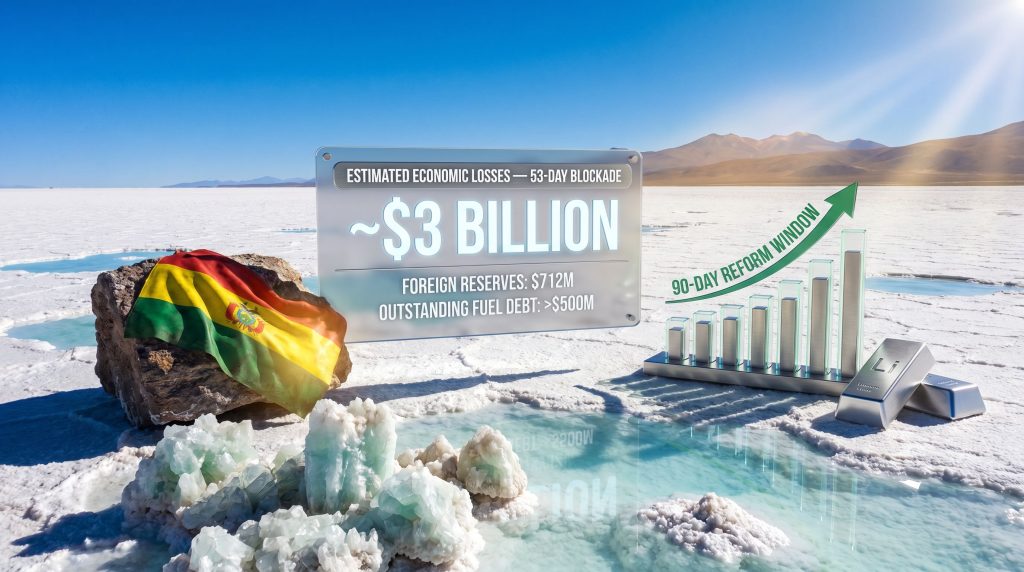
The 53-day blockade campaign did not merely disrupt daily commerce. It delivered a measurable shock to an economy that was already operating with limited resilience. The figures that have emerged from the crisis period paint a sobering picture.
| Economic Indicator | Estimated Impact |
|---|---|
| Total Economic Losses | ~$3 billion USD |
| GDP Contraction (Blockade Period) | ~6% of annual GDP |
| Foreign Cash Reserves (as of June 19, 2026) | $712 million USD |
| Outstanding Fuel Debt (Vitol SA and Trafigura Group) | Over $500 million USD |
| Duration of Blockades | 53 days |
| State of Emergency Duration | 90 days |
The 2026 Bolivian protests were organised by a coalition including the national labour union, the La Paz farmers federation, and followers of former President Evo Morales. Their collective action choked supply chains across the country, producing acute shortages of food, medicine, and fuel that hit residents of La Paz and El Alto with particular severity.
The logistics sector has not simply bounced back. Freight depots remain congested with unprocessed shipments, and the operational chaos facing transport businesses reflects a disruption that will take months to fully unwind. Truckers who spent more than 50 days stranded on highways are now queuing at fuel stations, with some waiting in lines stretching over a kilometre just to obtain diesel.
Jonathan Fortun, senior economist at the Institute of International Finance, has assessed that Bolivia enters its recovery phase carrying compounding vulnerabilities across output, inflation, and fiscal capacity, with considerably less room to manoeuvre than it had prior to the conflict. The combination of economic fatigue and constrained policy options represents a distinctly narrow corridor for reform.
The fuel debt figure deserves particular attention. Bolivia's central government owes more than $500 million to international commodity traders Vitol SA and Trafigura Group for fuel purchased on credit, while its central bank held only $712 million in foreign cash reserves as of mid-June 2026. This proximity between the debt obligation and total reserve holdings creates a sovereign vulnerability that significantly constrains the government's negotiating leverage with international creditors and the International Monetary Fund.
What Ignited the Crisis: The Fuel Subsidy Flashpoint
The immediate trigger for Bolivia's protest wave was Supreme Decree 5503, a government measure that attempted to reduce fuel subsidies. Bolivia has historically maintained heavily subsidised domestic fuel prices, a policy that became fiscally unsustainable as hydrocarbon revenues declined.
The partial rollback of these subsidies created immediate public resentment, but the catalyst that converted political discontent into sustained blockades was more visceral: thousands of vehicles across Bolivia were damaged by poor-quality gasoline earlier in 2026, producing tangible economic harm for ordinary citizens and truck operators before the formal protests even began.
This sequence is important for understanding why the blockades achieved the scale and duration that they did. The fuel quality scandal created a pre-existing grievance base that political organisers could mobilise, transforming what might have been a short-term protest into a 53-day national disruption. Former President Morales, who broadcasts regularly from a fortified radio station compound in the Chapare region, provided sustained political coordination for the movement.
The government's decision to implement a 90-day state of emergency ultimately broke the blockades, but it did not resolve the underlying political dynamics. A fresh blockade resumed in Chapare shortly after the main campaign ended, signalling that the reform window is operating under live political pressure.
The Four-Pillar Reform Architecture
Bolivia's post-protest policy agenda reflects a significant ideological departure from the nationalisation framework that defined economic governance under Morales for nearly two decades. The Paz administration is advancing four interconnected reform streams that collectively represent the most substantial opening to foreign capital that Bolivia has attempted in a generation. Furthermore, Bolivia industry reforms after protests must move swiftly to capitalise on the current political window before opposition coalitions regroup.
Macroeconomic Stabilisation: Abandoning the Fixed Exchange Rate
Bolivia's Finance Ministry announced the transition to a flexible exchange rate system, ending an arrangement that had long shielded domestic purchasing power but consumed foreign reserves at an unsustainable rate. A managed float introduces short-term volatility but restores a market-clearing mechanism that creditors and investors require as a foundation for capital deployment. This reform is directly linked to ongoing negotiations with the IMF, where exchange rate flexibility is typically a prerequisite for programme approval.
The currency adjustment carries its own political risks. Devaluation of the boliviano raises the domestic cost of imported goods, including fuel, creating inflationary pressure on the same population that has just endured weeks of shortages. Navigating this transition without triggering renewed social unrest is among the most technically demanding challenges facing the administration.
Energy Sector Privatisation: The Proposed Electricity Law
New electricity legislation is being drafted to introduce private competition into Bolivia's state-dominated energy sector. This represents a direct reversal of the nationalisation architecture built over the Morales era. The practical objective is to attract foreign capital into energy infrastructure, reducing the state's fiscal burden while expanding generation capacity. Opposition from labour organisations and indigenous communities is anticipated, and this legislation may prove to be the most politically contentious element of the entire reform package.
Mining and Lithium Investment Reform: Unlocking Critical Minerals
Bolivia holds some of the world's largest known lithium brine reserves, concentrated primarily in the Salar de Uyuni. The surge in critical minerals demand driven by the global energy transition makes Bolivia's geological endowment strategically significant, yet the country has historically struggled to convert deposits into production at scale.
The proposed mining reforms aim to reconstruct the legal environment for international capital, reactivating stalled contracts with foreign partners and reducing the sovereign risk perception that has kept major mining houses at arm's length. Bolivia's lithium is not a simple extraction proposition. The high magnesium-to-lithium ratios found in Salar de Uyuni brines have historically complicated processing economics compared to Chilean or Argentine deposits, requiring more sophisticated and costly beneficiation methods.
In addition, lithium brine extraction in Bolivia faces unique technical hurdles that investors must carefully evaluate before committing capital. Furthermore, emerging direct lithium extraction technologies could potentially address some of these processing challenges, making Bolivia's deposits more commercially viable for international partners. Any reform framework that attracts serious capital will need to account for this technical complexity in its royalty and revenue-sharing structures.
The competitive landscape for Bolivian lithium contracts involves Chinese, Russian, and Western corporate interests, each operating with different financing models and strategic objectives. China's approach has historically emphasised state-to-state arrangements and long-term supply security, while Western investors tend to require stronger legal protections and independent arbitration mechanisms. Crafting legislation that can satisfy multiple foreign capital frameworks simultaneously is a genuine structural challenge, as metals and mining geopolitics increasingly shape which partners nations choose to engage.
Agricultural Export Liberalisation
Four major reform bills targeting soybean export controls and land use policy are being prepared. Critics of these measures warn that their implementation could transfer significant portions of Bolivia's agricultural land to corporate entities, potentially displacing smallholder farmers and indigenous communities. This secondary reform stream creates its own social opposition risk that runs parallel to the energy and mining debates.
Regional Comparison: Bolivia's Reform Posture Among Latin American Peers
| Country | Reform Approach | Foreign Investment Climate | Key Resource |
|---|---|---|---|
| Bolivia (2026) | Post-crisis market opening | Transitioning, elevated risk | Lithium, hydrocarbons |
| Chile | Established mixed model | Moderate, stable | Copper, lithium |
| Argentina | IMF-driven fiscal reform | Improving, volatile | Lithium, agriculture |
| Peru | Persistent political instability | Constrained | Copper, gold |
Bolivia's situation is distinct from Argentina's ongoing IMF-driven adjustment in one critical respect. Argentina entered its reform cycle with considerably more developed private sector infrastructure and export capacity. The Argentina lithium brine market illustrates how a more open investment framework can accelerate production timelines, providing a useful benchmark for what Bolivia could achieve if its reforms succeed. Bolivia's state-centric economic architecture means that private sector institutions capable of absorbing and deploying foreign capital are less mature, consequently extending the timeline between policy reform and actual investment activity.
The Seven-Step Reform Sequence Bolivia Must Execute
The 90-day state of emergency provides a finite political window. The sequencing of reforms within this window will determine whether the agenda builds momentum or collapses under its own weight.
- Finalise IMF programme negotiations to unlock external financing and restore international creditor confidence.
- Implement the flexible exchange rate system and manage the inflationary consequences of currency adjustment.
- Pass the electricity privatisation legislation to demonstrate structural reform commitment to international investors.
- Advance mining and lithium investment laws to reactivate stalled foreign contracts and establish investment-safe legal frameworks.
- Resolve the $500 million fuel trader debt and restore reliable domestic fuel supply chains.
- Stabilise the Chapare region to prevent the Morales-aligned movement from reconstituting blockade infrastructure.
- Engage agricultural and indigenous communities on land reform proposals to reduce the risk of a secondary protest cycle.
The next major ASX story will hit our subscribers first
Risk Factors That Could Collapse the Reform Window
Bolivia's reform agenda operates within a fragile political and fiscal environment. Four distinct risk categories deserve careful monitoring.
- Renewed blockades: The Chapare region remains an active flashpoint, and the 90-day state of emergency will eventually expire, potentially removing the legal constraints on organised disruption.
- Fuel supply insecurity: With over $500 million owed to commodity traders and reserves of only $712 million, any deterioration in Bolivia's credit relationship with fuel suppliers could produce immediate supply disruptions.
- Social opposition coalitions: Labour unions, indigenous groups, and agricultural communities have demonstrated their capacity for sustained organised action. Privatisation measures targeting energy and land may consolidate these groups into a unified opposition.
- IMF conditionality friction: Currency devaluation, fiscal consolidation, and subsidy reduction are standard IMF programme requirements that historically generate significant social resistance in resource-dependent economies with large informal sectors.
The Institute of International Finance has highlighted that Bolivia industry reforms after protests must advance concurrently with currency devaluation and IMF negotiations, a combination that places simultaneous pressure on multiple points of social tolerance. This sequencing challenge has derailed comparable reform programmes in other Latin American resource economies.
What Exporters and Investors Need to See
The Bolivian Exporters Chamber has been explicit about its immediate priorities. The organisation is pressing for rapid legislative action within the 90-day window, guaranteed fuel supply continuity for export operations, and government assistance to help businesses manage shipping penalties and contract losses that accumulated during the blockade period. Full recovery of foreign trade flows is expected to require multiple months beyond the resolution of blockades, meaning the economic damage is not simply reversed when roads reopen.
For international mining investors, however, the requirements are more structural. Legal frameworks governing contract sanctity, royalty structures that account for the processing complexity of Bolivian lithium brines, and credible independent dispute resolution mechanisms are minimum requirements before significant capital commitments can be justified. The history of nationalisation in Bolivia's resource sector creates a sovereign risk premium that new legislation will need to actively dismantle, not merely acknowledge.
Three Scenarios for Bolivia's 24-Month Economic Trajectory
Scenario A: Reform Succeeds. The IMF programme is finalised, lithium and mining legislation passes within the 90-day window, foreign investment commitments begin flowing into the minerals sector, and exchange rate adjustment stabilises without triggering significant inflation-driven unrest. Bolivia emerges from the crisis with a diversified and more open investment framework.
Scenario B: Partial Reform. Key legislation stalls in the face of organised social opposition, fuel supply disruptions persist due to unresolved commodity trader debt, and investor confidence remains suppressed. The IMF programme experiences delays, prolonging fiscal vulnerability without delivering the external financing that would underpin economic recovery.
Scenario C: Reform Collapse. The state of emergency expires before core legislation is passed, renewed blockades resume in the Chapare and potentially spread, and capital flight accelerates. Bolivia's resource sector enters a period of prolonged contraction, and the lithium sector remains locked out of global supply chains at a moment when battery manufacturing demand continues to expand.
The outcome that materialises will depend not only on the Paz administration's legislative skill, but on whether Bolivia's fractured political landscape allows the 90-day window to function as intended. For a country that holds world-class mineral assets but has consistently struggled to translate geological endowment into economic development, Bolivia industry reforms after protests represent a pivotal juncture that extends well beyond any single administration's agenda.
This article contains forward-looking assessments and scenario projections based on publicly available economic data and analyst commentary. These do not constitute investment advice. Readers should conduct independent research before making any investment decisions related to Bolivian assets or Latin American resource markets.
Want to Track the Next Major Mineral Discovery Before the Market Does?
Discovery Alert's proprietary Discovery IQ model delivers real-time alerts on significant ASX mineral discoveries, turning complex geological and commodity data into actionable investment insights — explore the historic returns major discoveries have generated and begin your 14-day free trial to position yourself ahead of the broader market.