May 19, 2026
The Quiet Art of Outperforming: How Income-First Investors Find Value in Diversified Miners
There is a particular type of fund manager who rarely makes headlines. They are not chasing the next speculative growth story or rotating aggressively into thematic momentum plays. Instead, they construct portfolios around a deceptively simple principle: find high-quality businesses that generate reliable cash flows, return capital to shareholders through well-supported dividends, and carry meaningful exposure to structural demand trends that play out over years, not quarters.
This approach, sometimes dismissed as conservative or uninspiring, has a long track record of outperforming benchmark indices over full market cycles. And increasingly, it is precisely this framework that is pointing experienced portfolio managers toward an overweight position in BHP Group Ltd (ASX: BHP).
Understanding why this top fundie is overweight BHP shares requires looking beyond headline commodity prices. The real answer lies at the intersection of portfolio construction theory, commodity cycle positioning, dividend engineering, and a structural transformation in BHP's own earnings architecture.
When big ASX news breaks, our subscribers know first
Why Institutional Portfolio Managers Think Differently About Large-Cap Resource Stocks
Retail investors and institutional fund managers often look at the same stock and reach entirely different conclusions, not because they are working from different data, but because they are solving for different problems.
A retail investor might evaluate BHP based on recent share price momentum or the next iron ore shipment number. An institutional portfolio manager, by contrast, is solving for a far more complex optimisation problem: how does adding or increasing a position in BHP affect the portfolio's overall risk profile, income generation capacity, benchmark deviation, and long-term compounding trajectory?
For Leanne Pan, a portfolio manager at Prime Value Asset Management, BHP represents the clearest answer to that multi-variable question across the entire ASX. Pan, who has operated with a dividend-growth investment philosophy for over two decades, holds BHP as her largest portfolio position. Her investment framework centres on companies that simultaneously deliver income today and growth optionality tomorrow, a combination that is genuinely rare among ASX large-caps.
Her perspective on dividend income as a structural return component is grounded in long-term index data. The S&P/ASX 200 benchmark has historically delivered average annual returns of approximately 8% to 9% over the past two decades, with dividends contributing roughly 3% to 4% of that total. Stripping dividends out of total return calculations is not just an accounting error for income-oriented managers — it fundamentally misrepresents how wealth compounds over time.
The Mechanics of Overweighting: What It Actually Means in Practice
For investors unfamiliar with portfolio construction terminology, understanding what it means to be overweight a stock is essential context.
- An overweight position means a fund holds a larger percentage of a stock than its benchmark index weighting
- For a stock as large as BHP within the S&P/ASX 200, going overweight represents a high-conviction active bet
- This creates tracking error, meaning the portfolio will perform differently from the index depending on how BHP performs
- Fund managers who accept this tracking error are explicitly signalling that their conviction in BHP's risk-adjusted return profile exceeds what the index passively offers
This is not a small decision. When a manager of Pan's profile and tenure makes BHP their single largest holding, it reflects years of analysis, not a tactical trade. Furthermore, understanding BHP's strategic pivot toward higher-growth commodities adds important context to why this conviction has deepened in recent periods.
BHP's Structural Appeal: Why Scale, Liquidity, and Diversification All Matter
Large-cap fund managers face a constraint that smaller investors do not: they need to be able to move substantial capital into and out of positions without materially affecting market prices. This limits their effective investment universe to a subset of the ASX where daily trading volumes are large enough to absorb institutional-scale transactions.
BHP clears that threshold comfortably. As one of the largest companies by market capitalisation on the ASX, it offers the liquidity depth that institutional mandates require. However, liquidity alone does not explain Pan's conviction. BHP's commodity diversification is equally central to the thesis.
| Commodity | Demand Driver | Investment Narrative |
|---|---|---|
| Iron ore | Chinese industrial output and infrastructure spending | Steady cash flow anchor |
| Copper | Global electrification, EV adoption, AI data centre build-out | Long-term structural growth |
| Potash | Global food security, agricultural productivity | Multi-decade diversification |
This three-commodity structure is not accidental. It provides BHP with exposure to distinct economic cycles, reducing concentration risk while maintaining leverage to global industrial activity. Iron ore anchors near-term cash generation, copper provides the growth narrative most closely aligned with the energy transition, and potash adds a long-duration agricultural commodity exposure that is increasingly relevant to ESG-aware institutional allocators.
Copper's Ascent: When a Commodity Shift Becomes an Earnings Revolution
The most significant development in BHP's investment story over the past 18 months is not the iron ore price or the potash development timeline. It is copper, and specifically, the degree to which copper has transformed BHP's earnings composition.
At BHP's H1 FY2026 results, the company reported that copper earnings reached US$8 billion, surpassing iron ore contributions and accounting for more than 50% of group earnings for the first time in the company's history. This is not a marginal shift. It represents a fundamental rebalancing of BHP's financial identity.
The copper price environment underpinning this result is itself remarkable. Copper has surged approximately 43% over a 12-month period, reaching US$13,588 per tonne, driven by a confluence of structural demand pressures. The copper demand drivers fuelling this surge show no signs of reversing:
- Electric vehicle manufacturing requires significantly more copper per unit than internal combustion engine vehicles
- Grid infrastructure upgrades globally to support renewable energy integration demand substantial copper wiring and cabling
- AI-capable data centres require copper for power delivery systems, cooling infrastructure, and high-speed connectivity
- Renewable energy generation assets including wind turbines and solar installations are copper-intensive relative to fossil fuel equivalents
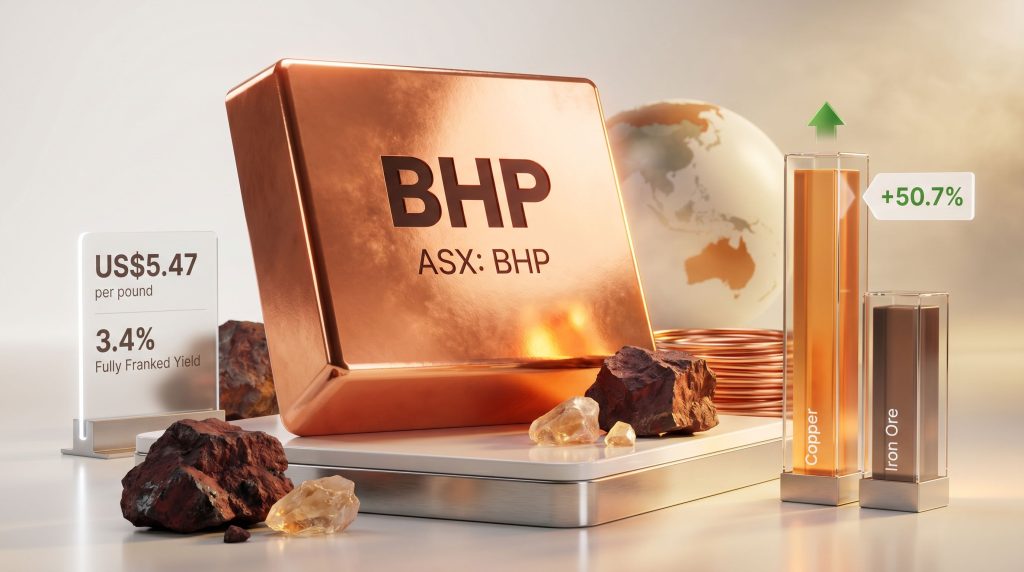
At BHP's Q3 FY2026 operational update, released on 22 April, the company reported year-to-date copper production of 1,461 tonnes, with an average realised copper price of US$5.47 per pound, representing a 31% year-on-year increase in realised pricing.
The significance of this pricing improvement cannot be overstated. A 31% increase in average realised price flows almost directly into margin expansion, given that copper production costs do not increase proportionally with commodity prices.
Understanding Copper Supply Constraints: A Less Commonly Discussed Dynamic
While demand-side drivers for copper receive extensive coverage, the supply side deserves equal attention. Copper ore grades at many of the world's largest producing mines have been declining over decades as the highest-quality ore bodies are progressively mined out. This means that even maintaining flat copper production volumes requires increasing amounts of ore to be processed, raising unit costs industry-wide.
The copper supply crunch is further compounded by new mine development lead times, typically 10 to 15 years from initial discovery to production, combined with increasing capital intensity and regulatory complexity. Consequently, demand increases do not translate quickly into new supply, creating conditions for sustained price elevation that benefit large, established producers like BHP disproportionately.
The Dividend Case: Franked Yield as a Return Engineering Tool
For Australian investors and fund managers operating within franking-credit-eligible structures such as superannuation funds and SMSFs, BHP's fully franked dividend is not merely an income component. It is a tax-efficient return engineering mechanism that materially enhances after-tax outcomes compared to unfranked alternatives.
BHP's trailing fully franked dividend yield of 3.4% appears modest in isolation. However, once the attached franking credits are factored into the after-tax return calculation, particularly for superannuation funds in accumulation phase paying a 15% tax rate, the effective yield improves considerably. Top fundies name BHP among their preferred holdings precisely because of this franking credit advantage in difficult market environments.
How Franking Credits Work in Practice
- BHP pays company tax at the Australian corporate tax rate on its Australian earnings
- Shareholders receive dividends with attached franking credits representing tax already paid at the corporate level
- Australian investors use these credits to offset their personal income tax obligations
- For superannuation funds, excess franking credits can generate direct cash refunds from the ATO
- This mechanism means a 3.4% franked yield can be equivalent to a materially higher unfranked yield depending on the investor's tax position
Pan's portfolio construction approach specifically targets this dynamic. By focusing on fully franked dividend payers operating within a growth framework, she delivers compounding after-tax total returns that passive international index exposure cannot replicate for Australian investors.
Share Price Performance: Contextualising an Exceptional 12-Month Run
BHP shares have delivered 50.7% price appreciation over the past 12 months, measured against a benchmark S&P/ASX 200 return of just 3.5% over the same period. When the 3.4% fully franked trailing dividend yield is incorporated, estimated total returns approach 54% or more, representing extraordinary outperformance for a mega-cap holding.
| Performance Metric | BHP | ASX 200 Benchmark |
|---|---|---|
| 12-Month Price Return | +50.7% | +3.5% |
| Trailing Dividend Yield | 3.4% (fully franked) | ~4.0% (index average) |
| Estimated Total Return | ~54%+ | ~7-8% |
This magnitude of outperformance from a company of BHP's size is unusual and warrants careful interpretation. It does not necessarily signal that further outperformance of this magnitude is likely in the near term. Rather, it reflects the market re-rating BHP's earnings quality upward as the copper earnings inflection became apparent and as institutional recognition of BHP's electrification commodity exposure deepened.
Disclaimer: Past share price performance is not indicative of future returns. Investors should consider their individual financial circumstances and risk tolerance before making investment decisions. This article contains general information only and does not constitute financial advice.
The next major ASX story will hit our subscribers first
Potash: The Long-Duration Growth Layer That Extends BHP's Investment Timeline
Beyond copper and iron ore, BHP's Jansen potash project in Saskatchewan, Canada, represents a genuinely long-duration growth asset that extends the company's investment narrative well beyond the current commodity cycle. Understanding broader commodity cycles helps explain why patient institutional investors place significant value on assets with this kind of multi-decade production horizon.
Potash is a potassium-rich mineral used primarily as a crop fertiliser. As global food demand grows alongside population increases and dietary shifts in developing economies, the agricultural productivity improvements that potassium-based fertilisers enable become increasingly economically significant. From an investment perspective, potash offers BHP several strategic advantages:
- Demand independence from industrial economic cycles, since food production continues regardless of manufacturing activity levels
- Geographic diversification of production assets away from Australian and South American operations
- ESG narrative alignment with food security as an increasingly important institutional investment consideration
- Multi-decade production horizon providing asset life extension well beyond existing commodity portfolios
The Jansen project is currently in active development. While it will not contribute materially to BHP's near-term earnings, it represents a call option on a structural demand theme that institutional investors with long investment horizons find compelling.
The Steady Compounder Philosophy: Why Boring Beats Brilliant Over Time
Pan's investment philosophy, which she has described as a steady-as-she-goes approach that does not chase speculative multi-bagger opportunities, reflects a well-documented body of evidence in investment research. Consistent, risk-adjusted returns compound more effectively over long periods than volatile high-growth strategies that experience significant drawdowns.
This philosophy is particularly well-suited to superannuation-linked mandates, where:
- Investment horizons span decades rather than years
- Income obligations to fund members require predictable cash distributions
- Drawdown sensitivity is higher because members approaching retirement cannot afford to wait for recovery from significant capital losses
- Tax efficiency from franked dividends materially enhances compounding returns within the superannuation tax structure
BHP fits this framework because its business model does not require optimistic commodity price assumptions to generate acceptable returns. The company produces cash flow across commodity cycles, maintains a strong balance sheet, and has demonstrated disciplined capital allocation through multiple industry downturns.
Bull Case Versus Bear Case: Balancing Conviction with Caution
| Investment Dimension | Bull Case | Bear Case |
|---|---|---|
| Copper price | Structural supply deficit supports elevated prices long-term | New project supply response could compress margins |
| Iron ore | Chinese industrial demand remains resilient | Property sector weakness reduces steel output |
| Potash | Food security drives sustained fertiliser demand | Long development timeline and capital intensity risks |
| Dividends | Strong free cash flow supports growing franked yield | Commodity price decline could pressure payout ratios |
| Valuation | Reasonable multiples relative to earnings quality | Premium to historical averages if the commodity cycle turns |
Institutional managers who go overweight BHP are not blind to these risks. They are making a considered judgement that the probability-weighted upside from copper exposure, dividend compounding, and potash optionality outweighs the downside risks over their investment horizon. In addition, Australia's best fund managers have consistently highlighted BHP among their most-loved positions, further validating this institutional conviction.
What This Means for Investors Evaluating BHP Shares Today
The confluence of factors driving institutional interest in BHP shares reflects more than a single commodity price cycle. The structural shift in BHP's earnings toward copper, the sustained demand tailwinds from global electrification and AI infrastructure development, the tax-efficient income delivery through fully franked dividends, and the long-duration growth option embedded in the Jansen potash project combine to create a multi-dimensional investment case that resonates across different investor mandates.
For income-oriented investors, the 3.4% fully franked yield provides a meaningful and tax-efficient return floor. For growth-oriented allocators, the copper earnings inflection and potash development pipeline offer structural upside that extends well beyond near-term commodity price movements. For benchmark-relative managers, BHP's S&P/ASX 200 weighting makes it a natural vehicle for expressing a bullish view on commodity sector earnings quality.
Understanding why this top fundie is overweight BHP shares ultimately comes down to one insight: BHP is not simply a mining company. In the hands of a skilled portfolio manager like Pan, it functions as a precision instrument for delivering diversified commodity exposure, tax-efficient income, and structural growth optionality within a single, highly liquid, ASX-listed position.
This article contains general information only and does not constitute personalised financial or investment advice. Investors should seek independent advice and conduct their own due diligence before making investment decisions. Commodity prices, company earnings, and share prices are subject to significant variability and past performance does not guarantee future outcomes.
Ready to Uncover the Next Major ASX Mineral Discovery Before the Market Does?
Whilst BHP offers diversified commodity exposure and structural growth through copper and potash, the most transformative investment returns on the ASX have historically come from being positioned in significant mineral discoveries at the earliest possible stage — Discovery Alert's proprietary Discovery IQ model scans ASX announcements in real time, instantly converting complex geological data into actionable opportunities across 30+ commodities, just as it did for subscribers during landmark discoveries by De Grey Mining and WA1 Resources. Explore historic discovery returns on Discovery Alert's dedicated discoveries page and begin a 14-day free trial to ensure you are positioned ahead of the broader market when the next major discovery is announced.