July 27, 2026
The Hidden Geology Problem Reshaping BHP's Copper Story
Few dynamics in mining investing are as misunderstood by retail investors as the relationship between ore grade and earnings power. A mine does not simply produce copper at a fixed rate indefinitely. As open-cut operations descend deeper into a porphyry deposit, the concentration of copper within each tonne of rock processed tends to decline. This geological reality, known as grade decline, sits at the centre of one of the most consequential questions facing BHP Group Ltd (ASX: BHP) as it heads into this reporting season — and the BHP shares reporting season copper outlook is drawing intense scrutiny from analysts and institutional investors alike.
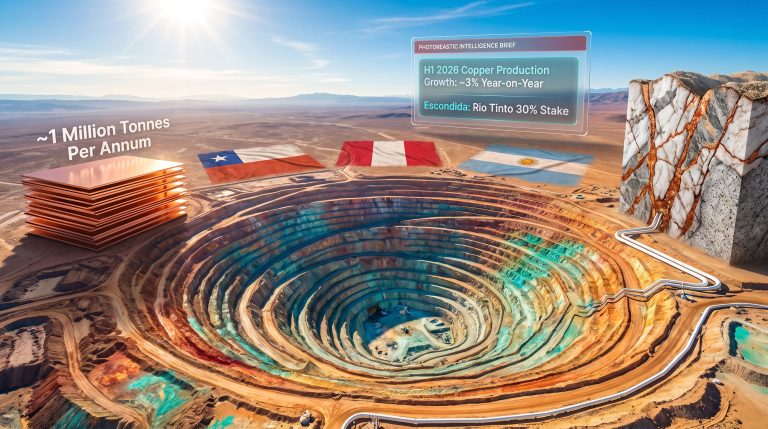
Understanding grade decline requires a basic grasp of how large porphyry copper systems work. These deposits, which include the world's biggest mines, are shaped like irregular columns of mineralised rock. The highest-grade ore is rarely distributed evenly throughout the deposit. At Escondida in northern Chile, the world's largest copper mine by output, BHP has been working through zones of varying quality for decades.
When concentrator feed grade — the copper content percentage of ore fed into the processing plant — drops, the mine must process more rock to produce the same amount of metal. This increases energy consumption, water usage, and operating costs per unit of output, compressing margins even when copper prices remain elevated. Furthermore, understanding cut-off grade economics helps investors appreciate why this shift carries such significant consequences for profitability.
This is precisely the dynamic BHP flagged in its operational review for the year ended 30 June 2026, and it is the variable that will dominate analyst questions when the company delivers its full-year result next month.
When big ASX news breaks, our subscribers know first
Why the BHP Shares Reporting Season Sets Up as a Two-Act Story
Act One: A Financial Result That Should Impress
The historical earnings picture for BHP in FY26 is expected to be genuinely strong. The foundation was established in the half-year result for the six months ended 31 December 2025, which delivered metrics that would have seemed optimistic twelve months prior.
| Financial Metric | H1 FY26 Result | Year-on-Year Change |
|---|---|---|
| Group Revenue | US$27.9 billion | +11% |
| Underlying EBITDA | US$15.5 billion | +25% |
| EBITDA Margin | 58% | Significant expansion |
| Underlying Attributable Profit | US$6.2 billion | +20%+ |
| Operating Cash Flow | US$9.4 billion | Strong |
| Net Debt | US$14.7 billion | Mid-range of target |
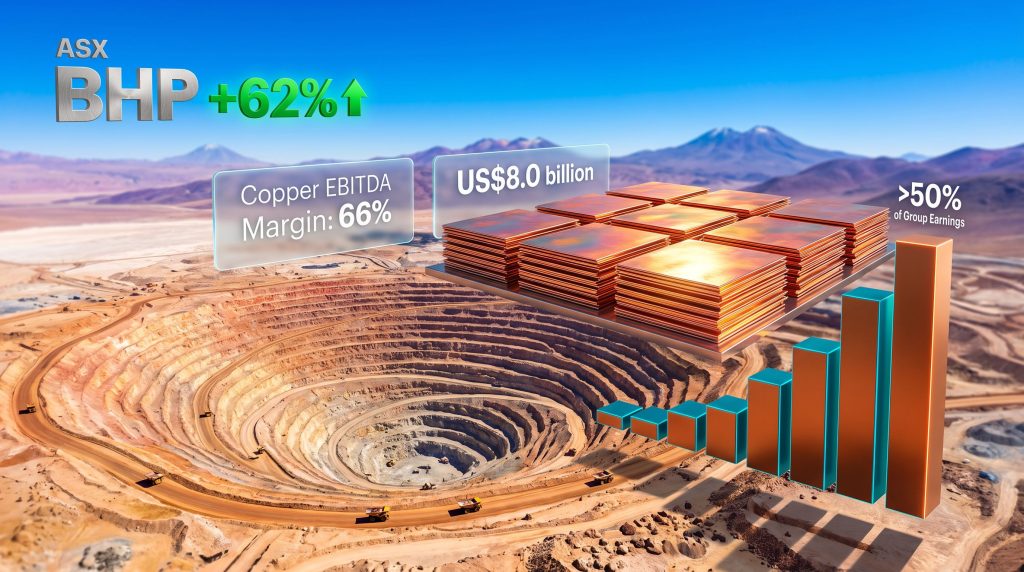
| Copper Segment EBITDA | US$8.0 billion (record) | Majority of group earnings |
| Copper EBITDA Margin | 66% | Best-in-class |
| Interim Dividend | 73 US cents per share | +46% on prior half |
What makes the copper EBITDA margin of 66% particularly significant is the operational leverage it reflects. At Escondida's scale, incremental revenue from higher copper prices flows almost directly to the bottom line because fixed costs are spread across an enormous production base. When that base contracts due to grade decline, the leverage works in reverse, which is why FY27 guidance is causing more concern than the FY26 numbers themselves.
For context, BHP's investor hub confirms that BHP shares closed the financial year at $59.40, representing a 62% gain across FY26 and the stock's strongest annual performance in close to two decades. The result landed during the resources sector's most productive year since 2006. Since that June peak, the shares have pulled back modestly to trade near the $58 mark following a broader market sell-off.
Act Two: The Forward Guidance That Will Drive the Share Price Reaction
Experienced resources investors understand a fundamental truth about reporting season: historical earnings are already priced into the market well before results day. What moves the share price is what management says about the future.
This dynamic intensifies for BHP this cycle because the operational review has already signalled a meaningful production step-down for FY27.
| Production Metric | FY26 Actual | FY27 Guidance Range | Change |
|---|---|---|---|
| Total Group Copper Output | 1,953 kilotonnes | 1,650-1,800 kilotonnes | -8% to -15% |
| Escondida Feed Grade | 0.90% | Declining trajectory | Down from 1.02% prior year |
A feed grade decline from 1.02% to 0.90% in a single year is not a minor operational fluctuation. At Escondida's throughput scale, that grade shift translates to a substantial reduction in recovered copper tonnes even if mill throughput remains constant. Mining engineers sometimes describe this phenomenon as the difference between mining ore and mining waste, and at the margin, it matters enormously for free cash flow calculations.
The critical question for long-term investors is not whether FY27 will be weaker than FY26 on copper volumes, because the guidance already confirms it will be. The real question is whether the grade decline is a temporary transition between mining phases, or the beginning of a prolonged structural deterioration.
The Copper Demand Architecture That Underpins BHP's Long-Term Investment Case
Why Copper's Demand Profile Is Structurally Different From Other Commodities
Iron ore demand is heavily tied to steel production in China, which is itself linked to property construction and infrastructure spending cycles that are maturing. Copper demand, by contrast, is being reshaped by forces that are largely independent of the Chinese property sector.
BHP's own market analysis projects that global copper demand will grow by approximately 70% by 2050, with annual demand growth averaging around 1 million tonnes per year through to 2035. To balance projected demand, the world will need an estimated 10 million additional tonnes of new copper supply by 2035.
This supply gap is not easy to close. The world's major undeveloped copper deposits are increasingly located in geopolitically complex jurisdictions, at depth, or in water-scarce regions where social licence to operate is difficult to maintain. Indeed, the copper supply crunch facing the industry is compounded by grade profiles at many prospective projects that are materially lower than historical averages, meaning the capital cost per tonne of new copper production is rising structurally.
The demand vectors driving this outlook include:
- Electric vehicles require approximately 3-4 times more copper than equivalent internal combustion engine vehicles, with battery electric vehicles using roughly 83 kilograms of copper per unit compared to approximately 23 kilograms for a conventional vehicle
- Utility-scale wind and solar installations are fundamentally more copper-intensive per megawatt of generating capacity than fossil fuel plants
- Grid infrastructure modernisation across Asia, Europe, and North America requires significant conductor upgrades, transformer replacements, and substation expansion
- Data centre construction, driven by artificial intelligence compute demand, is emerging as a fast-growing copper demand category that was not captured in demand models developed even three years ago
- Charging infrastructure networks for electric vehicle adoption require substantial copper wiring per installation point
The Underappreciated Data Centre Dimension
One insight that has only recently entered mainstream analyst coverage is the copper intensity of hyperscale data centre construction. A large AI training facility requires not only significant power infrastructure — including transformers, busbars, and cabling — but also cooling systems that are often copper-intensive. As the global buildout of AI compute infrastructure accelerates, this demand vector adds a layer to the copper demand case that was effectively invisible in demand projections published before 2023.
This does not mean copper demand is unlimited or that supply constraints are inevitable. However, it does mean the structural case for elevated copper prices through the late 2020s and into the 2030s has more supporting pillars than most commodity demand forecasts typically enjoy. Consequently, the copper price growth drivers that underpin BHP's investment case appear increasingly well-founded.
BHP's Copper Growth Pipeline: Genuine Options, Long Timelines
The Gap Between Strategic Value and Near-Term Earnings Contribution
A common mistake among less experienced resources investors is conflating the long-term strategic value of a project pipeline with near-term earnings capacity. BHP's copper growth projects are genuinely significant, but none will contribute materially to earnings in FY27 or FY28.
| Project | Geography | Development Stage | Earnings Timeline |
|---|---|---|---|
| Jansen Potash | Saskatchewan, Canada | Under construction | Long-dated |
| Resolution Copper | Arizona, United States | Permitting stage | Long-dated |
| Vicuña | Argentina/Chile border | Early development | Long-dated |
Resolution Copper is particularly interesting from a geological perspective. The deposit is hosted in a deep underground setting that requires block caving, a large-scale underground mining method that essentially allows rock to cave under gravity into drawpoints where it is collected and processed. Block caving is capital-intensive to establish but operationally efficient at scale. The project's permitting timeline has been subject to significant uncertainty related to environmental review processes and indigenous land rights considerations in Arizona.
Vicuña, located along the Argentina-Chile border, sits within a region that hosts some of the world's highest-grade undeveloped copper-gold porphyry systems. Porphyry deposits in this Andean corridor, sometimes referred to as the world's copper belt, have historically delivered some of the industry's most profitable operations. However, at-altitude operations in arid Andean environments face significant water supply, infrastructure, and social licence challenges that add years to development timelines. In addition, the Rio Tinto copper expansion strategy offers a useful comparative framework for understanding how major miners are navigating similar long-dated project timelines.
How BHP's Balance Sheet Positions Management for Results Day
Capital Structure Flexibility as a Strategic Asset
Heading into the full-year result, BHP's balance sheet is positioned in a way that gives management genuine optionality. Net debt of US$14.7 billion at the half-year mark sits comfortably within the stated target range of US$10-20 billion, leaving room on both sides for either additional investment or accelerated capital returns.
The interim dividend of 73 US cents per share, paid at a 60% payout ratio, was 46% higher than the previous comparable half. This signals that management had sufficient confidence in cash generation sustainability to return capital at an elevated rate even while guiding for higher capital expenditure in the periods ahead.
Capital expenditure guidance of approximately US$11 billion per annum for both FY26 and FY27 is the tension point in the capital allocation framework. This level of investment is strategically necessary to sustain existing operations and advance the growth pipeline. Furthermore, the interplay between copper capital allocation decisions and free cash flow generation is precisely what makes this reporting season so consequential for shareholders monitoring dividend sustainability.
The interplay between these three variables — lower near-term copper production, sustained high capex, and investor expectations for continued dividend growth — creates the most complex capital allocation narrative BHP management has had to communicate in several years.
What a New CEO Means for BHP's Reporting Season Narrative
Leadership Transitions and Market Uncertainty
The incoming chief executive, who assumed the role on 1 July 2026, will be presenting to institutional investors in a full results context for the first time. Leadership transitions at major mining companies are watched closely because they can signal shifts in capital allocation philosophy, acquisition appetite, and operational priorities.
Investors will be paying particular attention to:
- Whether the new CEO signals any appetite for merger or acquisition activity, which could divert capital from shareholder returns
- How they frame the Escondida grade decline narrative, specifically whether they characterise it as a temporary geological transition or a longer-duration challenge
- The emphasis placed on organic growth versus returning capital to shareholders
- Any changes to the existing project prioritisation framework across Jansen, Resolution, and Vicuña
- Commentary on BHP's positioning relative to peers in the global copper majors landscape
A new CEO who signals strategic ambition at the expense of near-term capital returns could be received poorly by a market that has priced the stock at a significant premium following the 62% FY26 rally.
The next major ASX story will hit our subscribers first
Comparing BHP's Positioning Against ASX Peers
Structural Differentiation Within the ASX 200 Resources Sector
| Attribute | BHP | Rio Tinto (ASX: RIO) | South32 (ASX: S32) |
|---|---|---|---|
| Primary Earnings Driver | Copper (greater than 50% of earnings) | Iron ore (dominant) | Diversified base metals |
| Copper Exposure | Major (Escondida majority stake) | Moderate (Oyu Tolgoi) | Growing (Hermosa project) |
| FY26 Share Price Performance | +62% | Moderate gains | Variable |
| Growth Pipeline Depth | Extensive (Jansen, Resolution, Vicuña) | Strong (lithium, copper) | Focused (Hermosa) |
| Balance Sheet Flexibility | High (mid-range net debt) | Strong | Moderate |
The comparison with Rio Tinto is instructive because Rio remains more heavily weighted to iron ore, exposing its earnings to Chinese steel demand cycles. BHP's structural shift toward copper gives it a fundamentally different earnings sensitivity profile — one that is more aligned with global electrification spending than with Chinese property construction.
Bull Case vs. Bear Case: How the Market Could React to Results
Scenario Analysis for BHP Shares Post-Results
After a 62% share price run, the asymmetry of the risk and reward profile is the central analytical question for investors approaching this result. A result that simply meets elevated expectations may produce only modest upside. A guidance disappointment could trigger a sharper correction than the earnings miss itself might justify, because sentiment at elevated price levels tends to be fragile.
Bull Case Conditions:
- Full-year copper earnings confirm or exceed the trajectory established in H1
- Management characterises the Escondida grade decline as a known, manageable, and temporary transition between higher-grade mining phases
- The final dividend surprises to the upside relative to consensus expectations
- The new CEO communicates a clear and investor-friendly capital allocation framework
- Copper spot prices remain elevated through the reporting period
Bear Case Conditions:
- FY27 production guidance is confirmed at the lower end of the 1,650-1,800 kilotonne range with no recovery pathway articulated
- Escondida grade decline commentary is more prolonged than anticipated, implying multiple years of volume headwinds
- Capital expenditure guidance is revised upward, further compressing free cash flow forecasts
- The new CEO signals acquisition interest or strategic review activity
- Copper prices soften materially before or during the reporting period
For investors weighing entry at current prices, the post-rally valuation demands a near-perfect result combined with credible forward guidance. The BHP shares reporting season copper outlook is broadly positive on a multi-year horizon, but the near-term path carries more downside risk than the FY26 share price performance alone would suggest.
Frequently Asked Questions: BHP Shares and the Copper Outlook
When Does BHP Report Its Full-Year FY26 Results?
BHP is scheduled to release its full-year results for the period ended 30 June 2026 in August 2026. Investors should monitor the ASX reporting season calendar for the confirmed date. According to recent market reporting, BHP has been among the standout performers helping the ASX profit season begin on an unusually strong footing.
What Is BHP's Copper Production Guidance for FY27?
BHP has guided FY27 copper production to between 1,650 and 1,800 kilotonnes, a material step-down from FY26 actual output of 1,953 kilotonnes, driven largely by grade decline at Escondida.
What Is Grade Decline and Why Does It Matter for BHP?
Grade decline refers to the reduction in the concentration of copper within ore fed to the processing plant over time. At Escondida, the feed grade dropped from 1.02% to 0.90% across FY26. Lower grades mean more rock must be processed to produce the same copper output, increasing per-unit costs and reducing margins.
What Is BHP's Dividend Payout Ratio Policy?
BHP targets a minimum 50% payout ratio of underlying attributable profit. The H1 FY26 interim dividend of 73 US cents per share was paid at a 60% payout ratio, reflecting the strength of earnings and operating cash flow.
Why Does Data Centre Construction Matter for Copper Demand?
Hyperscale data centres and AI compute facilities require substantial copper for power infrastructure, cabling, and cooling systems. This demand category has grown significantly faster than earlier forecasts anticipated and represents an emerging structural support for copper prices.
How Important Is Escondida to BHP's Earnings?
Escondida is the world's largest copper mine by production volume. BHP holds a majority interest and the mine is the primary driver of the company's copper segment earnings. Grade performance at Escondida is consequently the single most consequential operational variable for the group's copper division. As detailed in BHP's copper growth strategy, the company is actively investing to extend the operational life and efficiency of its copper assets, making Escondida's long-term trajectory central to the BHP shares reporting season copper outlook.
This article contains general information only and does not constitute financial advice. Investments can rise and fall in value, and past performance is not a reliable indicator of future returns. Readers should seek independent financial advice before making investment decisions.
Want to Track the Next Major Copper Discovery Before the Market Moves?
Discovery Alert's proprietary Discovery IQ model delivers real-time alerts on significant ASX mineral discoveries — instantly translating complex geological data into actionable investment insights for both short-term traders and long-term investors. Explore historic examples of major mineral discoveries and their exceptional returns, then begin your 14-day free trial at Discovery Alert to position yourself ahead of the market.