July 25, 2026
The Supply Crunch Reshaping Where the World's Biggest Miners Place Their Bets
Copper is not a commodity in transition. It is the commodity of transition. Every electric vehicle requires roughly 83 kilograms of copper. Every offshore wind turbine demands up to 9 tonnes. Every kilometre of upgraded grid infrastructure consumes copper at rates that existing mines, aging infrastructure, and slow permitting cycles are structurally unable to meet. The result is a gathering copper supply crunch that analysts across Wood Mackenzie, S&P Global, and the International Copper Study Group have flagged as one of the most consequential raw material gaps of the next decade.
Against this backdrop, the world's largest diversified miners are not simply expanding copper divisions. They are repositioning their entire capital allocation frameworks around the metal. For Rio Tinto copper in Chile Peru and Argentina, that repositioning has a distinct geographic logic: South America, and specifically the copper-endowed arc spanning those three nations, is emerging as the structural backbone of its long-term copper growth ambition. A 3% year-on-year production increase in the first half of 2026 may read as a modest headline figure, but the portfolio architecture being assembled beneath it tells a far more consequential story.
When big ASX news breaks, our subscribers know first
Chile: The Producing Anchor and the Escondida Advantage
What Makes Escondida Irreplaceable in Global Copper Supply
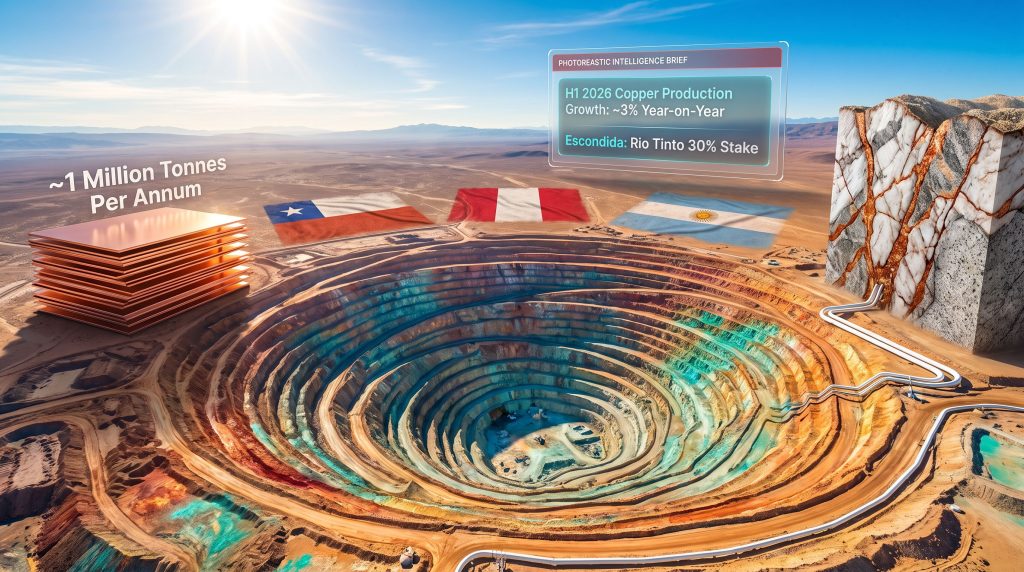
No single copper mine on earth carries more strategic weight than Escondida. Located in Chile's Atacama Desert at elevations exceeding 3,000 metres above sea level, Escondida produces approximately 1 million tonnes of copper per annum, making it the world's largest copper operation by a considerable margin. Rio Tinto's 30% ownership stake translates to roughly 300,000 attributable tonnes annually, a volume that would rank as a significant standalone copper business if measured independently.
What is less commonly understood about Escondida is the depth of its operational transformation over the past decade. Since 2019, the mine has operated entirely on desalinated water, eliminating its dependence on the already stressed freshwater systems of the Atacama. This was not a minor logistical adjustment. Constructing the desalination and pipeline infrastructure required to supply a mine of Escondida's scale at altitude represents one of the most technically complex water-security projects ever executed in open-pit mining. The mine also runs on 100% renewable energy, a combination that gives it an ESG profile that materially influences access to institutional capital in an era of tightening sustainability mandates.
For institutional investors subject to ESG screening criteria, the distinction between a copper producer with credible sustainability credentials and one without is increasingly the difference between being included or excluded from major fund mandates. Escondida's profile on both water and energy places Rio Tinto's copper expansion in an advantaged position relative to peers operating with less mature environmental frameworks. You can also explore Rio Tinto's South American operations directly for further operational detail.
The Codelco Partnership and the Nuevo Cobre Initiative
Beyond Escondida, Rio Tinto has been systematically building exploration optionality in northern Chile through a partnership with Codelco, the Chilean state-owned mining corporation and the world's largest copper producer by national ownership. The Nuevo Cobre initiative, advanced from a 2023 exploration agreement, represents a shared-infrastructure, coordinated-exploration model applied to identified copper targets in Chile's Atacama region.
The strategic logic of partnering with Codelco deserves careful attention. Codelco's relationships with Chilean communities, indigenous groups, and regulatory authorities are unparalleled among copper operators in the country. For a foreign private miner seeking access to new Atacama exploration corridors, alignment with Codelco provides a form of social and regulatory capital that cannot be purchased through conventional means. This is particularly significant given that Chilean mining law now requires increasingly rigorous indigenous consultation processes under frameworks aligned with ILO Convention 169, adding complexity and timeline risk to greenfield permitting.
The Atacama's porphyry copper systems, the geological family to which Escondida and most of Chile's major deposits belong, are among the highest-grade and largest-scale copper formations found anywhere on earth. Porphyry systems form through magmatic-hydrothermal processes associated with subduction zone volcanism, conditions that the Andes provide in exceptional abundance. However, the most accessible porphyry systems have already been discovered, meaning new exploration increasingly targets deeper, more structurally complex ore bodies. Furthermore, the Chile copper outlook suggests early-stage agreements like Nuevo Cobre represent long-duration optionality rather than near-term production visibility.
Peru: Strategic Presence Without Active Production
Understanding Rio Tinto's Peruvian Footprint
Rio Tinto does not currently operate a producing copper mine in Peru. The company maintains a registered corporate presence in the country but has not advanced to active extraction in a jurisdiction that is, by global standards, extraordinarily copper-rich. Peru ranks as the world's second-largest copper producer, hosting major operations including Las Bambas (MMG), Cerro Verde (Freeport-McMoRan), and the jointly owned Antamina (BHP, Glencore, Teck, and Mitsubishi).
The competitive landscape Rio Tinto would need to navigate in Peru is instructive. The producing tier of Peru's copper sector is already dominated by established operators with deep community relationships, long-term water and environmental permits, and decade-long development histories. Late entry into this producing tier requires either a significant acquisition, which demands a target willing to sell at a price Rio Tinto deems acceptable, or a greenfield development commitment that typically involves permitting timelines of 15 to 20 years from discovery to first production.
Peru's political environment adds a further layer of complexity. The country has experienced recurring community conflicts at major copper projects, and its permitting system has been subject to ongoing reforms that create uncertainty for new entrants. Rio Tinto's current posture in Peru therefore appears to reflect deliberate optionality: maintaining a corporate presence and monitoring opportunities without committing capital to a jurisdiction where risk-adjusted returns on new development remain uncertain.
Argentina: Frontier Geology, Structured Optionality, and the Vicuña District
Why Argentina Represents Rio Tinto's Highest-Asymmetry Copper Bet
Argentina's copper sector occupies a categorically different position from Chile's mature industry or Peru's mid-cycle producing base. The country has only recently begun to demonstrate the institutional stability required to attract large-scale mining capital, and its copper production remains minimal relative to its geological endowment. That gap between geological prospectivity and production reality is precisely where Rio Tinto has identified a strategic entry point.
The Vicuña copper-gold district, straddling the Chile-Argentina border in the high Andes, has emerged as one of South America's most closely watched exploration corridors. The district hosts multiple porphyry and epithermal targets, with the cross-border geology creating a situation where mineral systems identified on the Chilean side extend into Argentine territory, and vice versa. Rio Tinto's investment in Mogotes Metals provides exposure to Vicuña district exploration without requiring direct project ownership, a structure that limits upfront capital commitment while preserving participation in exploration upside.
This approach reflects a broader principle in frontier jurisdiction investing: when regulatory and macroeconomic risk is elevated, optionality structures that cap downside while preserving upside are typically superior to equity ownership models that concentrate both risk dimensions. In addition, analysts tracking the copper triangle region of Chile, Peru, and Argentina have noted the growing strategic significance of cross-border mineral systems like Vicuña.
Nuton and Los Azules: Technology as a Gateway to Copper Growth
Rio Tinto's Nuton subsidiary represents a genuinely distinctive element of its copper growth strategy. Rather than functioning as a conventional mining investment vehicle, Nuton focuses on applying next-generation copper extraction and processing technologies, with particular emphasis on heap leach optimisation and alternative processing methods. This advanced copper leaching technology is capable of recovering copper from ore types that conventional sulphide flotation cannot economically treat.
Nuton's interest in the Los Azules copper project in Argentina's San Juan province connects this technology mandate to one of South America's most significant pre-production copper assets. Los Azules is a large-scale porphyry copper deposit being advanced by McEwen Copper, and its scale and grade profile have attracted considerable industry attention. Nuton's involvement is structured around technology application and investment rather than conventional equity ownership, giving Rio Tinto a capital-efficient pathway into the project's development trajectory.
The distinction between Nuton's technology-linked exposure and traditional equity participation is more than structural. It reflects a view that the next wave of copper production growth will require processing innovation just as much as geological discovery, particularly as global ore grades decline and the industry is forced to process lower-quality feed material economically.
Argentina's Investment Climate: RIGI, Currency Risk, and the Maturity Gap
Argentina's RIGI framework (Régimen de Incentivo para Grandes Inversiones) has materially altered the risk calculus for large-scale mining investment in the country. The regime offers tax stability guarantees, import duty exemptions, and repatriation rights for qualifying projects above defined investment thresholds. For mining projects of the scale contemplated at Los Azules and in the Vicuña district, RIGI eligibility is a genuine economic variable rather than a peripheral consideration.
However, Argentina's history of policy reversal, currency controls, and macroeconomic volatility remains a legitimate concern. The contrast between federal investment incentives and the variable regulatory postures of individual provinces, where mining permits are ultimately issued, adds another layer of complexity. Consequently, Rio Tinto's indirect exposure model through Mogotes Metals and Nuton is consistent with a deliberate risk-management posture: participate in Argentina's copper potential without concentrating balance sheet risk in a jurisdiction whose institutional frameworks are still maturing.
Mapping Rio Tinto's South American Copper Architecture
The full portfolio picture across Chile, Peru, and Argentina reveals a deliberately layered risk and return structure:
| Growth Mechanism | Jurisdiction | Structure | Stage |
|---|---|---|---|
| Escondida (30% stake) | Chile | Joint venture (BHP-operated) | Producing |
| Nuevo Cobre / Codelco JV | Chile | Exploration joint venture | Exploration |
| Atacama exploration assets | Chile | Direct acquisition | Early-stage |
| Mogotes Metals investment | Argentina (Vicuña district) | Strategic minority investment | Exploration |
| Nuton / Los Azules interest | Argentina | Technology and investment arm | Development |
| Corporate entity | Peru | Registered presence | Pre-exploration |
This architecture balances near-term cash flow from Escondida against medium-term exploration potential in northern Chile and long-duration optionality in Argentina, while maintaining a watching brief in Peru.
Reading the 3% Production Growth Signal
What a Modest Headline Conceals About Portfolio Momentum
In a copper market where industry-wide output growth has stagnated due to declining ore grades, extended permitting timelines, and constrained capital availability, a 3% year-on-year production increase in H1 2026 is more significant than its face value suggests. Global copper mine supply has consistently failed to keep pace with demand growth projections, and the structural factors driving that gap are not short-cycle. Ore grades at existing mines globally have declined by roughly 25% over the past 20 years, meaning more rock must be processed to produce the same volume of refined metal.
For Rio Tinto, production growth at the margin is valuable not only for its direct revenue contribution but for what it signals about operational efficiency at Escondida and the trajectory of its copper division's contribution to group earnings. Copper has evolved from a secondary revenue stream for Rio Tinto into a strategic growth pillar, and the company's capital allocation decisions across South America reflect that elevated internal priority.
The next major ASX story will hit our subscribers first
Risk Factors Investors Should Monitor
Jurisdiction-Specific Pressures Across the Three-Country Portfolio
Each country in Rio Tinto's South American copper footprint carries a distinct risk profile:
-
Chile: Water rights competition in the Atacama remains structurally unresolved despite Escondida's desalination solution. New projects face indigenous consultation requirements under increasingly stringent legal frameworks. Potential mining royalty reforms could alter project economics for exploration-stage assets.
-
Peru: Community conflict history at major copper projects has resulted in extended operational suspensions at assets owned by other majors. New permitting in Peru faces timelines that can exceed two decades for greenfield development.
-
Argentina: Macroeconomic instability, provincial regulatory variability, and the risk of policy reversal on RIGI commitments represent the primary institutional risks for mining investment. Currency controls complicate cost management for projects with US dollar-denominated capital structures.
If copper prices sustain above US$5.00 per pound through 2027 and 2028, the economic threshold for accelerating development at frontier assets like Los Azules and the Vicuña district shifts materially, potentially compressing the timeline between exploration and development-stage commitment. This is the scenario in which Rio Tinto's current optionality positions convert into substantive capital decisions.
FAQ: Rio Tinto Copper in Chile, Peru and Argentina
Does Rio Tinto own a copper mine in Chile?
Yes. Rio Tinto holds a 30% stake in Escondida, the world's largest copper mine, located in Chile's Atacama Desert. The operation produces approximately 1 million tonnes of copper per year and has operated on 100% renewable energy and desalinated water since 2019.
What is Rio Tinto's copper strategy in Argentina?
Rio Tinto's Argentina exposure is structured through minority investments and technology partnerships rather than direct mine ownership. The company has invested in Mogotes Metals for exposure to the Vicuña copper-gold district and holds a technology-linked interest in the major copper-gold project Los Azules through its Nuton subsidiary.
Does Rio Tinto produce copper in Peru?
Not currently. Rio Tinto maintains a registered corporate presence in Peru but does not operate a producing copper mine there. Peru remains a jurisdiction of strategic interest given its position as the world's second-largest copper producer.
What is Nuton?
Nuton is Rio Tinto's copper technology and investment subsidiary. It focuses on next-generation copper extraction methods, including advanced heap leach technologies capable of processing ore types that conventional sulphide processing cannot treat economically.
What is the Vicuña district?
The Vicuña district is a copper-gold exploration corridor straddling the Chile-Argentina border in the high Andes. It hosts multiple porphyry and epithermal targets and has attracted growing interest from major miners due to its geological scale and the cross-border continuity of its mineralised systems.
The Long Game: South America as Rio Tinto's Copper Foundation
The combination of a world-class producing asset in Escondida, a state-partnership exploration model in Nuevo Cobre, technology-linked frontier exposure through Nuton and Los Azules, and minority exploration participation via Mogotes Metals in the Vicuña district forms a portfolio that is deliberately constructed for different time horizons and risk tolerances within a single geographic region.
What makes this architecture strategically coherent is not any single component but the way the components interact. Escondida generates the cash flow and credibility that funds exploration risk. The Codelco partnership provides regulatory access that accelerates Chilean exploration timelines. Furthermore, Nuton's technology mandate creates a differentiated entry mechanism in Argentina that pure equity investors cannot replicate. The Vicuña minority investment, in addition, offers exposure to one of the region's most geologically compelling frontiers at a fraction of the capital cost of direct project ownership.
Key milestones to monitor through 2026 and into 2027 include Nuevo Cobre exploration drilling results, development progress at Los Azules, Vicuña district assay outcomes from Mogotes Metals activity, and Escondida's production trajectory as the mine navigates the operational challenges of processing increasingly complex ore zones. Each of these data points will shape the market's assessment of whether Rio Tinto copper in Chile Peru and Argentina delivers on its long-duration strategic logic.
This article contains forward-looking statements and scenario analysis that involve assumptions about future copper prices, regulatory outcomes, and project development timelines. These represent analytical perspectives and not financial advice. Readers should conduct independent due diligence before making investment decisions.
Want to Capitalise on the Next Major Copper Discovery Before the Market Does?
Discovery Alert's proprietary Discovery IQ model scans ASX announcements in real time, instantly identifying significant mineral discoveries across copper and 30+ other commodities — turning complex geological data into clear, actionable investment insights for both short-term traders and long-term investors. Explore how historic mineral discoveries have delivered exceptional returns on Discovery Alert's dedicated discoveries page, and begin your 14-day free trial today to position yourself ahead of the market.