
July 25, 2026
The Structural Fault Line Beneath the World's Copper Belt
Global copper markets are priced on fundamentals that most analysts can model with reasonable confidence: demand trajectories, smelter utilisation rates, inventory cycles, and long-run grade decline at major deposits. What those models routinely underestimate is the degree to which a concentrated geographic footprint creates systemic exposure to a single, deeply localised variable: the weather above the Atacama Desert and its surrounding high-altitude plateau.
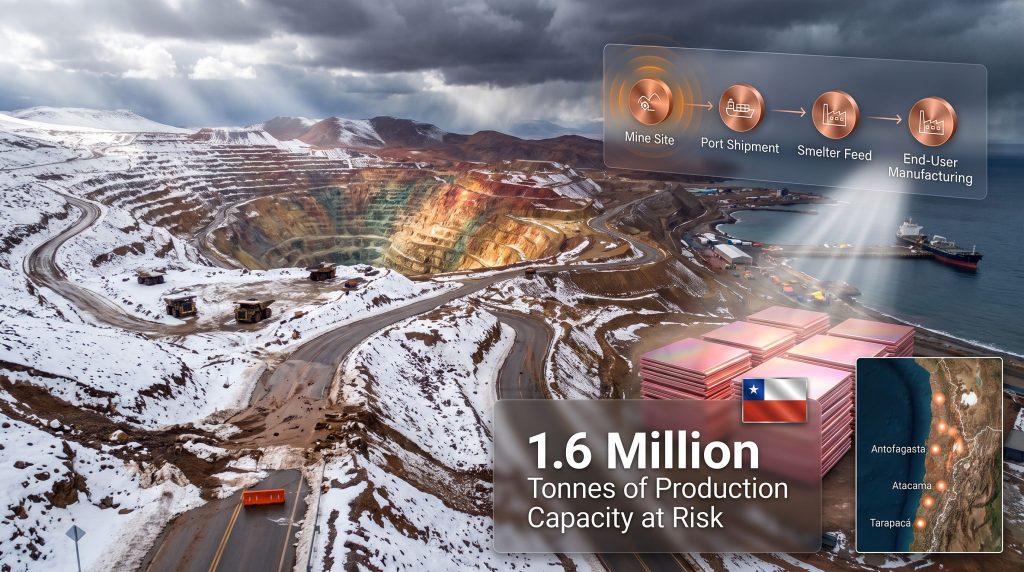
Northern Chile's copper belt, spanning the Antofagasta, Atacama, and Tarapacá regions, produces an estimated 30% of global refined copper output. That concentration is a geological gift, but it is also a structural vulnerability that storms in northern Chile mining operations have increasingly exposed. When precipitation events of unusual intensity sweep across the altiplano during austral winter months, the consequences extend far beyond a handful of suspended shifts. They ripple through spot markets, disrupt shipment schedules, and test the operational resilience architectures that mining companies have spent decades assuming they would rarely need.
When big ASX news breaks, our subscribers know first
The Engineering Paradox at the Heart of Chilean Copper Production
There is a deep irony embedded in how Chile's mining infrastructure was designed. The Atacama Desert's coastal and low-altitude zones receive less than 15mm of annual rainfall in many locations, making them among the driest inhabited places on the planet. Mine planners, infrastructure engineers, and logistics operators built their systems around this baseline, engineering roads, power corridors, tailings facilities, and port connections for a world defined by water scarcity rather than water excess.
The high-altitude altiplano tells a different story. At elevations between 3,000m and 4,500m above sea level, where many of Chile's largest copper operations are situated, the seasonal moisture flux known as the Bolivian Winter — a high-altitude expression of the South American Monsoon system — delivers snowfall, hail, and flash flooding between June and August each year. The critical point is not that these events are unknown. It is that the infrastructure serving these operations was dimensioned for the statistical baseline, not for the upper tail of the precipitation distribution.
When events exceed design tolerances, even modestly, the consequences cascade rapidly across four distinct vulnerability categories:
| Vulnerability Category | Mechanism of Failure | Operational Consequence |
|---|---|---|
| Access Road Networks | Mudslides, washouts, snow accumulation | Personnel evacuation, supply chain interruption |
| Power Transmission Infrastructure | Line damage, substation flooding | Processing plant shutdowns, mill stoppages |
| Port and Logistics Corridors | Highway closures, port disruptions | Copper cathode shipment delays |
| Tailings and Water Management Structures | Overflow risk, dam integrity concerns | Regulatory-triggered operational suspension |
What makes altitude a particularly insidious compounding factor is the distinction between direct physical damage and access-driven suspension. A processing facility sitting at 4,000m may sustain zero structural damage during a snowfall event while simultaneously becoming completely inaccessible for 48 hours. The production impact is identical in practical terms, but the risk category is entirely different — and most standard operational risk frameworks fail to adequately weight access risk at altitude as a distinct and recurring exposure.
How Recent Events Have Tested the Limits of Operational Resilience
The 2026 austral winter season provided a particularly instructive stress test for storms in northern Chile mining operations. The events that unfolded across the copper belt illustrated the full spectrum of disruption outcomes, from precautionary suspensions to forced operational halts.
Lundin Mining's Caserones operation in the Atacama region suspended operations on July 18 following heavy snowfall that simultaneously restricted site access and interrupted power supply through damage to transmission infrastructure. This was a textbook access-driven suspension: the physical plant remained intact, but the combination of road impassability and power interruption made continued operation untenable from both a safety and practical standpoint.
The Candelaria mine, also operated by Lundin Mining, experienced a different disruption profile. Heavy rainfall affected surface operations, but the processing facility sustained mill operations by drawing down stockpiled ore inventory, demonstrating precisely how buffer stock management functions as a frontline resilience tool when external supply chains are temporarily severed.
Codelco production outlook across the same geographic corridor has a documented history of implementing precautionary operational restrictions during storm cycles. These preventive protocol activations, while less dramatic than forced suspensions, carry their own production cost when aggregated across a large portfolio.
Key Metric: Storm events across northern Chile's copper belt have been reported to temporarily place an estimated 1.6 million tonnes of annual copper production capacity under suspension risk simultaneously — a figure that reframes even short-duration weather disruptions as globally significant supply events rather than localised operational inconveniences.
The distinction between capacity at risk and production lost is analytically important here. Stockpile drawdowns, deferred maintenance windows, and accelerated post-storm production recovery can absorb significant portions of the theoretical loss. However, when multiple operations are simultaneously affected, the combined impact on spot market availability becomes measurable within days.
Transport and Logistics: The Overlooked Disruption Vector
Beyond the mine gate, storm events trigger a secondary wave of disruption that rarely receives adequate attention in production loss calculations. Furthermore, a key mining highway severed by storm activity compounds the challenge considerably:
- Highway closures along arterial routes connecting inland mines to coastal port terminals delay copper cathode loading and vessel scheduling, compressing shipment windows that downstream buyers have contracted against.
- Port operational disruptions, even when mine-site production resumes, can extend delivery delays by days to weeks, creating inventory gaps at smelters and refineries that rely on just-in-time concentrate delivery.
- Communications infrastructure failures at remote high-altitude sites complicate real-time operational coordination, slowing decision-making at precisely the moment when rapid response is most critical.
- Supply delivery interruptions for reagents, fuel, and critical maintenance components create secondary production constraints that persist beyond the storm event itself, as depleted inventories require replenishment before full operational capacity is restored.
The Climatological Architecture Behind the Risk
Understanding why storms in northern Chile mining operations have become an increasingly prominent risk category requires a working knowledge of the regional climate system driving these events.
The Bolivian Winter, sometimes called the altiplanic winter, is a seasonal atmospheric pattern in which moisture originating in the Amazon basin is transported westward and upward by upper-level circulation patterns, delivering precipitation to the high Andes between June and August. At altitude, this moisture arrives predominantly as snow and hail rather than rain, creating accumulation conditions that can restrict vehicle access within hours even when lower-altitude areas remain unaffected.
The intensity and geographic extent of individual storm events within this seasonal window are modulated by broader climate variability signals, including La Niña and El Niño cycles, which influence sea surface temperatures in the Pacific and subsequently alter the atmospheric dynamics governing moisture transport to the altiplano. This interannual variability is what makes operational planning particularly challenging: the seasonal window is predictable, but the intensity distribution within that window is not.
What has shifted meaningfully over recent decades is the operational framing. Northern Chile's mining sector was built during a period when altiplanic storm events were classified as exceptional anomalies. The accumulating evidence of more variable precipitation intensity events has begun forcing a reclassification: these are no longer rare tail risks but recurring operational scenarios that require systematic, capital-backed resilience planning.
Chile's mining safety regulator, SERNAGEOMIN, and environmental authorities increasingly incorporate climate-related operational risk considerations into permitting and compliance frameworks, reflecting the regulatory sector's own adjustment to this changing risk landscape.
Resilience Strategies That Separate Leading Operators from the Pack
The operational response gap between well-prepared and inadequately prepared operators during storm events is substantial. Leading Chilean copper producers have moved toward tiered alert architectures that define pre-scripted responses at each meteorological severity threshold, eliminating the decision latency that characterises reactive management.
Best-practice resilience frameworks typically incorporate the following layers:
- Predictive meteorological integration: dedicated weather monitoring networks, including high-altitude automated stations, that feed real-time data into operational planning systems with 48-72 hour forecasting horizons.
- Tiered suspension protocols: clearly defined thresholds at which personnel evacuation, shelter-in-place activation, or full operational suspension is triggered, removing ambiguity from high-pressure decision environments.
- Pre-positioning of critical supplies: reagent inventories, fuel reserves, and maintenance components stockpiled ahead of forecast storm windows to maintain post-storm recovery capacity.
- Ore and product buffer management: maintaining stockpile levels sufficient to sustain downstream processing through access interruptions of 72 hours or longer.
- Infrastructure hardening investment: road reinforcement, alternative access route development, power supply redundancy through backup generation and grid interconnection improvements, and tailings facility upgrades designed to accommodate higher peak precipitation loads.
There is also a less obvious strategic dimension to storm resilience that is beginning to attract serious capital attention: stormwater capture and storage. Northern Chilean copper operations face a chronic long-term water scarcity challenge that has driven billions of dollars in desalination investment. The same precipitation events that threaten operational continuity also deliver episodic water volumes that, if captured rather than allowed to become flood hazards, could partially offset freshwater supply requirements.
Strategic Insight: Northern Chile's copper operations face a dual water challenge that is rarely framed as a single strategic problem: chronic long-term scarcity driving desalination investment, and episodic storm-driven flooding threatening infrastructure. Operators that design dual-purpose water management infrastructure effectively convert a climate liability into a partial resource asset.
What Downstream Copper Markets Actually Experience
The supply chain consequences of storms in northern Chile mining operations do not terminate at the mine boundary. They propagate through a multi-stage value chain, with each stage carrying its own recovery timeline:
| Supply Chain Stage | Storm Impact Mechanism | Recovery Timeline |
|---|---|---|
| Mine Site Production | Suspension of extraction and processing | Hours to days (access-dependent) |
| Concentrate and Cathode Inventory | Stockpile drawdown during suspension | Days to weeks |
| Port Shipment Schedules | Delayed loading, vessel rescheduling | Days to weeks |
| Smelter and Refinery Feed | Reduced concentrate availability | Weeks to months if prolonged |
| End-User Manufacturing | Extended lead times, spot market pressure | Variable |
The LME copper price has historically demonstrated measurable sensitivity to Chilean production disruption signals, particularly when multiple operations are simultaneously affected. Trader positioning and prevailing inventory levels at LME warehouses function as amplification or dampening mechanisms: low inventory environments translate weather-driven supply signals into sharper price responses. For a broader view of how these dynamics play out, the copper market trends heading into 2025 and beyond provide essential context.
The strategic weight of this dynamic will intensify as global copper demand grows. Chile's copper supply gap is already a structurally significant issue, and storm-driven disruptions to Chilean output carry disproportionate strategic significance relative to equivalent disruptions in lower-volume producing nations. Consequently, efforts toward global copper supply diversification are gaining traction among policymakers and major buyers alike.
The next major ASX story will hit our subscribers first
An Investor's Framework for Assessing Storm Exposure in Chilean Copper Assets
For investors evaluating exposure to Chilean copper operations, storm-related operational risk warrants a structured due diligence lens that goes beyond standard production guidance review. The following factors differentiate high-exposure from lower-exposure assets:
- Elevation profile: operations situated above 3,500m face materially elevated snowfall-related access risk during the June-August austral winter window.
- Access route concentration: mines dependent on a single highway corridor carry concentrated logistics vulnerability that single-event road closures can fully exploit.
- Power supply architecture: operations with genuine generation redundancy — whether through backup diesel capacity, dual grid connections, or hybrid renewable-diesel systems — demonstrate materially superior resilience to transmission line damage.
- Stockpile policy: operators maintaining ore buffer inventories sized for 72-hour access interruptions absorb short-duration disruptions without measurable output loss.
- TCFD alignment: operators that have conducted formal climate risk assessments aligned with Task Force on Climate-related Financial Disclosures standards are more likely to have systematically quantified and mitigated storm exposure.
Key Due Diligence Questions for Chilean Copper Asset Evaluation
- At what specific meteorological thresholds does the operation trigger operational suspension, and are those thresholds documented in a formal protocol?
- What is the current ore stockpile volume relative to processing throughput, and does it provide genuine 72-hour buffer capacity?
- Has the operator invested in alternative access route infrastructure, and what is the estimated road clearance timeline following a major snowfall event?
- What capital has been specifically allocated to climate resilience infrastructure in the current investment cycle, and how is that spend categorised in project economics?
- How does the operator's water management plan address both scarcity and episodic flood risk simultaneously?
In addition, the Chile copper price forecast offers a useful companion lens for contextualising how storm-related production risk interacts with longer-run price dynamics when stress-testing investment theses.
Building Copper Operations That Can Withstand a Changing Climate
The operators that will carry a sustainable competitive advantage through the coming decade of copper demand growth are not necessarily those with the highest-grade deposits or the lowest current cost structures. They are the operators that have treated climate resilience as a core capital planning discipline rather than an emergency response afterthought.
Predictive meteorological modelling, shared weather monitoring networks across the copper belt, coordinated port contingency planning, and industry-government collaboration on critical shared infrastructure hardening represent the next frontier of operational resilience investment in northern Chile. The economics of that investment are increasingly compelling: demonstrated operational continuity during adverse weather events is becoming a tangible differentiator in offtake agreement negotiations and project financing discussions.
The structural reality is that storms in northern Chile mining operations have transitioned from exceptional events to a permanent feature of the operational risk landscape. Companies that price that reality into their capital programmes now will find themselves considerably better positioned than those waiting for the next disruption to force the investment decision.
Disclaimer: This article contains forward-looking statements, production estimates, and market analysis that involve inherent uncertainty. Figures relating to production capacity at risk and market price sensitivity are indicative estimates based on publicly available information and should not be relied upon as precise forecasts. Readers should conduct independent research and seek professional advice before making investment decisions based on any information contained herein.
Want to Stay Ahead of Significant ASX Mineral Discoveries Before the Broader Market Does?
Discovery Alert's proprietary Discovery IQ model delivers real-time alerts on high-potential ASX mineral discoveries, transforming complex data across more than 30 commodities into clear, actionable insights for both traders and long-term investors — explore historic examples of exceptional discovery outcomes to understand the scale of opportunity, and begin your 14-day free trial at Discovery Alert to position yourself ahead of the market.