
June 19, 2026
The Investor's Dilemma: When Strong Returns Create Their Own Risk
There is a particular type of paralysis that grips investors after a stock has run hard. The gains are real, the portfolio looks healthy, and yet the decision of what to do next becomes genuinely difficult. Selling feels like abandoning a winner. Holding feels like tempting fate. This tension is not irrational; it reflects a well-documented pattern in investor psychology known as the disposition effect, where the emotional weight of locking in a loss or surrendering a gain distorts otherwise rational decision-making.
For Australian investors currently holding BHP Group Ltd (ASX: BHP) shares, this dilemma is playing out in a particularly acute way. With the stock delivering roughly 32% gains year-to-date and approximately 57% appreciation over the prior 12 months, the question of should i sell my bhp shares in june is one that deserves a structured, data-driven answer rather than an emotional one.
When big ASX news breaks, our subscribers know first
Understanding What Has Actually Driven the BHP Rally
Before deciding whether to sell, hold, or trim, it is worth dissecting the specific forces that have propelled BHP shares toward their recent all-time high of A$62.06, recorded in mid-May.
Copper's Structural Demand Story
Copper futures climbed to above US$6.60 per pound, a level that reflects something fundamentally different from the cyclical price spikes seen in previous commodity booms. Three distinct demand pillars are converging simultaneously:
- Electric vehicle manufacturing requires roughly two to four times more copper than a conventional internal combustion engine vehicle.
- Utility-scale solar installations are copper-intensive at both the panel and grid transmission level.
- AI-driven data centre construction has emerged as a surprisingly significant copper consumer, with hyperscale facilities requiring extensive electrical infrastructure and cooling systems.
What separates this copper demand cycle from historical booms is the duration and structural nature of the underlying drivers. Energy transition timelines are measured in decades, not quarters. This makes copper demand less susceptible to the kind of inventory destocking that typically reverses metal price rallies in traditional economic cycles. However, the looming copper supply crunch adds another compelling dimension to BHP's long-term copper positioning.
BHP's copper operations, which contribute an estimated 25% of group revenue, give the company meaningful leverage to this structural theme without the single-commodity concentration risk that smaller copper-focused miners carry.
Geopolitical Sentiment and Its Limits
Improving signals around US-Iran diplomatic engagement contributed to a broader shift in commodity market sentiment, particularly as the prospect of greater Strait of Hormuz stability reduced near-term supply disruption risk for energy markets. When energy corridor uncertainty eases, base metals like copper tend to benefit from reduced cost-of-production assumptions and improved global trade sentiment.
However, geopolitical tailwinds are among the most fragile inputs in any commodity valuation model. They can reverse without warning, and basing a long-term hold decision on diplomatic progress that has yet to be formalised would represent a significant analytical error.
Governance Signal: The Mark Vassella Appointment
BHP's announcement of Mark Vassella as a non-executive director was well-received by institutional investors. Vassella's background as former CEO of BlueScope Steel Ltd (ASX: BSL) brings deep operational expertise in Australian heavy industry. For institutional shareholders, board appointments carry signal value beyond the individual: they reflect the strategic direction the board is seeking to reinforce, and an operator of Vassella's calibre suggests BHP is focused on disciplined capital allocation and operational efficiency.
What the Analyst Consensus Is Actually Telling You
The analyst ratings landscape for BHP is worth examining carefully, because the headline numbers can be misleading if taken at face value.
The Hold Rating Explained
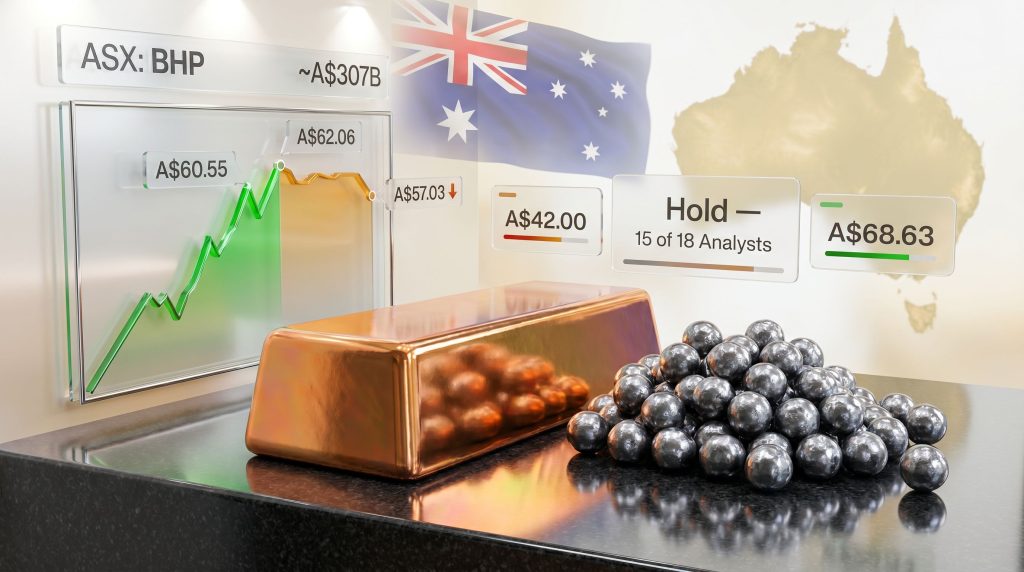
Of 18 analysts tracked on TradingView, 15 carry a Hold rating on BHP shares. The average consensus target price sits at approximately A$57.03, which implies roughly 6% downside from recent trading levels near A$60.55.
| Metric | Value |
|---|---|
| Recent Share Price | ~A$60.55 |
| All-Time High (mid-May) | A$62.06 |
| Analyst Consensus | Hold (15 of 18 analysts) |
| Average Analyst Target | A$57.03 |
| Implied Downside from Target | ~6% |
| Bull Case Target (Maximum) | A$68.63 |
| Implied Upside (Bull Case) | ~14% |
| Morningstar Intrinsic Value Estimate | A$42.00 |
| Stockopedia Consensus Target | ~A$54.08 |
| 12-Month Price Appreciation | ~57% |
Important context: A professional analyst's Hold rating and a retail investor's Hold interpretation are not the same thing. For an institutional fund manager constrained by benchmark weightings, Hold may simply mean maintaining index-proportionate exposure. For a retail investor with concentrated exposure, the same rating may warrant a more active response.
Furthermore, for a broader perspective on how analysts are currently positioning on major mining stocks, Goldman Sachs has notably favoured Rio over BHP in 2025, a signal worth considering when weighing relative value within the sector.
The Valuation Gap Problem
The most striking feature of BHP's current valuation picture is not the consensus target price but rather the distance between the current share price and Morningstar's intrinsic value estimate of A$42.00. At a trading price around A$60.55, BHP shares are carrying a premium of more than 30% above this long-run fundamental estimate.
This does not mean the stock is about to collapse. It does mean that a meaningful portion of the current price reflects sentiment, momentum, and forward commodity optimism rather than present-day earnings power. Historically, large-cap mining stocks that trade at sustained premiums to intrinsic value estimates tend to experience mean reversion, particularly when the commodity price tailwinds that justified the premium begin to soften.
The bull case target of A$68.63 represents approximately 14% upside from recent levels, but achieving that target would require copper prices to remain elevated, iron ore demand to stabilise, and geopolitical conditions to remain benign. That is a high-dependency scenario.
Should I Sell My BHP Shares in June? Three Variables That Actually Matter
Disclaimer: The analysis in this section is general in nature and does not constitute personal financial advice. Individual tax positions, portfolio compositions, and investment objectives differ materially. Always consult a licensed financial adviser before making investment decisions.
Rather than applying a single answer to a question that depends on individual circumstances, the most productive framework involves three core variables.
Variable 1: Has Your Original Investment Thesis Been Fulfilled?
Every investment should be anchored to a thesis. For BHP shareholders, the relevant questions are:
- If you bought for capital growth, a 57% gain in 12 months likely exceeds almost any reasonable original target. The question becomes whether you believe a further 14% upside is more probable than a 6-30% correction.
- If you bought for dividend income, note that as BHP's share price has risen, the effective dividend yield on your cost base has increased substantially. However, the forward yield calculated on the current price has compressed, making the income case less compelling for new buyers.
- If you bought for portfolio diversification, the 57% appreciation has almost certainly increased BHP's proportional weight in your portfolio, potentially creating the exact concentration risk you were trying to avoid.
Variable 2: Portfolio Concentration and Sizing Risk
BHP's market capitalisation of approximately A$307 billion makes it the largest stock on the ASX by a significant margin. This size creates two competing forces: institutional support from index-weight mandates provides a valuation floor, but it also means the stock is widely held and subject to coordinated selling pressure during risk-off periods.
For investors whose BHP position has grown to represent more than 10-15% of total portfolio value, the concentration risk argument for at least partial reduction becomes difficult to ignore. A commodity-sensitive stock of this nature can move 20-30% in either direction within a 12-month period based on factors largely outside management's control. In addition, exploring diversification strategies can help investors better manage this kind of single-stock exposure.
Variable 3: Tax Timing and Franking Credit Value
Australian tax law provides a 50% capital gains tax discount for assets held longer than 12 months. For investors who purchased BHP shares less than 12 months ago, waiting until the anniversary before selling could materially improve the after-tax outcome.
Additionally, BHP's dividend carries franking credits that hold real monetary value for Australian resident shareholders in lower marginal tax brackets, and are particularly valuable within SMSF structures where the tax rate on investment earnings in accumulation phase is just 15%. Selling before the ex-dividend date means forfeiting both the dividend and the attached franking credit entitlement.
BHP typically announces its full-year results and final dividend in August. Investors considering a sale should confirm the relevant ex-dividend date before executing any transaction.
Sell, Hold, or Trim: A Scenario-Based Decision Guide
The Case for Selling in June
A sale decision is most defensible when several of the following conditions are met simultaneously:
- BHP shares are trading above multiple independent fair value estimates, including Morningstar's A$42 intrinsic value.
- The rally has incorporated geopolitical optimism that has not yet been formalised through binding agreements.
- BHP represents an outsized percentage of your total portfolio.
- Your shares have been held for more than 12 months, making the CGT discount available.
- Your original return target has been met or exceeded.
The Case for Holding Through June
Retaining the full position makes more sense under the following conditions:
- Copper's structural demand thesis remains intact and you have conviction in the multi-year trajectory.
- BHP's earnings diversification across iron ore, copper, metallurgical coal, and potash provides a degree of revenue resilience.
- A weaker Australian dollar continues to amplify the AUD value of USD-denominated commodity revenues.
- Institutional index-weight support provides a meaningful price floor at current levels.
The Case for Trimming (The Balanced Approach)
For many investors, neither a full sale nor a full hold is the optimal outcome. A trimming strategy involves:
- Reducing position size by 25-50% to crystallise partial gains.
- Reinvesting proceeds into complementary positions that reduce resources sector concentration, such as Rio Tinto (ASX: RIO) or South32 (ASX: S32).
- Maintaining residual BHP exposure to participate in any further copper-driven upside.
- Reassessing the remaining position at the August full-year earnings result.
Key Risk Factors to Monitor Through June
The Commodity Revenue Sensitivity Matrix
| Commodity | Approx. Revenue Contribution | Key Price Driver | Near-Term Risk |
|---|---|---|---|
| Iron Ore | ~50% | Chinese steel demand | Moderate: China stimulus uncertainty |
| Copper | ~25% | Energy transition demand | Low-to-Moderate: structural demand intact |
| Metallurgical Coal | ~15% | Global steelmaking activity | Moderate: cyclical exposure |
| Potash / Other | ~10% | Agricultural commodity cycles | Low near-term |
China: The Variable Analysts Cannot Model With Confidence
Iron ore remains BHP's single largest revenue contributor, and iron ore pricing is heavily dependent on Chinese steel production volumes. The China steel and iron ore outlook remains one of the most consequential variables in any BHP valuation model, particularly as China's ongoing property sector contraction has suppressed steel demand in ways that were not widely anticipated two years ago.
Improving diplomatic relations between China and Australia are a positive sign for trade continuity, but they do not mechanically translate into higher commodity purchase volumes or better pricing. The CMRG framework highlights the degree to which BHP, Rio Tinto, and Fortescue's earnings remain structurally linked to Chinese economic outcomes. For BHP specifically, a sustained Chinese slowdown would disproportionately affect the iron ore division, which contributes roughly half of group revenue.
Dividend Sustainability Under Capital Expenditure Pressure
BHP's ongoing capital expenditure commitments are substantial. The Jansen potash project in Canada represents one of the largest single mining investments currently underway anywhere in the world, and copper expansion programs require sustained funding. As these commitments intensify, the relationship between operating cash flows and dividend payments warrants careful monitoring. Understanding the broader commodity price impact on mining company performance provides useful context for assessing how sustainable BHP's current dividend trajectory may be.
The next major ASX story will hit our subscribers first
How BHP Compares to ASX Mining Peers
| Metric | BHP (ASX: BHP) | Rio Tinto (ASX: RIO) | South32 (ASX: S32) |
|---|---|---|---|
| Market Cap | ~A$307B | ~A$150B+ | ~A$20B+ |
| Primary Exposure | Iron Ore, Copper | Iron Ore, Aluminium | Base Metals, Coal |
| Analyst Consensus | Hold | Hold/Buy | Buy |
| Valuation vs. Fair Value | Above (Morningstar) | Moderate | Moderate-Undervalued |
| Approx. Dividend Yield | ~4-5% (franked) | ~5-6% (partially franked) | ~3-4% |
Investor insight: For shareholders concerned about BHP's current valuation premium, both South32 and Rio Tinto may offer more attractive risk-adjusted entry points within the diversified mining sector. South32 in particular carries a Buy consensus from broker analysts, suggesting the market sees greater relative upside at current prices.
Frequently Asked Questions
Is now a good time to sell BHP shares?
From a valuation perspective, BHP shares are trading above several independent fair value benchmarks, which limits the near-term upside probability. The structural copper demand story supports a long-term hold case, but investors with concentrated positions or short-term return objectives may find the current price level an appropriate exit point.
What is the BHP share price target for 2025-2026?
Analyst consensus targets range from approximately A$54 to A$57 on average, implying modest downside from current levels. The highest analyst target sits at A$68.63, representing roughly 14% upside under favourable commodity conditions. These estimates should be treated as probabilistic ranges rather than definitive forecasts. For a detailed view of BHP's current share price data, the ASX company page provides up-to-date market information.
Will BHP pay a dividend in June 2025?
BHP's final dividend is typically announced alongside its full-year results in August. June does not coincide with a dividend payment for most shareholders. Investors should verify the specific ex-dividend date before executing any sale decision.
Should I sell BHP before or after the ex-dividend date?
Income-focused investors, particularly those within SMSF structures or lower tax brackets, should carefully calculate the after-tax value of the upcoming franking credit entitlement before deciding to sell. In many cases, the franking credit value will exceed the cost of holding through a period of modest price volatility.
What would cause BHP shares to fall materially from current levels?
The most credible downside triggers include:
- A sharper-than-expected deterioration in Chinese economic activity reducing iron ore demand.
- A reversal in copper prices from multi-year highs as supply-side capacity catches up with demand.
- An appreciating Australian dollar reducing the AUD equivalent of USD-denominated commodity revenues.
- A broader ASX or global equity market correction driven by risk-off sentiment.
Key Takeaways for BHP Shareholders Heading Into June
Consequently, investors weighing up should i sell my bhp shares in june should consider the following summary points before making any decisions:
- BHP has delivered exceptional returns over 12 months, but strong historical performance is not a reliable predictor of near-term continuation.
- Analyst consensus is overwhelmingly Hold, with the average target price implying modest downside from recent trading levels.
- Morningstar's intrinsic value estimate of A$42 suggests BHP shares carry a premium of more than 30% above long-run fundamental value.
- Copper's structural demand story remains genuinely compelling over a multi-year horizon, but the current price may already reflect much of this optimism.
- A trimming strategy represents the most balanced approach for investors who are uncertain: locking in partial gains while retaining upside exposure.
- CGT timing and franking credit entitlements should be central considerations in any sell decision, not afterthoughts.
- Investors with heavy resources concentration should consider whether diversifying into Rio Tinto or South32 better serves their medium-term risk management objectives.
This article is general in nature and does not represent personal financial advice. Past performance is not indicative of future results. Readers should seek advice from a licensed Australian financial adviser before making any investment decisions. All figures cited are based on data available at the time of publication and are subject to change.
Want to Spot the Next Major Mineral Discovery Before the Broader Market Does?
While BHP offers exposure to structural commodity themes, significant wealth in the resources sector has historically been built by identifying transformative discoveries early — Discovery Alert's proprietary Discovery IQ model delivers real-time alerts on significant ASX mineral discoveries, converting complex mineral data into clear, actionable insights for investors at every experience level. Explore historic discovery returns that demonstrate just how consequential early positioning can be, and begin a 14-day free trial to ensure the next major discovery doesn't pass unnoticed.