June 19, 2026
The Hidden Architecture of Global Oil: Why 33 Kilometres Holds the World to Ransom
Most investors think about oil prices through the lens of OPEC decisions, US shale output, or Chinese demand cycles. Far fewer pause to consider how dramatically the physical geography of energy trade concentrates risk into a single corridor. The Strait of Hormuz, a narrow channel between Iran and Oman barely 33 kilometres wide at its tightest navigable point, sits at the intersection of every major force currently reshaping global energy markets. The US-Iran ceasefire and Strait of Hormuz oil markets are now inseparable topics for anyone trying to understand where energy prices go next.
Understanding what the recent ceasefire framework actually means requires looking beyond the diplomatic headlines and examining the structural mechanics of how oil physically moves from producer to consumer, why disruption to this one waterway triggers cascades across global inflation, monetary policy, and geopolitical risk pricing, and what history tells us about the durability of interim agreements in one of the world's most complex security environments.
When big ASX news breaks, our subscribers know first
The Irreplaceable Corridor: Scale, Dependency, and Geographic Lock-In
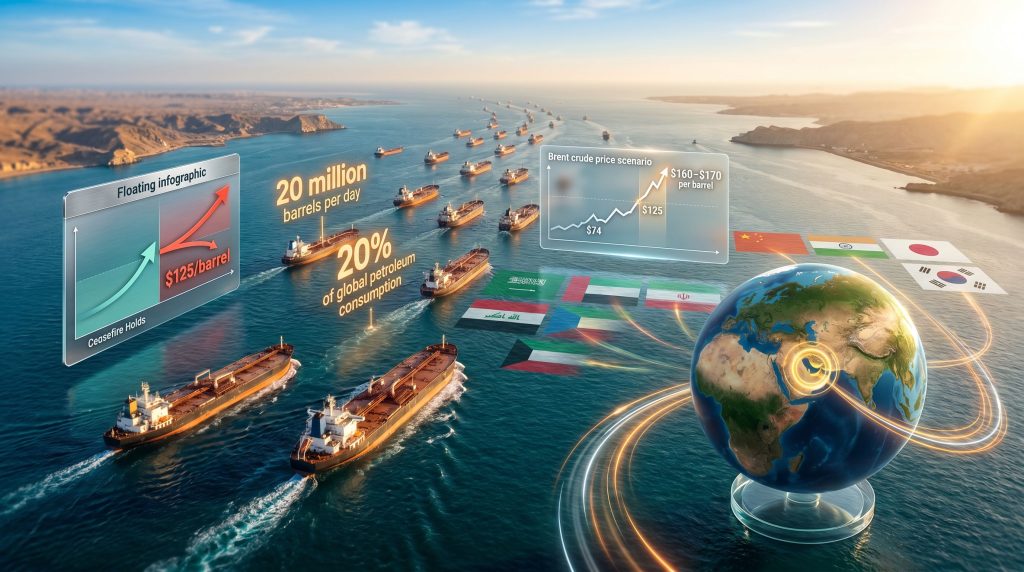
Approximately 20 million barrels per day of oil transited the Strait of Hormuz in 2024, a volume representing roughly 20% of total global petroleum liquids consumption. The strait functions as the primary export gateway for crude oil and condensate from Saudi Arabia, Iraq, Kuwait, the UAE, and Iran simultaneously. No other single shipping lane on Earth concentrates this density of energy trade.
What makes the strait uniquely consequential is the geographic concentration of destination markets. 84% of crude and condensate flowing through Hormuz is bound for Asian markets, with 83% of LNG following the same eastward trajectory. China, India, Japan, and South Korea, four of the world's largest energy-consuming economies, depend on this corridor in ways that cannot be quickly substituted.
"The Panama Canal, Suez Canal, and Bab el-Mandeb each carry substantially less petroleum volume than Hormuz. None can serve as a substitute at scale. This is not a redundant system with backup pathways, it is a single point of failure embedded in the architecture of global trade."
Why Alternative Routes Offer Only Partial Relief
The absence of viable alternatives is a structural feature of Hormuz dependency, not a temporary gap. Furthermore, consider the arithmetic of what exists:
- Saudi Arabia's East-West Pipeline (Petroline) can handle approximately 5 million barrels per day, significant as a buffer but covering only a quarter of normal strait throughput
- Rerouting supertankers around the Cape of Good Hope adds two to three weeks to delivery times and substantially increases freight costs, compressing refiner margins before a single barrel is processed
- Qatar, the world's largest LNG exporter, has no viable alternative export route whatsoever, making gas markets particularly exposed to any strait disruption
- Overland pipeline infrastructure across the region has neither the capacity nor the terminal connectivity to absorb a full Hormuz closure
This asymmetry between the volume at risk and the capacity of alternatives is what gives the strait its extraordinary leverage over global energy pricing. For a broader current crude oil overview of how these structural vulnerabilities feed into pricing, the underlying data reinforces just how exposed markets remain.
Decoding the Ceasefire Framework: What Was Actually Agreed
The interim agreement that emerged in June 2026, after more than three months of conflict that disrupted shipping routes and generated acute supply anxiety across Asian import markets, represents a conditional rather than comprehensive settlement. Understanding its architecture matters enormously for assessing its durability.
At its operational core, the framework involves a cessation of active hostilities, restoration of commercial shipping transit rights through the Strait of Hormuz, and a 60-day structured negotiation window intended to convert the interim understanding into something more durable. The most structurally complex issues, nuclear verification, sanctions sequencing, and regional security arrangements, have been deferred into that negotiating period rather than resolved upfront.
| Dimension | Reported Commitment |
|---|---|
| Military operations | Cessation of active hostilities during ceasefire window |
| Strait access | Restoration of commercial shipping transit rights |
| Nuclear diplomacy | Entry into formal structured negotiations |
| Sanctions framework | Discussions to begin within the 60-day period |
| Proxy force activity | Not directly addressed in the bilateral framework |
What both sides have agreed to stop doing is more clearly defined than what they have agreed to achieve. That distinction matters for any analysis of the agreement's likely trajectory. According to reporting from CNBC, fears around Strait of Hormuz turmoil had already been revived well before the formal ceasefire was announced, underscoring how sensitive markets were to even partial escalation signals.
The Unresolved Architecture Beneath the Headlines
Several structural issues remain outside the scope of the interim agreement and, consequently, represent the primary fault lines that could collapse the 60-day negotiating process:
- Verification mechanisms for compliance on both sides have not been publicly confirmed
- Iran's existing nuclear enrichment infrastructure remains operational, with its status under negotiation rather than settled
- Regional proxy networks involving forces in Yemen, Lebanon, and Iraq were not party to the bilateral framework and retain independent capacity to create incidents
- The sequencing of any sanctions relief relative to Iranian compliance steps is deeply contested and historically has been the breaking point of previous diplomatic processes
- Domestic political constraints in both Washington and Tehran create persistent pressure on negotiators to harden positions
Professor Samina Yasmeen, Director of the Centre for Muslim States and Societies at the University of Western Australia and one of Australia's foremost analysts of Middle East security dynamics, has identified several structural challenges to the agreement's durability. The ceasefire addresses immediate military behaviour but does not reach the underlying political grievances that drove the conflict. The 60-day timeline is extremely compressed for resolving issues as complex as nuclear verification and the architecture of sanctions relief.
Oil Market Behaviour During the Conflict: What the Data Reveals
The market's response to the conflict period illustrated both the sensitivity of oil pricing to Hormuz risk and the limits of that sensitivity when disruption remains partial rather than total. Brent crude rose from approximately $69 to $74 per barrel in direct response to regional tensions, even before any complete blockage of the strait materialised. That approximately 7% move on partial disruption risk is instructive, implying far larger price responses under scenarios of confirmed closure.
Beyond the headline price move, several second-order market dislocations were more structurally significant:
- Marine war risk insurance became severely constrained, with some underwriters withdrawing coverage for strait transit entirely
- Shipping traffic through the waterway fell toward near-standstill levels during peak disruption
- IEA member nations coordinated strategic petroleum reserve releases to cushion the supply shock, though SPR drawdowns are a finite instrument with a limited operational window
- Asian importers experienced acute supply anxiety, while Atlantic Basin markets enjoyed relative insulation due to greater access to alternative crude sources
The bifurcated market dynamic that emerged, with Asia and Europe facing fundamentally different supply risk profiles, is a pattern likely to persist even after any normalisation of strait transit. In addition, oil price movements driven by trade war dynamics had already introduced volatility into the system before the conflict escalated, compounding the pressure on market participants.
Scenario Analysis: Two Price Paths and the Lag Nobody Is Pricing
The critical analytical point for market participants is that a ceasefire announcement and a functioning strait are not the same thing. Physical, commercial, and financial infrastructure requires demonstrated stability over weeks to months before oil market normalisation can occur.
| Scenario | Brent Price Outlook | Key Market Dynamics |
|---|---|---|
| Ceasefire holds, negotiations progress | Gradual easing from crisis levels over months | Vessel repositioning, production restarts, inventory rebuilding all create lag |
| Ceasefire collapses or negotiations fail | Near-term Brent estimated around $125/barrel | Supply shortfall persists; insurance markets remain frozen |
| Prolonged closure (worst case) | Estimated demand-destruction threshold $160-$170/barrel | Macro recession risk becomes primary constraint on further upside |
| Elevated disruption risk sustained | Warnings of prices approaching $150/barrel | Inflationary pressure returns; central bank rate cut expectations delayed |
The Multi-Stage Recovery No One Is Talking About
Even under the most optimistic ceasefire scenario, the oil market faces a recovery sequence that markets are chronically poor at pricing correctly:
- Physical infrastructure assessment across vessels, port facilities, and loading terminals, all requiring inspection after the conflict period before normal operations resume
- Insurance market re-engagement, with underwriters requiring weeks of demonstrated transit safety before restoring normal war risk coverage at commercial rates
- Production restart sequencing at upstream operations across the Gulf, as operators work through safety protocols and logistics after reduced activity periods
- Inventory rebuilding across both strategic and commercial storage networks, which creates sustained demand pressure above normal consumption levels for an extended period
- Freight rate normalisation, with elevated tanker rates persisting until vessel supply, routing patterns, and crewing logistics stabilise
"A ceasefire announcement is a political event. A functioning strait is a commercial and operational reality. The gap between those two states is where oil price risk lives in the weeks after any agreement."
Regional Exposure: Who Faces the Greatest Structural Vulnerability
The geography of Hormuz dependency creates sharply unequal exposure across importing regions. Asian nations face the greatest structural vulnerability precisely because the strait's traffic flows overwhelmingly toward them.
India faces particular exposure given its growing dependence on Middle Eastern crude and relatively limited strategic petroleum reserve capacity relative to consumption. India's refiners have built significant operational reliance on Gulf crude grades that cannot be easily substituted without capital investment in refinery conversion.
Japan and South Korea, with minimal domestic hydrocarbon production, operate with near-total import dependency. Both nations maintain strategic reserves, however sustained disruption would exhaust buffer capacity and force demand rationing with broader economic consequences.
China, while possessing the largest strategic reserve capacity among Asian importers and significant domestic production, still faces material exposure given the volume of Hormuz-dependent crude embedded in its refining system.
Sector Winners and Losers Across Both Scenarios
| Sector | Ceasefire Holds | Ceasefire Fails |
|---|---|---|
| Oil producers (non-Gulf) | Moderate price support fades | Significant windfall revenue |
| Asian refiners | Input cost relief; margin recovery | Severe margin compression; potential rationing |
| Global airlines | Jet fuel cost relief | Severe operational cost pressure |
| Tanker operators | Rate normalisation (negative for owners) | Elevated rates sustained (positive for owners) |
| LNG importers | Gas price stabilisation | Acute supply anxiety; price spikes |
| Global inflation | Disinflationary impulse supports central bank flexibility | Renewed inflationary pressure; rate cut expectations delayed |
The next major ASX story will hit our subscribers first
The Geopolitical Variables That Could Derail Everything
Any analysis of the US-Iran ceasefire and Strait of Hormuz oil market implications must account for the actors who were absent from the bilateral negotiating table but retain the capacity to shape outcomes on the ground. Broader geopolitical oil price analysis consistently shows that regional actors outside formal frameworks have historically been among the most disruptive forces in energy markets.
Iran's relationship with proxy networks across the region creates implementation complexity that a US-Iran bilateral framework cannot fully resolve. Houthi forces in Yemen, Hezbollah in Lebanon, and militia networks in Iraq each operate with significant autonomy and have their own strategic incentives that do not necessarily align with Tehran's diplomatic posture at any given moment.
Saudi Arabia and other Gulf Cooperation Council members occupy a complex position, with strategic interests that diverge from both Washington and Tehran in important respects. Furthermore, OPEC's global influence over production decisions will inevitably intersect with how Gulf members interpret the ceasefire's durability when setting output levels through the negotiating window.
How Investors Should Think About Risk Premium Recalibration
Oil markets had already priced in a substantial geopolitical risk premium during the conflict period. A ceasefire announcement characteristically triggers rapid reduction of that premium, compressing prices toward a new near-term equilibrium. However, the analytical trap is assuming that risk reduction in pricing equals risk elimination in reality.
Investors who exit energy positions on ceasefire euphoria may be systematically underestimating the probability of negotiation breakdown over the 60-day window. The trade war oil impact demonstrated a similar dynamic, where markets priced in relief prematurely before underlying structural tensions reasserted themselves.
Key variables to monitor over the 60-day negotiating window:
- Vessel movement data through the strait, the most immediate real-time indicator of operational normalcy
- Marine war risk insurance pricing and coverage availability, reflecting commercial confidence in the arrangement
- OPEC+ production decisions from Gulf members, which will signal their internal assessment of ceasefire durability
- Iranian nuclear enrichment activity, where any continuation of weapons-grade enrichment would signal bad faith
- Proxy force behaviour targeting shipping, which would test the framework's boundaries and trigger escalation risk
The Long View: What a Durable Settlement Would Restructure
If the 60-day negotiating process produces something durable rather than another temporary pause, the structural implications for global energy markets extend well beyond the immediate price cycle. Bloomberg analysis has suggested that Hormuz flows may not normalise until year's end even under favourable conditions, reinforcing the view that physical market recovery lags political announcements by a considerable margin.
A lasting settlement would reduce the structural risk premium embedded in Middle Eastern crude pricing, potentially lowering the long-run oil price floor by removing a persistent uncertainty discount. Sanctions relief for Iran would add meaningful incremental supply to global markets, given that Iran holds some of the world's largest proven oil and gas reserves, currently significantly underproduced relative to geological potential.
For Asian importers, a stable Hormuz corridor would reduce the urgency of energy transition timelines driven primarily by supply security concerns rather than climate economics. That shift in motivation could meaningfully affect the pace and investment priority of renewable energy buildout across the region's largest economies.
The significance of this framework, if it holds, extends beyond oil pricing into the broader architecture of US-Middle East strategic relationships, nuclear non-proliferation norms, and the long-term trajectory of energy geopolitics. Whether the 60-day window produces substance or stalemate will determine whether the US-Iran ceasefire and Strait of Hormuz oil markets experience genuine stabilisation or simply another chapter in a decades-long cycle of diplomatic proximity and strategic distance.
Disclaimer: This article is for informational and educational purposes only and does not constitute financial advice. Readers should conduct their own research and consult with a licensed financial adviser before making any investment decisions. Forward-looking statements and price scenarios involve inherent uncertainty and should not be treated as forecasts or guarantees of future outcomes.
For ongoing coverage of global energy market developments and geopolitical risk analysis, visit The Market Online.
Want To Stay Ahead of the Next Major Resource Discovery Triggered by Energy Market Shifts?
Discovery Alert's proprietary Discovery IQ model scans ASX announcements in real time, instantly identifying significant mineral discoveries across 30+ commodities before the broader market reacts — explore historic discoveries and their exceptional returns to understand the opportunity, then start your 14-day free trial at Discovery Alert to position yourself ahead of the market.