June 19, 2026
Inside the Engineering and Economics of Alberta's Most Significant Oil Sands Milestone in a Decade
The economics of heavy oil extraction have quietly undergone one of the most underappreciated transformations in the North American energy industry. For much of the past decade, a prevailing narrative cast Canadian oil sands as expensive, emissions-heavy, and increasingly difficult to finance. Greenfield development all but ceased. Producers retreated to optimising existing assets rather than building new ones. What has since emerged, however, tells a different story: one of systematic cost reduction, engineering discipline, and renewed strategic relevance. The Blackrod oil sands project sits at the centre of that story.
When big ASX news breaks, our subscribers know first
What Is the Blackrod Oil Sands Project?
Located in Alberta, Canada, the Blackrod oil sands project is a steam-assisted gravity drainage (SAGD) bitumen development owned and operated entirely by International Petroleum Corporation (IPC), which holds a 100% working interest in the asset. That full ownership structure is notable: it grants IPC complete operational and expansion decision-making authority, without the governance complexity or alignment challenges inherent to joint-venture arrangements that are common across the oil sands sector.
The project carries regulatory approval for production of up to 80,000 barrels per day, and its commencement of commercial production in late May 2026 marks a watershed moment. Blackrod is the first genuinely new oil sands facility, not an expansion of an existing operation, to enter production in Alberta in approximately ten years.
Key Project Facts at a Glance
| Metric | Detail |
|---|---|
| Operator | International Petroleum Corporation (IPC) |
| Ownership | 100% IPC |
| Location | Alberta, Canada |
| Recovery Method | SAGD (Steam-Assisted Gravity Drainage) |
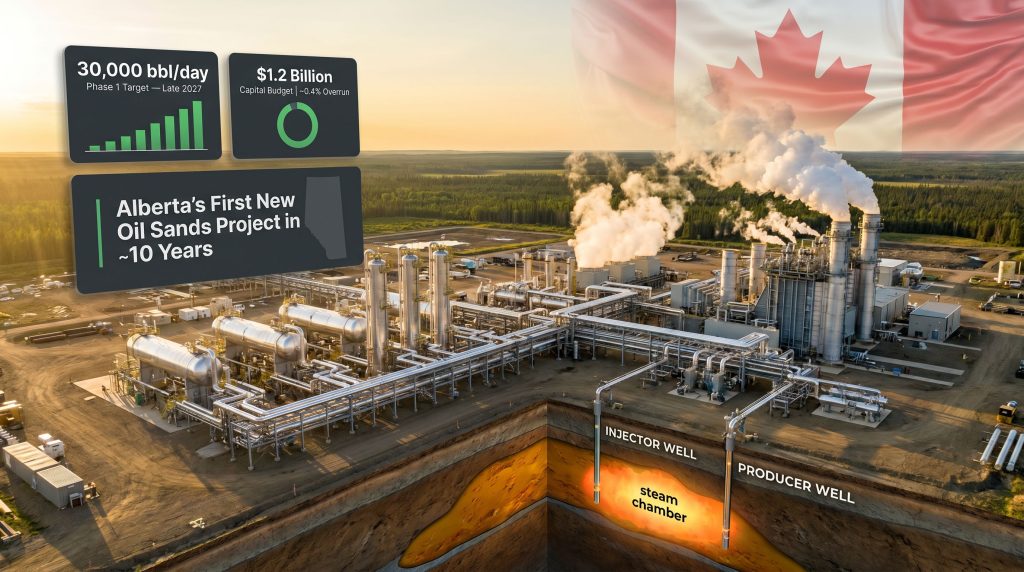
| Phase 1 Production Target | 30,000 bbl/day (by late 2027) |
| Regulatory Approval Ceiling | 80,000 bbl/day |
| Steam Facility Capacity | 90,000 bbl/day |
| Capital Budget | ~$1.2 billion |
| Cost Overrun | |
| First Steam | December 2025 |
| Commercial Production Start | Late May 2026 (ahead of schedule) |
| Historical Significance | First new Alberta oil sands project in ~10 years |
How Does SAGD Technology Work, and Why Was It Selected for Blackrod?
Understanding why SAGD was the logical choice for Blackrod requires a working knowledge of the geology involved. Alberta's Athabasca oil sands contain bitumen, a form of crude oil so viscous at reservoir temperatures that it cannot flow under natural pressure. Depending on deposit depth, operators choose between open-pit mining for shallow reserves and thermal in-situ recovery for deeper formations. Blackrod's bitumen lies beyond the economical reach of surface mining, making SAGD the technically appropriate solution.
The Engineering Principles Behind Steam-Assisted Gravity Drainage
SAGD operates through a deceptively elegant mechanism. Two horizontal wells are drilled in parallel pairs, one positioned roughly five metres above the other within the bitumen-bearing formation. The upper well, known as the injector, continuously delivers high-pressure steam into the reservoir. Over weeks and months, this steam creates an expanding cavity known as a steam chamber, which radiates heat outward through the bitumen deposit.
As bitumen heats up, its viscosity drops dramatically, transitioning from a substance closer in consistency to cold molasses to a fluid capable of flowing. Gravity then does the remainder of the work: liquefied bitumen, along with condensed steam water, drains downward to the producer well positioned beneath, from which it is pumped to surface. The physics are straightforward, but execution at scale demands precision in well placement, steam pressure management, and water treatment infrastructure.
Several characteristics make SAGD particularly well-suited to deep bitumen deposits:
- Deposits that begin at 150 metres or deeper are generally not viable for open-pit mining, making SAGD one of the few commercially scalable alternatives
- The method leaves a substantially smaller surface disturbance footprint compared to open-pit operations, a meaningful advantage in an era of heightened environmental scrutiny
- SAGD is scalable through phased well-pair additions, allowing output to be ramped in measured stages without major infrastructure rebuilds
- The technique has a long operational lifespan, with many SAGD projects designed for multi-decade production horizons
How Blackrod's SAGD Design Compares to Conventional Oil Sands Operations
| Feature | Open-Pit Mining | SAGD (Blackrod) |
|---|---|---|
| Surface Disturbance | High | Low |
| Deposit Depth Requirement | Shallow (under 75m) | Deep (over 150m) |
| Water and Steam Intensity | Very High | Moderate to High |
| Emissions Profile | Higher per barrel | Lower per barrel |
| Scalability | Limited by deposit geometry | Phased expansion possible |
| Infrastructure Footprint | Large tailings ponds required | Compact central processing model |
What Makes Blackrod's Central Processing Facility Strategically Significant?
One of the less-discussed engineering decisions at Blackrod carries considerable strategic weight. The Phase 1 central processing facility was deliberately sized for 90,000 barrels per day of steam generation capacity, meaningfully above the Phase 1 production target of 30,000 barrels per day. This is not an oversight or conservative engineering buffer. It is a forward-looking infrastructure decision.
By building steam generation capacity that significantly exceeds the initial production requirements, IPC has effectively pre-positioned Blackrod's infrastructure to support future phase expansions without the cost and disruption of major facility rebuilds. Paired with an integrated cogeneration plant that simultaneously produces electricity and steam, the facility is engineered for long-term efficiency and capital discipline in subsequent phases. Furthermore, details about the Alberta Energy Regulator's approval process for Blackrod illustrate the depth of technical scrutiny these projects undergo before construction can commence.
Investor Insight: Oversizing the steam facility relative to Phase 1 output is a structural signal of expansion intent. It reduces the marginal capital cost of future phases significantly, a detail often overlooked in headline production figures but directly relevant to long-run project economics.
Blackrod's Construction Timeline and Budget Performance
A Phase-by-Phase Chronology
- 2024: Full construction commences following regulatory approvals
- December 2025: First steam injection achieved, the critical operational milestone in any SAGD project, confirming reservoir response and well pair functionality
- Q3 2026 (original schedule): Planned first oil production date per initial project timeline
- Late May 2026 (actual): Commercial production commenced, ahead of the original schedule by approximately four to six weeks
- Late 2027 target: Phase 1 ramp-up to 30,000 barrels per day, revised to occur earlier than originally projected
How Blackrod Performed Against Its Capital Budget
Capital discipline in major resource projects is notoriously difficult to achieve. Industry studies consistently show that large oil and gas construction projects routinely exceed their original cost estimates, sometimes by substantial margins. Blackrod's performance stands in marked contrast to that norm.
- Total approved capital budget: $1.2 billion
- Reported cost overrun: approximately $5 million
- Overrun as a percentage of total project cost: roughly 0.4%
- Delivery timing: ahead of the originally scheduled production start
A cost overrun of less than half a percent on a billion-dollar oil sands greenfield project is, by virtually any industry benchmark, exceptional. It validates IPC's project management capability and strengthens the credibility of future cost estimates for subsequent phases. For investors evaluating capital allocation risk, near-budget delivery on a complex SAGD build carries meaningful signal value. The Canadian Energy Centre's coverage of this milestone similarly notes how rare such disciplined execution is in the modern oil sands environment.
Notable: Delivering a first-of-its-kind greenfield SAGD project on time and effectively within budget, in the current regulatory and inflationary construction environment, represents a meaningful proof of execution capability.
Blackrod's Full Production Potential and Long-Term Trajectory
Phase 1 vs. the Regulatory Ceiling
| Production Stage | Target Output |
|---|---|
| Phase 1 Ramp-Up Target (by late 2027) | 30,000 bbl/day |
| Regulatory Approval Ceiling | 80,000 bbl/day |
| Steam Infrastructure Capacity | 90,000 bbl/day (supports future phases) |
The gap between Phase 1 targets and the regulatory ceiling is not simply a placeholder. Blackrod sits atop a large contingent resource base that extends well beyond the scope of Phase 1 well pairs. The combination of already-approved production limits up to 80,000 barrels per day, pre-sized steam infrastructure, and 100% owner control gives IPC a clear and relatively low-friction pathway to future capacity additions.
It is worth understanding the distinction between what SAGD ramp-up looks like in practice compared to other extraction methods. Because bitumen mobilisation in SAGD depends on the progressive growth of the steam chamber, production does not ramp linearly from day one. Output climbs gradually as more reservoir volume is heated, which is why the timeline to 30,000 barrels per day extends into late 2027 despite commercial production already being underway.
Alberta's Oil Sands Landscape: Understanding Blackrod's Broader Context
The Greenfield vs. Brownfield Distinction
A frequently misunderstood aspect of oil sands development is the difference between greenfield and brownfield projects. A brownfield expansion adds production capacity to an existing site with already-established infrastructure, regulatory approvals in place, and operational knowledge embedded. A greenfield project builds an entirely new facility from scratch, requiring fresh regulatory permits, new infrastructure from the ground up, and demonstration of the project's viability to financing markets.
Since approximately 2014, the combination of low oil prices, rising carbon policy complexity, activist pressure, and tightening ESG-driven financing conditions pushed Canadian oil sands producers almost exclusively toward brownfield expansions. Greenfield development effectively stopped. The Blackrod oil sands project's approval, construction, and now commercial production represent a rare and meaningful exception to that decade-long pattern.
Alberta's Oil Sands by the Numbers
The strategic weight of Alberta's oil sands is often understated outside energy industry circles. For a broader picture of where prices sit within this context, the crude oil market overview provides useful context on current conditions shaping investment decisions:
- Oil sands account for approximately 97% of Canada's total oil resource base
- Proven recoverable reserves stand at roughly 167 billion barrels, one of the largest concentrations of proven reserves anywhere on earth
- In July of the prior year, Alberta recorded record oil sands output of 3.67 million barrels per day, according to provincial reporting
- Breakeven costs across the sector have fallen to levels that compete with portions of the U.S. shale patch, according to analysis from Enverus, reflecting sustained investment in operational efficiency
Key Insight: The convergence of falling breakeven costs, a massive proven reserve base, and growing pipeline capacity has repositioned Alberta's oil sands as one of North America's most cost-competitive and strategically durable hydrocarbon resources, a shift that was barely conceivable at the sector's nadir in 2016.
What Drove Breakeven Costs Lower?
The cost reduction story in Alberta oil sands is not purely a function of oil price pressure forcing efficiency. It reflects a genuine technological evolution:
- Improvements in steam-to-oil ratio (SOR) management, meaning producers now generate more bitumen output per unit of steam injected
- Advances in solvent-assisted SAGD techniques, where light hydrocarbon solvents are co-injected with steam to further reduce viscosity and lower energy consumption
- Optimisation of water recycling systems, reducing freshwater requirements and operating costs simultaneously
- Economies of scale at established facilities, where fixed costs are spread across higher production volumes
The next major ASX story will hit our subscribers first
Energy Security and the Return of Supermajor Interest in Canada
Why Geopolitics Is Reshaping Capital Flows Toward Alberta
The oil sands investment landscape has shifted materially as energy security moved back to the centre of geopolitical priority. Stable, rule-of-law jurisdictions with large reserve bases and established export infrastructure have attracted renewed attention from producers and consuming nations alike. Consequently, understanding oil geopolitics and supply dynamics is increasingly essential for contextualising where Alberta fits within the global energy picture.
Canada's oil sands fit that profile precisely. The Trans Mountain pipeline is operating at full capacity, with its operator planning to add further throughput capacity in response to strong producer demand. That pipeline expansion is a critical piece of infrastructure that enables Alberta crude to reach tidewater and access Asian markets, where demand for reliable, non-Middle Eastern supply remains structurally strong. Furthermore, the ambition to position Canada as a Canada energy superpower has added further political momentum to the sector's resurgence.
Are the Supermajors Returning to the Canadian Oil Patch?
Evidence of renewed major company interest in Canadian oil sands is accumulating. In addition, the Canadian energy outlook has shifted notably amongst executives who previously held a more cautious posture toward greenfield development:
- Shell announced a $16.4 billion acquisition of ARC Resources, adding roughly 370,000 barrels of oil equivalent per day to its production base and providing access to approximately 2 billion barrels of reserves. The deal also strengthens Shell's position in LNG Canada, the export facility it operates with a 40% stake as an Asia-Pacific supply anchor.
- TotalEnergies, Equinor, ConocoPhillips, and BP have reportedly engaged investment banks to compile acquisition target lists in the Canadian energy sector, according to Reuters reporting in May 2026, citing unnamed sources. While no guarantee of completed transactions exists, the active advisory mandates reflect a materially changed investment posture toward Canada.
The return of supermajor interest, combined with Blackrod's successful greenfield execution, suggests a meaningful recalibration of how the institutional investment community perceives Alberta oil sands risk and opportunity. Moreover, tracking WTI and Brent futures remains critical for understanding how benchmark pricing will influence the pace of future Blackrod phase expansions.
Frequently Asked Questions: Blackrod Oil Sands Project
What type of oil does Blackrod produce?
Blackrod produces bitumen, a dense, viscous form of crude oil that must be either upgraded into synthetic crude or blended with diluent to produce diluted bitumen, commonly referred to in the industry as dilbit, before it can be transported through pipelines.
Who owns and operates the Blackrod project?
The project is 100% owned and operated by International Petroleum Corporation (IPC), a publicly listed international oil and gas company.
When did Blackrod reach commercial production?
Commercial production commenced in late May 2026, ahead of the originally planned Q3 2026 schedule.
What is the maximum approved production rate?
Blackrod holds regulatory approval for up to 80,000 barrels per day. Phase 1 is targeting a ramp to 30,000 barrels per day by late 2027, with central processing infrastructure already sized to support expansion beyond that level.
What did the Blackrod project cost to build?
Total construction was delivered within a capital budget of approximately $1.2 billion, with a cost overrun of around $5 million, representing less than 0.5% of total project expenditure.
Why is Blackrod historically significant?
The Blackrod oil sands project is the first genuinely new oil sands facility to enter production in Alberta in approximately ten years, distinguishing it from the brownfield expansions that dominated the sector throughout the previous decade.
What is the steam-to-oil ratio and why does it matter?
The steam-to-oil ratio (SOR) measures how many barrels of water-equivalent steam are required to produce one barrel of bitumen. A lower SOR indicates greater energy efficiency and lower operating costs. Improvements in SOR management have been central to the cost reduction achievements across the Alberta oil sands sector over the past decade.
Disclaimer: This article is intended for informational and educational purposes only. It does not constitute financial, investment, or legal advice. Forecasts, timelines, and production targets referenced herein are subject to change and carry inherent uncertainty. Readers should conduct their own due diligence and consult qualified professionals before making investment decisions. Past project performance is not necessarily indicative of future outcomes.
Want to Stay Ahead of the Next Major Resource Discovery?
Discovery Alert's proprietary Discovery IQ model delivers real-time alerts on significant ASX mineral discoveries, transforming complex resource data into actionable investment insights for both short-term traders and long-term investors — explore historic discoveries and their remarkable returns to understand what's possible, then begin your 14-day free trial at Discovery Alert to position yourself ahead of the market.