
June 19, 2026
How G7 Requirements for Latin American Critical Minerals Are Reshaping Global Supply Chains
Across the global mining sector, a quiet but consequential shift is underway. The rules governing who gets access to the most capital-rich, demand-driven markets are no longer determined solely by geology or commodity price cycles. Increasingly, they are determined by governance architecture, compliance documentation, and the ability to demonstrate accountability across the entire production chain. For Latin America, a region sitting atop some of the world's most strategically vital mineral deposits, this shift is not a distant regulatory abstraction. It is a present-day commercial reality with measurable consequences for investment access, offtake agreements, and long-term industrial positioning.
The G7 requirements for Latin American critical minerals, formalised through the 2026 G7 Leaders' Declaration, represent the most structured articulation yet of how wealthy democracies intend to govern their mineral supply chains. Understanding what those requirements actually demand, and which countries and producers are best positioned to meet them, is now a prerequisite for anyone operating in or investing in the region's mining sector. This is especially true given the growing importance of critical minerals and energy security in shaping long-term industrial policy across G7 nations.
When big ASX news breaks, our subscribers know first
From Commodity Trade to Compliance Architecture
For decades, Latin America's relationship with industrialised mineral-consuming nations operated on relatively simple terms: the region extracted, processed to a degree, and exported. Pricing was set by global benchmarks, and the main variables were cost, volume, and logistics. That model is being restructured at its foundations.
The G7's 2026 framework introduces what is effectively a market certification system for critical minerals. Access to G7-aligned demand, financing instruments, and offtake agreements is now contingent on meeting a defined threshold of standards compliance. This does not function as a legally binding international treaty. Latin American governments face no formal obligation to adopt these standards.
What they face instead is a market-access incentive structure: align with G7 compliance expectations and gain preferential access to the fastest-growing segment of global mineral demand. Decline to align and risk capital diversion to competing jurisdictions in Australia, Canada, and parts of Africa that are further along the compliance curve. Furthermore, the European critical raw materials strategy is reinforcing this same direction, creating a parallel set of compliance pressures that amplify the G7's expectations.
The G7's approach functions less like a regulatory regime and more like a market certification system. Compliance unlocks access. Non-compliance redirects capital elsewhere.
The minerals at the centre of this framework are concentrated, perhaps unsurprisingly, in Latin America: copper, lithium, nickel, cobalt, graphite, manganese, niobium, and rare earths. The region holds the world's largest copper reserves in Chile, the dominant share of the Lithium Triangle across Chile, Argentina, and Bolivia, and approximately 90% of global niobium production in Brazil. This concentration is precisely why the G7's compliance architecture matters so intensely for the region.
The Five-Pillar Compliance Framework Explained
The G7's standards threshold for critical mineral supply chains can be understood through five interconnected compliance pillars. Each pillar creates specific operational demands for Latin American producers.
Pillar 1: Responsible Extraction and Environmental Standards
Projects seeking G7-aligned market access must demonstrate that environmental costs are genuinely internalised across the production lifecycle. This includes environmental impact assessments, land rehabilitation obligations, and emissions accounting. The relevant international benchmarks include the IFC Performance Standards and the OECD Due Diligence Guidance for Responsible Mineral Supply Chains.
Producers operating in ecologically sensitive zones — a category that captures much of the Andean copper belt and Amazonian mineral corridors — face the most intensive scrutiny under this pillar. The IEA's critical minerals framework provides additional context on how environmental benchmarks are shaping procurement decisions among energy transition actors globally.
Pillar 2: Traceability and Supply Chain Transparency
The G7's 2026 action plan explicitly calls for traceability mechanisms and standards-based markets. This requires provenance documentation from extraction point through to processing and export. For Latin American producers, many of whom operate alongside fragmented artisanal and small-scale mining (ASM) supply chains, this creates a significant infrastructure burden.
| Traceability Requirement | Operational Implication |
|---|---|
| Provenance documentation | Mine-level data reporting systems required |
| Processing chain visibility | Smelter and refinery certification needed |
| Export-level reporting | Customs and trade data integration |
| Third-party audit compliance | Independent verification infrastructure |
Digital traceability tools, including blockchain-based provenance systems and third-party audit frameworks, are expected to become baseline requirements for G7-aligned supply chain participation. Producers that cannot generate this documentation face increasing difficulty accessing institutional capital, regardless of their geological assets.
Pillar 3: Labour Standards and Worker Protections
G7 compliance requires adherence to internationally recognised labour rights, including freedom of association, prohibition of child and forced labour, and verifiably safe working conditions. Critically, compliance must be demonstrated through third-party social audits rather than self-reporting. This distinction matters enormously in practice.
Peru's copper sector, which has seen sustained labour disputes at major operations, and parts of Brazil's nickel and bauxite supply chains, where informal labour arrangements remain common, face the most material exposure under this pillar.
Pillar 4: Indigenous Consultation and Community Benefit Sharing
The G7's 2026 declaration names local consultation and cooperation with Indigenous Peoples, local communities, trade unions, and civil society as a non-negotiable component of the standards threshold. This goes beyond the existing requirements of ILO Convention 169 on Indigenous and Tribal Peoples, which is already ratified by Peru, Chile, Argentina, and Brazil, but which is inconsistently implemented across all four countries.
Projects that lack documented Free, Prior, and Informed Consent (FPIC) processes risk disqualification from G7-aligned financing instruments, regardless of their geological or commercial merits.
Community benefit-sharing mechanisms, including local employment targets and revenue-sharing agreements, are expected to form part of the compliance evidence base. This pillar is arguably the most difficult to retrofit onto existing operations, since authentic community partnership requires years of trust-building that cannot be accelerated through documentation alone.
Pillar 5: Anti-Corruption and Governance Integrity
Anti-bribery controls and governance transparency are explicitly named in the G7 standards threshold. The Extractive Industries Transparency Initiative (EITI) is identified as a relevant framework, and several Latin American nations, including Peru and Honduras, are already EITI members. However, EITI membership at the national level does not automatically translate into corporate-level compliance.
Producers with state-owned enterprise involvement face heightened scrutiny under this pillar given the governance opacity that can accompany public-sector participation in commercial mining operations.
Country-by-Country Compliance Exposure
The G7 requirements for Latin American critical minerals do not apply uniformly across the region. Each major producer nation carries a distinct combination of geological assets, compliance strengths, and structural vulnerabilities.
Chile holds the world's largest copper reserves and ranks as the second-largest lithium producer globally. Its existing regulatory institutions, including the Environmental Impact Assessment system and the 2023 Lithium National Strategy, provide a partial foundation for G7 alignment. Chile's lithium strategy has drawn considerable international attention precisely because it attempts to balance sovereign control with the compliance expectations of G7-aligned partners. Key compliance gaps include the pace of FPIC implementation in lithium-rich Atacama communities and the water-use standards governing brine extraction operations.
Argentina sits at the heart of the Lithium Triangle, with the Puna region's brine deposits representing significant battery-grade lithium carbonate potential. However, the country's federal structure, where provincial governments retain mineral rights, creates jurisdictional fragmentation that complicates national-level compliance standardisation. The RIGI large investment incentive framework offers project certainty but has drawn criticism from Indigenous and environmental groups, a tension that directly implicates G7 community consultation requirements.
Peru is the world's second-largest copper producer and a significant source of zinc, silver, and gold. The country's structural challenge is its chronic social conflict record, with over 200 active mining-related disputes documented in recent years. This represents the most significant barrier to G7 compliance alignment among the major Latin American producers. The root causes of Peru's social licence failures — inadequate prior consultation processes and insufficient community benefit distribution — are precisely what the G7's Pillar 4 requirements are designed to address.
Brazil presents the most diversified mineral endowment in the region, spanning iron ore, niobium, nickel, bauxite, copper, graphite, and rare earths. Its position supplying approximately 90% of global niobium production gives it unique strategic leverage. The most complex G7 alignment challenge for Brazil is environmental: mining operations near or within the Amazon biome face intense international scrutiny, and the EU's Carbon Border Adjustment Mechanism (CBAM) creates a parallel compliance pressure that reinforces the G7 standards agenda.
Mexico, often underweighted in G7 critical mineral discussions, has growing strategic relevance. Its copper, silver, and lithium resources, combined with USMCA trade architecture and geographic proximity to the United States, position it as a natural supply chain partner. However, the nationalisation of lithium resources and uncertainty around the Sonora Lithium Project introduce state-ownership dynamics that require careful navigation.
The Rare Earth Diversification Target and Its Regional Implications
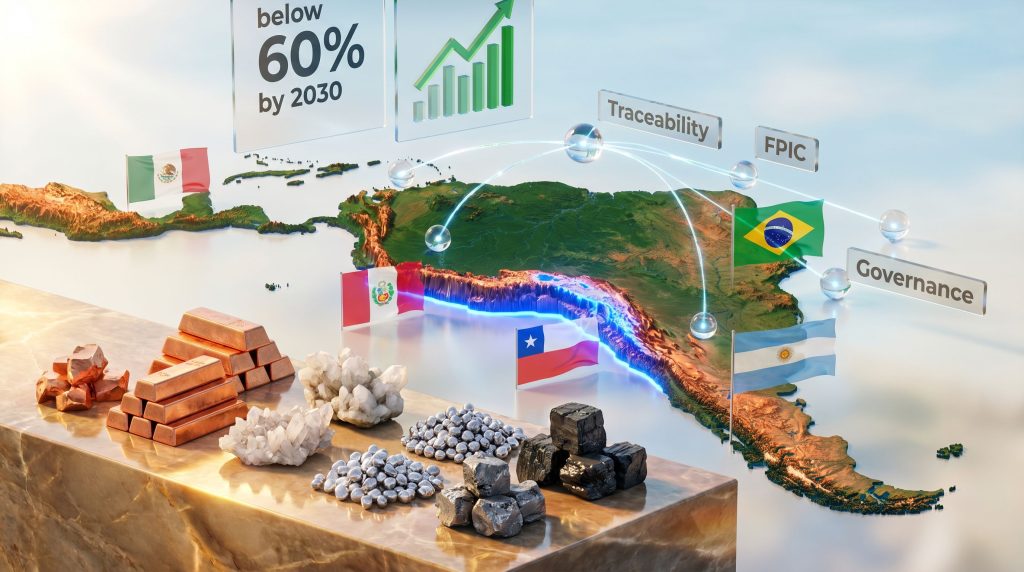
One of the most consequential and least widely understood provisions of the G7's 2026 framework is a concrete quantitative benchmark: reducing dependence on non-G7, non-partner-country suppliers for rare earths and permanent magnets to below 60% by 2030, with an aspirational target of 50% as soon as feasible.
This target is a direct response to China's dominance in rare earth processing, which currently accounts for approximately 85 to 90% of global refined rare earth output. The broader context of rare earth supply chains illustrates how deeply this dependency has shaped G7 industrial vulnerability, reinforcing the urgency behind the 2030 target.
Brazil's carbonatite rare earth deposits, particularly in Minas Gerais and Goiás, represent the most advanced development pipeline in the region. However, the gap between geological endowment and production-ready supply chain capacity is substantial. Processing infrastructure, separation technology, and downstream magnet manufacturing are largely absent across Latin America.
The G7's explicit commitment to local value creation rather than raw material export dependency gives regional governments a legitimate basis for negotiating technology transfer and processing investment as conditions of partnership agreements.
The G7's rare earth diversification target creates a time-bounded investment opportunity for Latin American producers. Only those who can demonstrate compliance readiness across all five pillars of the standards framework will be positioned to capture it.
How G7 Compliance Standards Are Reshaping Investment Flows
Multilateral development banks aligned with G7 priorities, including the IFC, IDB, and the US International Development Finance Corporation (DFC), are increasingly conditioning project finance on ESG compliance documentation that mirrors the G7 standards framework. The Partnership for Global Infrastructure and Investment (PGII) explicitly targets critical mineral supply chains in partner countries with compliance alignment as a prerequisite for project eligibility.
The Columbia Energy Policy analysis of G7 mineral commitments highlights a critical unresolved tension: whilst G7 nations have committed to diversifying supply, the question of who bears the cost of compliance infrastructure remains largely unanswered. This ambiguity has direct implications for how Latin American producers structure negotiations with G7-aligned financing partners.
The investment screening effect this creates is already visible in market behaviour. Projects that cannot demonstrate traceability, environmental compliance, and community consultation documentation face increasing difficulty accessing G7-aligned capital markets. Conversely, projects with robust compliance frameworks can command:
- Lower cost of capital from development finance institutions
- Preferential offtake terms from G7-aligned end users
- Access to export credit agency (ECA) support structures
- Eligibility for PGII project financing instruments
Chile's lithium sector provides a concrete illustration. The joint venture structure between SQM and Codelco was partly designed to satisfy governance transparency expectations from international financing partners, demonstrating that compliance architecture is already influencing deal structure, not just project screening.
The next major ASX story will hit our subscribers first
Building G7-Aligned Compliance: A Practical Roadmap for Producers
For Latin American mining companies navigating this environment, the pathway to G7 compliance readiness involves five sequential steps:
- Conduct a baseline gap assessment mapping current operations against each of the five G7 compliance pillars, with prioritisation based on capital-access impact.
- Invest in traceability infrastructure, beginning with mine-to-market provenance tracking systems and engagement with internationally recognised certification schemes such as the Responsible Minerals Initiative (RMI) and the Initiative for Responsible Mining Assurance (IRMA).
- Strengthen Indigenous and community engagement frameworks, establishing FPIC processes that meet or exceed ILO Convention 169 standards and creating independent grievance mechanisms accessible to affected communities.
- Align governance and anti-corruption controls through EITI reporting or equivalent transparency frameworks applied at the corporate level, with third-party anti-bribery audits covering permitting, procurement, and export processes.
- Engage G7-aligned financing partners early, using development finance institution technical assistance programmes to build compliance capacity before project financing is required.
The Strategic Stakes: Compliance as Competitive Advantage
A critical and frequently underappreciated dimension of the G7 requirements for Latin American critical minerals is that compliance is not merely a cost centre. For producers and governments that invest strategically, it functions as a competitive moat. The broader context of metals and mining geopolitics makes clear that compliance positioning is increasingly inseparable from geopolitical alignment, particularly as G7 nations accelerate their efforts to reduce exposure to single-source supply dependencies.
Latin American producers that fail to build G7-aligned compliance frameworks face capital diversion to competing jurisdictions. The window for establishing competitive compliance positioning is time-bounded. As the 2030 rare earth target approaches, G7 capital allocation decisions will increasingly favour jurisdictions with demonstrated compliance track records over those with superior geology but fragile governance.
Simultaneously, the G7's explicit commitment to local value creation gives Latin American governments genuine negotiating leverage. Countries like Chile and Argentina are already applying this logic in lithium negotiations, insisting on domestic processing capacity and technology transfer as conditions of foreign investment approvals. This represents a structural departure from the extractive model that characterised the region's mineral export history.
For investors, producers, and policymakers across the region, the message is consistent: the G7 requirements for Latin American critical minerals are not a compliance burden to be minimised. They are a strategic framework to be leveraged by those with the foresight to build the necessary architecture now.
Disclaimer: This article is intended for informational purposes only and does not constitute financial or investment advice. Forecasts, projections, and policy interpretations reflect current available information and may change as regulatory frameworks evolve. Readers should conduct independent due diligence before making investment decisions.
Want to Stay Ahead of Critical Mineral Discoveries on the ASX?
Discovery Alert's proprietary Discovery IQ model scans ASX announcements in real time, instantly identifying significant mineral discoveries across copper, lithium, rare earths, and more than 30 other commodities — turning complex data into actionable investment insights for both short-term traders and long-term investors. Explore historic examples of major mineral discoveries and their market returns, then begin your 14-day free trial at Discovery Alert to position yourself ahead of the market.