
June 19, 2026
When Emerging Markets Face a Binary Choice: What Colombia's Runoff Reveals About Political Risk Pricing
Every few years, a single election in an emerging market forces global investors to confront a question that portfolio theory struggles to model cleanly: what happens when two candidates represent not just different policies, but fundamentally incompatible economic operating systems? Colombia's presidential runoff is precisely that kind of event. Understanding what Colombia runoff investors need to know before the vote requires more than reading polling data. It demands a structured framework for assessing sovereign risk, currency exposure, energy sector dynamics, and the structural constraints that will shape governance long after the votes are counted.
When big ASX news breaks, our subscribers know first
The Two Economic Visions on the Ballot
Colombia's runoff is unusual in Latin American electoral history for the sharpness of the contrast it presents. The competing candidates do not occupy adjacent points on the political spectrum. They represent divergent philosophies about the role of the state, the future of the extractive economy, and the appropriate pace of fiscal consolidation. Furthermore, geopolitical mining risks add another layer of complexity for those with exposure to Colombian extractive assets.
Energy Policy: The Commercial Centrepiece
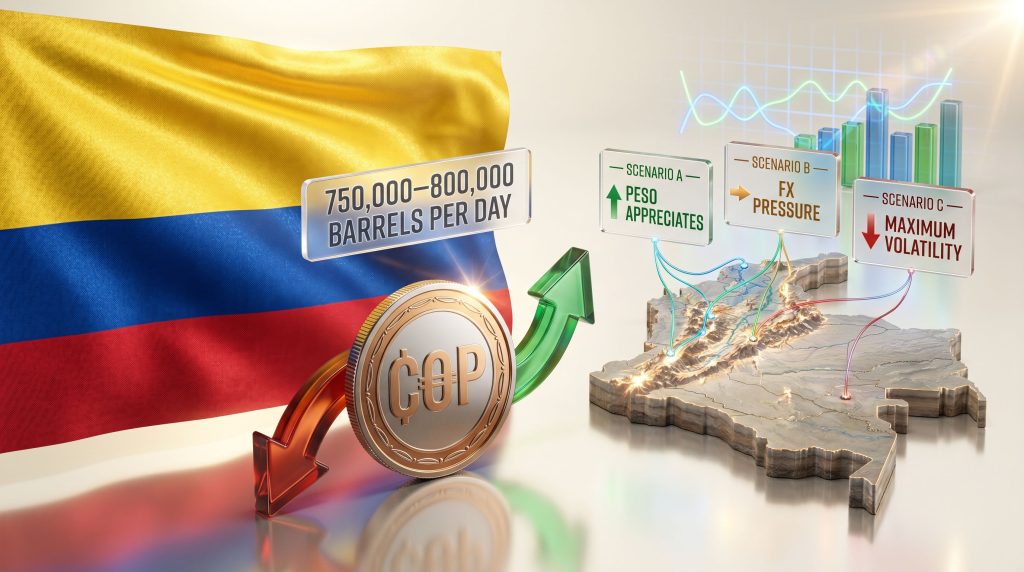
For investors with exposure to Colombian assets, energy policy is the most commercially consequential dimension of this contest. Colombia currently produces approximately 750,000 to 800,000 barrels of oil per day, making it a mid-tier but meaningful hydrocarbon producer within the Latin American context. The country's fiscal revenues, currency performance, and sovereign creditworthiness are all partially tethered to upstream sector health.
The policy fork is stark:
- A market-oriented administration would be expected to resume upstream licensing rounds, provide regulatory clarity for hydraulic fracturing (fracking) pilot programs, and actively court foreign direct investment in exploration and production.
- A left-leaning administration would likely impose restrictions or a de facto moratorium on new fossil fuel exploration contracts, accelerate energy transition minerals mandates, and introduce tighter environmental permitting thresholds that could delay or cancel existing projects.
The fracking question deserves particular attention. Colombia's geological formations, particularly in the Middle Magdalena Valley and certain Llanos Basin structures, are considered prospective for unconventional hydrocarbons. Several international operators have conducted seismic programs and are positioned to move toward pilot drilling if the regulatory environment permits. A restrictive government would effectively mothball years of preparatory work and push those operators toward other jurisdictions.
Investors should note that Colombia's upstream sector is not in a position to absorb a prolonged licensing freeze without measurable production decline. Under a no-new-licenses scenario, analyst modelling suggests output could fall below 700,000 barrels per day within a three to five year horizon, a threshold that would have material consequences for the fiscal balance and sovereign spread trajectory.
Fiscal Sustainability and the Credit Rating Question
Beyond energy, the fiscal management question is where sovereign bond investors are most focused. Colombia's public debt profile requires careful stewardship to preserve its investment-grade credit standing. Fitch Ratings has signalled that the election outcome carries direct implications for the country's economic policy trajectory, which feeds directly into the agency's assessment of debt servicing capacity and fiscal credibility.
The incoming president will inherit a consolidation challenge that cannot be resolved through political will alone. Coalition-building in a fragmented Congress will determine whether any reform mandate can be translated into legislation. This structural constraint applies equally to both candidates, but the fiscal risks under each scenario differ in character:
| Policy Dimension | Market-Friendly Scenario | Left-Leaning Scenario |
|---|---|---|
| Oil and Gas Licensing | Expansion expected | Likely restrictions or pause |
| Fracking Exploration | Probable advancement | Likely prohibition |
| Fiscal Consolidation | Higher credibility signal | Reform-dependent, uncertain |
| Foreign Investment Climate | Improved sentiment | Cautious or deterrent signals |
| Renewable Energy Transition | Moderate acceleration | Aggressive mandates |
| Colombian Peso Outlook | Appreciation support | Downside depreciation risk |
How Colombian Financial Markets Are Pricing the Risk
The Peso as a Political Barometer
The Colombian peso (COP) functions as one of the most politically sensitive currencies in the emerging market universe. Its dual exposure to domestic governance risk and global oil price movements makes it a highly responsive instrument during election cycles. COP implied volatility in the options market typically spikes in the weeks surrounding Colombian presidential contests, and first-round results have already begun influencing positioning among currency traders.
A critical but underappreciated dynamic is that the peso's oil correlation means that even investors with no explicit political view on the runoff are effectively taking a position through their COP exposure. When oil revenues are threatened by policy shifts, the currency channels that risk quickly and often before equity markets fully adjust. In addition, broader trade war supply chain impacts are compounding pressure on commodity-linked currencies across emerging markets, making peso risk management even more critical at this juncture.
Sovereign Bond Spreads: The Fiscal Credibility Signal
Colombia's EMBI spread — the premium above US Treasuries demanded by investors to hold Colombian sovereign debt — is the most direct barometer of fiscal confidence. Under a credible consolidation scenario, spreads could compress as investors price in improved debt sustainability. Under an expansionary fiscal scenario without matching revenue measures, spread widening would likely follow, echoing the pattern observed in Peru following Castillo's election in 2021, where institutional fragility amplified market volatility well beyond what policy content alone would have justified.
Equity Sector Exposure: A Risk Matrix
| Sector | Market-Friendly Outcome | Left-Leaning Outcome | Key Variable |
|---|---|---|---|
| Oil and Gas | Positive repricing | Negative pressure | Licensing and fracking policy |
| Financials | Positive | Neutral to negative | Sovereign risk, growth trajectory |
| Infrastructure | Positive | Neutral | Concession and regulatory framework |
| Renewables | Neutral | Positive | Transition mandate speed |
| Mining and Metals | Positive | Cautious | Royalty reform and permitting |
Sector timing note: Historical patterns in Latin American electoral cycles suggest that sector-specific equity repricing can begin five to seven trading days before official results are announced, as institutional investors adjust risk weights based on late-breaking polling data and prediction market signals.
Governance Complexity: Why a Majority Vote Doesn't Guarantee Policy Delivery
One of the most important and least discussed dimensions of this runoff is what happens after the winner is declared. Colombia's Congress is structurally fragmented, with no single party or coalition commanding a working legislative majority. This is not a temporary condition. It reflects deep regional, ideological, and interest-group cleavages that have resisted consolidation across multiple electoral cycles.
For investors, congressional fragmentation acts as a natural policy moderator in both directions. The most aggressive left-leaning reform scenarios — including sweeping royalty restructuring or nationalisation of energy infrastructure — would face formidable legislative resistance. However, a market-friendly administration's ability to accelerate licensing reform or lock in fiscal consolidation through structural legislation would equally depend on constructing fragile multiparty coalitions that can fracture under pressure.
This structural reality produces a paradox that sophisticated investors should internalise: the runoff result determines the direction of travel, but Congress determines the speed and the completeness of the journey.
Three Post-Runoff Investment Scenarios
Scenario A: Market-Friendly Victory with Strong Mandate
- Peso appreciates on improved investor confidence; sovereign spreads compress
- Upstream licensing rounds resume; fracking pilots advance toward regulatory approval
- Energy sector FDI recovers, with international operators accelerating pre-positioned programs
- Key risk: Social opposition from environmental groups and indigenous communities creates project-level delays even where national policy is supportive
Scenario B: Left-Leaning Victory with Moderate Governance
- Short-term pressure on COP and sovereign bonds as investors reprice fiscal risk
- Renewable energy investment accelerates, creating opportunities in the power and infrastructure sectors
- Extractive sector FDI pauses as operators await regulatory clarity on new licensing
- Key risk: Fiscal expansion without credible consolidation triggers a credit rating review by Fitch, Moody's, or S&P within 12 to 18 months
Scenario C: Contested Result or Prolonged Uncertainty
- Maximum cross-asset volatility; investment decisions deferred across all sectors
- Peso under sustained depreciation pressure; sovereign spreads widen as institutional credibility is questioned
- Medium-term risk: Damage to Colombia's governance reputation creates a persistent risk premium that outlasts the electoral dispute itself
What Latin American Electoral History Teaches About Market Reactions
Three recent precedents offer instructive parallels for investors navigating the Colombia runoff investors need to know before committing capital.
Chile 2021: Gabriel Boric's first-round lead triggered significant repricing in Chilean mining equities and peso positions. However, markets partially recovered as investors concluded that institutional checks and coalition constraints would moderate the most radical elements of his platform. The lesson is that initial market reactions to left-leaning victories in institutionally stable contexts frequently overshoot, creating tactical re-entry opportunities for long-duration investors willing to look through short-term volatility.
Brazil 2022: Lula's return to the presidency triggered spread widening and BRL depreciation driven primarily by fiscal framework uncertainty rather than by the election result itself. The debate over Brazil's fiscal anchor consumed markets for more than twelve months post-election. The lesson is that the signalling period after an election often matters as much as the vote itself, particularly for bond investors monitoring credit rating agency commentary.
Peru 2021: Castillo's victory demonstrated how institutional fragility can amplify market volatility independently of economic policy content. In markets where governance architecture is under stress, risk premiums reflect institutional uncertainty as much as policy specifics. Colombia's institutional environment, while more developed than Peru's at the time of Castillo's election, carries its own fragility risks that investors should not discount. Consequently, monitoring global recession risks alongside domestic political developments is increasingly essential for managing Colombian exposure.
Asset-Class Risk Priorities Before the Vote
For investors managing Colombian exposure across multiple instruments, the priority hierarchy looks broadly as follows:
- Sovereign bonds (TES and quasi-sovereign debt): The highest sensitivity category. Monitor credit rating commentary from Fitch, Moody's, and S&P in the 30 to 60 day post-election window. Spread direction will be driven by the fiscal credibility signal of the incoming administration's early appointments and policy statements.
- Colombian peso (COP): Review hedging strategies for all COP-denominated exposures before the runoff result. Options market implied volatility is a cost-effective tool for managing binary outcome risk in a defined time window.
- Energy sector equities: The single most directly policy-exposed segment. Upstream operators and service companies with Colombian project exposure face material repricing risk under either scenario. Position sizing should reflect the binary nature of the licensing policy outcome. Understanding broader commodity price impacts is equally critical when sizing energy sector positions.
- Financial sector equities: Sensitive to sovereign risk repricing and economic growth trajectory. A scenario of fiscal expansion without consolidation would compress net interest margins and increase non-performing loan risk across the banking system.
- Infrastructure and mining equities: Moderately exposed to regulatory framework changes. Royalty reform and environmental permitting modifications are the key watchpoints in this segment.
The next major ASX story will hit our subscribers first
Frequently Asked Questions: Colombia Runoff Investment Risk
What is the Colombia presidential runoff and why does it matter to investors?
A runoff election is triggered when no candidate achieves an outright majority in the first round of voting. Colombia's runoff matters to investors because the two finalists represent sharply contrasting approaches to fiscal management, energy regulation, and the foreign investment environment. Each pathway carries distinct implications for the peso, sovereign bonds, and sectoral equities. Analysts at Speyside Group have similarly highlighted that the 2026 contest represents a defining moment for the country's investment trajectory.
Which sectors face the greatest repricing risk from the Colombia election?
The upstream oil and gas sector carries the most direct policy exposure given the debate over new exploration licensing and fracking. Financial sector equities are sensitive to sovereign risk repricing, while infrastructure, mining, and metals face regulatory uncertainty depending on which administration takes office. This is precisely why understanding Colombia runoff investors need to know centres on sectoral positioning rather than macro forecasting alone.
What does Fitch's commentary signal about Colombia's sovereign debt outlook?
Fitch has indicated the election outcome will have a significant bearing on Colombia's economic policy direction, implying the result could influence the agency's assessment of fiscal trajectory and debt servicing capacity. Investors should treat any post-election rating agency commentary as a leading indicator for spread direction.
Could the Colombia runoff result be disputed?
Allegations surrounding electoral administration processes have introduced a layer of pre-result uncertainty independent of the policy outcome itself. A contested result would represent the highest-risk scenario for Colombian assets, potentially triggering sustained cross-asset volatility and institutional credibility damage with medium-term consequences.
How does congressional fragmentation affect the investment outlook?
No incoming president will command a working legislative majority. This structural constraint moderates the most extreme reform scenarios in either direction but also creates governability risk that could slow economic decision-making and delay investment-critical regulatory clarifications.
Disclaimer: This article is intended for informational purposes only and does not constitute investment advice. All forecasts, scenario projections, and market assessments involve inherent uncertainty and should not be relied upon as predictions of future performance. Investors should conduct their own due diligence and consult qualified financial advisors before making investment decisions. Readers seeking additional context on Colombian political and economic developments can explore related regional analysis published by BNamericas at bnamericas.com.
Ready to Position Yourself Ahead of the Next Major Mineral Discovery?
While political risk in emerging markets demands careful analysis, Discovery Alert's proprietary Discovery IQ model delivers real-time alerts on significant ASX mineral discoveries, transforming complex geological data into actionable investment insights — begin your 14-day free trial today and explore historic discoveries that have generated exceptional market returns to understand what early positioning can mean for your portfolio.