June 19, 2026
The Strait of Hormuz: Why One Narrow Passage Controls the World's Energy Pulse
Few geographic features carry the economic weight of a narrow strip of water measuring just 21 miles at its most constricted point. The Strait of Hormuz has long functioned as the central nervous system of global energy supply, a passage so structurally irreplaceable that no realistic pipeline infrastructure exists to substitute for it at any comparable scale. Understanding why the U.S. Navy ends blockade of Iran ports matters to global markets requires first understanding what that blockade actually interrupted, and how deeply integrated Hormuz is with the daily functioning of the world economy.
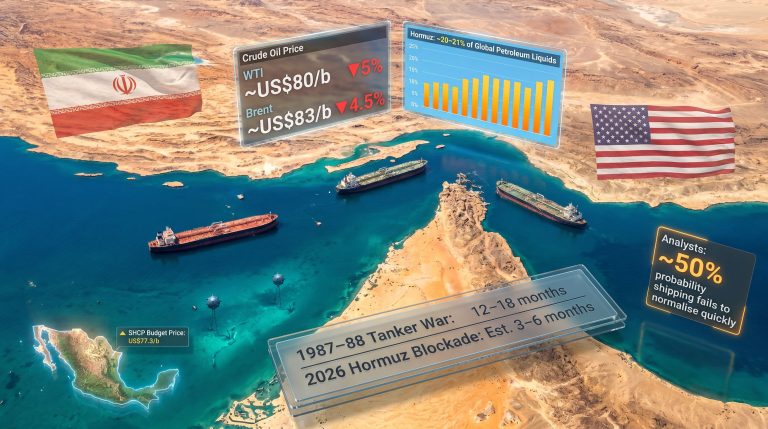
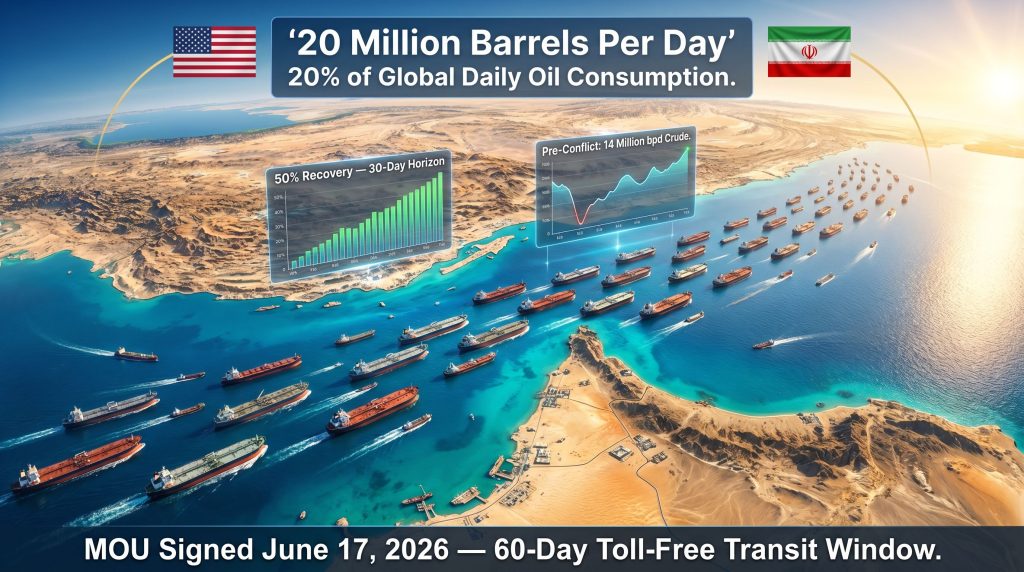
Before hostilities began on 28 February 2026, following a U.S.-Israel military operation against Iran, the strait was carrying an estimated 14 million barrels per day (bpd) of crude oil along with a further 6 million bpd of refined petroleum products. Taken together, this single maritime corridor was responsible for transmitting roughly 20% of the world's daily oil consumption through one navigable passage. The producers dependent on this route include Saudi Arabia, Iraq, Kuwait, the United Arab Emirates, and Iran itself, none of which possess export pipeline capacity capable of absorbing volumes anywhere near this magnitude as an alternative.
When Tehran responded to the February 28 strikes by targeting commercial vessels transiting the strait, the resulting disruption was characterised by energy analysts as the most significant oil supply shock in recorded history. Furthermore, it surpassed the Arab oil embargo of 1973 and the Gulf War disruptions of 1990 in both scale and speed of onset.
When big ASX news breaks, our subscribers know first
How the Naval Blockade Was Constructed and What It Accomplished
The U.S. Navy, operating under U.S. Central Command (CENTCOM), established a naval blockade of Iranian ports and coastal zones as a mechanism of strategic economic pressure following the Iranian retaliation. This created an unusual double constraint on the strait: Iranian forces were actively targeting commercial shipping from one direction, while U.S. naval enforcement was restricting access to Iranian port infrastructure from the other.
The commercial consequences radiated outward rapidly. This kind of oil market disruption created cascading effects across nearly every sector of the global economy:
- Tanker operators suspended transits and rerouted vessels through longer, costlier alternative paths
- War risk insurance premiums for vessels operating near the Persian Gulf spiked to levels not seen in decades
- Energy traders began pricing in sustained supply disruption, pushing crude benchmarks sharply higher
- Asian importers, particularly China, Japan, South Korea, and India, faced acute inventory pressure as Gulf crude flows dried up
- Long-term supply contracts were disrupted, forcing buyers into spot market competition at unfavourable prices
The blockade functioned as designed in terms of applying economic coercion. However, the cost was distributed across the entire global economy through elevated energy prices and supply uncertainty.
The U.S.-Iran Memorandum of Understanding: What Was Agreed and What Wasn't
On 17 June 2026, President Donald Trump and Iranian President Masoud Pezeshkian signed a Memorandum of Understanding intended to establish a framework for ending the U.S.-Iran conflict. The following day, CENTCOM issued a formal statement confirming that American naval forces had ceased all blockade enforcement activities, stating that U.S. forces were no longer impeding the transit of vessels to or from Iranian ports.
The core terms of the agreement can be summarised as follows:
| Agreement Element | Detail |
|---|---|
| Signing date | 17 June 2026 |
| Signatories | President Donald Trump and Iranian President Masoud Pezeshkian |
| Document type | Memorandum of Understanding (MOU) |
| Primary obligation (Iran) | Allow commercial vessels to transit Hormuz toll-free for 60 days |
| Primary obligation (U.S.) | Lift naval blockade enforcement of Iranian ports |
| Nuclear provisions | Left explicitly for future, separate negotiation |
Vice President JD Vance confirmed to reporters that Iran had not fired on ships for two consecutive nights following the signing, describing the early compliance as encouraging. The operational trigger for the formal CENTCOM announcement was precisely this demonstrated restraint, with Vance noting that Tehran appeared to be honouring its initial commitments.
However, the picture became more nuanced following subsequent White House communications. President Trump later indicated that the blockade on vessels specifically departing from or docking at Iranian ports would remain in some form, suggesting the lifting was conditional rather than absolute. This distinction matters significantly for market participants trying to assess actual shipping risk.
"Critical Distinction: CENTCOM's announcement that all blockade enforcement had ceased must be read alongside White House clarifications suggesting residual restrictions may remain for certain vessel categories. This is an actively evolving diplomatic and military situation, not a clean resolution."
What the Agreement Leaves Unresolved
The MOU is not a peace treaty, and consequently several critical dimensions of the U.S.-Iran conflict remain entirely open:
- Nuclear provisions were explicitly acknowledged as requiring separate negotiation, meaning the fundamental strategic disagreement between Washington and Tehran is unresolved
- The 60-day toll-free transit window provides only a temporary operational framework, leaving commercial shipping companies uncertain about what terms apply from Day 61 onward
- U.S. sanctions on Iranian crude exports are a separate legal and policy matter that the MOU does not address, meaning the oil sanctions impact on Iranian exports means Iranian oil may not re-enter global markets freely even with Hormuz open
- No publicly confirmed independent monitoring mechanism exists to verify Iranian compliance with the toll-free transit commitment
Oil Flow Recovery: What the Data Actually Shows
The early signals following the blockade removal were meaningful but require careful interpretation. Vice President Vance stated that more than 12 million barrels of oil transited Hormuz in the first overnight period after the lifting, a figure that, if accurate, would represent a substantial initial surge. CNBC was unable to independently verify this number at time of reporting.
What was independently verified came from trade intelligence firm Kpler, which confirmed that three Saudi tankers carrying approximately 6 million barrels had successfully crossed the strait. Saudi Arabia's willingness to commit tankers early signals that Riyadh had sufficient confidence in the initial corridor stability to resume export movements, a commercially significant indicator given the kingdom's role as the world's largest crude exporter.
Kpler's broader recovery projections paint a more measured picture:
| Timeframe | Projected Recovery Level |
|---|---|
| Days 1 to 7 | Vessels previously anchored or delayed begin transiting; early tanker movements resume |
| 30-day horizon | Approximately 50% of pre-conflict flow levels if the deal holds without disruption |
| Full recovery timeline | No confirmed date; depends on diplomatic, logistical, and insurance factors |
Amrita Sen, founder of Energy Aspects, emphasised that the recovery process would be inherently gradual rather than immediate. Her assessment, shared with CNBC, was that while vessels caught in the backlog would begin moving first, the return to pre-conflict volumes would take considerably longer than initial market optimism might suggest.
Why Full Capacity Recovery Faces Structural Delays
Several friction points will slow the normalisation process regardless of diplomatic goodwill:
- War risk insurance reassessment is mandatory before tanker operators can commit vessels. Underwriters at Lloyd's and comparable institutions will need time to reprice coverage for the corridor, and premiums will remain elevated until a sustained period of incident-free transits is established.
- Freight rate recalibration is non-linear. Rates that spiked during the conflict period will not compress overnight, as carriers have locked in alternative routing arrangements with their own contractual obligations.
- Port infrastructure restart along the Iranian coast requires operational preparation time after months of heavily restricted activity.
- Contractual re-routing unwinding is complex. Shipping companies that redirected vessels through the Cape of Good Hope or other alternatives have ongoing logistical commitments that cannot be instantly reversed.
- The 60-day uncertainty window itself creates hesitation. Long-term commercial contracts require certainty beyond two months, and buyers may delay recommitting to Gulf supply chains until a more durable arrangement is confirmed.
Market Implications and the Price Normalisation Challenge
Global oil markets had been embedding a substantial supply risk premium throughout the conflict period. The Hormuz disruption, described by analysts as historically unprecedented in scope, pushed crude oil price trends significantly above pre-conflict levels as traders priced in the possibility of sustained interruption to 20% of global daily consumption.
The MOU announcement and subsequent CENTCOM confirmation triggered an unwinding of these risk premiums, creating downward price pressure on crude benchmarks. However, analysts consistently caution that price normalisation will not track linearly with diplomatic headlines.
Key variables that energy markets will be monitoring closely include:
- Iranian compliance consistency throughout the 60-day toll-free window, particularly whether any incidents involving commercial vessels occur
- CENTCOM communications clarifying which vessel categories, if any, remain subject to residual U.S. restrictions
- Nuclear negotiation progress, given that failure to advance on the core strategic dispute could destabilise the broader MOU framework before the 60 days expire
- OPEC's market influence over production decisions in response to Hormuz reopening, since Gulf producers may adjust output targets as export constraints ease
- Sanctions architecture governing Iranian crude specifically, as the resumption of Iranian oil on world markets would depend on separate policy decisions unrelated to the MOU
The next major ASX story will hit our subscribers first
The Geopolitical Architecture Behind the Agreement
The Trump administration's decision to lift the blockade reflects a transactional diplomatic approach: extracting specific, time-bound behavioural commitments from Tehran in exchange for military de-escalation. This model prioritises near-term observable compliance over comprehensive structural resolution. In addition, the broader geopolitical trade tensions surrounding U.S.-Iran relations add further complexity to this already fragile diplomatic framework.
The risks embedded in this framework are real and worth understanding clearly:
- Domestic political pressures in both countries could undermine sustained engagement. Iranian hardliners and U.S. Congressional critics of the deal represent potential disruption vectors.
- Non-state actors historically aligned with Iranian interests operate with degrees of autonomy that Iranian state directives do not fully control, meaning Hormuz could face incidents even if Tehran is acting in good faith.
- The 60-day cliff creates a built-in deadline that concentrates risk. If nuclear negotiations do not advance meaningfully within that window, the entire framework may unravel rapidly.
- Verification gaps in the current arrangement mean that compliance disputes could escalate quickly without established institutional mechanisms to manage them.
What a genuinely durable resolution would require goes considerably beyond the current MOU. Consequently, it would need a formal, independently verified agreement on Iranian nuclear activity; permanent commercial shipping protocols for Hormuz that operate outside military enforcement frameworks; a sanctions relief architecture that creates sustained economic incentives for Iranian compliance; and multilateral diplomatic engagement to reduce the fragility of a purely bilateral arrangement.
The reopening of the Strait of Hormuz is a meaningful development for global energy markets. The U.S. Navy ends blockade of Iran ports as a first step, but whether this marks the beginning of lasting stabilisation or a temporary pause in a deeper conflict remains the central question for energy investors, shipping operators, and policymakers navigating the months ahead.
Disclaimer: This article contains forward-looking analysis, analyst forecasts, and assessments of an actively evolving geopolitical situation. All projections regarding oil flow recovery timelines, price dynamics, and diplomatic outcomes involve significant uncertainty. Readers should not interpret this content as financial or investment advice. Situations described may change materially following publication.
Want To Stay Ahead of the Next Major Market-Moving Discovery?
While geopolitical shocks like the Strait of Hormuz disruption dominate energy headlines, some of the most significant investment opportunities emerge from major mineral discoveries on the ASX — and timing is everything. Discovery Alert's proprietary Discovery IQ model delivers real-time alerts the moment significant ASX mineral discoveries are announced, turning complex data across 30+ commodities into clear, actionable insights for traders and investors alike — start your 14-day free trial today and see why historic discoveries like those made by De Grey Mining and WA1 Resources have delivered exceptional returns, as showcased on Discovery Alert's dedicated discoveries page.