
June 19, 2026
The Governance Gap at the Heart of Africa's Most Critical Mining Belt
When a country controls the majority of the world's supply of a mineral that underpins the global energy transition, the rules it writes for its mining sector carry consequences far beyond its borders. That reality is now crystallising in the Democratic Republic of Congo, where a provision embedded in national mining law since 2018 but left largely dormant for nearly eight years is suddenly at the centre of a high-stakes standoff between foreign mining giants, organised labour, and the Congolese state.
The debate over the Congo miners 5% worker equity rule is not simply about percentages on a shareholder register. It cuts to the heart of how DRC mineral wealth is distributed in frontier jurisdictions, how foreign capital interacts with resource nationalism, and what governance failures made this confrontation inevitable.
When big ASX news breaks, our subscribers know first
Understanding the Legal Architecture of the 5% Rule
What the 2018 Mining Code Actually Created
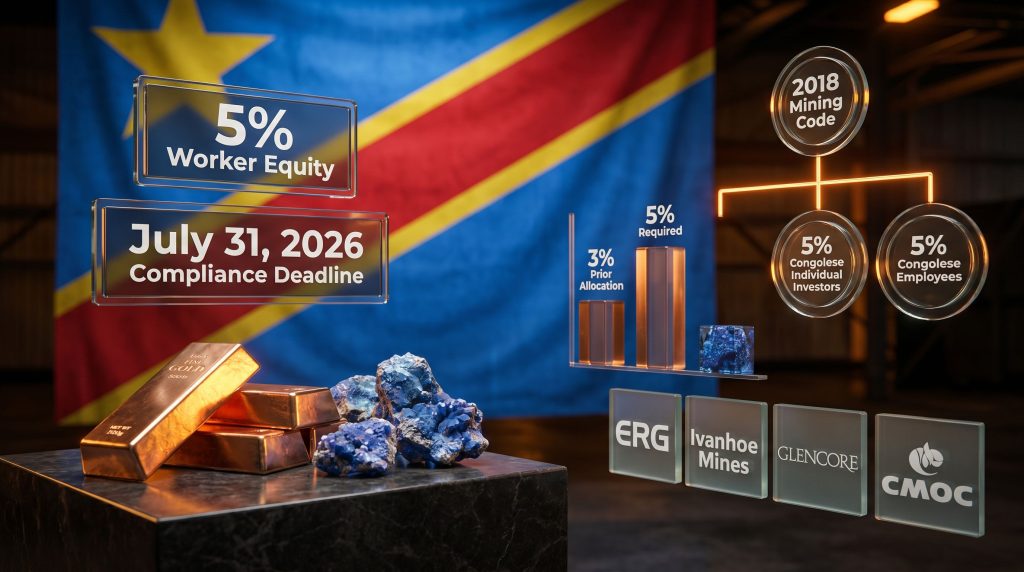
The Democratic Republic of Congo's 2018 Mining Code introduced a dual local participation mandate that significantly restructured the terms under which foreign mining companies could operate in the country. The code established a combined 10% minimum Congolese participation threshold in mining capital, split into two distinct obligations:
- 5% reserved for Congolese individual investors, representing private domestic capital participation
- 5% allocated directly to Congolese employees, representing workforce equity entitlement
The distinction matters. These are not interchangeable requirements. A company cannot satisfy the worker equity obligation by simply selling shares to Congolese private investors, nor can employee equity be consolidated into a broader ownership arrangement without meeting the specific workforce entitlement standard.
| Requirement | Pre-2018 Framework | Post-2018 Mining Code |
|---|---|---|
| Congolese individual equity | Limited and largely discretionary | 5% mandatory |
| Employee equity allocation | Largely unenforced | 5% mandatory |
| Total local participation | Variable | 10% minimum |
| Compliance documentation | Informal | Formal legal submission required |
Despite being embedded in law in 2018, the employee equity clause remained effectively inactive until a ministerial circular issued on January 30, 2026 formally activated enforcement. That circular, issued under the authority of Mines Minister Louis Watum Kabamba, required mining companies to submit proof of compliance, including updated articles of association, revised shareholder agreements, and amended shareholder registers. The compliance deadline was set at July 31, 2026.
Why Eight Years of Dormancy Made This Harder
The prolonged period of non-enforcement created a structural problem: mining companies built their capital structures, signed shareholder agreements, and raised international financing without fully internalising this liability. When enforcement arrived, it landed not on greenfield projects still in design, but on operating mines with established ownership hierarchies, international debt facilities, and cross-listed equity structures.
This is not an unusual dynamic in resource-rich developing nations. Regulatory provisions often outpace enforcement capacity, creating a gap that narrows only when political conditions or commodity price cycles shift the balance of power between host governments and foreign investors. In the DRC's case, that shift has now occurred.
Why Enforcement Is Arriving Now: The Macro Context
Resource Nationalism as a Continental Movement
The DRC's enforcement push does not exist in isolation. Across sub-Saharan Africa, governments are asserting greater sovereign control over mineral wealth at precisely the moment when the global energy transition has transformed demand forecasts for cobalt, copper, lithium, and manganese. The DRC occupies a uniquely powerful position within this dynamic.
The country is the world's largest cobalt producer, accounting for roughly 70% of global mine supply, and the second-largest copper producer globally. No credible pathway to scaling electric vehicle battery production exists without sustained access to Congolese cobalt. Furthermore, that supply concentration gives Kinshasa a form of structural leverage that no policy framework can easily replicate. Indeed, the DRC cobalt export ban earlier demonstrated just how forcefully Kinshasa is willing to use that leverage.
Similar resource nationalism impulses have surfaced in:
- Zambia, which has revised its mining tax regime and ownership requirements
- Zimbabwe, which pursued aggressive indigenisation policies requiring majority local ownership
- Guinea, where state participation in bauxite and iron ore projects has been renegotiated
- Indonesia, which enforces divestment requirements for foreign copper and nickel miners
The DRC's worker equity rule fits within this pattern, though its specific focus on employee-level ownership rather than purely state capture is a structurally distinct feature worth noting.
The Transparency Failure That Triggered Escalation
A critical piece of context that often goes unreported is that the Congo miners 5% worker equity rule enforcement did not emerge from a vacuum of prior arrangements. According to union sources cited in Reuters reporting, mining companies had previously channelled approximately 3% of capital value toward worker-linked benefit schemes. However, the oversight and transparency of those schemes was deeply inadequate.
This matters enormously. The government's move to enforce the full 5% statutory entitlement is, at its core, as much a governance reform as it is an equity expansion. The prior 3% arrangements lacked the structural accountability that a formal share registration requires. Workers received something, but could not verify what, how it was managed, or whether the valuation was accurate.
"The shift from informal worker-linked schemes to formal equity registration is a fundamental change in accountability architecture, not simply a 2 percentage point increase in allocation."
The government has framed the expanded requirement as a mechanism to direct investment into mining-affected communities in regions that have historically borne the environmental and social costs of extraction without receiving proportional economic benefit. Consequently, this framing has resonated with labour unions and domestic constituencies who have long argued that foreign operators extract disproportionate value from Congolese resources.
The Compliance Reality: Zero Companies, One Deadline
Major Operators and the June 11 Chamber Meeting
As of the most recent reporting period, no mining company operating in the DRC has submitted proof of compliance with the ministerial directive. The scale of affected operations is significant. Some of the world's largest mining corporations are subject to the rule, including:
- Eurasian Resources Group (ERG)
- Ivanhoe Mines
- Glencore
- CMOC (China Molybdenum Co.)
These companies convened at the DRC Chamber of Mines on June 11, 2026 to coordinate a unified industry response. The outcome of that meeting was a formal request for a moratorium on enforcement, pending structured consultations with stakeholders. Notably, the Chamber's request did not include a proposed alternative compliance timeline, which underscores the extent of the unresolved legal uncertainty.
Three Unresolved Questions Blocking Compliance
The Chamber of Mines has identified three structural questions that it argues must be resolved before any standardised compliance framework is workable:
| Unresolved Question | Why It Matters |
|---|---|
| Must existing shareholders transfer equity to workers? | Determines whether current ownership dilution is required or whether new share issuances satisfy the obligation |
| Does the rule apply retroactively to long-established operations? | Could affect mines that have operated for decades under prior regulatory frameworks |
| What is the approved legal mechanism for the equity transfer? | No standardised instrument has been confirmed by the ministry |
These are not trivial objections. The question of retroactivity, in particular, has significant implications for how companies calculate their exposure and whether historical financing structures are affected. International lenders and equity partners in DRC mining projects will scrutinise these answers closely before allowing compliance actions that could alter their security positions.
The Financial Mechanics of a 5% Worker Equity Allocation
Understanding what the Congo miners 5% worker equity rule means in practical financial terms requires stepping through the mechanics carefully. Consider a hypothetical mid-tier copper mining operation with a total share capital valuation of $500 million USD. A 5% worker equity allocation would represent a $25 million stake distributed across the Congolese workforce. However, the mechanism of transfer determines the actual governance and financial implications:
- Direct shareholding: Workers receive registered shares in the operating entity, entitling them to dividends and, potentially, voting rights
- Employee Share Ownership Plan (ESOP): A trust structure holds shares on behalf of workers, pooling governance while distributing economic returns
- Dedicated worker trust: An independent vehicle manages the equity block, with distributions tied to mining performance and profit milestones
Each structure carries different implications for foreign investor returns, corporate governance, and the administrative burden on Congolese regulatory bodies. The absence of a confirmed legal framework means companies cannot yet determine which model satisfies the ministry's requirements. For additional context on how this intersects with broader cobalt price impacts across global supply chains, the stakes extend well beyond domestic governance.
Comparative Frameworks: How the DRC Stacks Up Globally
| Country | Local Equity Requirement | Employee Equity Component | Enforcement Status |
|---|---|---|---|
| DRC (Congo) | 10% total (5% individual + 5% worker) | 5% mandatory | Active enforcement from 2026 |
| Zambia | Variable under revised mining laws | Not separately mandated | Ongoing reform |
| Zimbabwe | Historically 51% indigenisation | Included within broader mandate | Partially reformed |
| Guinea | State equity participation | No specific worker equity rule | Evolving |
| Indonesia | Divestment requirements for foreign miners | Not employee-specific | Enforced |
What distinguishes the DRC's approach is its explicit disaggregation of worker equity from general local participation. Most comparable frameworks treat local ownership as a monolithic requirement, without ring-fencing a portion specifically for the workforce. This specificity has operational advantages in terms of accountability, but creates additional legal complexity in implementation.
International Investment Treaty Considerations
Mining companies with significant DRC assets operate under bilateral investment treaties (BITs) that their home jurisdictions have signed with the DRC. These treaties typically include investor-state dispute settlement (ISDS) mechanisms that allow companies to seek arbitration if they believe host government measures constitute unlawful expropriation or discriminatory treatment.
The legal risk calculus here is genuinely complex. A mandatory equity transfer to workers could, under certain treaty interpretations, constitute a measure affecting the fair market value of an investor's asset. However, most ISDS tribunals apply a reasonableness standard that considers whether a measure serves a legitimate public policy objective, applied non-discriminatorily. Worker equity mandates grounded in domestic legislation, applied uniformly across all operators, are likely to survive this scrutiny in most frameworks. Furthermore, the growing US-China cobalt rivalry adds a geopolitical dimension that complicates how major powers may respond to any investor-state disputes arising from enforcement.
Three Scenarios Before the July 31 Deadline
Scenario 1: Moratorium Granted
The mines ministry agrees to pause enforcement pending a structured multi-stakeholder consultation. Companies gain additional time to develop standardised compliance instruments. The risk is that political pressure from organised labour and domestic constituencies intensifies, and any delay becomes a flashpoint for union mobilisation.
Scenario 2: Selective Enforcement
The government targets a subset of operators as a demonstration of enforcement intent, while allowing others additional time. This approach creates asymmetric competitive dynamics across the sector and is likely to trigger legal challenges from companies singled out ahead of peers.
Scenario 3: Full Enforcement Proceeds on Schedule
All operators face the July 31 deadline without extension. Non-compliant companies risk operational licence reviews or suspension proceedings. This scenario would most acutely test the industry's willingness to comply under pressure versus pursue international arbitration. Indeed, mining companies have been given a six-month deadline to demonstrate progress, underscoring that the government considers this a firm regulatory priority.
The next major ASX story will hit our subscribers first
Investor Implications: Treating DRC Regulatory Risk as a Structural Variable
For investors with exposure to DRC copper and cobalt operations, the emergence of the Congo miners 5% worker equity rule enforcement is a signal worth taking seriously as a recurring regulatory variable rather than a one-off compliance issue. The DRC government's reported parallel intention to apply a similar worker equity model to the telecommunications sector suggests a broader economic sovereignty agenda is in motion. In this context, the broader US-Congo mining partnership framework adds another layer of complexity to how international stakeholders will respond.
Key indicators investors should monitor include:
- Ministerial communications and the outcome of the scheduled mines ministry meeting with unions
- Whether the Chamber of Mines moratorium request receives a formal response
- The legal mechanism ultimately confirmed for equity transfer, as this will determine the capital structure impact on individual operators
- Union activity and the degree of alignment between organised labour and the government's enforcement position
"Regulatory uncertainty in the DRC introduces supply-side risk into cobalt and copper markets that spot price models do not always adequately capture. Investors should account for scenario-weighted operational disruptions when assessing DRC-exposed equity valuations."
The DRC's cobalt supply concentration means any sustained disruption to major operators carries disproportionate consequences for battery supply chains globally. Copper's centrality to electrification infrastructure amplifies the stakes further. The July 31 deadline is not merely a compliance milestone for mining companies. It is a signal about the direction of the regulatory environment in one of the most consequential mining jurisdictions on Earth.
Frequently Asked Questions
What is the Congo miners 5% worker equity rule?
It is a requirement under the DRC's 2018 Mining Code obligating mining companies to allocate 5% of their share capital to Congolese employees, separate from a parallel 5% requirement for Congolese individual investors.
When must companies comply with the 5% worker equity rule in Congo?
The current compliance deadline is July 31, 2026, as established by a ministerial circular issued on January 30, 2026.
Has any mining company complied with the Congo worker equity directive?
As of the most recent reporting period, no company has submitted proof of compliance.
Why are miners requesting a moratorium on the Congo equity rule?
Companies cite unresolved legal questions around retroactivity, the identity of transferring shareholders, and the absence of a confirmed legal transfer mechanism as the basis for requesting additional time.
Which companies are affected by the Congo 5% worker equity requirement?
All mining companies operating in the DRC are subject to the directive, including Eurasian Resources Group, Ivanhoe Mines, Glencore, and CMOC, among others.
This article is intended for informational purposes only and does not constitute financial or investment advice. Regulatory outcomes in frontier jurisdictions involve significant uncertainty, and investors should seek professional guidance before making decisions based on evolving policy environments.
Want To Stay Ahead of Major Mineral Discoveries Before the Market Catches On?
Discovery Alert's proprietary Discovery IQ model delivers real-time alerts on significant ASX mineral discoveries, transforming complex mineral data into clear, actionable insights for both short-term traders and long-term investors — explore historic discovery returns on Discovery Alert's dedicated discoveries page and begin your 14-day free trial today to secure a market-leading advantage.