July 30, 2026
The Geology Is Already There — The Question Is Whether the Technology Can Find It Fast Enough
Africa's geological endowment is not a secret. Researchers, colonial-era surveyors, and modern geoscientists have long understood that the continent sits atop an extraordinary concentration of the minerals the world's energy transition depends upon. The challenge has never been the geology itself. It has been the speed, cost, and reliability of identifying precisely where economically viable deposits are concentrated within that geology.
That challenge is now being addressed by a new generation of exploration companies that treat data science as their primary tool, not a supplementary one. The arrival of KoBold AI at African Mining Week 2026 is a signal that this shift has moved from concept to operational reality, with multi-billion dollar capital commitments to match.
When big ASX news breaks, our subscribers know first
Africa's Mineral Endowment vs. Africa's Exploration Deficit
The figures framing Africa's resource position are striking. The continent is estimated to hold roughly 30% of the world's mineral reserves, yet exploration spending per square kilometre of prospective terrain has historically lagged far behind comparable jurisdictions in Australia, Canada, and South America.
This gap is not purely a function of political risk or infrastructure deficits. A significant portion of the underexploration problem is informational. Vast stretches of African terrain are covered by what geologists call regolith — deeply weathered surface material that obscures bedrock signatures and makes conventional surface sampling unreliable. Beneath that surface, however, the structural and stratigraphic settings that host world-class deposits remain intact.
Several compounding factors have historically suppressed African exploration intensity:
- Sparse modern geophysical coverage across large frontier basins
- Geological records held in analogue or colonial-era archive formats, inaccessible to digital analysis
- High capital costs associated with remote access, logistics, and permitting in frontier jurisdictions
- Elevated perceived political risk depressing junior exploration capital flows
The energy transition has recalibrated each of these barriers. Copper, lithium, cobalt, and nickel — all critical to battery chemistries and grid-scale storage — are concentrated in African geology in quantities that make the continent strategically indispensable to global supply chains through the 2030s and beyond. The question for investors and policymakers alike is whether the right technologies can extract value from this endowment at the pace the market requires.
How KoBold's AI Platform Addresses the Exploration Problem at Its Root
KoBold Metals was not built as a mining company that adopted technology. It was designed from inception around the premise that mineral exploration is fundamentally an information problem, and that machine learning is the most powerful tool available for solving it. Furthermore, advanced exploration AI of this kind is increasingly demonstrating that probabilistic modelling can outperform conventional geological interpretation in frontier environments.
The company's proprietary platform works by ingesting heterogeneous geological datasets and identifying subsurface mineralisation signatures that human interpretation would likely miss or take significantly longer to detect. The data sources processed can include:
- Historical drill core records, including colonial-era logs converted to machine-readable formats
- Airborne geophysical surveys (magnetic, gravity, and electromagnetic data)
- Satellite and remote sensing imagery
- Geochemical sampling results
- Regional stratigraphic and structural geological models
What makes this approach particularly powerful in African contexts is that the platform is specifically designed to extract signal from incomplete or fragmented datasets. In well-explored jurisdictions, conventional geological interpretation remains effective because dense historical data provides reliable baselines. In frontier African terrains where data density is low, probabilistic AI modelling delivers its greatest comparative advantage by constructing deposit models from sparse inputs that conventional methods cannot adequately interpret.
The practical outcome is a narrower, higher-confidence set of drill targets before any capital-intensive drilling commences, which directly compresses the exploration timeline and reduces the cost per discovery. Techniques such as downhole geophysics complement this AI-driven approach by providing high-resolution subsurface data that feeds directly into the machine learning models.
KoBold's African Portfolio: Three Countries, Three Strategic Bets
KoBold's current African footprint spans three distinct geological and political environments, each representing a different dimension of the AI-exploration thesis.
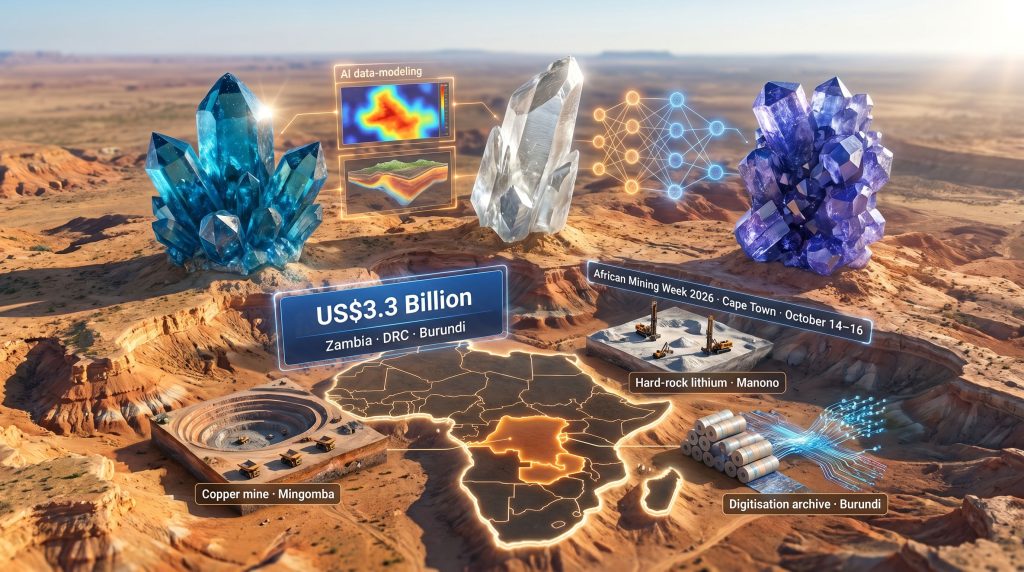
| Country | Project | Primary Commodity | Committed Capital |
|---|---|---|---|
| Zambia | Mingomba Copper Project | Copper | US$2.3 billion |
| DRC | Manono Lithium Project | Lithium | Over US$1 billion |
| Burundi | National Geological Digitisation | Nickel, Copper, Cobalt | Government partnership |
Zambia: Copper, National Ambition, and the 3-Million-Tonne Target
Zambia's copper belt is one of the most significant sediment-hosted copper provinces on earth. The Mingomba project, valued at US$2.3 billion, sits within this belt and represents one of the largest active exploration and development commitments anywhere in sub-Saharan Africa.
The broader national context matters here. Zambia has set an ambitious production target of lifting annual copper output to 3 million tonnes by 2031, a figure that would more than double the country's current production levels. Achieving that target requires not only existing mines operating at capacity, but significant new deposits being brought into production within a compressed timeframe.
KoBold's AI platform is being deployed at Mingomba to identify high-grade copper zones with greater precision than conventional exploration approaches, accelerating the transition from resource delineation to production-stage development. The speed advantage is not marginal in this context. Every 12 months saved on the path from discovery to production has material implications for Zambia's revenue trajectory and KoBold's return profile.
DRC: Unlocking the World's Largest Hard-Rock Lithium Deposit
The Democratic Republic of Congo is globally recognised for its cobalt dominance, with global cobalt production heavily concentrated in the country's Katanga region. Less widely appreciated, but strategically significant, is the country's hard-rock lithium potential. The Manono deposit is classified as one of the world's largest known accumulations of spodumene, the lithium-bearing mineral used in battery-grade lithium carbonate and hydroxide production.
KoBold has committed over US$1 billion to Manono, applying AI-assisted 3D geological modelling to improve deposit delineation and inform development sequencing across a deposit whose sheer scale creates genuine complexity for conventional interpretation methods. The mineral chemistry at Manono is relevant to understanding its commercial significance. Spodumene lithium concentrates typically carry lithium oxide (Li₂O) grades that determine downstream processing costs and battery precursor quality, and accurately mapping grade distribution across a deposit of Manono's scale is precisely the kind of problem where machine learning models add deterministic value.
The DRC's pivot from cobalt-dominant to lithium-strategic narrative represents a meaningful reframing of the country's role in the battery supply chain, one that the Manono project is central to establishing.
Burundi: The Colonial Data Archive Problem and Its AI Solution
Of the three country programmes, Burundi is perhaps the most instructive from a policy and data-sovereignty perspective. KoBold is working directly with the Burundian government to digitise the country's national geological archive, converting analogue records accumulated over colonial and post-colonial survey programmes into machine-readable formats that can be processed by the AI platform.
This matters beyond the immediate prospectivity modelling applications. Many African nations hold geological survey records in physical archive formats that are deteriorating, inaccessible to modern analysis, and effectively invisible to the global exploration investment community. The process of digitising these records does not merely enable AI modelling; it creates a durable national geological intelligence asset that outlasts any individual exploration licence.
Notably, a separate but related development has emerged: the DRC and Belgium recently agreed on the transfer of colonial-era geological records that had remained in Belgian archives since independence. This transfer, reported by the Canadian Mining Journal in June 2026, represents a growing recognition that historical data repatriation is a prerequisite for informed modern exploration across the continent.
KoBold AI at African Mining Week 2026: What the Conference Platform Signals
African Mining Week 2026, scheduled for October 14 to 16 in Cape Town, has designated AI and advanced technology as a central thematic pillar of the conference programme. The confirmed participation of Mfikeyi Makayi, CEO of KoBold Metals Africa, as a featured presenter reflects the degree to which KoBold's multi-country portfolio has become the primary proof-of-concept for AI-native mineral exploration at scale.
Her presentation is expected to address several dimensions of KoBold's operational methodology:
- How the data-modelling platform is applied at different stages of the exploration-to-development pipeline
- Project-specific updates across Zambia, the DRC, and Burundi
- How AI tools are reducing exploration risk in frontier jurisdictions where conventional methods face structural limitations
- The implications of AI adoption for project timelines, capital efficiency, and discovery rates
The AMW platform also exposes KoBold's approach to a diverse audience that extends well beyond the technical community, including national government delegations, institutional investors, and junior exploration companies evaluating whether to partner with or build AI exploration capabilities of their own.
Other AI-adjacent applications are expected to feature alongside KoBold's programme, including geospatial mapping projects in the DRC, prospectivity modelling initiatives in Ghana targeting gold and base metals, and AI-powered exploration programmes in Botswana building on that country's established diamond-sector data infrastructure.
The Labour Question: A Debate That Will Follow AI Into Cape Town
The efficiency narrative around AI-driven exploration carries an unavoidable counterweight. Both Zambia's Mineworkers Union and South Africa's Labour Research Service have formally raised concerns that automation technologies, including AI-driven exploration tools, risk systematically displacing lower-skilled workers in jurisdictions where formal mining employment represents a critical share of household income and government revenue.
The debate requires some structural disaggregation to assess properly. AI's near-term impact is concentrated primarily at the exploration stage, not in operational mine environments where the bulk of lower-skilled employment is located. The displacement risk during exploration phases affects field-based geological teams, sample processing crews, and logistics workforces — groups that are meaningful in size but represent a fraction of total mining sector employment.
The more complex long-term question is whether AI-accelerated exploration generates sufficient net new mine development to offset any workforce reductions within existing operations. The following framework helps distinguish these dynamics:
| Workforce Dimension | Near-Term Risk | Medium-Term Potential |
|---|---|---|
| Exploration field teams | Moderate displacement as drill targeting improves | Redeployment toward data-supported field validation |
| Operational mine workers | Low direct impact | Expansion if new mines develop faster |
| Geological and data specialists | Strong demand growth | Structural shortage risk if training capacity lags |
| Government fiscal position | Broadly neutral | Improved royalty base if production timelines compress |
The credible response to this tension requires proactive negotiation rather than reactive policy. Jurisdictions that build AI literacy and geospatial data skills into technical training institutions before AI adoption peaks are better positioned to capture the employment upside without the transitional disruption. The Burundi model, where government partnership with KoBold includes meaningful data skills transfer, offers a template for what proactive engagement can look like.
The next major ASX story will hit our subscribers first
Why Patient Capital Is Flowing Into AI-Enabled African Exploration
KoBold's combined committed capital across Zambia and the DRC alone exceeds US$3.3 billion, a figure that places the company among the most significant single-entity investment commitments in African mineral exploration in recent history. The investor base underpinning KoBold, which includes prominent technology and venture capital figures, introduces a class of capital with characteristics that differ materially from conventional mining finance.
Technology-sector investors are accustomed to long development cycles, high early-stage expenditure, and non-linear value creation. This risk tolerance profile aligns well with frontier exploration in jurisdictions where political complexity, infrastructure gaps, and data scarcity create extended timelines to production. Where conventional mining investors might require a clearer near-term production catalyst, technology-oriented patient capital can absorb a longer discovery-to-development curve.
This dynamic also has implications for how African governments negotiate exploration agreements. When the counterparty is a data-science platform company rather than a conventional miner, the negotiable value extends beyond royalty rates and employment commitments to include data access terms, geological archive digitisation obligations, and AI model transparency requirements.
Governments that secure provisions requiring AI companies to share processed geological datasets with national geological surveys are effectively building sovereign geoscience infrastructure at no direct cost to the public balance sheet.
Frequently Asked Questions: KoBold AI and African Mining Week 2026
What is KoBold Metals' core technology approach?
KoBold operates a proprietary machine learning platform that processes diverse geological datasets including geophysical surveys, drill records, and remote sensing data to generate probabilistic models of subsurface mineralisation, allowing exploration teams to prioritise targets before drilling capital is deployed.
What is the scale of KoBold's African investment?
KoBold has committed US$2.3 billion to the Mingomba copper project in Zambia and over US$1 billion to the Manono lithium project in the DRC, with a separate government partnership programme active in Burundi. Total committed capital across these three programmes exceeds US$3.3 billion.
Why is the Manono lithium deposit strategically significant?
Manono is recognised as one of the world's largest known hard-rock lithium accumulations. The deposit's scale and spodumene grade profile position it as a potentially critical source of battery-grade lithium as global electric vehicle and grid storage demand accelerates through the 2030s.
What distinguishes African Mining Week 2026 from previous editions?
The 2026 conference has formally designated AI and advanced technology as a central thematic pillar, reflecting the transition of AI from experimental to operational status in African mineral exploration. KoBold AI at African Mining Week is represented by CEO Mfikeyi Makayi as a confirmed featured presenter.
What are the key labour concerns surrounding AI in African mining?
Both Zambia's Mineworkers Union and South Africa's Labour Research Service have raised concerns about AI-driven efficiency gains potentially displacing lower-skilled workers, particularly in exploration-phase roles. The debate centres on whether net employment creation from accelerated mine development will offset near-term field workforce reductions.
How does KoBold's Burundi programme differ from its Zambia and DRC operations?
The Burundi programme focuses on digitising the country's national geological archive and applying AI prospectivity modelling to the resulting datasets, with targets including nickel, copper, and cobalt. It is structured as a government partnership rather than a single project development, with broader national data infrastructure implications.
Disclaimer: This article contains forward-looking statements, investment observations, and references to production targets and capital commitments sourced from publicly available information. Readers should conduct independent due diligence before making any investment decisions. Mineral exploration involves significant risk and actual outcomes may differ materially from projections referenced herein.
Want To Catch the Next Major Mineral Discovery the Moment It Hits the ASX?
Discovery Alert's proprietary Discovery IQ model scans ASX announcements in real time, instantly identifying significant mineral discoveries across copper, lithium, cobalt, and more — turning complex geological data into actionable investment opportunities before the broader market reacts. Explore how historic discoveries have generated substantial returns and begin your 14-day free trial at Discovery Alert to position yourself ahead of the market.