July 30, 2026
When Volume Records and Margin Compression Collide: What Metro Mining's Q2 2026 Really Tells Us
The bauxite shipping industry operates under a paradox that few outside the sector fully appreciate: the quarters that generate record output volumes are not always the quarters that generate record earnings. Wet season transitions, transhipment logistics, freight contract timing, and commodity price cycles can all conspire to decouple tonnage milestones from financial outcomes. Understanding this dynamic is essential to interpreting Metro Mining record Q2 bauxite shipments, which simultaneously achieved the highest Q2 shipment volume in the company's history and the lowest site EBITDA margin in recent memory.
That tension is not a sign of failure. It is, in many ways, a textbook illustration of how capital-intensive bulk commodity producers manage operational resilience through cycle troughs, investing in production capacity and logistics flexibility precisely when prices are weakest, positioning themselves to capture the upswing when market conditions normalise.
When big ASX news breaks, our subscribers know first
Metro Mining Record Q2 Bauxite Shipments: The Numbers Behind the Headlines
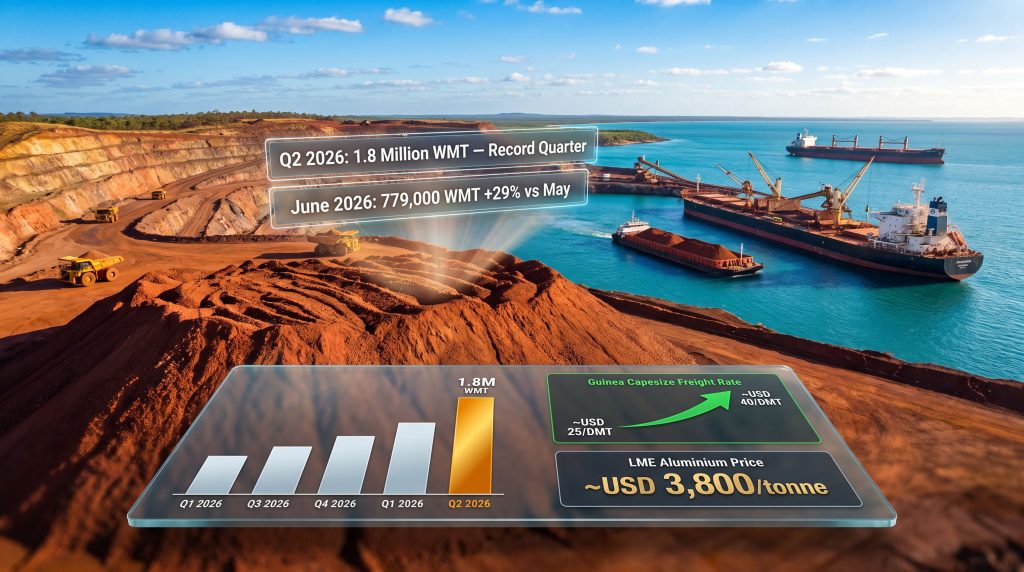
For the three months ended 30 June 2026, Metro Mining shipped 1.8 million wet metric tonnes (WMT) of bauxite from its Bauxite Hills Mine on Queensland's Cape York Peninsula. This result represents a 7% year-on-year increase over the corresponding quarter of 2025 and stands as the highest Q2 shipment volume ever recorded by the company. Furthermore, Metro Mining Bauxite Hills production figures demonstrate how consistently the operation has built its throughput capacity over recent years.
To contextualise why this matters, it is worth understanding what WMT actually measures. Unlike dry metric tonnes (DMT), which strip out moisture content to reflect the mass of the ore itself, WMT captures the total weight of ore as loaded, including its natural moisture. In a tropical mining environment like Cape York Peninsula, moisture levels can fluctuate meaningfully with seasonal rainfall patterns, making WMT the practical commercial standard for loading and shipping operations, while DMT conversion factors are applied downstream for refinery pricing calculations.
The quarterly result was anchored by a standout June performance. Metro shipped 779,000 WMT in June alone, a figure that represents a 29% increase over May 2026 and sets a new monthly shipment record for the operation. Critically, 97% of June's shipments were handled through the Offshore Floating Terminal (OFT) Ikamba, Metro's primary transhipment vessel, which had returned from its mandatory five-year dry-dock service during the month. Mining.com.au provided detailed coverage of these record-breaking shipment results.
What Makes Q2 the Hardest Quarter for Northern Australian Bauxite Producers
Queensland's Cape York Peninsula sits within Australia's monsoonal tropical belt, where the wet season typically extends from November through to April. The transition period between the wet and dry seasons, which broadly spans Q2 of any calendar year, is historically the most operationally challenging window for northern Australian mining operations. Ground conditions remain soft in the wake of the wet season, access roads and mine faces take time to consolidate, and loading windows at marine facilities can be constrained by residual weather activity.
This seasonal reality makes Metro Mining's Q2 record all the more operationally significant. The company did not simply achieve a volume milestone in favourable conditions. It did so while contending with Tropical Cyclone Narelle, which temporarily halted loading operations and required post-event recovery work, and while managing the simultaneous absence of OFT Ikamba for a portion of the quarter.
| Disruption Factor | Nature of Impact | Resolution Timeline |
|---|---|---|
| Tropical Cyclone Narelle | Halted loading operations; post-cyclone recovery required | Resolved within Q2 2026 |
| OFT Ikamba Dry-Docking | Loss of primary transhipper for a portion of Q2 | Returned to service; handled 97% of June shipments |
| Elevated Diesel Costs | Compressed site-level margins | Ongoing into H2 2026 |
| Freight Volatility | Temporary additional freight expenses | Partially offset by long-term contracts |
How the Offshore Floating Terminal Model Defines Metro's Export Logistics
Metro Mining's export model is built around an offshore transhipment system that is less common in the global bauxite trade than standard deep-water port loading. The Bauxite Hills Mine sits on a stretch of coastline where water depths are too shallow to accommodate large bulk carriers directly. To bridge this gap, Metro uses shallow-draft barges to transport ore from a marine loading facility to the OFT Ikamba, which is anchored in deeper offshore waters. Ikamba then transfers the cargo into deep-water bulk vessels capable of undertaking the voyage to Chinese alumina refineries.
This model provides genuine operational flexibility in a region where fixed port infrastructure would require enormous capital expenditure. However, it also introduces a concentration risk: the OFT is the single critical node through which virtually all export volume must pass.
The mandatory five-year dry-dock service that Ikamba underwent in Q2 2026 is a statutory requirement under international maritime regulations, covering structural inspections, hull maintenance, propulsion systems, and safety equipment certification. The absence of Ikamba for even a portion of a quarter creates a material throughput constraint, which is precisely why its return to service, and the subsequent 97% contribution to June's shipments, was so operationally decisive.
The June 2026 monthly record of 779,000 WMT, achieved after Ikamba's return, effectively served as a proof-of-concept validation for Metro's new integrated planning and operating system and its realigned management structure, demonstrating that the revised operational framework could unlock throughput levels not previously achieved in Q2.
Stripping, Stockpiles, and the Science of Mine Flexibility
One of the less-discussed but strategically important aspects of Metro's Q2 and H1 2026 performance is the volume of waste material moved ahead of schedule. During the first half of 2026, Metro cleared and moved approximately 833,000 bank cubic metres (BCM) of waste, which was roughly 70% above the planned stripping schedule.
BCM, or bank cubic metres, refers to the volume of material measured in its undisturbed, in-situ state before excavation. It is a fundamental planning unit in open-cut mining because it determines how much equipment time, diesel consumption, and tyre wear is required to expose ore. Running ahead of the stripping plan by 70% is not an accident; it reflects a deliberate front-loading strategy designed to maximise ore access for the peak H2 operating season.
In practical terms, accelerated stripping widens what miners call the ore exposure envelope: the lateral and vertical extent of ore that can be accessed and blended at any given time. A wider envelope enables better grade management, smoother scheduling, and reduced dependence on any single ore zone for hitting shipment targets. For a mine like Bauxite Hills, where bauxite grades vary spatially across the deposit, this flexibility is a meaningful operational asset.
Port Stockpile Expansion: 170,000 WMT of New Capacity
Complementing the waste stripping programme, Metro completed an extension to its port stockpile during the quarter, adding 170,000 WMT of storage capacity. This expansion serves several interlocking purposes:
- It allows ore from different mining zones to be blended to customer specification before loading, improving product consistency.
- It decouples mining rates from shipping rates, enabling the mine to continue operating during short-duration shipping delays without creating a throughput bottleneck.
- It supports higher peak shipment volumes by ensuring a sufficient buffer of pre-loaded ore is available when vessel windows open.
- It signals to prospective customers that the operation has the logistical depth to reliably fulfil large offtake volumes.
The commercial dimension of this last point materialised directly: Metro's improved grade management capability during Q2 enabled it to secure trial cargo agreements with two new customers, a tangible demand-side validation of the infrastructure investment.
Vegetation Clearing Innovation: 276 Hectares Prepared
At Bauxite Hills, accessible ore inventory is directly determined by the area of vegetation that has been cleared, prepared, and approved for mining. During H1 2026, Metro utilised a new vegetation clearing methodology that enabled it to prepare a record 276 hectares for upcoming mining activity.
The implications of this figure extend beyond the headline. On Cape York Peninsula, vegetation clearing must operate within Queensland's native vegetation management framework and is subject to environmental approvals that define clearing zones and rehabilitation obligations. Achieving a record clearing volume within these constraints indicates both operational capability and effective environmental planning. The cleared area directly translates into expanded ore inventory available for extraction in H2 2026 and beyond.
Dry-Screening Trials: Unlocking Higher-Silica Ore Zones
Perhaps the most technically forward-looking development in Metro's Q2 report was the completion of dry-screening trials on higher-silica bauxite zones within the Bauxite Hills ore body. Dry screening is a physical size-separation process that uses vibrating screens to classify ore particles without the addition of water. In the context of bauxite processing, it can be used to reject fine, silica-rich particles from coarser, higher-grade fractions, effectively upgrading the usable alumina content of ore that would otherwise fall outside customer grade specifications.
The significance of this trial is that it potentially expands the proportion of the ore body that Metro can commercially exploit. Bauxite deposits typically contain zones of varying quality, and reactive silica content is the primary contaminant that reduces refinery efficiency and drives down commercial value. A proven dry-screening capability would allow Metro to access ore zones previously considered marginal, increasing the effective resource inventory available for future shipments.
With trial results described as encouraging, Metro has confirmed plans to move to commercial-scale dry-screening production in Q3 2026. The volume and cost implications of this scale-up have not been publicly quantified at this stage.
The Global Bauxite and Aluminium Market Context in 2026
Metro Mining's Q2 performance did not unfold in a vacuum. The company was navigating one of the more complex commodity price environments in recent years, characterised by simultaneous pressure from multiple directions. Understanding the broader bauxite and alumina market outlook helps contextualise why these pressures emerged and how they are likely to evolve through H2 2026.
Pricing Trends: From Trough to Recovery
| Pricing Period | Movement | Key Driver |
|---|---|---|
| Q4 2025 to Q2 2026 (CIF) | -14% decline | Weak negotiation conditions in Feb-Mar window |
| Q2 2026 to Q3 2026 (CIF) | +9% increase | Rising Guinea freight rates |
| International Alumina (from Mar-Apr lows) | +~12% recovery | Supply tightening, LME price surge |
| Southern China Alumina (from Mar-Apr lows) | +~4% recovery | New refinery capacity entering production |
Both bauxite and alumina prices reached their lowest levels in March and April 2026, following more than a year of declining values. The timing of this trough proved commercially costly for Metro because CIF prices for Q2 shipments are typically negotiated during February and March, meaning the company locked in rates at the weakest point in the cycle. The resulting 14% price decline relative to Q4 2025 was the single largest contributor to margin compression during the quarter.
The Gulf Conflict's Cascading Effect on Aluminium Supply Chains
The outbreak of hostilities in the Gulf during Q2 2026 introduced a significant exogenous shock to the aluminium supply chain. The Middle East hosts several large-scale aluminium smelting operations, and production curtailments at these facilities compounded an already tight global supply position. LME aluminium prices climbed to approximately USD 3,800 per tonne during the quarter, a level roughly 20% above year-earlier figures, before easing modestly in June.
For bauxite producers, elevated aluminium prices are generally a positive signal because they incentivise alumina refiners to maximise throughput and pull more raw material. However, the transmission mechanism from LME aluminium prices to spot bauxite pricing is not instantaneous, and the intervening variable of Chinese port inventory levels created a friction point that delayed the full price recovery. Consequently, tracking these broader aluminium sector developments remains important for understanding the upstream pricing trajectory.
Guinea Freight Rate Escalation and Its Bauxite Pricing Implications
Guinea is the world's largest bauxite exporter, and freight rates from its major shipping ports serve as a critical reference point for seaborne bauxite pricing globally. During Q2 2026, Capesize freight rates from West Africa increased from approximately USD 25 per DMT to around USD 40 per DMT, a 60% increase driven in part by the broader freight market disruption associated with the Gulf conflict.
This freight escalation had a direct repricing effect on Guinea-origin bauxite, which in turn lifted the floor price for competing seaborne suppliers including Metro. The company was able to negotiate a 9% average CIF price increase for Q3 2026 shipments on the back of this dynamic.
However, Chinese buyers have not accepted the full extent of price increases implied by the freight shift. Large bauxite inventories at Chinese ports and persistently soft alumina prices in southern China, where multiple new refineries have recently commenced production, have given Chinese buyers negotiating leverage to resist stronger price increases. Metro's own assessment is that current pricing levels remain insufficient to fully offset elevated freight and diesel costs in H2 2026, and that a more complete price recovery requires Chinese port inventories to normalise first. A notable leading indicator is the significant decline in vessel arrivals at Guinea's major bauxite ports over the preceding three months, suggesting that some producers are already exercising shipment restraint in response to inadequate pricing.
Disclaimer: Commodity price forecasts and market outlook statements referenced above reflect company disclosures and publicly available market data as of the reporting period. They do not constitute investment advice. Actual market outcomes may differ materially from current expectations.
Metro Mining's Freight Strategy: Structural Insulation from Spot Market Volatility
One of the most strategically differentiated aspects of Metro Mining's business model is its freight contracting approach. While many smaller bauxite producers rely heavily on spot freight arrangements, Metro entered 2026 with approximately 80% of its offtake schedule covered by long-term freight contracts negotiated in 2025, featuring fixed charter rates and fixed bunker fuel rates.
The practical value of this pre-positioning became apparent in Q2 2026. With spot Capesize freight rates from West Africa rising from USD 25/DMT to USD 40/DMT, producers without long-term coverage experienced a sudden and material increase in delivered cost. Metro's contracted freight structure insulated the large majority of its shipments from this spike.
Comparing Freight Exposure Scenarios
| Freight Coverage Type | Estimated Q2 Cost Impact | Margin Vulnerability |
|---|---|---|
| Fully spot-exposed producer | Full USD 15/DMT increase absorbed | High |
| Metro Mining (80% contracted) | ~20% of volume exposed to spot rates | Low to moderate |
| 100% long-term contracted | Minimal spot exposure | Minimal |
This contracting strategy does carry a counterparty consideration: in a falling freight environment, locked-in rates can represent an above-market cost. However, given the trajectory of global shipping costs in 2025 and 2026, the 2025 contracting decision has proved well-timed. The competitive cost advantage this creates relative to spot-dependent peers is difficult to quantify precisely without access to competitors' freight cost disclosures, but the directional benefit is clear.
The next major ASX story will hit our subscribers first
Financial Results: Understanding Why Record Volume Did Not Mean Record Earnings
The financial reality of Q2 2026 illustrates a principle that applies across bulk commodity mining: unit margin, not volume, ultimately drives profitability. Metro's site EBITDA declined to AUD 4.4 per WMT (USD 3.1) during the quarter, a sharp contraction from the AUD 12.0 per WMT (USD 8.34) recorded in Q4 2025 and dramatically below the AUD 31.9 per WMT (USD 22.2) achieved in Q2 2025.
Site EBITDA Per WMT: Quarterly Comparison
| Quarter | Site EBITDA (AUD/WMT) | Site EBITDA (USD/WMT) | Primary Variance Driver |
|---|---|---|---|
| Q2 2025 | AUD 31.9 | USD 22.2 | Strong pricing environment |
| Q4 2025 | AUD 12.0 | USD 8.34 | Pricing normalisation |
| Q2 2026 | AUD 4.4 | USD 3.1 | Lower prices, cyclone costs, dry-dock expenses |
Four cost pressures combined to compress Q2 2026 margins:
- Lower realised CIF prices, down 14% versus Q4 2025, negotiated during a trough in market conditions.
- Elevated diesel costs, which affect both mining equipment operations and barge movements, with no short-term relief expected.
- Increased stripping activity, which is a deliberate investment in H2 operational capacity but generates higher cost in the near term.
- One-off freight and recovery expenses associated with Tropical Cyclone Narelle and the Ikamba dry-docking.
The distinction between structural and one-off cost pressures matters for assessing Metro's forward earnings trajectory. The cyclone recovery and dry-dock expenses are non-recurring in nature. If the 9% Q3 CIF price improvement translates into realised pricing, and if diesel and freight costs stabilise, the margin recovery pathway into H2 is credible, even if the absolute EBITDA per tonne is unlikely to immediately revert to Q2 2025 levels.
Balance Sheet Position at 30 June 2026
At quarter end, Metro held AUD 23.8 million (USD 16.5 million) in cash and cash equivalents. Secured debt declined to USD 31.5 million following scheduled quarterly repayments, indicating that the company is progressing its deleveraging trajectory even during a period of margin compression. The combination of available liquidity and a contracting debt burden provides Metro with the financial headroom necessary to execute the H2 2026 shipment ramp without requiring additional capital. That said, investors should monitor diesel cost trends and freight escalation risk as variables capable of altering the near-term cash generation profile.
Disclaimer: Balance sheet figures are sourced from company disclosures. Investors should consult the company's full quarterly report and any ASX announcements for complete financial information before making investment decisions.
Can Metro Mining Ship More Than 5 Million WMT in H2 2026?
With full-year 2026 guidance maintained at 6.6 to 7.1 million WMT, and with approximately 1.8 million WMT shipped in Q2, the arithmetic of achieving the guidance range requires a substantial H2 step-up. Metro's management has publicly confirmed that it expects to ship more than 5 million WMT across the second half of the year.
H2 Enablers and Risk Factors
Several operational developments from H1 2026 provide genuine support for this target:
- The expanded port stockpile adds 170,000 WMT of buffer capacity, enabling higher sustained shipment rates.
- Accelerated stripping in H1 has expanded ore access ahead of the peak operating window.
- OFT Ikamba is fully available throughout H2, removing the transhipment constraint that affected part of Q2.
- Commercial-scale dry-screening in Q3 could incrementally expand the usable ore inventory.
- Two new trial cargo customers represent a potential volume uplift pathway.
Counterbalancing these catalysts are several risks that deserve consideration:
- Continued diesel cost inflation could erode per-unit margins even as volumes rise.
- Chinese buyer resistance to price increases, underpinned by elevated port inventories, may limit realised pricing upside.
- Southern China alumina refinery overcapacity is moderating the regional price recovery, potentially dampening upstream demand pull.
- Any further weather disruption, while statistically less likely in H2, cannot be entirely discounted.
The Aluminium Value Chain: Why Bauxite Quality Is Not a Commodity Variable
A dimension of Metro Mining's operational strategy that is sometimes underappreciated by generalist investors is the degree to which bauxite quality — specifically aluminium oxide content and reactive silica levels — determines commercial value. Bauxite is not a uniform commodity. Refineries are engineered around specific feed material parameters, and deviations from specification can reduce extraction efficiency, increase caustic consumption in the Bayer process, and ultimately increase the cost per tonne of alumina produced. In addition, the global bauxite market fundamentals confirm that quality differentiation is becoming an increasingly decisive factor in supplier selection.
Reactive silica is the critical quality contaminant in bauxite. During the Bayer process, reactive silica reacts with sodium aluminate to form desilication products, which consume both caustic soda and alumina, reducing refinery yield. This is why Metro's dry-screening trials on higher-silica ore zones are commercially significant: they represent a technical pathway to monetising previously marginal resource areas without compromising the product quality delivered to refinery customers.
The structural demand backdrop for quality bauxite remains intact. Aluminium's role in renewable energy infrastructure, including solar panel mounting systems, wind turbine nacelles, and high-voltage transmission components, in electric vehicle lightweighting, and in construction and packaging ensures a durable long-run demand base. With LME aluminium prices at approximately USD 3,800 per tonne during Q2 2026, the upstream incentive for refiners to secure reliable, quality-consistent bauxite supply is robust. Moreover, the aluminium supply chain leaders continue to prioritise upstream supply security as a core strategic objective.
Metro Mining Record Q2 Bauxite Shipments: Key Performance Summary
| Metric | Q2 2026 Result | Comparison |
|---|---|---|
| Total Q2 Shipments | 1.8 million WMT | +7% vs Q2 2025 (record Q2) |
| June Monthly Shipments | 779,000 WMT | +29% vs May 2026 (monthly record) |
| Ikamba Share of June Shipments | 97% | Post dry-dock return |
| Waste Stripping (H1 2026) | 833,000 BCM | ~70% above plan |
| New Stockpile Capacity Added | 170,000 WMT | Port expansion completed |
| Vegetation Cleared | 276 hectares | Record clearing volume |
| Full-Year Shipment Guidance | 6.6-7.1 million WMT | Maintained |
| H2 2026 Target | >5 million WMT | Management-endorsed |
| Site EBITDA (Q2 2026) | AUD 4.4/WMT (USD 3.1) | vs AUD 31.9 in Q2 2025 |
| CIF Price Change (Q2 vs Q4 2025) | -14% | Trough negotiation conditions |
| CIF Price Change (Q3 vs Q2 2026) | +9% | Guinea freight-driven recovery |
| LME Aluminium (Q2 2026 peak) | ~USD 3,800/tonne | ~20% above year-earlier levels |
| Guinea Capesize Freight Rate | ~USD 40/DMT | Up from ~USD 25/DMT |
| Cash Position (30 June 2026) | AUD 23.8M (USD 16.5M) | Post-repayment balance |
| Secured Debt | USD 31.5M | Following scheduled quarterly repayments |
| Long-Term Freight Contract Coverage | ~80% of 2026 offtake | Fixed charter and bunker rates |
Frequently Asked Questions
What volume of bauxite did Metro Mining ship in Q2 2026?
Metro Mining shipped 1.8 million wet metric tonnes of bauxite during the three months ended 30 June 2026, representing a 7% increase over the same period in 2025 and the highest Q2 result in the company's operational history.
What disruptions affected Metro Mining's Q2 2026 operations?
Two primary disruptions impacted the quarter: Tropical Cyclone Narelle, which temporarily halted loading operations and required post-event recovery work, and the scheduled five-year dry-docking of OFT Ikamba, which removed the primary transhipper from service for a portion of Q2. Despite both events, the quarter still delivered a record result.
Why did Metro Mining's site EBITDA decline despite record shipments?
Site EBITDA fell to AUD 4.4 per WMT in Q2 2026, compared with AUD 31.9 per WMT in Q2 2025. The decline reflected lower realised bauxite prices, elevated diesel costs, above-plan stripping activity, and one-off expenses associated with the cyclone and dry-dock disruptions.
What is Metro Mining's full-year 2026 shipment guidance?
The company has maintained full-year guidance at 6.6 to 7.1 million WMT, requiring more than 5 million WMT to be shipped across the second half of 2026 to achieve the lower end of the range.
How does Metro Mining protect itself from freight market volatility?
Approximately 80% of Metro's 2026 offtake schedule is covered by long-term freight contracts with fixed charter and bunker fuel rates that were negotiated in 2025, providing substantial insulation from the spot freight escalation that occurred during Q2 2026.
What is dry-screening and why does it matter for Metro Mining?
Dry screening is a water-free physical separation process that removes fine, silica-rich particles from coarser bauxite fractions, upgrading the alumina content of ore that would otherwise fall below customer grade specifications. Successful commercialisation at scale in Q3 2026 could expand the proportion of Bauxite Hills' ore body that Metro can economically exploit, increasing effective resource inventory without requiring new mine development.
General Disclaimer: This article is intended for informational purposes only and does not constitute financial advice. All financial data, shipment volumes, pricing figures, and market observations are sourced from publicly available company disclosures and industry reporting as at the date of publication. Forward-looking statements involve inherent uncertainty, and actual results may differ materially from current expectations. Readers should conduct their own independent research before making any investment decisions.
Want to Catch the Next Major ASX Mineral Discovery Before the Broader Market Does?
Discovery Alert's proprietary Discovery IQ model scans ASX announcements in real time, instantly converting complex mineral data across 30-plus commodities into clear, actionable insights for both short-term traders and long-term investors — explore historic discoveries and their returns to understand what early positioning can mean, then start your 14-day free trial at Discovery Alert to secure your market-leading edge.