July 30, 2026
When a Monopoly Meets Its Match: The Forces That Brought Down a Diamond Empire
Few industries in modern economic history have been as deliberately constructed around artificial scarcity as the global diamond trade. For the better part of a century, De Beers engineered not just a commodity market but a cultural mythology, persuading generations of consumers across multiple continents that compressed carbon represented love, commitment, and permanence. That mythology is now unravelling in real time, and the De Beers sale by Anglo American, reportedly valued at approximately $1 billion, is the most visible evidence of that unravelling.
To understand how a business once valued at over $18 billion arrived at this moment, it is necessary to examine not just the headline numbers, but the convergence of technological disruption, demand-side structural shifts, sovereign resource politics, and corporate strategy that produced one of the most dramatic valuation collapses in modern mining history.
When big ASX news breaks, our subscribers know first
The Arithmetic of Decline: A Valuation That Tells a Bigger Story
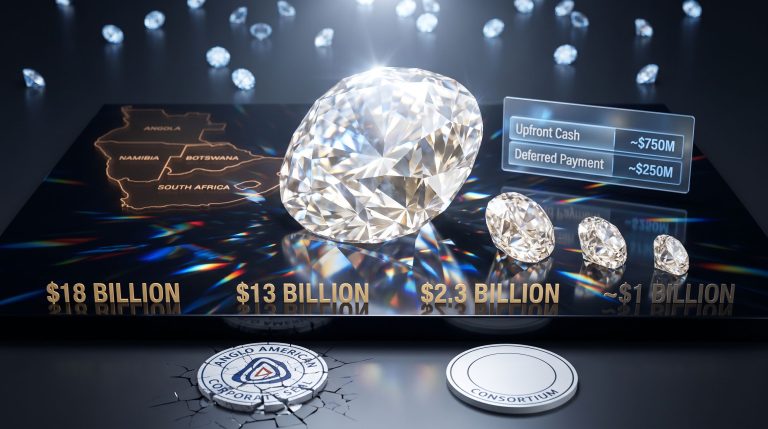
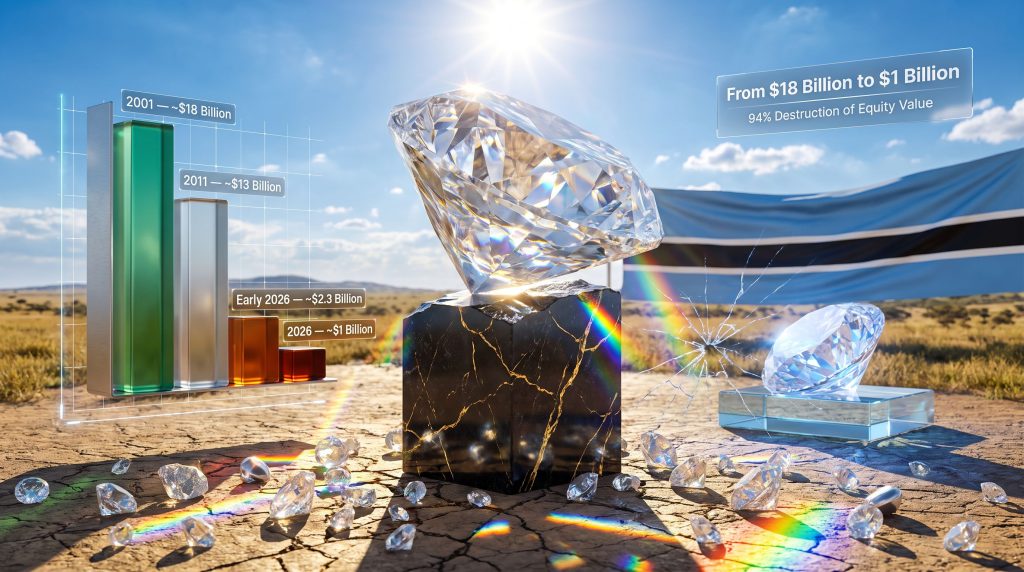
The numbers alone are striking. Consider how De Beers' implied equity value has moved across key transaction milestones:
| Milestone | Year | Implied Valuation |
|---|---|---|
| Anglo American and Oppenheimer family privatisation | 2001 | ~$18 billion |
| Anglo acquires Oppenheimer's remaining 40% stake | 2011 | ~$13 billion |
| Anglo's carrying value after successive impairments | Early 2026 | ~$2.3 billion |
| Reported sale price to Global Diamond Consortium | 2026 | ~$1 billion |
What this table captures is not a single bad year or a temporary commodity cycle. It is a 25-year structural erosion of an asset that once commanded near-monopoly pricing power over global diamond supply. Anglo American restructuring involved three successive impairment charges against De Beers across a three-year period, each one a formal accounting acknowledgement that the business was worth materially less than previously stated.
By early 2026, the carrying value had been written down to approximately $2.3 billion before the sale process produced an even lower realised exit price. Furthermore, Rapaport has documented in detail how Anglo American effectively slashed De Beers' value in half through these successive write-downs.
A company that once controlled upward of 80% of the world's rough diamond supply by volume is now being sold for less than a single year of operating cash flow generated at its peak. This is not a cyclical correction. It is a structural verdict.
Lab-Grown Diamonds: Understanding the Substitution Mechanism
To appreciate why the De Beers business model is under existential pressure, it helps to understand what lab-grown diamonds actually are and why they represent a fundamentally different threat than previous competitive challenges.
Synthetic diamonds are not imitations. They are chemically, physically, and optically identical to mined stones, produced through one of two industrial processes:
-
High Pressure High Temperature (HPHT): Replicates the geological conditions under which natural diamonds form, using intense pressure and heat to crystallise carbon around a seed crystal.
-
Chemical Vapour Deposition (CVD): Grows diamond layer by layer from a carbon-rich gas in a controlled chamber, allowing for greater precision in producing specific grades and cuts.
The critical market dynamic is that neither process produces a product that a gemological instrument can distinguish from a mined diamond without specialised equipment. For the end consumer purchasing an engagement ring, there is no experiential quality differential. The only meaningful difference is price, and that gap has widened dramatically over the past five years.
Lab-grown diamond prices have fallen by an estimated 70–80% since 2020 as production technology has scaled, while natural rough diamond prices have simultaneously declined due to demand weakness. This has created a pricing environment where the premium justification for natural stones is increasingly difficult to sustain outside the ultra-high-net-worth segment.
Unlike previous competitive threats that De Beers could absorb through marketing spend or supply management, lab-grown diamonds eliminate the quality differential that justified premium pricing entirely. This is a demand-side structural shift with no precedent in the company's history.
What This Means for Natural Diamond Pricing Architecture
De Beers historically operated a system known as the sightholder model, in which a curated group of approved buyers, called sightholders, purchased rough diamonds at prices set by De Beers at ten scheduled sales per year. This system gave De Beers extraordinary pricing power because it controlled both supply allocation and price setting simultaneously.
As lab-grown alternatives have compressed the market, that pricing architecture has become increasingly untenable. Sightholders who once accepted De Beers' terms without negotiation are now operating in a market where their downstream customers have credible, lower-cost alternatives. Consequently, the leverage that underpinned the sightholder model for decades has materially weakened.
China's Luxury Contraction and the Demand-Side Double Pressure
The lab-grown disruption did not occur in isolation. It compounded a simultaneous and severe contraction in Chinese luxury spending that removed one of the diamond industry's most important growth engines at precisely the wrong moment.
China's contribution to global diamond demand grew substantially through the 2000s and 2010s, driven by rapid wealth creation, urbanisation, and the adoption of Western engagement ring customs that De Beers actively promoted through marketing campaigns. By the early 2020s, China represented one of the world's two or three most significant diamond consumer markets.
The pullback has been driven by several intersecting forces:
- Macroeconomic deceleration and property sector stress reducing household wealth effects
- Regulatory pressure on conspicuous consumption affecting gifting behaviour among affluent consumers
- Generational shifts, with younger Chinese consumers demonstrating lower attachment to diamond jewellery as a status signal
- A broader reorientation toward domestic luxury brands and experiences over imported commodity goods
This dual-front pressure — synthetic substitution from below and Chinese demand contraction from above — created a structural challenge that periodic marketing campaigns and supply management could not resolve.
The BHP Bid That Triggered a Corporate Transformation
The De Beers sale by Anglo American would likely not have occurred on this timeline without an external catalyst. In early 2024, BHP Group launched an unsolicited takeover proposal for Anglo American valued at approximately $50 billion. The BHP strategic pivot toward future-facing commodities was central to the rationale behind that bid.
Anglo American successfully resisted the offer, but the defence required a credible counter-narrative for shareholders. That narrative took the form of a sweeping portfolio restructuring commitment, promising to divest non-core assets including:
- De Beers (diamonds)
- Platinum group metals operations
- Steelmaking coal portfolio
The strategic logic was to concentrate Anglo American's portfolio around future-facing commodities — principally copper, iron ore, and crop nutrients — that aligned with long-term structural demand themes including electrification and food security. De Beers, facing a structurally challenged market with no clear recovery catalyst, did not fit that framework.
May 2024 saw the formal announcement of De Beers' intended divestiture. By June 2026, the sale process had reached an advanced stage. On July 17, 2026, Reuters reported that Anglo American had identified a preferred bidder, subsequently confirmed by Botswana's government as the Global Diamond Consortium (GDC). By late July 2026, Bloomberg was reporting a contemplated transaction price of approximately $1 billion, with deal closure targeted for the final quarter of 2026.
The Global Diamond Consortium: Who Is Buying and Why
The GDC is led by Gareth Penny, a former Chief Executive Officer of De Beers who brings deep institutional knowledge of the company's operational structure, sightholder relationships, and African government dynamics. His involvement signals that the consortium intends active stewardship rather than financial engineering.
The proposed transaction architecture reflects sophisticated risk allocation:
| Component | Reported Amount |
|---|---|
| Upfront cash payment | ~$750 million |
| Deferred payment | ~$250 million |
| Earn-out provisions | Tied to future performance metrics |
| Capital injection by consortium | ~$500 million |
The earn-out structure is particularly notable from an investment analysis perspective. By linking a portion of total consideration to De Beers' future financial performance, the GDC has effectively transferred a share of market recovery risk back to Anglo American. If rough diamond prices remain depressed, Anglo receives less total consideration. If the market recovers, the earn-out provisions activate.
The $500 million capital injection is equally significant. It signals that the consortium is committed to operational investment rather than a strip-and-sell approach, which would be the more cynical interpretation of a distressed asset acquisition. Both Anglo American and the GDC declined to comment publicly on the reported terms.
The next major ASX story will hit our subscribers first
Botswana's Strategic Position: The Non-Negotiable Variable
No analysis of the De Beers sale by Anglo American is complete without understanding Botswana's role — and it is a role that goes far beyond a 15% minority equity position.
Botswana competes with Russia for the title of the world's largest diamond producer by volume. Diamond revenues have historically contributed a substantial portion of Botswana's government budget and foreign exchange earnings, making De Beers' ownership structure a matter of genuine national economic security. However, as Forbes has reported, Botswana has actively sought to influence the sale outcome, complicating Anglo American's divestiture timeline.
The country has demonstrated the geological credentials to support this strategic importance. Botswana has now recorded at least ten diamond discoveries exceeding 1,000 carats, including a 1,305-carat stone that ranks among the largest gem-quality diamonds ever found.
Kimberlite pipes are ancient volcanic conduits through which diamonds are transported from the mantle to the earth's surface. Botswana's Jwaneng and Orapa mines, both operated through De Beers' joint venture with the government, sit above some of the world's richest kimberlite formations by both grade and stone quality.
President Duma Boko has previously articulated Botswana's aspiration for majority control of De Beers. More recent reporting suggests the government may accept an enhanced minority position as a pragmatic outcome. If Namibia and Angola also join the consortium as equity participants, the restructured De Beers would carry African sovereign interests across three producing nations — a governance configuration that would have been inconceivable at the time of the 2001 privatisation.
Three Scenarios for De Beers Under New Ownership
The forward trajectory for De Beers under GDC ownership is genuinely uncertain. Three plausible scenarios deserve consideration:
Scenario 1: Market Recovery and Operational Stabilisation
If rough diamond prices recover as lab-grown market saturation limits further price compression among entry-level and mid-market stones, De Beers' production assets could generate substantially higher cash flows than current valuations imply. The $500 million capital injection would position the company to capitalise on any supply-demand rebalancing.
Scenario 2: Continued Structural Decline
If synthetic diamond adoption accelerates across mid-market and premium segments, natural diamond pricing may face a permanent structural discount that no marketing investment can reverse. Under this scenario, the earn-out provisions would yield minimal additional consideration, and the $1 billion acquisition price would retrospectively appear generous.
Scenario 3: Radical Repositioning as a Provenance Premium Brand
De Beers could pursue a strategy of extreme differentiation — leaning into geological rarity, certified chain-of-custody traceability, and the narrative of billions of years of natural formation to create a category that synthetic stones cannot credibly occupy. This approach would require ceding volume market share in exchange for margin preservation at the ultra-premium tier.
What the De Beers Divestiture Signals for the Broader Mining Sector
The De Beers sale by Anglo American carries lessons that extend well beyond the diamond industry. In addition, the broader trends at play here reflect the mining geopolitical landscape that is reshaping resource ownership and investment across multiple continents. Furthermore, the consolidation pressures in mining that drove Anglo American's restructuring decision are being felt across the sector as companies rationalise portfolios around thematic commodity narratives.
The key implications are as follows:
- Technological substitution can permanently re-rate commodity valuations. The De Beers case suggests that when a substitute product eliminates the quality differential justifying a price premium, the result is structural re-rating, not cyclical correction.
- Delayed divestiture decisions compound value destruction. Three successive impairment charges illustrate the accounting and opportunity cost of holding a deteriorating asset through a prolonged downturn.
- African sovereign participation in resource ownership is accelerating. Botswana's enhanced negotiating position reflects a continent-wide trend toward greater state participation in extractive industry economics.
- Portfolio concentration around thematic commodity narratives is the new playbook. Anglo American's transformation mirrors a broader mining industry consolidation trend away from diversification toward focused, thematically coherent asset portfolios.
Disclaimer: This article is intended for informational purposes only and does not constitute financial or investment advice. All transaction details remain subject to finalisation, regulatory approvals, and governmental consent. Forward-looking scenarios are speculative and involve material uncertainty. Readers should conduct independent due diligence before making any investment decisions.
Frequently Asked Questions: De Beers Sale by Anglo American
Why is Anglo American selling De Beers?
Anglo American committed to divesting De Beers as part of a comprehensive portfolio restructuring announced in 2024, following its successful defence against BHP Group's approximately $50 billion unsolicited takeover proposal. The sale also reflects sustained financial underperformance amid a prolonged diamond market downturn driven by lab-grown diamond competition and weakening demand from key consumer markets.
How much is Anglo American selling De Beers for?
Anglo American is reported to be in advanced negotiations to sell its 85% controlling stake for approximately $1 billion, structured as roughly $750 million upfront, $250 million deferred, and earn-out provisions linked to future performance metrics. These terms have not been finalised and remain subject to change.
Who is buying De Beers from Anglo American?
The preferred buyer is the Global Diamond Consortium, led by former De Beers CEO Gareth Penny. The consortium reportedly includes major diamond trading participants and potentially the governments of Namibia and Angola, though neither has publicly confirmed involvement.
What was De Beers worth at its peak?
De Beers carried an implied valuation of more than $18 billion when Anglo American and the Oppenheimer family took the company private in 2001. A decade later, the acquisition of the Oppenheimer family's remaining 40% stake implied a valuation of approximately $13 billion.
Why has De Beers' valuation fallen so dramatically?
The decline reflects multiple structural forces converging simultaneously: the rapid rise of lab-grown diamonds as chemically identical but dramatically cheaper alternatives, a sustained contraction in Chinese luxury spending, broader macroeconomic weakness suppressing discretionary demand, and three successive impairment charges that reduced Anglo's carrying value to approximately $2.3 billion before the sale concluded.
What role does Botswana play in the De Beers sale?
Botswana holds a 15% equity stake in De Beers and must negotiate directly with any acquiring consortium. Botswana has expressed interest in increasing its ownership position, and the outcome of those negotiations will materially influence the final deal structure, governance arrangements, and Botswana's long-term economic relationship with the global diamond sector.
Want to Know Which Mining Companies Could Be the Next Major Discovery?
While De Beers' decline illustrates how structural forces can permanently re-rate commodity valuations, Discovery Alert's proprietary Discovery IQ model scans ASX announcements in real time to identify significant mineral discoveries before the broader market reacts — turning complex geological data into actionable investment insights across more than 30 commodities. Explore historic examples of major discovery returns and begin a 14-day free trial to position yourself ahead of the next transformative find.