July 30, 2026
When Empires Crumble: What the De Beers Disposal Tells Us About Natural Diamond Markets
Few industries have maintained an aura of permanence as effectively as the global diamond trade. For most of the twentieth century, De Beers operated as one of the most successful commodity cartels the world had ever seen, controlling supply pipelines, setting benchmark prices through its sightholder system, and cementing diamonds as the universal symbol of enduring value. That system did not collapse overnight, but the reported Anglo American sale of De Beers for approximately $1 billion in mid-2026 signals something far more consequential than a single corporate divestiture. It marks the possible end of an era for natural diamond markets as the industry knew them.
When big ASX news breaks, our subscribers know first
From Diamond Monopoly to Distressed Asset: Understanding the Valuation Collapse
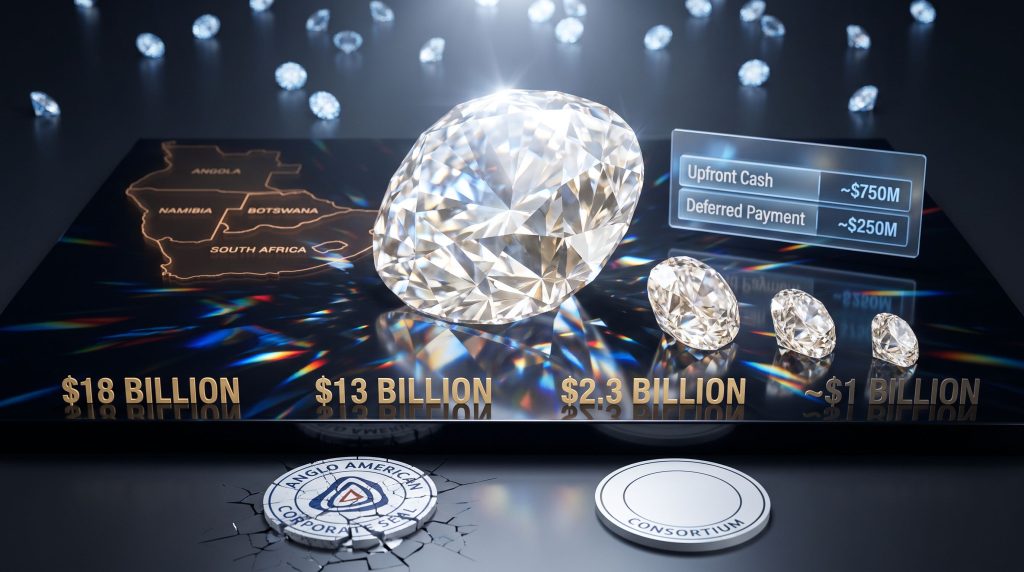
To fully appreciate the scale of what is happening, the numbers need to be placed in historical sequence. When Anglo American and the Oppenheimer family took De Beers private in 2001, the business carried an implied valuation exceeding $18 billion. A decade later, Anglo acquired the Oppenheimer family's remaining stake in a deal that pegged De Beers' worth at approximately $13 billion. That transaction made Anglo the dominant shareholder in what was then considered one of mining's most coveted franchise assets.
By early 2026, Anglo had recorded three successive impairment charges against De Beers within a three-year window, compressing the unit's carrying value to roughly $2.3 billion. Today, discussions are reportedly centred around a transaction worth approximately $1 billion for Anglo's 85% stake. Furthermore, this commodity price pressure has been a defining feature of the deterioration in valuations across the sector.
| Year | Event | Implied or Carrying Valuation |
|---|---|---|
| 2001 | Anglo and Oppenheimers take De Beers private | Over $18 billion |
| 2011 | Anglo acquires Oppenheimer family's stake | ~$13 billion |
| Early 2026 | Anglo carrying value after three impairments | ~$2.3 billion |
| Mid-2026 | Reported deal discussions with consortium | ~$1 billion |
The trajectory is stark. A business that once commanded premium valuations now trades at a fraction of its historical worth, reflecting both cyclical market weakness and what increasingly appears to be a structural reconfiguration of global diamond demand.
The BHP Bid That Changed Everything
While the diamond market's deterioration is the proximate cause of De Beers' diminished valuation, the catalytic corporate event was BHP Group's near-$50 billion takeover approach for Anglo American in early 2024. Anglo successfully fended off the bid, but the defensive manoeuvre came at a cost: the company was compelled to articulate a leaner, more focused corporate structure to shareholders, and De Beers became an obvious candidate for disposal.
The BHP approach effectively forced Anglo's hand. Without that external pressure, it is plausible that Anglo might have continued carrying De Beers on its books while waiting for diamond markets to recover. Instead, the company was pushed to monetise a deteriorating asset into a market showing few signs of near-term improvement. These mining consolidation trends have become increasingly common as major miners restructure their portfolios under shareholder pressure.
Breaking Down the $1 Billion Deal Structure
The reported transaction is more nuanced than the headline figure suggests. Understanding the full deal architecture matters for assessing what Anglo ultimately recovers versus what it concedes.
| Deal Component | Estimated Value |
|---|---|
| Upfront cash payment | ~$750 million |
| Deferred payment | ~$250 million |
| Capital injection into De Beers by GDC | ~$500 million |
| Anglo's stake being sold | 85% |
| Total headline deal value | ~$1 billion |
The additional $500 million capital injection by the Global Diamond Consortium into De Beers itself is a critical detail often overlooked in headline coverage. It suggests the new ownership group is prepared to invest meaningfully in rehabilitating the business rather than simply acquiring a distressed asset at a discount and extracting remaining value. There are also performance-linked earnout provisions reportedly attached to the deal, which could provide Anglo with partial upside recovery if diamond markets rebound post-completion.
It is worth noting that the discussions remain ongoing and no binding agreement has been confirmed as of late July 2026. There is no guarantee the deal will be completed on these terms or at all.
Who Is the Global Diamond Consortium?
The identity of the preferred bidder adds meaningful context to what the new ownership of De Beers might look like in practice. The Global Diamond Consortium is led by Gareth Penny, a former De Beers chief executive who helmed the company through one of its most turbulent periods, the 2008 to 2009 global financial crisis. During that downturn, Penny made difficult operational decisions including idling mines and conducting a $1 billion rights offering to restore the company's financial stability. His selection as consortium lead implies the new ownership group is calibrated for a sustained recovery phase rather than a rapid turnaround.
The consortium's composition extends beyond Penny's leadership:
- Sovereign participants: Namibia and Angola are both consortium members, introducing geopolitical dimensions that could influence future operational and export decisions
- Private participants: Some of the world's largest diamond trading entities are reportedly included, bringing deep knowledge of rough diamond distribution and downstream market dynamics
- Strategic focus: The consortium's stated intent is to refocus De Beers on core activities: the mining and marketing of natural gems, stepping back from broader diversification
Penny's prior experience navigating financial distress is arguably the most relevant credential available for this specific assignment. The challenge ahead mirrors elements of the 2008 crisis, though with the additional complication of a structurally altered competitive landscape.
The Four Forces That Broke the Diamond Market
Understanding why Anglo American is selling De Beers for what amounts to a fraction of its peak worth requires mapping the convergence of pressures that have compressed natural diamond prices to levels unseen in modern market history.
-
Post-pandemic demand reversal: Elevated gem purchases during 2020 to 2022 created artificial demand acceleration. Once pandemic-era consumer behaviour normalised, the unwind proved faster and deeper than most industry participants anticipated.
-
Chinese luxury spending contraction: China had become a central pillar of premium gem demand growth over the prior decade. A structural pullback in high-end consumer expenditure, driven by a combination of economic slowdown and shifting social attitudes toward conspicuous consumption, removed a critical demand engine from the market.
-
Lab-grown diamond proliferation: Synthetic diamonds have achieved near price parity with natural stones in several carat categories. Technological advances in chemical vapour deposition (CVD) and high-pressure, high-temperature (HPHT) production methods have dramatically reduced manufacturing costs, enabling lab-grown stones to undercut natural gems on price while achieving comparable optical and physical characteristics. For consumers who prioritise aesthetics over geological origin, the value proposition of a natural diamond has genuinely weakened.
-
Geopolitical and trade disruptions: Sanctions regimes, shifting trade routes, and diplomatic realignments have introduced supply chain friction that has compounded price weakness and created market uncertainty. The broader mining geopolitics outlook suggests these pressures are unlikely to ease significantly in the near term.
The combination of structural demand erosion and synthetic substitution represents a qualitatively different challenge from cyclical downturns. Previous diamond market recoveries were primarily driven by demand restimulation; this cycle requires the industry to defend the fundamental value proposition of natural gems.
Lab-Grown Diamonds: A Structural Threat, Not a Cyclical Headwind
Industry observers have debated for years whether lab-grown diamonds represent a passing trend or a permanent market force. The weight of evidence increasingly favours the latter interpretation. Retail price differentials between natural and synthetic diamonds have compressed dramatically in recent years, with lab-grown stones in the one-carat round brilliant category trading at discounts that make natural gem premiums difficult to justify on purely aesthetic grounds.
The natural diamond industry's historical defence relied on scarcity and geological authenticity as value drivers. The challenge is that scarcity arguments lose traction when consumers can purchase chemically identical stones at a fraction of the price. De Beers itself recognised this shift when it launched its Lightbox lab-grown diamond brand in 2018, though that positioning has since been reviewed.
The next major ASX story will hit our subscribers first
Botswana's Role: The Variable That Could Define the Deal's Outcome
Any analysis of the Anglo American sale of De Beers that omits Botswana's position is fundamentally incomplete. The African nation holds influence over this transaction through two distinct channels:
- A 15% direct equity stake in De Beers itself
- A 50% interest in Debswana, the joint venture that provides the majority of De Beers' diamond output
Critically, approximately 70% of De Beers' total diamond production originates from Botswana. This geographic concentration means Botswana is not simply a minor stakeholder; it is operationally central to the business the Global Diamond Consortium is seeking to acquire. Indeed, Forbes reports that Botswana has actively complicated Anglo American's divestment plans by asserting its ownership ambitions throughout the negotiation process.
Botswana must negotiate its own agreement with any new ownership structure, separate from Anglo's bilateral discussions with the consortium. President Duma Boko has publicly articulated a preference for majority control of De Beers, though subsequent reporting has suggested the government may accept a materially larger minority position as a pragmatic outcome.
The distinction matters enormously for deal timing. A transaction that satisfies Botswana's ownership aspirations could close within the anticipated Q4 2026 timeframe. A protracted negotiation could delay completion well into 2027 or beyond, introducing additional uncertainty for all parties.
De Beers' Global Mining Footprint
Understanding the global mining landscape is essential context for appreciating just how geographically concentrated De Beers' production base truly is.
| Country | Operational Significance |
|---|---|
| Botswana | ~70% of total production; Debswana JV with government |
| Namibia | Active operations; Namibia is also a consortium member |
| South Africa | Historical heartland of De Beers diamond mining |
| Canada | Northern hemisphere asset providing geographic diversification |
The overlap between Namibia's role as both a producing jurisdiction and a consortium member creates an interesting alignment of interests, one that could smooth sovereign approval processes in that jurisdiction while adding complexity to the governance structure of the future entity.
What a Sub-$1 Billion Valuation Signals to the Broader Mining M&A Market
For investors and capital allocators monitoring the global mining mergers and acquisitions landscape, the implied price in the De Beers discussions sends a series of signals worth examining carefully.
First, it confirms that prolonged commodity price pressure can overwhelm even the most iconic franchise assets. De Beers' brand recognition is arguably unmatched in the gem sector, yet brand equity has provided limited protection against structural market deterioration.
Second, the earnout structure reflects the genuine uncertainty surrounding natural diamond market recovery. Neither buyer nor seller appears sufficiently confident in near-term price trajectories to commit to a fixed valuation that fully reflects any potential upside. Performance-linked payments represent a form of shared risk acknowledgement.
Third, the deal demonstrates how sovereign interests increasingly shape mining asset transactions in Africa. Any acquirer of a major African mining asset must navigate not just commercial terms but geopolitical relationships, community obligations, and national ownership aspirations. This complexity is not new, but the De Beers situation illustrates its deal-shaping power in sharp relief.
Key Risks That Could Derail the Transaction
Several material risks warrant attention before any assumption of deal completion is made:
- Botswana negotiation complexity: The separate stakeholder process with the Botswana government introduces an independent variable that could alter deal terms, timing, or structure
- Sustained diamond price weakness: If natural diamond prices continue declining through the second half of 2026, the consortium's willingness to proceed on current terms may diminish
- Regulatory approvals across four jurisdictions: Operations spanning Botswana, Namibia, South Africa, and Canada require navigating multiple regulatory frameworks, each with its own approval timeline
- Lab-grown market acceleration: Any further rapid expansion of synthetic diamond market share could undermine the recovery thesis underpinning the consortium's investment case
- Earnout dependency: Anglo's ability to recover value above the $1 billion headline figure is contingent on De Beers' performance after sale, which is dependent on market conditions neither party controls
Frequently Asked Questions: Anglo American Sale of De Beers
What price is Anglo American selling De Beers for?
Anglo American is reportedly in discussions to sell its 85% stake in De Beers for approximately $1 billion, structured as an upfront payment of around $750 million, a deferred component of approximately $250 million, and additional performance-linked payments contingent on post-completion business performance.
Who is buying De Beers from Anglo American?
The preferred bidder is the Global Diamond Consortium, led by former De Beers chief executive Gareth Penny, with Namibia and Angola as sovereign participants alongside some of the world's largest diamond trading entities.
Why has De Beers' value declined so dramatically?
A convergence of post-pandemic demand normalisation, a collapse in Chinese luxury spending, rapid growth of lab-grown diamond substitutes, and geopolitical trade pressures has produced sustained price weakness and required Anglo to record three successive asset impairments within three years. Among the top diamond-producing countries, this demand deterioration has been felt most acutely in those with heavy reliance on gem-quality output.
Does Botswana have a say in the De Beers sale?
Yes, and a significant one. Botswana holds a 15% direct stake in De Beers and a 50% interest in Debswana, the joint venture responsible for approximately 70% of De Beers' total production. Any ownership restructure requires a separate negotiation with the Botswana government. Reuters reporting indicates that the De Beers CEO views a finalised sale as a matter of weeks rather than months, suggesting Botswana's position may be closer to resolution than earlier commentary implied.
When is the De Beers sale expected to close?
Subject to stakeholder negotiations and multi-jurisdictional regulatory approvals, the transaction is anticipated around Q4 2026, though no binding agreement has been confirmed and discussions remain ongoing.
What is the new consortium's strategy for De Beers?
The consortium has indicated its intent to refocus De Beers on its foundational competencies: the mining and marketing of natural diamonds, with an additional $500 million capital injection into the business forming part of the deal structure.
The Long-Term Question: Can Natural Diamonds Reclaim Their Premium?
The Anglo American sale of De Beers is ultimately a referendum on whether the natural diamond industry can construct a credible long-term value narrative in a world where synthetic alternatives exist at scale. The consortium's focus on mining and natural gem marketing suggests a belief that geological provenance, rarity, and emotional resonance can still command a meaningful premium over lab-grown alternatives.
That belief is not without foundation. Natural diamonds carry verifiable geological histories spanning billions of years of formation under extreme pressure conditions deep within the Earth's mantle. The rarity of gem-quality stones in terms of colour, clarity, carat weight, and cut remains genuine. For a segment of consumers, those qualities will continue to matter.
However, the industry's challenge is communicating that distinction effectively to younger consumer demographics who show less attachment to the traditional diamond narrative than prior generations. How the new ownership of De Beers approaches that marketing challenge may ultimately matter more than any operational restructuring in determining whether this transaction proves to be a distressed-asset acquisition or the foundation for genuine business recovery.
Disclaimer: This article is intended for informational purposes only and does not constitute financial or investment advice. The deal discussions referenced herein are based on publicly available reporting as of late July 2026. No binding agreement between Anglo American and the Global Diamond Consortium has been confirmed. Readers should conduct their own due diligence before making any investment decisions related to companies or assets mentioned in this article.
Want to Stay Ahead of the Next Major Resource Discovery Before the Market Moves?
While the De Beers saga illustrates how dramatically commodity markets can shift, Discovery Alert's proprietary Discovery IQ model scans ASX announcements in real time, instantly identifying significant mineral discoveries and delivering actionable alerts to subscribers — explore historic discoveries and their extraordinary returns, then begin your 14-day free trial to ensure you're positioned ahead of the next major find.