July 30, 2026
India's Coal Infrastructure Crossroads: Decoding the ₹68,000 Crore Capital Commitment
The economics of large-scale resource extraction have rarely been simple, but in countries where energy security and industrial growth are inseparable, capital allocation decisions by state-owned miners carry consequences that ripple far beyond balance sheets. When a single enterprise controls roughly 80% of a nation's coal output and commits to a multi-year infrastructure investment programme worth approximately ₹68,000 crore, the implications extend into power generation, industrial pricing, logistics networks, and employment across entire regions. Understanding the Coal India capex plan for FY27 through FY30 requires looking past the headline figure and examining what the spending architecture reveals about where Indian energy infrastructure genuinely stands today.
When big ASX news breaks, our subscribers know first
Why Land Is the Binding Constraint, Not Coal Reserves
A common misconception among those unfamiliar with the operational realities of Indian coal mining is that proven reserves are the primary determinant of production capacity. In practice, the situation is far more nuanced. India holds among the largest coal reserves globally, yet production has historically fallen short of theoretical potential. The reason is straightforward: no volume of geologically confirmed coal can be extracted until land tenure is secured, community resettlement obligations are fulfilled, and regulatory clearances for mine development are obtained.
This is precisely why the single largest capital allocation category within the Coal India capex plan is land acquisition and rehabilitation and resettlement (R&R) activities, accounting for more than one-third of the entire four-year outlay, estimated at over ₹23,000 crore. This is not a peripheral operational cost. It is the foundational prerequisite without which every other category of spending becomes irrelevant.
The R&R dimension adds layers of complexity that distinguish Indian mining expansion from open-cut operations in Australia, Indonesia, or South Africa. Indian law requires comprehensive compensation, livelihood restoration, and in many cases physical resettlement of affected communities before land can be transferred for mining use. These obligations introduce both cost escalation risk and timeline uncertainty that no amount of engineering or equipment procurement can resolve. Furthermore, these coal supply challenges are not unique to India, but the regulatory and community consultation requirements here add distinctive layers of complexity.
"Land acquisition remains the rate-limiting factor in Indian coal mine development. Irrespective of how large a reserve base is, production cannot commence without secured land tenure and fulfilled resettlement obligations. This makes the R&R budget category not just significant, but structurally non-negotiable."
Breaking Down the ₹68,000 Crore Capex Allocation
The four-year programme directs capital across four primary segments, which collectively represent over 80% of the total planned outlay. The remaining balance covers ancillary mining infrastructure including access roads, smaller civil works, and administrative facilities.
Capex Allocation Framework: FY27 to FY30
| Investment Category | Estimated Allocation | Share of Total | Strategic Function |
|---|---|---|---|
| Land Acquisition and R&R | >₹23,000 crore (est.) | >33% | Enabling new mine development and expansion |
| Coal Evacuation Infrastructure | >₹17,000 crore | ~25% | Railway sidings, corridors, handling plants, roads |
| Plant and Machinery | >₹9,000 crore | ~13% | HEMM procurement, washery construction |
| Solar and Diversification | Remaining allocation | ~10-15% | Renewable energy strategic hedge |
| Ancillary Mining Infrastructure | Balance | ~10-15% | Silos, weighbridges, access roads |
Note: Sub-category figures are derived from company disclosures and senior official statements. Exact allocations remain subject to annual budget review and revision.
The coal evacuation infrastructure segment, at over ₹17,000 crore, targets the development of railway sidings and dedicated rail corridors, alongside coal handling plants, silos, weighbridges, and road networks. This investment category addresses what industry analysts have long identified as the logistics gap: the inability to move coal from pithead to power plant at speeds and volumes that match extraction capacity. Stranded output at mine gates has historically been a silent drag on realised production figures.
The plant and machinery allocation of over ₹9,000 crore covers heavy earth moving machinery (HEMM) procurement and the construction and expansion of washeries. Washery investment is particularly significant from a demand-side perspective. Higher-quality washed coal commands better pricing and is increasingly required by industries seeking lower ash content for both efficiency and environmental compliance.
FY26 Overperformance: A New Baseline, Not an Outlier
The FY27-FY30 plan does not exist in isolation. It is grounded in demonstrated execution capacity from the preceding fiscal year. According to Coal India's press releases, this overperformance reflects genuine improvements in internal project execution and procurement management.
FY26 Capex Performance Against Target
| Metric | FY26 Annual Target | FY26 Actual Spend | Variance |
|---|---|---|---|
| Total Capital Expenditure | ₹16,000 crore | ₹19,607 crore | +22.5% overperformance |
| Implied Annual Run-Rate (FY27-FY30 Plan) | ₹17,000 crore | — | Above prior target, below FY26 actual |
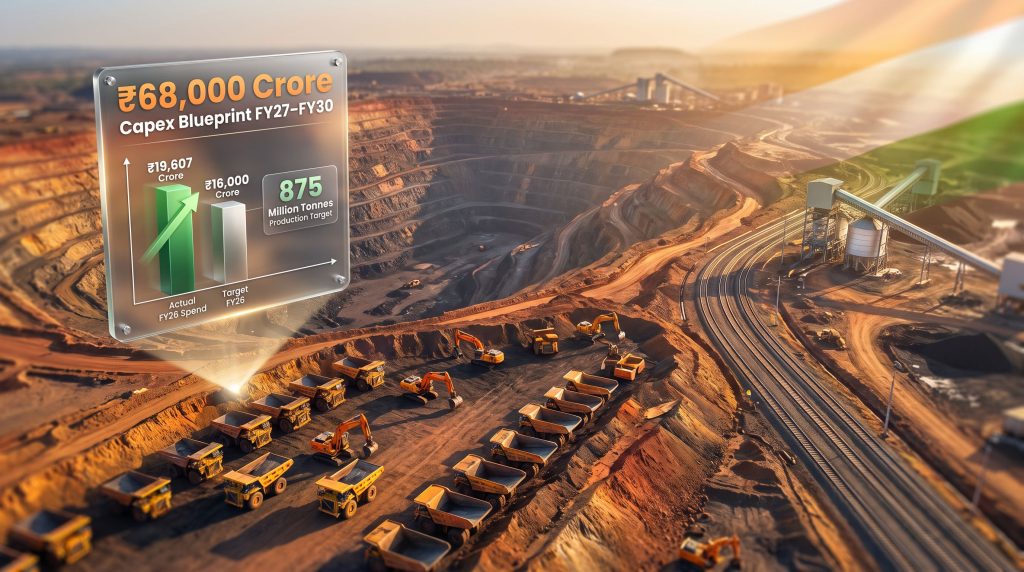
Coal India spent ₹19,607 crore in FY26, exceeding its own annual target of ₹16,000 crore by more than ₹3,600 crore, representing a 22.5% overrun above plan in a positive direction. This matters for two reasons. First, it signals that internal project execution capacity has genuinely improved, particularly in procurement and contract management. Second, it establishes that the ₹17,000 crore average annual implied by the four-year plan is not aspirational — it is conservative relative to what was achieved in FY26.
For investors and analysts tracking Coal India capex plan execution, this overperformance history suggests that capital deployment risk is tilted toward upside delivery rather than systemic underspend. The mining industry evolution seen globally reflects similar patterns, where state-owned enterprises that consistently exceed targets tend to attract stronger long-term institutional confidence.
The Logistics Investment Case: Why ₹17,000 Crore Is Going Into Coal Evacuation
The coal evacuation segment represents one of the least visible but most operationally critical dimensions of mining infrastructure investment. India's coal supply chain has historically relied heavily on road-based transportation for last-mile movement, which is both cost-inefficient and environmentally taxing at scale. The strategic priority, consequently, is to shift a larger proportion of coal movement onto dedicated rail corridors.
Key components of the evacuation infrastructure buildout include:
- Construction and upgrading of railway sidings that connect mine clusters directly to the broader rail network
- Development of dedicated rail corridors to reduce congestion and improve average coal transit times
- Construction of coal handling plants that enable efficient loading, blending, and dispatch at source
- Installation of silos and weighbridges to improve stock management accuracy and reduce losses in transit
- Road infrastructure improvements in areas where rail access is structurally limited
A critical but underappreciated dynamic here is the coordination dependency with Indian Railways. Private or state-enterprise investment in rail sidings requires alignment with Indian Railways on connectivity, scheduling, and capacity allocation. This institutional coordination layer introduces execution risk that sits outside Coal India's direct control, regardless of the capital it commits.
HEMM and Washery Investment: The Mechanisation Multiplier
Heavy Earth Moving Machinery procurement is often discussed as a straightforward equipment spend. In practice, it functions as a bottleneck multiplier: the rate at which HEMM can be deployed determines the rate at which expanded mine faces can be operationalised, which in turn determines when newly acquired land actually contributes to output.
Global HEMM supply chains are concentrated among a small number of manufacturers, with lead times for large equipment such as rope shovels, draglines, and high-capacity dumpers extending to 18-36 months under normal market conditions. This creates a sequencing dependency in any multi-year capex programme: HEMM orders must be placed well in advance of the production windows they are intended to support.
Washery construction adds a separate dimension. The expansion of coal washing capacity is aligned with a gradual shift in customer requirements, particularly from:
- Thermal power plants under environmental compliance pressure requiring lower ash content fuel
- Steel and coke producers who require coking coal with tightly specified quality parameters
- Industrial consumers seeking consistent calorific value and reduced handling waste
Washed coal also improves logistics economics by increasing energy density per tonne moved, effectively reducing the cost per unit of energy delivered to end users.
The next major ASX story will hit our subscribers first
Solar Diversification: Strategic Signal, Not Structural Pivot
The inclusion of solar projects within the Coal India capex plan has attracted commentary as evidence of an energy transition strategy. A more measured reading is that it represents early-stage portfolio hedging rather than a fundamental reorientation. However, the broader context matters here: the India coal trading exchange proposal currently under discussion reflects similar institutional hedging behaviour across Indian energy policy.
The solar allocation remains a minority share of total planned capital, likely in the 10-15% range. For a state-owned enterprise whose revenue base, workforce, and operational mandate are entirely oriented around coal extraction, this level of renewable investment is best understood as an acknowledgment of long-term demand transition risks rather than an active pivot away from core business.
What it does signal, furthermore, is that capital planning frameworks within Coal India are beginning to incorporate scenario thinking about a world where thermal coal demand growth eventually plateaus. Embedding solar infrastructure investment now reduces the adjustment costs of a larger transition later.
Key Execution Risks Across the Four-Year Horizon
| Risk Category | Nature of Risk | Likely Impact |
|---|---|---|
| Land Acquisition Delays | Legal disputes, community opposition, regulatory lag | Timeline slippage on mine development |
| R&R Cost Escalation | Rising compensation benchmarks, litigation | Budget overruns in the largest capex category |
| Indian Railways Coordination | Siding approvals, scheduling alignment | Evacuation bottlenecks persist despite investment |
| HEMM Supply Chain | Global manufacturer lead times, commodity pricing | Delayed mechanisation of expanded mine faces |
| Washery Execution | Civil construction timelines and contractor capacity | Quality improvement benefits delayed |
| Policy Transition Risk | Shifts in national energy policy or demand trajectory | Long-term volume assumptions under pressure |
| Solar Project Execution | Nascent renewable delivery capability | Underperformance in diversification objectives |
"Among all execution risks in the Coal India capex plan, land acquisition timeline variability remains the single most consequential variable. It is the only category where delays cannot be compensated by accelerating spending in other segments, because it is the prerequisite input to all other investment categories becoming productive."
What the FY27-FY30 Plan Tells Investors About India's Energy Infrastructure Trajectory
Stepping back from individual spending categories, the Coal India capex plan communicates several structural realities about Indian energy infrastructure that deserve investor attention. In addition, these dynamics resonate with broader resource export challenges observed internationally, where physical infrastructure constraints consistently outpace reserve-based production assumptions.
- Physical infrastructure constraints, not reserve availability, are the binding limits on coal production growth. The fact that logistics and land together consume more than 55% of planned capital makes this explicit.
- The average annual implied spend of ~₹17,000 crore represents a permanent step-up in capital intensity from historical norms, supported by FY26's actual ₹19,607 crore delivery.
- Washery and HEMM investment points toward a quality-led growth strategy, not just volume expansion. This matters for pricing dynamics in domestic coal markets.
- Solar inclusion within a coal-sector capex plan is a globally observable pattern among state-owned energy enterprises navigating transition pressures, but should not be interpreted as diluting the core production mandate.
- Execution risk is real and concentrated in land, logistics coordination, and global equipment supply chains, none of which are fully within Coal India's operational control.
Understanding how India compares with other global coal producers also provides useful context for evaluating whether this level of capital commitment is exceptional or consistent with broader industry trends.
Disclaimer: This article is for informational purposes only and does not constitute financial or investment advice. Projections, estimates, and forward-looking statements involve inherent uncertainty. Readers should conduct independent research and consult qualified advisors before making investment decisions.
Frequently Asked Questions: Coal India Capex Plan FY27-FY30
What is the total size of Coal India's capex plan for FY27 to FY30?
Coal India has outlined a capital expenditure programme of approximately ₹68,000 crore across four fiscal years, targeting capacity expansion, logistics strengthening, mechanisation, and early-stage renewable energy diversification.
Which spending category receives the largest share of capital?
Land acquisition and related rehabilitation and resettlement activities account for more than one-third of the total planned outlay, making it the single largest category across the four-year programme.
How did FY26 capex perform against Coal India's target?
Coal India spent ₹19,607 crore in FY26, exceeding its annual target of ₹16,000 crore by approximately 22.5%, or more than ₹3,600 crore above plan. Detailed reporting on this overperformance is available via ET EnergyWorld's coverage of Coal India's quarterly capex figures.
How much is allocated to coal evacuation infrastructure?
Over ₹17,000 crore has been earmarked for coal evacuation systems, covering railway sidings, rail corridors, coal handling plants, silos, weighbridges, and road infrastructure.
What does the plant and machinery allocation cover?
More than ₹9,000 crore targets heavy earth moving machinery procurement, washery construction and expansion, and other capital equipment requirements across the mine portfolio.
Is solar energy investment part of the capex plan?
Yes. Solar projects form one of the four primary spending categories, representing Coal India's strategic positioning toward energy diversification while remaining a minority share of total capital deployed.
Want to Track the Next Major Mineral Discovery Before the Market Does?
Discovery Alert's proprietary Discovery IQ model delivers real-time alerts on significant ASX mineral discoveries, transforming complex resource data into actionable investment insights for both short-term traders and long-term investors — explore historic discovery returns to understand the scale of opportunity, and begin your 14-day free trial today to position yourself ahead of the market.