July 30, 2026
The Hidden Economics of Bulk Commodity Volume Records
In the world of bulk commodity mining, volume milestones are rarely just vanity metrics. For investors who understand how cost structures behave at scale, a production record carries information far beyond the headline tonne figure. Fixed infrastructure costs, transhipment agreements, and freight contracts all behave differently as volumes rise, meaning the distance between a modest quarterly result and a record one can translate into disproportionate margin improvement. This dynamic sits at the heart of what Metro Mining Ltd (ASX: MMI) achieved during the June 2026 quarter, and why the Metro Mining record Q2 bauxite shipments result deserves closer examination than a surface reading might suggest.
When big ASX news breaks, our subscribers know first
Understanding Metro Mining's Bauxite Hills Operation: The Foundation Behind the Numbers
Where Geography Creates Logistical Complexity
The Bauxite Hills Mine sits on the Cape York Peninsula in far North Queensland, one of Australia's most remote and environmentally sensitive regions. This location is not incidental to the operation's economics; it defines them. Unlike bauxite operations with direct port access, Bauxite Hills relies on a carefully choreographed logistics chain that moves ore from the mine face to barges, then to an offshore transhipment vessel, and finally into bulk carriers bound for alumina refineries across Asia.
Transhipment operations of this kind introduce a layer of operational dependency that onshore operations do not face. The availability, scheduling, and maintenance cycle of the offshore transhipment vessel directly constrains how much ore can be loaded onto export ships in any given window. This is not a theoretical risk; it was demonstrated during Q2 2026 when the primary transhipper, the Ikamba, underwent its scheduled five-year dry-dock maintenance programme, temporarily removing a critical link from the logistics chain.
Seasonal Operating Windows and Their Strategic Significance
North Queensland's wet season fundamentally shapes Bauxite Hills' annual production calendar. Tropical cyclone activity, heavy rainfall, and poor sea conditions compress the viable shipping window into the dry-season months, meaning H2 of each calendar year typically represents the highest-volume, lowest-disruption period for the operation. This seasonal asymmetry is not a weakness unique to Metro Mining; it is a structural feature of all Cape York Peninsula resource operations.
What matters strategically is how well a mine prepares during the constrained first half to capitalise on the open conditions of the second. Pre-stripping, vegetation clearing, stockpile building, and planning system improvements are all investments made in H1 that pay dividends in H2 throughput. The Metro Mining Bauxite Hills production data from Q2 2026 suggests Metro Mining executed this preparation phase more effectively than in prior years.
What the Q2 2026 Production Data Actually Reveals
Breaking Down the Record: 1.8 Million WMT and the Factors Behind the 7% Year-on-Year Lift
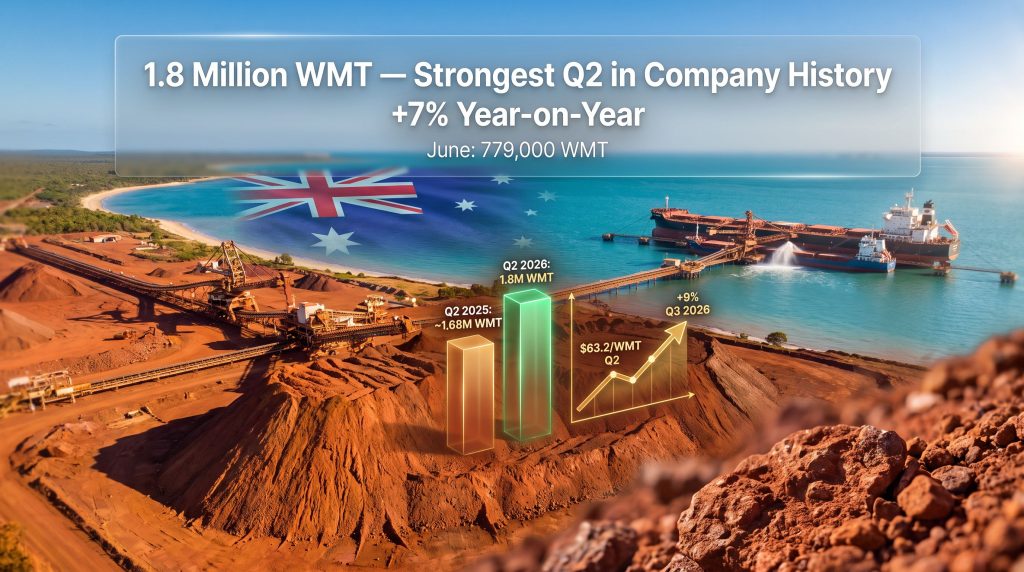
Metro Mining's June 2026 quarter produced 1.8 million wet metric tonnes (WMT) of bauxite, the strongest second-quarter result in the company's operational history and a 7% improvement on the same period in 2025. What makes this result particularly notable is the context in which it was achieved. Tropical Cyclone Narelle disrupted early-quarter operations, and the Ikamba transhipper was absent for a portion of the quarter during its dry-dock service. Achieving a volume record while navigating both disruptions simultaneously points to a genuine improvement in operational resilience rather than simply favourable conditions.
June's standalone contribution of 779,000 WMT represented a 29% surge over May's volumes, a single-month record that effectively confirmed the capacity of the new operational systems to accelerate throughput when conditions aligned.
| Metric | Q2 2026 | Q2 2025 | Change |
|---|---|---|---|
| Total Shipments (WMT) | 1.8 million | ~1.68 million | +7% YoY |
| June Shipments (WMT) | 779,000 | N/A | Monthly record |
| Closing Cash | A$23.8 million | N/A | N/A |
| Secured Debt | US$31.5 million | US$36.5 million | -US$5 million |
| Site EBITDA | $4.4/WMT | N/A | Impacted by costs and pricing |
| Q2 Average CIF Price | $63.2/WMT | N/A | -14% vs. Q4 2025 |
How the Compressed Shipping Window Shaped June's Performance
The temporary absence of the Ikamba created a compressed shipping window that concentrated vessel loading activity into a narrower timeframe than normal. When the transhipper returned to service, the operation effectively needed to recover lost throughput time. That June delivered a monthly record under these circumstances is a strong operational signal. It suggests that the mine face, barge fleet, and stockpile management were all positioned to respond quickly when capacity was restored. Port stockpile expansion, which added 170,000 WMT of additional storage capacity, was a direct enabler of this responsiveness.
What Operational Changes Enabled the Volume Breakthrough?
A New Integrated Planning and Operating System
Perhaps the most significant structural change in Q2 2026 was the commissioning and proof-of-concept validation of a new integrated planning and operating system. In mining operations, planning system quality has a compounding effect: better scheduling reduces idle time for equipment and personnel, improved grade control reduces rework and cargo rejection risk, and more accurate production forecasting allows logistics partners to be better prepared.
The June 2026 result served as a live demonstration that the new system could coordinate mine face activity, barge scheduling, stockpile management, and vessel loading into a coherent operational rhythm, rather than a series of independently managed functions.
Grade Control as a Competitive Tool
One element of the operational improvement that deserves specific attention is enhanced grade control. In bauxite mining, grade consistency is not merely a quality metric; it is a customer relationship tool. Alumina refineries operate with tightly calibrated refinery inputs, and bauxite shipments that vary significantly in alumina content, reactive silica, or moisture can cause processing disruptions downstream. Producers that deliver consistent, predictable grade profiles build the kind of trust with refinery customers that converts trial cargo agreements into long-term offtake contracts.
The two new trial cargo agreements secured during Q2 2026 are most credibly explained by this grade control improvement. It is unlikely that a refinery customer would commit to a trial cargo with a new supplier based solely on volume capacity; cargo quality consistency is the primary filter.
Vegetation Clearing and Overburden Removal: Investing in H2 Access
Substantial progress in vegetation clearing and overburden removal during Q2 positions the mine for expanded mining access during the H2 2026 dry season window. Overburden removal, or pre-stripping, involves removing the non-ore material sitting above the ore body to expose fresh bauxite for extraction. This work is capital and diesel intensive, which explains part of the cost pressure Metro experienced in the quarter, but it is fundamentally a forward investment in ore availability.
How Does Metro Mining's Cost Structure Hold Up Against the Revenue Headwinds?
Diesel, Stripping, and the Logic of Short-Term Cost Inflation
Site EBITDA of $4.4/WMT reflected the dual pressure of higher diesel costs and accelerated pre-stripping activity. Neither of these cost drivers represents a structural deterioration. Higher diesel reflects a macroeconomic input cost environment that all remote mining operations face, while accelerated stripping is a deliberate capital allocation decision with a clear production rationale.
The cost vs. volume trade-off framework for Q2 2026 can be understood as follows:
- Higher diesel costs in Q2 reflect deliberate pre-stripping investment, not operational inefficiency
- Accelerated overburden removal front-loads costs in H1 to unlock greater mining access in H2
- Fixed ocean freight contracts insulate per-tonne economics from spot shipping market volatility
- The net result is short-term margin compression exchanged for structurally lower per-unit costs at higher H2 volumes
Fixed Freight as an Operating Leverage Mechanism
A detail that often receives insufficient attention in assessments of Metro Mining's economics is the fixed-cost nature of most ocean freight obligations. In a period of significant freight rate volatility, having freight costs locked at predetermined rates provides two benefits: cost certainty for planning purposes, and the potential for below-market freight economics if spot rates rise. More importantly, fixed freight costs create natural operating leverage as volumes increase. A fixed cost spread across more tonnes means a lower per-tonne freight burden, directly improving site EBITDA at higher shipment rates.
Pricing Dynamics: How Does a 14% Price Drop Coexist With a Record Quarter?
CIF Pricing at $63.2/WMT and the Global Alumina Market Context
The $63.2/WMT average CIF price for Q2 2026 represented a 14% decline from the Q4 2025 average, reflecting softer early-quarter market sentiment in the bauxite and alumina market complex. Cost, Insurance and Freight (CIF) pricing is the standard trade mechanism for bauxite, with the seller responsible for freight and insurance to the destination port. Price softness in early 2026 is broadly consistent with alumina refinery margin pressures that flowed through to raw material procurement decisions during that period.
The Q3 2026 Price Recovery and Guinea's Indirect Role
Metro has secured a 9% price uplift for Q3 2026 shipments. Understanding why this recovery occurred requires a brief look at Guinea, which accounts for a substantial share of global bauxite production in the seaborne supply mix. Guinea's bauxite producers face structurally rising freight and diesel costs due to infrastructure limitations and energy price exposure. As their delivered costs increase, the floor price at which West African material becomes economic to ship rises, providing a competitive pricing benefit to lower-freight-cost producers like Metro Mining.
This dynamic creates what could be described as an indirect pricing support mechanism for Australian bauxite producers. As Guinea's cost curve shifts upward, the market equilibrium price for seaborne bauxite tends to adjust, benefiting producers operating with more stable freight economics.
Note: Pricing forecasts and market dynamics involve inherent uncertainty. The above analysis reflects current market conditions and should not be taken as a guarantee of future pricing outcomes.
The next major ASX story will hit our subscribers first
What Does Full-Year Guidance of 6.6 to 7.1 Million WMT Require from H2 2026?
The Arithmetic of the Second Half
With approximately 1.8 million WMT shipped in H1 2026 (combining Q1 and Q2 results), achieving the full-year guidance range of 6.6 to 7.1 million WMT places significant but achievable demands on H2 production. Management has flagged a target of more than 5 million tonnes in the second half, which aligns with the guidance arithmetic.
| Scenario | H2 2026 Required Volume | Full-Year Outcome |
|---|---|---|
| Low-end guidance | ~4.8 million WMT | 6.6 million WMT |
| Mid-range guidance | ~5.05 million WMT | 6.85 million WMT |
| High-end guidance | ~5.3 million WMT | 7.1 million WMT |
| Management target | 5+ million WMT | Supports full guidance range |
The dry-season conditions of the Queensland winter and spring create the optimal environment for both mining activity and vessel loading. Combined with the pre-stripping work completed in Q2, expanded stockpile capacity, and the new planning system operating at scale, the operational foundations for H2 delivery appear stronger than at the equivalent point in prior years. However, weather events remain an unhedgeable risk in this geography, and cyclone activity or unseasonable rainfall could compress the effective shipping window.
Customer Diversification: What Do Two New Trial Cargo Agreements Signal?
Trial Cargos as Strategic Indicators
In the seaborne bauxite trade, a trial cargo agreement is structurally significant. Alumina refineries are capital-intensive, long-life assets whose operators are deeply cautious about raw material supply changes. The qualification process for a new bauxite supplier typically involves detailed mineralogical assessment, refinery compatibility testing, and multiple layers of commercial negotiation before a cargo is committed. A trial cargo represents the final stage of that qualification process.
Two new trial cargo agreements in a single quarter therefore signal that Metro Mining's grade control improvements have elevated the mine's standing in the supplier qualification processes of at least two new refinery customers. If those trial cargos perform to specification, the commercial pathway to longer-term offtake arrangements becomes considerably shorter. Furthermore, these developments align with broader alumina sector developments that are reshaping how refineries approach raw material sourcing.
Bauxite quality is assessed across several technical parameters that are critical to refinery operators:
- Available alumina content – the proportion of aluminium oxide recoverable through the Bayer refining process
- Reactive silica percentage – high reactive silica increases caustic soda consumption in refining, raising operational costs
- Moisture content – affects the wet metric tonne to dry metric tonne conversion and shipped weight economics
- Trace element profiles – certain impurities can cause scaling or processing complications in specific refinery configurations
Balance Sheet Trajectory: Is Metro Mining's Financial Position Strengthening?
Liquidity and Debt Reduction in the Same Quarter
Closing cash of A$23.8 million alongside a US$5 million reduction in secured debt to US$31.5 million in a single quarter represents a meaningful balance sheet improvement. The simultaneous delivery of a volume record, positive site EBITDA, cash preservation, and debt reduction is an unusual combination for a small-cap resources company operating in a soft pricing environment.
When a company initiates a share buy-back while simultaneously reducing secured debt and maintaining positive operating margins, even in a compressed pricing environment, it typically reflects management confidence in near-term cash generation capacity that is stronger than the external conditions alone would suggest.
The Share Buy-Back Signal
The announcement that an on-market share buy-back will commence in Q3 2026, having been delayed earlier in the year due to market volatility, carries informational content that goes beyond the mechanical impact of buying shares. Buy-back programmes at small-cap resource companies are infrequent and typically only sanctioned when a board has high conviction in the sufficiency of near-term operating cash flows. The timing, following a record shipping quarter and ahead of the seasonally strongest production period, amplifies this signal. In addition, the decision sits within a broader context where aluminium mining companies across the sector are reassessing capital return strategies.
This article contains general information only and does not constitute financial advice. Investors should conduct their own due diligence and consider their personal circumstances before making any investment decisions.
Key Risks That Could Disrupt the H2 2026 Outlook
Not all of the factors shaping Metro Mining's H2 trajectory are within management's control. Investors should weigh the following risk factors:
- Tropical weather events: The Cape York Peninsula remains exposed to cyclone risk even during the dry season shoulder months. A significant weather event could compress the effective shipping window materially
- Transhipment infrastructure dependency: The Ikamba dry-docking demonstrated how a single piece of offshore infrastructure can constrain the entire export chain. Future unplanned maintenance events carry the same risk
- Alumina refinery demand softness: If downstream alumina overcapacity or weak aluminium demand persists, bauxite pricing could remain under pressure beyond Q3 2026, limiting the margin recovery embedded in current guidance assumptions
- Diesel and input cost volatility: Remote operations in North Queensland face structurally elevated diesel costs, and any further rise in global energy prices would flow directly into operating costs
- Volume execution risk: Delivering more than 5 million tonnes in a single half-year period would be a record outcome for the operation and requires sustained reliability from all components of the logistics chain simultaneously
Three Metrics Investors Should Monitor Through H2 2026
For investors tracking Metro Mining's progress against its full-year guidance, three data points carry the most forward-looking information:
- Monthly shipment volumes tracked against the implicit monthly run-rate required to reach 5 million tonnes for the half. Any sustained shortfall below approximately 800,000 to 900,000 WMT per month would signal guidance risk
- Q3 2026 realised CIF pricing confirming whether the negotiated 9% uplift from Q2 levels actually materialises in reported figures, which would validate the pricing recovery thesis and support site EBITDA improvement
- Site EBITDA per WMT measuring whether the fixed freight operating leverage and higher volumes translate into the per-tonne margin recovery that the cost front-loading strategy was designed to deliver
The broader thesis for Metro Mining in the second half of 2026 rests on a relatively straightforward but operationally demanding proposition: more tonnes shipped at higher prices across a fixed-cost base should produce meaningfully better economics than the compressed Q2 result. Whether the mine's upgraded planning system, expanded stockpile infrastructure, and pre-stripped ore access can consistently sustain the throughput rates demonstrated in June 2026 will determine whether the Metro Mining record Q2 bauxite shipments quarter represents an operational turning point or a high watermark.
Frequently Asked Questions: Metro Mining Record Q2 Bauxite Shipments
What Were Metro Mining's Q2 2026 Bauxite Shipment Volumes?
Metro Mining shipped 1.8 million wet metric tonnes (WMT) of bauxite during the June 2026 quarter, a 7% increase on Q2 2025 and the highest second-quarter volume in the company's operating history. June alone contributed 779,000 WMT, a single-month record representing a 29% lift over May 2026.
What Is Metro Mining's Full-Year 2026 Shipment Guidance?
The company has maintained its 2026 shipment guidance range of 6.6 to 7.1 million WMT, with management targeting more than 5 million tonnes in the second half of the year to achieve this outcome.
Where Does Metro Mining Operate Its Bauxite Mine?
Metro Mining operates the Bauxite Hills Mine on Cape York Peninsula in North Queensland, Australia. The operation relies on offshore transhipment infrastructure to load bulk vessels for export to Asian alumina refineries.
What Caused the Soft Pricing in Q2 2026?
The average CIF price for Q2 2026 was $63.2/WMT, down 14% from the final quarter of 2025, reflecting softer early-quarter market conditions in the global alumina and bauxite complex. Metro has since negotiated a 9% price uplift for Q3 2026 shipments.
What Is the Significance of the New Integrated Planning System?
The system, deployed as a proof-of-concept in June 2026, improved production reliability, grade control, and scheduling efficiency, directly contributing to the record monthly shipment volume and enabling trial cargo agreements with two new customers.
Is Metro Mining Planning a Share Buy-Back?
Yes. Metro Mining announced plans to commence an on-market share buy-back in Q3 2026, having delayed the programme earlier in the year due to market volatility conditions.
Readers seeking additional context on Australian bauxite operations and the global aluminium supply chain may find value in reviewing Metro Mining's original quarterly activities report and Appendix 5B cash flow report, available via the ASX announcements platform for Metro Mining Ltd (ASX: MMI). This article is intended for informational purposes only and does not constitute financial advice. Past performance is not indicative of future results. Investments can rise and fall in value.
Want to Stay Ahead of Significant ASX Mineral Discoveries Before the Broader Market Reacts?
Discovery Alert's proprietary Discovery IQ model delivers real-time alerts on significant ASX announcements across more than 30 commodities, turning complex mineral data into clear, actionable insights for both short-term traders and long-term investors. Explore how major mineral discoveries have historically generated substantial returns on Discovery Alert's dedicated discoveries page, and begin your 14-day free trial today to position yourself ahead of the market.