July 30, 2026
The Quiet Transformation Reshaping One of the World's Largest Mining Companies
For most of its modern history, Rio Tinto's financial identity was inseparable from the red dirt of the Pilbara. Iron ore defined the company's earnings profile, its capital allocation rhythm, and its exposure to Chinese steel demand. That era is not over, but it is being fundamentally renegotiated. The H1 2026 results represent the clearest evidence yet that Rio Tinto earnings copper aluminium and lithium are now collectively driving a multi-commodity transformation, and that the company's earnings engine is genuinely powered by several commodities rather than a single dominant one.
Understanding what this shift means for investors, commodity markets, and the global energy transition requires more than reading the headline numbers. It demands a segment-by-segment examination of what drove performance, where the risks remain concentrated, and whether the trajectory is durable or simply the product of a favourable pricing cycle.
When big ASX news breaks, our subscribers know first
How Did Rio Tinto Perform Financially in H1 2026?
Key Headline Metrics at a Glance
The scale of the earnings improvement across every major financial metric is difficult to dismiss as coincidental. According to Rio Tinto's official results release, H1 2026 reflected simultaneous gains across revenue quality, operational efficiency, and capital returns.
| Metric | H1 2026 Result | Year-on-Year Change |
|---|---|---|
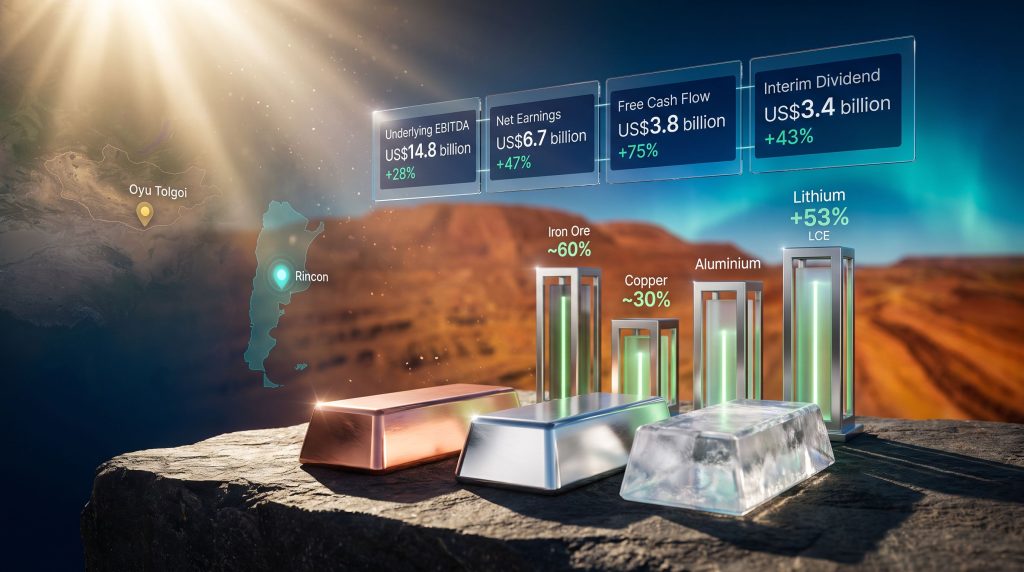
| Underlying EBITDA | US$14.8 billion | +28% |
| Net Earnings | US$6.7 billion | +47% |
| Free Cash Flow | US$3.8 billion | +75% |
| Interim Ordinary Dividend | US$3.4 billion | +43% |
What Drove the Earnings Uplift?
Three forces converged to produce this result. Commodity prices across copper and aluminium remained elevated relative to prior-year averages. Production volumes improved across key assets, most notably in the copper and lithium segments. Furthermore, the company's productivity programme began delivering material cost benefits at scale.
The most analytically significant figure is not the EBITDA number itself but the relationship between earnings growth and cash flow growth. Free cash flow expanded by 75% against net earnings growth of 47%, a gap that reflects genuine operational leverage rather than accounting-driven improvement. When cash conversion accelerates faster than reported earnings, it typically signals that working capital is under control and that capital expenditure is being deployed efficiently relative to the production gains it generates.
The 43% increase in the interim dividend to US$3.4 billion is equally instructive. Mining companies historically exercise caution in raising dividends during periods of commodity price elevation, preferring to preserve optionality if prices retreat. A dividend increase of this magnitude signals that Rio Tinto's board views the current earnings level not as cyclically elevated but as a new sustainable floor supported by structural volume growth and productivity-driven cost reduction.
A Productivity Programme Delivering at Scale
Rio Tinto's chief executive Simon Trott described the period as representing a step-change in operational performance, attributing the result to an accelerating productivity programme that had already realised $870 million in benefits during the half, with the company on track to reach an annualised run-rate of $1.8 billion by year-end 2026. The programme is described as multi-year in scope, implying that the benefits already booked represent only a portion of the total opportunity.
What makes this credible rather than aspirational is the specificity of the numbers. A $870 million realised figure is auditable. The trajectory toward $1.8 billion annualised requires sustained execution but is grounded in a defined programme rather than vague efficiency language. For institutional investors, the distinction between realised productivity gains and projected cost savings is material, and Rio Tinto's H1 2026 result sits firmly in the former category.
Which Commodities Are Now Carrying Rio Tinto's Earnings?
The Portfolio Shift: From Iron Ore Dependency to Multi-Commodity Balance
A decade ago, iron ore accounted for roughly 70% of Rio Tinto's underlying earnings. By H1 2026, copper, aluminium and lithium collectively contributed more than half of the group's EBITDA result, with iron ore's relative share declining to approximately 60% of group earnings. This is not a story of iron ore weakness. The Pilbara delivered its highest H1 production volumes since 2018. It is, however, a story of the other segments growing faster.
This distinction matters enormously for how investors should classify and value Rio Tinto. A company with 70% iron ore earnings concentration is essentially a leveraged instrument on Chinese steel production. A company with 40-plus percent earnings from copper, aluminium and lithium is something qualitatively different: a diversified energy transition metals platform with iron ore providing a stable earnings and cash flow base.
Copper: The Highest-Growth Earnings Engine
Copper has undergone the most dramatic earnings re-rating within Rio Tinto's portfolio. In H1 2025, copper generated US$3.1 billion of underlying EBITDA, representing a 69% year-on-year increase that established the trajectory continuing into H1 2026. Copper's share of group earnings has risen to approximately 30%, a structural repositioning rather than a temporary price-driven anomaly. Rio Tinto's copper expansion strategy has been central to this transformation.
Consolidated copper production reached 442kt in H1 2026, up 1% from the prior year, while copper-equivalent production across the portfolio increased 3%. The modest volume growth understates the earnings leverage because copper prices remained materially elevated, compressing unit costs relative to revenue and amplifying EBITDA margins.
Oyu Tolgoi: The Standout Operational Performer
The underground mine at Oyu Tolgoi in Mongolia was the defining operational story within the copper segment. Production grew 31% from H1 2025 as the underground block cave continued to ramp toward its design capacity. Two factors amplified this volume gain beyond simple throughput increase:
- Higher ore grades from the underground levels relative to the open pit material being replaced
- Improved metallurgical recoveries reflecting process optimisation as the concentrator team gained experience with the underground ore blend
Block cave mining is technically complex and operationally demanding. Achieving consistent grade delivery from a cave requires precise draw management, where operators control the rate at which broken ore flows from each draw point. Too slow and the cave stalls; too fast and dilution from surrounding waste rock erodes grade. The Oyu Tolgoi team's ability to sustain 31% production growth while managing planned concentrator maintenance indicates that the underground operation has moved beyond the high-risk early ramp-up phase into a more predictable production rhythm.
Block cave mines characteristically display a production profile that is slow to build but highly stable once fully ramped. Oyu Tolgoi's trajectory suggests the operation is approaching the phase where output becomes genuinely consistent, which has significant implications for the reliability of Rio Tinto's copper earnings base over the medium term.
Kennecott: Managing Operational Disruptions
Kennecott in Utah presented a more complicated picture. Production was constrained by reduced availability of high-quality copper concentrate, mine sequencing adjustments related to geotechnical management, planned maintenance, and a temporary operational shutdown following a fatality during Q1. Each of these factors is operationally distinct, which makes the combination particularly challenging to absorb.
The more significant near-term issue is a flash converting furnace breach that occurred in late June 2026. Flash converting is the smelting technology used to process copper concentrate into blister copper, and a furnace breach requires significant repair work before operations can resume at full capacity. Rio Tinto has flagged that this event will reduce Kennecott's refined copper and gold output in H2 2026, though the company maintained full-year total copper production guidance by drawing on the buffer provided by Oyu Tolgoi's continued ramp-up.
Escondida: Grade Headwinds and Leaching Offsets
At Escondida in Chile, one of the world's largest copper operations, lower concentrate production reflected expected grade decline and mine sequencing effects as the open pit progresses deeper into lower-grade zones. This is a well-understood feature of large porphyry copper deposits, where ore grades typically decline with depth in open pit operations before higher-grade underground extensions can be accessed.
Escondida partially offset this headwind through improved leaching performance. Heap leach and stockpile leach operations, which process oxide and secondary sulphide ores, delivered higher refined copper output, providing a degree of production diversification within the single asset. Grade trajectory at Escondida remains a long-term consideration for the entire copper supply industry, given the mine's scale relative to global refined copper supply.
Aluminium: The Consistent Earnings Contributor
Aluminium tends to receive less attention than copper in energy transition narratives, yet its role in Rio Tinto's earnings profile is structurally important. In H1 2025, aluminium generated US$2.4 billion of underlying EBITDA, up 50% year-on-year, establishing a performance baseline that carried into the current period.
Bauxite production declined 7% to 28.5mt following significant weather disruptions in Q1 2026, predominantly at Rio Tinto's Australian operations. However, production recovered strongly in Q2, demonstrating operational resilience across the bauxite-to-aluminium value chain. This recovery pattern is worth examining. Unlike copper or lithium operations, bauxite mining is relatively straightforward to restart after weather interruptions because the ore does not require the complex underground development or hydrometallurgical processing that constrains flexibility in other commodities.
Why Aluminium Matters Beyond Earnings:
Aluminium is a critical structural material for electric vehicle bodies, renewable energy infrastructure components, and commercial aircraft lightweighting. Rio Tinto's integrated bauxite, alumina refining and aluminium smelting value chain provides exposure to demand growth across all three of these sectors without requiring battery-grade chemistry or the supply chain complexity associated with lithium processing.
Lithium: The Fastest-Growing but Smallest Contributor
Lithium carbonate equivalent production reached 27.3kt in H1 2026, up 53% year-on-year, making it the highest-growth segment by volume percentage in Rio Tinto's portfolio. The scale of this increase was primarily driven by the consolidation of Arcadium Lithium's production assets following the acquisition completed in March 2025, with supplementary contributions from first production at Fenix 1B and Sal de Vida, both delivered ahead of schedule.
Q2 2026 lithium production growth reached approximately 20% year-on-year as the Rincon starter plant in Argentina continued to ramp up. The starter plant is a deliberate strategy in lithium project development, deploying a smaller-scale initial operation to demonstrate the process chemistry and operational parameters before committing capital to the full-scale facility. This approach reduces technical risk in what remains a complex hydrometallurgical process, particularly for brine-hosted lithium deposits where the recovery chemistry varies significantly between projects. Rio Tinto's Congo lithium strategy further illustrates the breadth of its lithium expansion ambitions.
What Is Rio Tinto's Lithium Growth Strategy Through 2028?
The 200ktpa Capacity Target: Ambition, Assets and Timeline
Rio Tinto has articulated a target of approximately 200ktpa of broader lithium capacity by 2028, anchored by three assets: Rincon in Argentina, Sal de Vida, and Fenix 1B. The 60ktpa Rincon development is currently under construction, representing the single largest volume contributor to the 2028 target.
The phrase "broader lithium capacity" is important. It encompasses lithium carbonate equivalent across different product forms, including lithium carbonate and lithium hydroxide, which have different end-market applications. Battery cathode chemistry is evolving, and the relative demand for carbonate versus hydroxide depends on which cathode types dominate electric vehicle manufacturing over the next decade. An integrated platform with multiple product forms provides flexibility that pure-play producers with a single chemistry may lack.
Comparative Scale: Where 200ktpa Sits in the Global Lithium Supply Picture
| Benchmark | Approximate LCE Capacity |
|---|---|
| Rio Tinto 2028 Target | ~200ktpa |
| H1 2026 Annualised Run-Rate | ~54ktpa |
| Global Lithium Supply (2025 est.) | ~1,000-1,100ktpa |
| Rio Tinto's Projected Market Share (2028) | ~18-20% of current supply |
Note: Global supply figures are indicative estimates based on publicly available industry data. Actual market share will depend on demand growth, competing supply additions, and project execution timelines.
Achieving 18-20% of current global lithium supply would represent a profound repositioning. For context, few single companies control that proportion of any major base metal market. The comparison is complicated by the fact that global lithium supply will also grow between now and 2028, but even on a growing supply base, Rio Tinto's target positions the company as a top-tier lithium producer by volume.
Why the Arcadium Acquisition Was a Portfolio-Defining Move
The strategic logic behind the Arcadium Lithium acquisition extends beyond volume acquisition. Arcadium brought an integrated lithium chemicals platform encompassing both brine and spodumene-derived production, multiple geographies, and established customer relationships with battery manufacturers. Acquiring this capability rather than building it organically is estimated to have accelerated Rio Tinto's lithium timeline by five to seven years, based on typical greenfield development timelines for brine operations of comparable complexity.
Brine-hosted lithium, which accounts for the majority of Arcadium's and therefore Rio Tinto's current and planned production, has fundamentally different production economics to hard-rock spodumene mining. Capital costs are typically lower per tonne of LCE, but operating complexity is higher due to the need to manage solar evaporation pond performance, which varies with seasonal weather patterns and brine chemistry. The Rincon starter plant's ramp-up provides real-world data on how Rio Tinto's operational teams are managing these dynamics.
How Is Iron Ore Performing as the Portfolio Diversifies?
Pilbara Iron Ore: Record H1 Production Since 2018
Iron ore production in the Pilbara reached 162.3mt in H1 2026, up 6% from the prior year and representing the operation's highest H1 output since 2018. Shipments rose 5% to 157.7mt. These are operationally significant numbers that often get overshadowed by the narrative of portfolio diversification, but sustaining and growing Pilbara volumes is essential while the copper, aluminium and lithium segments scale toward their full earnings potential.
Rio Tinto's three Pilbara replacement mines remain on budget and on track to deliver first ore in 2027. These replacement mines are critical to maintaining production rates as older mine areas reach the end of their economic lives. The ability to deliver replacement mine development on budget is a meaningful indicator of project execution capability, particularly relevant for investors assessing execution risk across the company's broader growth pipeline. Furthermore, understanding the China steel and iron ore dynamics of 2025 provides important context for how Pilbara volumes are being priced.
Simandou: The Long-Horizon Iron Ore Growth Asset
Simandou in Guinea represents arguably the most consequential iron ore development globally in the past decade. SimFer mine construction and port infrastructure each exceeded 75% completion as of H1 2026, full rail commissioning was achieved during Q1, and the project recorded its first high-grade iron ore sales in April 2026.
Simandou's high-grade ore profile, with iron content meaningfully above typical Pilbara blends, positions it as directly relevant to the steel industry's decarbonisation agenda. Higher-grade iron ore reduces the amount of coke required per tonne of steel produced, lowering carbon intensity without requiring fundamental process change at the blast furnace level. This aligns closely with progress in green iron production methods that are reshaping the steelmaking landscape. This makes Simandou ore potentially valuable as a decarbonisation tool for steelmakers, independent of any transition to electric arc furnace technology.
The Simandou Safety Context:
Two fatalities occurred at Simandou and Kennecott during H1 2026. Rio Tinto launched its Management Operating System on 1 July 2026, establishing a unified framework covering safety and risk management, people and leadership standards, and planning and performance protocols across all operations. For institutional investors with ESG screening requirements, safety performance at mega-projects under construction represents a material risk consideration that extends beyond reputational impact to include regulatory, productivity, and social licence dimensions.
How Does Rio Tinto's Productivity Programme Work?
The $1.8 Billion Annualised Run-Rate Target: Mechanics and Progress
Productivity programmes in mining are frequently announced and rarely delivered at the scale originally promised. What distinguishes Rio Tinto's current programme is the granularity of its reporting. The company has specified that $870 million in productivity benefits were realised in H1 2026, a figure that investors can interrogate against financial statements rather than accept on faith.
The pathway to $1.8 billion in annualised run-rate by year-end 2026 implies approximately doubling the H1 realisation rate in the second half, which is an ambitious but not implausible target if the programme is structured around identifiable discrete initiatives with defined timelines. Typical levers in large-scale mining productivity programmes include:
- Autonomous haulage system deployment and optimisation
- Process control improvements reducing energy consumption per tonne processed
- Maintenance scheduling optimisation reducing unplanned downtime
- Workforce rostering and logistics efficiency gains
- Ore blending improvements maximising mill throughput within metallurgical constraints
The Management Operating System: A Common Language for Performance
Launched across all Rio Tinto operations on 1 July 2026, the Management Operating System establishes four integrated pillars:
- Safety and risk management
- People and leadership standards
- Planning and performance frameworks
- Operational standards and compliance
A standardised operating system matters because productivity gains achieved in one asset can only be systematically replicated across a globally distributed portfolio if there is a common language for how performance is measured, reported, and improved. Without standardisation, each asset develops local practices that cannot be easily transferred, limiting the scalability of productivity initiatives.
Productivity as a Financial Lever: Modelling the Earnings Impact
Illustrative Scenario: If Rio Tinto achieves its $1.8 billion annualised productivity run-rate by end-2026 and sustains it through FY2027, this represents an approximate 12% uplift to H1 2026 EBITDA on an annualised basis before any commodity price movement. At current copper and aluminium price levels, the compounding effect of volume growth from Oyu Tolgoi's continued ramp-up, Rincon's commissioning, and Pilbara replacement mine delivery, combined with structural cost reduction, could position FY2027 EBITDA materially above the H1 2026 annualised trajectory. This is an illustrative scenario, not a forecast, and actual outcomes will depend on commodity prices, operational performance, and execution against stated targets.
The next major ASX story will hit our subscribers first
How Do Rio Tinto's H1 2026 Results Compare to Prior Periods?
Earnings Trajectory: Building the Multi-Year Picture
| Period | Underlying EBITDA | Net Earnings | Key Driver |
|---|---|---|---|
| H1 2025 | ~US$11.6b (implied) | US$4.5b | Copper EBITDA +69%, aluminium +50% |
| FY 2025 | Broadly flat YoY | ~US$10.87b underlying | Copper profits doubled; diversification gains |
| H1 2026 | US$14.8b | US$6.7b | Multi-commodity uplift, productivity gains |
Note: H1 2025 EBITDA is implied from the reported 28% year-on-year growth to H1 2026. FY2025 figures are sourced from publicly reported data. These figures are provided for analytical context and should not be relied upon as investment guidance.
The trajectory reveals something important: the earnings improvement is not a single-period anomaly. It is the product of compounding gains across multiple segments over multiple reporting periods. Copper's EBITDA nearly doubled in FY2025, then continued to grow from that higher base into H1 2026. Aluminium followed a similar pattern. Lithium, while smaller in absolute earnings contribution, is growing from a larger production base following the Arcadium acquisition.
What Are the Key Risks to Rio Tinto's Earnings Outlook?
Operational Risk: Kennecott's H2 Production Headwind
The flash converting furnace breach at Kennecott is the most immediately quantifiable risk to H2 2026 earnings. Furnace repairs of this nature typically require several months of reduced throughput, meaning the impact will likely extend across most of the second half. Rio Tinto's decision to maintain full-year copper production guidance implies confidence that Oyu Tolgoi's continued ramp-up provides sufficient buffer, however, guidance maintenance under these circumstances carries execution risk if Oyu Tolgoi experiences any unexpected interruption.
Commodity Price Sensitivity
With copper now accounting for approximately 30% of group earnings, a sustained decline in copper prices would have a material impact on consolidated results. A 10% decline in copper prices at current production volumes would reduce group EBITDA by roughly 3% in absolute terms, though this estimate is illustrative and depends on the precise price-earnings relationship within the copper segment. Aluminium exposure adds a second commodity price sensitivity that did not exist at scale five years ago.
Geopolitical and Permitting Risk
- Oyu Tolgoi: Mongolia's sovereign relationship with the project includes a royalty and taxation framework that has historically been a source of periodic renegotiation. As underground production scales and earnings from the asset grow, fiscal terms may attract renewed government attention. In addition, Rio Tinto's global taxes and royalties framework provides further context on how the company navigates these pressures across jurisdictions.
- Simandou: Guinea's political environment and infrastructure context introduce sovereign and logistical risks that are inherent to frontier project development, regardless of construction progress milestones.
Safety and Social Licence Risk
Two fatalities during H1 2026 are a material concern that extends beyond operational disruption. Regulatory scrutiny following fatalities can result in production suspensions, mandatory review periods, and enforceable improvement notices that affect throughput. The Management Operating System launch is positioned as a systemic, preventative response, but its effectiveness will be judged over multiple reporting periods rather than by its launch date alone.
Frequently Asked Questions: Rio Tinto Earnings Copper Aluminium and Lithium
What was Rio Tinto's EBITDA in H1 2026?
Rio Tinto reported underlying EBITDA of US$14.8 billion in the first half of 2026, a 28% increase from the same period in 2025, driven by commodity price strength, higher production volumes, and productivity gains.
How much did copper contribute to Rio Tinto's earnings?
Copper has grown to account for approximately 30% of Rio Tinto's group earnings. In H1 2025, copper generated US$3.1 billion of underlying EBITDA, up 69% year-on-year, establishing the performance trajectory that continued into H1 2026.
What is Rio Tinto's lithium production target?
Rio Tinto is targeting approximately 200ktpa of broader lithium capacity by 2028, anchored by its Rincon, Sal de Vida and Fenix 1B assets, substantially expanded through the Arcadium Lithium acquisition completed in March 2025.
Why did Rio Tinto's lithium production increase 53% in H1 2026?
The primary driver was consolidation of Arcadium Lithium's production assets post-acquisition, with additional contributions from first production at Fenix 1B and Sal de Vida ahead of schedule, and the ongoing ramp-up of the Rincon starter plant in Argentina.
What happened at Oyu Tolgoi in H1 2026?
Oyu Tolgoi delivered 31% production growth from H1 2025 as underground block cave operations continued to ramp up, with higher ore grades and improved metallurgical recoveries amplifying the volume gain despite planned concentrator maintenance.
Is Rio Tinto still an iron ore company?
Iron ore remains Rio Tinto's largest single earnings contributor, but its relative share has declined from approximately 70% to around 60% of group earnings as copper, aluminium and lithium have scaled. The Pilbara produced 162.3mt in H1 2026, its highest first-half output since 2018.
Strategic Outlook: Is Rio Tinto's Multi-Commodity Transition Sustainable?
The Investment Thesis in Three Dimensions
The durability of Rio Tinto's transformation rests on three mutually reinforcing pillars:
-
Volume growth: Oyu Tolgoi underground ramp-up, Rincon's 60ktpa facility under construction, Pilbara replacement mines targeting first ore in 2027, and Simandou approaching commercial-scale production collectively represent a pipeline of volume additions that does not depend on commodity price tailwinds to deliver earnings growth.
-
Productivity as a structural cost advantage: An $1.8 billion annualised productivity run-rate, if sustained, effectively reduces Rio Tinto's breakeven commodity prices across segments. This creates earnings resilience in a price downturn that production growth alone cannot provide.
-
Portfolio balance: For the first time, copper, aluminium and lithium collectively exceed iron ore's earnings contribution. This is a structural shift, not a cyclical one, because it is supported by capital investment in long-life assets with decade-plus production horizons.
What the H1 2026 Result Means for Long-Term Positioning
Rio Tinto earnings copper aluminium and lithium in H1 2026 are best understood as a milestone within a longer transformation rather than a standalone achievement. The company is no longer solely a leveraged instrument on Chinese steel demand. Its exposure to copper for electrification infrastructure, aluminium for lightweight manufacturing and renewable energy components, and lithium for battery storage aligns its earnings with structural demand growth that analysts widely expect to persist across the next decade.
The 43% increase in the interim dividend signals that management views capital returns and growth investment as complementary rather than competing priorities. When a mining company at this stage of a transformation cycle can simultaneously fund a major construction programme, execute a billion-dollar productivity initiative, and raise shareholder distributions by nearly half, it is communicating a level of financial confidence that deserves to be taken seriously.
Key Takeaway for Investors: Rio Tinto earnings copper aluminium and lithium in H1 2026 are not evidence of a single strong commodity cycle. Consequently, they represent the measurable output of a portfolio transformation that began with strategic capital allocation decisions made several years earlier. The assets now generating earnings growth — Oyu Tolgoi underground, the Arcadium lithium platform, and the Pilbara replacement mine programme — were each investment decisions made before the current commodity price environment. That sequence matters for assessing whether the earnings improvement is durable. This article is for informational purposes only and does not constitute financial advice. Investors should conduct their own due diligence before making investment decisions.
Readers seeking additional context on Rio Tinto's financial results and commodity market developments can explore related coverage at Rio Tinto's investor relations hub, which tracks ongoing developments across Rio Tinto's operational portfolio, Australian iron ore markets, and the broader energy transition metals sector.
Want to Track the Next Major Mineral Discovery Before the Market Does?
Rio Tinto's multi-commodity transformation underscores how pivotal early exposure to copper, lithium, and other energy transition metals can be — and for investors seeking to identify the next generation of significant ASX mineral discoveries in real time, Discovery Alert's proprietary Discovery IQ model delivers instant, actionable alerts the moment major discoveries are announced, while its dedicated discoveries page illustrates the kind of historic returns that early-stage mineral discoveries have generated — start your 14-day free trial today and position yourself ahead of the broader market.