July 30, 2026
The Mineral Nobody Noticed Until It Became a National Security Problem
For decades, natural graphite occupied an unglamorous corner of industrial commodity markets. It lubricated heavy machinery, lined steel furnaces, and sat quietly inside pencils. Few investors tracked it. Fewer policymakers worried about it. Then the electrification economy arrived, hypersonic weapons programs accelerated, and satellite constellations began multiplying in low-earth orbit, and the strategic calculus around graphite changed almost overnight.
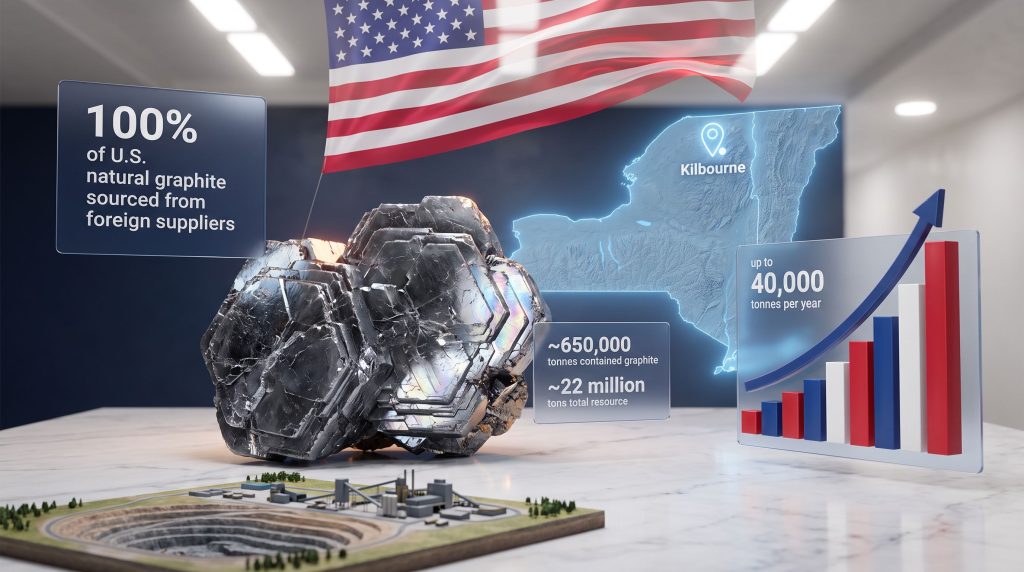
The uncomfortable reality that emerged was stark: the United States produces zero domestically mined natural graphite at commercial scale. Every tonne consumed by American aerospace contractors, battery manufacturers, and defense primes flows through foreign supply chains, with the vast majority of global processing capacity concentrated in a single country. That exposure, long tolerated as an acceptable cost of globalised trade, now registers as a genuine vulnerability in defence procurement circles.
The Titan Mining graphite defense supply agreement, announced in late July 2026, offers an early window into how American industry is beginning to respond, and why the geology of northern New York may matter more to national security than most people realise.
When big ASX news breaks, our subscribers know first
Graphite's Invisible Presence in Defence Systems
Understanding why this matters requires appreciating just how deeply graphite is embedded in high-specification military and aerospace applications, a dependency that rarely appears in mainstream coverage. Furthermore, the critical minerals demand surge across defence sectors has made this dependency increasingly difficult to ignore.
Graphite's defining physical properties, combining exceptional thermal conductivity, high-temperature structural stability, electrical conductivity, and natural lubricity, make it functionally irreplaceable in several defence-critical contexts:
- Thermal management in aerospace platforms: Military aircraft, hypersonic vehicles, and reentry systems generate extreme localised heat. Graphite-based composite materials are used to channel and dissipate that energy in ways that lightweight metals cannot match at equivalent weight penalties.
- Aircraft brake systems: Carbon-carbon composites derived from graphite are the standard material for high-performance military aircraft brakes, where stopping distances and thermal loads far exceed commercial aviation requirements.
- Electromagnetic shielding: Graphite's electrical conductivity makes it a key material in shielding sensitive electronic systems aboard military platforms from electromagnetic interference and radar signature management.
- Missile guidance and structural housings: The dimensional stability of graphite under thermal cycling is exploited in precision guidance system housings, where thermal expansion tolerances are measured in microns.
- Battery anodes in military platforms: Every lithium-ion battery cell, including those powering autonomous vehicles, unmanned aerial systems, and soldier-worn electronics, requires a graphite anode. There is currently no commercially viable, high-performance substitute at scale.
Technical Note: A critical but underappreciated distinction exists between natural graphite and synthetic graphite. While synthetic graphite can be manufactured from petroleum coke, the production process is extraordinarily energy-intensive, costing roughly three to five times more per tonne than natural graphite processing. For high-volume anode applications, natural graphite remains the economically dominant input. For certain thermal and structural defence applications, the crystalline structure of natural graphite also delivers performance characteristics that synthetic variants struggle to replicate at equivalent cost.
What the Kilbourne Deposit Actually Represents Geologically
Not all graphite deposits are equal, and the geology of the Kilbourne project carries specific characteristics worth examining carefully.
The deposit was identified in 2023 during exploration activities near Titan's operating ESM #4 zinc mine in northern New York, approximately 30 miles south of the Canadian border. Its proximity to existing infrastructure was immediately recognised as commercially significant, but the resource metrics announced in December 2024 confirmed the deposit's substance:
| Geological Parameter | Kilbourne Data |
|---|---|
| Total rock tonnage | ~22 million tons |
| Average graphite grade | ~3% |
| Estimated contained graphite | ~650,000 tons |
| Distance from existing mill | Less than 1 mile |
| Deposit discovery year | 2023 |
A grade of approximately 3% graphite is considered commercially meaningful for a large-tonnage flake graphite deposit, particularly when processing infrastructure already exists nearby. For context, many greenfield graphite projects in development globally carry grades between 2% and 10%, with higher grades typically found in smaller, less continuous bodies. A consistent 3% grade across 22 million tons of rock provides the kind of geological predictability that feasibility studies and financiers require.
The deposit type matters too. New York State hosts a metamorphic geological terrain where graphite occurs in crystalline flake form rather than as microcrystalline or amorphous varieties. Crystalline flake graphite commands premium pricing over amorphous graphite because it can be processed into large-flake, high-purity products that meet aerospace and defence specifications. This is a geologically specific advantage that not every graphite-bearing region can offer.
From Demonstration Plant to Defence Qualification: The Technical Bridge
Why the Demonstration Plant Changes Everything
One of the most strategically significant but least discussed aspects of Titan's position is the role of its 1,200-tonne-per-year demonstration plant, which is already operating and integrated with the Empire State zinc mill.
In critical mineral development, the gap between a resource estimate and a qualified defence-sector supplier is substantial. It involves not just proving that ore can be mined, but demonstrating that it can be processed to the purity and particle-size specifications demanded by end users, and doing so with sufficient consistency to satisfy procurement quality requirements.
Defence and aerospace manufacturers typically require graphite to meet carbon purity thresholds exceeding 99.9% for high-specification applications, along with tightly controlled particle size distributions and documented chain-of-custody traceability. These requirements cannot be assessed from a drill core alone. They require actual processed material, produced under controlled conditions, that can be submitted for laboratory testing and applications evaluation.
This is precisely what Titan's demonstration plant produces. The samples currently being evaluated under the newly signed Letter of Intent were processed at this facility, and the company has reported that early qualification testing has generated positive results alongside indicative pricing reflective of aerospace- and defence-grade material.
"The qualification process for defence supply chains is not a formality. It typically spans twelve to twenty-four months, involves rigorous materials testing across multiple application scenarios, and requires comprehensive supplier documentation. Suppliers who complete this process successfully occupy a structurally protected commercial position, because re-qualifying alternative suppliers requires repeating the entire cycle."
Dissecting the LOI: What Investors and Analysts Need to Understand
The Titan Mining graphite defense supply agreement is structured as a non-binding Letter of Intent, and precision matters here when assessing its commercial significance.
| Feature | LOI (Current Stage) | Binding Offtake Agreement |
|---|---|---|
| Legal enforceability | Non-binding | Contractually enforceable |
| Volume commitments | Not specified | Defined quantities |
| Pricing terms | Indicative only | Fixed or formulaic |
| Customer identity | Undisclosed | Specified in contract |
| Conditions precedent | Multiple material conditions | Typically fewer |
| Commercial certainty | Low-to-moderate | High |
Before any supply relationship under this LOI could be formalised into a binding contract, Titan must satisfy a sequence of material conditions:
- Complete the Kilbourne commercial facility feasibility study
- Secure adequate project financing for construction
- Obtain all required regulatory and environmental approvals
- Successfully pass the customer's full product qualification testing program
- Negotiate and execute a definitive supply agreement with agreed commercial terms
Each of these steps carries genuine execution risk. Feasibility studies can reveal capital cost overruns relative to preliminary estimates. Financing for critical mineral projects, while increasingly available through government-aligned channels, remains competitive and conditions-dependent. Regulatory approvals in New York State involve environmental review processes that are thorough and not always predictable in timeline.
That said, dismissing the LOI as commercially immaterial would misread how defence supply chain relationships actually develop. In this sector, early-stage qualification work with a defined manufacturer is a meaningful structural milestone, not a press release placeholder. The customer has committed resources to testing Titan's material. That investment of time and analytical effort signals genuine procurement intent. Consequently, Titan Mining's agreement with the US Army to establish domestic graphite processing at defence installations reinforces this trajectory considerably.
The Infrastructure Advantage That Most Competing Projects Cannot Replicate
Capital Efficiency as a Competitive Moat
A dimension of Titan's Kilbourne project that deserves more analytical attention is the capital efficiency advantage created by the existing Empire State Mines infrastructure.
Greenfield graphite projects, starting from scratch on undeveloped land, face a capital expenditure profile that includes road construction, power connection, water management systems, tailings management facilities, and either a purpose-built processing plant or a toll-processing arrangement. In remote jurisdictions, this pre-production infrastructure investment can represent hundreds of millions of dollars and years of permitting before a single tonne of graphite is processed.
Kilbourne sits less than one mile from an operating processing mill with existing road access, established power connections, functioning water management, and decades of regulatory compliance history. The demonstration plant already runs within this infrastructure envelope. For the commercial facility, Titan is not building a supply chain from the ground up, it is extending one that already exists.
This creates a compressed development timeline and a lower capital intensity per tonne of production capacity compared to most competing domestic graphite development projects, a factor that will matter significantly when the company approaches project financiers and potential offtake partners for commercial-scale commitments.
The next major ASX story will hit our subscribers first
The U.S. Army Partnership: Context and Significance
In June 2026, the U.S. Army selected Titan through its Enhanced Use Lease program to establish graphite processing facilities at two defence installations:
- Anniston Army Depot, Alabama
- Pine Bluff Arsenal, Arkansas
Enhanced Use Lease arrangements allow the Army to grant commercial access to underutilised land on military installations in exchange for services or facilities that align with defence requirements. For Titan, these agreements represent access to defence-proximate processing locations and a direct relationship with Army logistics and procurement infrastructure.
It is important to note that these leases represent a commercial land-access arrangement rather than a confirmed government supply contract or funding commitment. However, the Army's willingness to select Titan for this program signals that the company's technical approach and project trajectory were assessed as credible and aligned with defence industrial base requirements. This development also reflects the broader defence critical materials strategy emerging across allied nations to reduce dependence on concentrated foreign supply chains. In addition, Titan's aerospace and defense supply agreement with a major U.S. manufacturer further validates the commercial credibility of its graphite programme.
Competitive Position: Why First-Mover Status Carries Durable Value
The domestic U.S. graphite development landscape remains thin. Unlike lithium, where a cluster of advanced-stage domestic projects now compete for financing and offtake, natural graphite has almost no developed domestic supply chain to speak of.
| Developer | Project Location | Development Stage |
|---|---|---|
| Titan Mining Corp. | Northern New York | Demonstration plant operating; commercial facility targeted 2028 |
| Graphite One Inc. | Alaska | Advanced development stage |
| Other developers | Various U.S. states | Early-stage exploration |
The scarcity of operational domestic graphite processing, even at demonstration scale, means that U.S. manufacturers seeking to qualify domestic suppliers face an extremely limited pool of candidates. Titan's demonstration plant, already producing defence-specification samples with documented early positive qualification results, places the company in a structurally advantaged position relative to projects still at the drill-core or scoping stage.
For defence primes and aerospace manufacturers operating under procurement guidelines that increasingly require domestic sourcing for critical inputs, the combination of an operating demonstration facility, active qualification programmes, and a credible path to commercial-scale production by 2028 represents exactly the supplier profile they are looking for. Furthermore, concerns about defence mineral supply chains have intensified demand for exactly this kind of domestic development momentum.
Key Conditions, Risks, and the Path to 2028
Milestone Pathway to Commercial Production
Investors and analysts assessing the Titan Mining graphite defense supply agreement should hold several considerations in parallel.
Milestone pathway to commercial production:
- Feasibility study completion (timeline not publicly specified)
- Project financing secured (scale and structure not yet disclosed)
- Regulatory approvals obtained in New York State
- Customer qualification programme successfully concluded
- Definitive supply agreement negotiated and executed
- Commercial facility construction and commissioning (targeted 2028)
Key Risks and Structural Advantages
Key risks to monitor:
- Feasibility study outcomes relative to preliminary resource estimates
- Capital cost escalation in processing plant construction
- Regulatory timeline uncertainty in New York
- Graphite pricing dynamics by the time commercial volumes reach market
- Competition from other domestic developers accelerating on similar timelines
Structural advantages working in Titan's favour:
- Existing mill infrastructure compressing capital requirements
- Demonstrated processing capability at operating demonstration plant
- Active qualification programme with a named defence-sector end user
- U.S. Army Enhanced Use Lease selection at two defence installations
- New York's crystalline flake graphite geology supporting high-purity product potential
Analytical Perspective: The 2028 target commissioning year is ambitious but not unrealistic given the infrastructure advantages Titan holds relative to greenfield competitors. The more material uncertainty lies in financing and feasibility outcomes, both of which will define the capital structure and ultimate economic viability of the commercial facility. The LOI itself does not de-risk either of these variables, but it does confirm that end-market demand exists at the specification level Titan is targeting.
What This Development Signals for U.S. Critical Mineral Supply Chains
The broader significance of the Titan Mining graphite defense supply agreement extends beyond a single company's development timeline. It represents evidence of a structural shift in how U.S. aerospace and defence manufacturers are approaching supply chain risk management for critical minerals.
For decades, procurement logic in these industries prioritised cost and reliability above geographic sourcing considerations. That calculus has visibly shifted. Defence-sector manufacturers are now committing resources, including the time and laboratory capacity required for a multi-month qualification programme, to evaluate suppliers who do not yet have commercial-scale production operating.
That willingness to invest in early-stage qualification reflects a genuine urgency to identify and develop domestic alternatives before strategic supply chain pressures intensify further. China's position covering an estimated 70 to 80 percent of global natural graphite processing capacity is not expected to diminish on any near-term horizon, which means the window for U.S. developers to establish credible domestic alternatives carries real time sensitivity. Moreover, the intersection of critical minerals and energy security has elevated graphite's status from an industrial afterthought to a top-tier strategic priority across allied governments.
Titan's New York graphite project, with its operational demonstration plant, active defence-sector qualification work, and planned 40,000-tonne annual commercial facility, is one of the clearest expressions yet of what a domestic graphite supply chain rebuild could look like in practice. The emergence of a critical minerals coalition among allied nations further underscores just how significant these early domestic supply chain developments may prove to be.
This article contains forward-looking statements and analysis based on publicly available information. It does not constitute financial advice. Development timelines, resource estimates, and commercial outcomes referenced herein are subject to material risks and uncertainties. Readers should conduct their own due diligence before making any investment decisions.
Want to Identify the Next Major Critical Minerals Discovery Before the Market Does?
Discovery Alert's proprietary Discovery IQ model scans ASX announcements in real time, instantly alerting subscribers to significant mineral discoveries — including the critical minerals reshaping defence and energy supply chains — and translating complex geological data into actionable investment insights. Explore historic discoveries and the returns they generated, then start your 14-day free trial at Discovery Alert to position yourself ahead of the broader market.