July 30, 2026
The Legal Architecture Driving Mexico's Most Complex Industrial Insolvency
Few mechanisms in corporate restructuring law carry as much strategic weight as the concurso mercantil — Mexico's commercial insolvency framework. When courts face the collapse of an integrated industrial giant, the fundamental question is never simply whether to sell, but how to sell, and in what configuration. The architecture of the sale determines who recovers, what survives, and whether an entire regional economy can be stabilised or is left to fragment. That question sits at the heart of the AHMSA and MINOSA auction, now rescheduled for September 25, 2026, and its resolution will carry consequences far beyond the balance sheets of the creditors involved.
When big ASX news breaks, our subscribers know first
What a "Single Productive Unit" Sale Actually Means Under Mexican Insolvency Law
Mexico's Ley de Concursos Mercantiles permits courts to structure the disposal of insolvent assets as a bundled, going-concern transaction rather than a piecemeal liquidation. This mechanism — known formally as a venta de unidad productiva — transfers an entire operating business to a new owner, preserving its operational continuity, workforce, and productive relationships rather than extracting individual assets at distressed prices.
The logic is straightforward but the implications are profound. In a piecemeal liquidation, a blast furnace sells as scrap metal. In a going-concern auction, that same furnace is a revenue-generating industrial asset embedded in a vertically integrated supply chain. The price difference can be enormous.
In the case of AHMSA and MINOSA, the court opted for the bundled structure precisely because the two entities are operationally inseparable. Minera del Norte (MINOSA) functions as the captive upstream supplier of iron ore and coking coal inputs to Altos Hornos de México's (AHMSA) steelmaking operations. Separating them would sever the raw material pipeline from the processing infrastructure, destroying the integrated value premium that makes the combined asset worth acquiring in the first place.
Key Legal Concept: A venta de unidad productiva under Mexican insolvency law is designed to preserve going-concern value rather than liquidation value. For complex industrial assets, this distinction can represent hundreds of millions of dollars in recoverable value.
How AHMSA and MINOSA Arrived at Court-Supervised Insolvency
The Industrial and Financial Collapse of Mexico's Steel Giant
AHMSA has long been one of the cornerstones of Mexico's industrial economy, historically representing one of the country's most significant integrated flat steel producers. Its operations anchor the Coahuila industrial corridor in northern Mexico, an area whose economic identity is deeply intertwined with steelmaking and coal mining activity.
The company's financial deterioration accelerated through a combination of mounting debt obligations, operational disruptions, and protracted labour disputes that progressively undermined its ability to service creditors and maintain production continuity. MINOSA, as the captive mining subsidiary supplying critical raw material inputs, was drawn into the same insolvency proceedings given its structural dependence on AHMSA as its primary offtake counterparty.
The social and economic stakes are substantial. AHMSA has historically employed tens of thousands of workers directly and supported a far larger supplier ecosystem across Coahuila. Municipal tax revenues, local service industries, and regional supply chains are all calibrated around the assumption of continued steelmaking activity. Prolonged insolvency limbo poses risks of asset deterioration, workforce attrition, and supply chain disruption that compound over time.
Insolvency Proceedings: Key Milestones
| Milestone | Approximate Period | Key Development |
|---|---|---|
| Formal insolvency filing | Pre-2025 | Concurso mercantil proceedings initiated under court supervision |
| Asset appraisal and valuation | 2025 | Combined enterprise appraised at approximately US$1.326 billion |
| First auction announced | Late 2025 / Early 2026 | Bundled sale scheduled with minimum reference bid established |
| First auction postponed | Early 2026 | Delayed pending resolution of worker payment calculations |
| First auction declared void | Mid-2026 | No compliant bid submitted; proceedings reset |
| New auction date confirmed | July 2026 | Court sets September 25, 2026 as revised auction date |
Breaking Down the US$1.127 Billion Minimum Bid Threshold
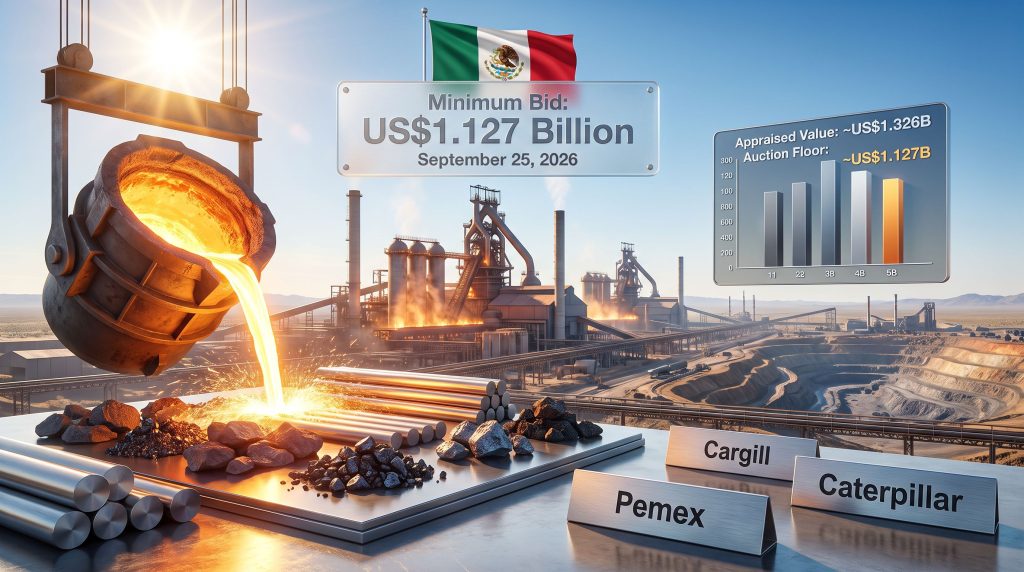
The court-established floor price for the AHMSA and MINOSA auction is approximately US$1.127 billion, representing 85% of the total appraised enterprise value of roughly US$1.326 billion.
The 85% threshold is not arbitrary. Mexican insolvency courts routinely apply a discount to appraised value when establishing auction floors, balancing two competing risks: setting the floor too high risks attracting no compliant bids, while setting it too low risks under-recovering for creditors relative to the asset's true productive worth. The 15% discount built into the floor is intended to create a modest acquisition premium for prospective buyers while protecting creditor recovery.
Valuation Snapshot:
- Total appraised enterprise value: approximately US$1.326 billion
- Court-established auction floor (85% of appraised value): approximately US$1.127 billion
- Asset composition: Integrated flat steel production (AHMSA) combined with captive iron ore and coking coal mining operations (MINOSA)
For prospective acquirers, the US$1.127 billion floor creates a substantial capital requirement. Financing an acquisition of this scale in a distressed industrial context — where operational restart costs, deferred maintenance, and labour obligation assumptions add to the headline bid price — demands sophisticated transaction structuring. This capital intensity is a primary reason the first auction failed to attract a compliant submission.
What the winning bidder ultimately acquires includes:
- Full operational control of an integrated steelmaking and raw material extraction platform
- Inherited workforce obligations and the legal duty to honour existing labour entitlements
- Infrastructure assets across the Coahuila region including plant, equipment, and mineral rights
- A vertically integrated production model that eliminates raw material supply chain risk
- The potential to acquire productive capacity at a meaningful discount to replacement cost in today's steel market
The Creditor Landscape: Who Holds Claims and Who Can Bid
Recognised Creditors Within the Insolvency Proceedings
The insolvency record contains a diverse creditor roster spanning sovereign entities, global commodity traders, domestic financial institutions, and equipment manufacturers. Formally recognised creditors include:
- Pemex — Mexico's state-owned energy company, representing sovereign-level credit exposure
- Cargill — a global agricultural and commodities trading firm carrying commercial credit claims
- Banca Afirme — a Mexican financial institution with direct lending exposure to the insolvent entities
- Unifin — a Mexican financial leasing company that has itself navigated prior insolvency proceedings, adding complexity to its creditor status
- Caterpillar — the heavy equipment manufacturer with equipment financing claims against the mining and steelmaking fleet
- Tubacero — a steel tube manufacturer holding commercial credit exposure
What makes the creditor composition strategically important is the mechanism under Mexico's insolvency law that permits recognised creditors to offset their outstanding receivables against the minimum bid price. This compensación de créditos provision means that a creditor holding a substantial recognised claim can reduce the cash component of its bid by the value of what it is owed — a structural bidding advantage over external acquirers who must finance the entire purchase price in cash.
Strategic Insight for Investors: Creditors with large recognised claims effectively hold a call option on the asset at a reduced effective acquisition cost. The larger the claim and the higher the court's valuation, the greater the strategic leverage this creates. External bidders must price in the competitive disadvantage of paying full cash against creditors who can partially offset their bid.
Why Did the First Auction Fail?
The first auction's failure was not a single-cause event. Several structural and market forces converged:
-
Labour obligation uncertainty: The precise quantum of worker entitlements — wages, severance, and pension claims — had not been conclusively determined, creating an unquantifiable liability that prospective acquirers could not responsibly price.
-
Capital intensity and financing constraints: The US$1.127 billion floor, combined with uncertain restart and remediation costs, created a financing challenge that most potential acquirers struggled to resolve within the auction timeline.
-
Global steel market headwinds: Chronic overcapacity in global steel markets, intensified by surging Chinese export volumes at below-market prices, has depressed the economic case for investing in legacy integrated steel capacity. Furthermore, the Chinese steel market continues to export surplus tonnage that undermines pricing across the developing world.
-
Transaction complexity: The bundled structure, while value-preserving in theory, creates a complex due diligence burden that requires simultaneous analysis of steelmaking operations, mining concessions, mineral reserves, infrastructure condition, and labour liabilities.
Mexico's Labour Super-Priority Framework: The First Lien Nobody Discusses
One of the most consequential — and least publicly understood — features of Mexico's Ley de Concursos Mercantiles is the absolute super-priority status accorded to worker claims. Before any financial creditor receives a single peso from auction proceeds, the full quantum of worker entitlements must be satisfied. This includes accumulated wages, statutory severance under the Ley Federal del Trabajo, and pension obligations.
In practical terms, this means the labour liability quantification is not merely an administrative step in the process — it is the foundational calculation that determines how much of the auction proceeds are actually available to financial creditors. For AHMSA, a company with a large historical workforce and years of accumulated labour disputes, this calculation is complex and politically sensitive.
| Creditor Class | Priority Under Mexican Insolvency Law |
|---|---|
| Workers (wages, severance, pension entitlements) | Super-priority — settled first |
| Secured financial creditors | Second tier |
| Unsecured commercial creditors | Third tier |
| Subordinated and equity claims | Final distribution, if residual value remains |
This framework differs meaningfully from comparable Latin American jurisdictions. Brazil's recuperação judicial and Argentina's concurso preventivo both provide labour protections, however the absolute priority waterfall in Mexico's framework is among the most worker-protective in the region — a feature that carries real financial consequences for creditor recovery analysis.
The next major ASX story will hit our subscribers first
The Coahuila Industrial Corridor: What's Actually at Stake
Coahuila is not simply a geographic location for AHMSA's assets — it is an economic ecosystem built around the assumption of continued integrated steel and coal mining activity. The region holds some of Mexico's most significant coking coal reserves, making it one of the few locations in the Americas where an integrated steelmaker can source metallurgical coal domestically rather than importing it from Australia, Canada, or the United States.
This geological reality is strategically important and frequently underappreciated. Coking coal — the high-carbon, low-sulphur coal required to produce metallurgical coke for blast furnace steelmaking — is a globally traded commodity where supply concentration creates persistent price risk for importers. An acquirer of AHMSA and MINOSA would control a domestic coking coal supply embedded within the same corporate structure as its steel production assets, insulating the integrated business from global metallurgical coal price volatility in a way that most regional steel producers cannot replicate. Consequently, this vertical integration represents a meaningful competitive advantage in a market increasingly exposed to commodity price pressure.
Scenario Analysis: Three Pathways from September 25, 2026
Scenario 1: Successful Acquisition at the September 25 Auction
A strategic industrial buyer or a creditor consortium submits a compliant bid at or above the US$1.127 billion floor. Operations transition to new ownership, the workforce is retained under negotiated agreements, and the Coahuila industrial corridor regains its productive anchor. This outcome produces the highest aggregate creditor recovery and the greatest regional economic stability.
Scenario 2: Second Consecutive Failed Auction
No compliant bid is received on September 25. According to SteelOrbis, the trustee has already submitted a new sale proposal following the first failed auction, suggesting that contingency planning is already under way. The court must reassess the minimum valuation, potentially lowering the floor to attract interest, or restructure the sale terms entirely. This pathway risks further asset deterioration — particularly in complex industrial environments where prolonged idle time degrades equipment, depletes skilled labour pools, and erodes supplier relationships.
Scenario 3: Abandonment of the Bundled Structure
The court determines that the integrated sale model is deterring acquirers and permits separate disposal of AHMSA's steelmaking assets and MINOSA's mining concessions. This structure may expand the bidder pool by attracting specialised steel investors and mining companies independently, but it destroys the integrated value premium. Aggregate recovery under a carve-out structure would likely be materially lower than under a successful bundled sale.
Key Indicators for Creditors, Investors, and Industry Observers
The AHMSA and MINOSA auction is not merely a creditor recovery exercise. It is a stress test for Mexico's industrial insolvency framework and a signal to global investors about the country's ability to manage complex, socially sensitive asset disposals at scale.
Several variables warrant close monitoring:
-
Labour liability finalisation: The completed worker payment calculation is the single most important prerequisite for a credible bid. Its resolution directly determines net proceeds available to financial creditors.
-
Creditor bidding strategy: Whether entities like Pemex or Cargill elect to bid independently, form a consortium, or pursue a passive creditor recovery strategy will shape competitive dynamics significantly.
-
Global steel market conditions: Any deterioration in flat steel pricing or further escalation in Chinese export volumes between now and September 25 will reduce acquirer appetite for distressed integrated capacity. In addition, the broader iron ore market impact of ongoing trade policy shifts adds another layer of uncertainty for prospective bidders to weigh.
-
Court flexibility on the floor price: If no compliant bid materialises, the court's willingness to revise the 85% threshold will determine whether the process remains viable or enters prolonged limbo.
-
Nearshoring tailwinds: Mexico's manufacturing sector is experiencing elevated demand from nearshoring activity, which theoretically supports domestic flat steel consumption. However, the global steel outlook remains subdued, and whether this structural demand shift can offset competitive pressure from imported steel in the acquirer's investment calculus remains an open and genuinely consequential question. Mexico Business News has previously reported on the repeated delays, underscoring just how sensitive the timeline remains to evolving market conditions.
This article is intended for informational purposes only and does not constitute financial, legal, or investment advice. All figures and timelines referenced are based on publicly available information and court proceedings as reported. Readers should conduct independent due diligence before making any investment or business decisions related to the entities or proceedings discussed.
Want to Stay Ahead of Significant Mineral Discoveries on the ASX?
While complex industrial insolvencies like AHMSA reshape entire regional economies, Discovery Alert's proprietary Discovery IQ model is scanning ASX announcements in real time — instantly identifying significant mineral discoveries across 30-plus commodities and turning complex data into actionable investment insights. Explore the historic returns major discoveries have generated and begin your 14-day free trial to position yourself ahead of the broader market.