July 30, 2026
The Graphite Supply Chain Gap That Battery Makers Can No Longer Ignore
For most of the past decade, Western battery manufacturers operated under a comfortable assumption: graphite was abundant, cheap, and reliably available through established import channels. That assumption has unravelled with remarkable speed. As geopolitical fault lines deepen and domestic content requirements tighten under North American industrial policy, the upstream graphite sector is experiencing a structural reassessment that is reshaping how capital flows into development-stage projects. The GBM buys Lomiko Quebec graphite project transaction, announced in late July 2026, is one of the clearest signals yet that a consolidation wave has arrived in Canadian critical minerals.
Understanding why this deal matters requires stepping back from the transaction itself and examining the geological and market forces that have elevated large-scale flake graphite deposits to the top of the battery supply chain agenda. Furthermore, the critical minerals energy security conversation has never been more urgent for Western governments and manufacturers alike.
When big ASX news breaks, our subscribers know first
Natural Graphite vs. Synthetic Graphite: A Critical Distinction for Battery Investors
Not all graphite is equal, and the distinction matters enormously at the investment level. Natural flake graphite is mined, processed, and shaped into spherical graphite particles before being coated and used as anode material in lithium-ion cells. Synthetic graphite, by contrast, is manufactured at high temperatures from petroleum coke and carries a significantly higher energy cost per tonne of production.
The key technical reality is that natural graphite offers a meaningful cost-per-unit advantage at scale, provided the flake size distribution, carbon purity, and crystalline structure of the deposit are suitable for battery-grade processing. Not every graphite deposit qualifies. Battery manufacturers require graphite with total graphitic carbon (TGC) grades typically above 94% after processing, with particle morphology suited to the spheronisation and purification steps that transform raw flake into battery-ready material.
This is why deposit quality is not interchangeable across graphite projects. Large tonnage alone does not define strategic value. The combination of large-scale resources with appropriate flake size distribution and processing amenability is what makes certain Quebec deposits particularly attractive to integrated battery materials developers. In addition, the global graphite shortage has sharpened investor focus on which deposits can realistically deliver battery-grade material at scale.
Large flake graphite, typically classified as material with particle sizes above 180 microns, commands premium pricing and is more amenable to spheronisation for battery anodes. Jumbo and large flake fractions from high-quality deposits can trade at multiples of the price achieved by smaller or amorphous graphite grades.
What the GBM–Lomiko Deal Actually Involves
Global Battery Materials (GBM), a privately held battery materials developer, has entered into a definitive agreement to acquire Lomiko Metals (TSXV: LMR; US-OTC: LMRMF) through a court-approved plan of arrangement. The transaction is structured as an all-share deal, with GBM offering C$0.13 per Lomiko share, implying a total deal value of approximately C$11 million (roughly US$7.9 million).
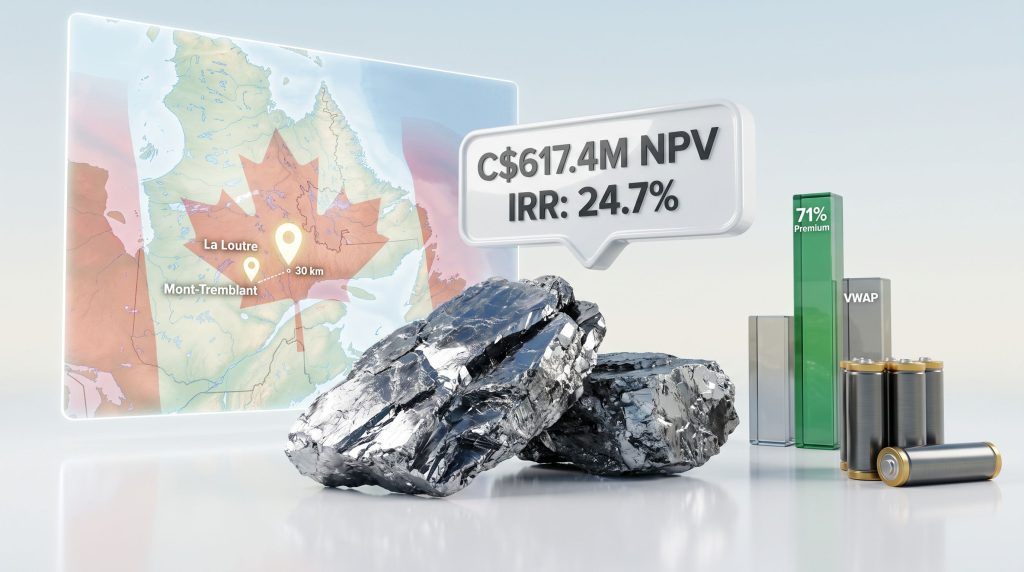
That offer price represents a 71% premium to Lomiko's 20-day volume-weighted average price on the TSX Venture Exchange in the period leading up to the announcement. On the day of the announcement, Lomiko shares surged 60%, closing at approximately C$0.12 in Toronto trading and placing the company's implied market capitalisation at around C$9.6 million.
The transaction requires Lomiko shareholder approval, court sanction under a plan of arrangement, and standard regulatory clearances. Closing is targeted for Q4 2026.
Transaction Structure at a Glance
| Parameter | Detail |
|---|---|
| Acquirer | Global Battery Materials (GBM, private) |
| Target | Lomiko Metals (TSXV: LMR; US-OTC: LMRMF) |
| Deal Structure | All-share, Plan of Arrangement |
| Offer Price | C$0.13 per share |
| Total Implied Value | |
| Premium to 20-Day VWAP | 71% |
| Closing Target | Q4 2026 |
| Bridge Loan (to close) | Up to C$800,000 at 8% p.a. |
| Bridge Loan (if deal fails) | Up to C$1.2 million at 8% p.a. |
| Loan Maturity | 18 months from initial advance |
To support Lomiko's working capital through the transaction period, GBM has committed a bridge financing facility of up to C$800,000, bearing interest at 8% per annum and maturing within 18 months of the first drawdown. Should the acquisition not complete, that facility expands to a maximum of C$1.2 million, providing Lomiko a financial backstop regardless of outcome.
La Loutre: The Asset Driving the Strategic Logic
The centrepiece of the acquisition is the La Loutre graphite project, situated approximately 30 kilometres from Mont-Tremblant in southern Quebec. La Loutre is broadly recognised as one of the largest undeveloped flake graphite deposits in North America, which places it in rare geological company on the continent.
In March 2026, Lomiko released a preliminary feasibility study assigning La Loutre the following economic profile:
| Economic Metric | Assessed Value |
|---|---|
| After-Tax NPV | C$617.4 million |
| Internal Rate of Return | 24.7% |
| Payback Period | 3.2 years |
| Initial Capital Cost | C$504.6 million |
| Modelled Graphite Price | US$1,524 per tonne |
A 24.7% IRR with a sub-four-year payback is a compelling economic profile for a development-stage mining project, particularly when benchmarked against the cost of capital for comparable critical minerals developments. The NPV-to-CapEx ratio of approximately 1.22x suggests the project's value is sensitive to graphite price assumptions, meaning upside from price recovery could materially expand the NPV beyond the current C$617.4 million figure.
What this also means for GBM is that the company is acquiring a project assessed at C$617.4 million for a headline acquisition price of roughly C$11 million. That gap between acquisition cost and assessed NPV reflects the substantial execution risk embedded in the asset, primarily the permitting and community engagement challenges that have historically constrained La Loutre's development timeline.
The Community Opposition Variable
La Loutre's location near a recreational lake region has generated documented resistance from local community groups, with concerns centred on potential environmental and water quality impacts in an area that derives significant economic activity from tourism and outdoor recreation. This opposition is not a minor administrative footnote; it represents a genuine material risk that has weighed on Lomiko's ability to advance the project independently.
GBM has indicated it plans to initiate a structured stakeholder review following deal close, engaging local rights holders and community representatives to assess viable development pathways. The outcome of that engagement process will be a primary determinant of whether La Loutre's C$617.4 million NPV is achievable within any reasonable timeframe.
The gap between a project's assessed NPV and its acquisition price almost always reflects a specific category of risk. At La Loutre, that risk is not geological or economic. It is social. Investors evaluating GBM's long-term upside need to assign probability-weighted scenarios to community resolution, not just graphite price trajectories.
Ruisseau and the Broader Lomiko Portfolio
Beyond La Loutre, Lomiko controls a set of early-stage graphite exploration properties in Quebec, including the Ruisseau project. Field programs at Ruisseau have identified multiple graphite-bearing geological trends that remain open for further drilling, representing optionality that GBM acquires alongside the flagship asset. While Ruisseau is pre-resource stage, it adds geological breadth to the Quebec portfolio and potential for future resource definition.
GBM's Kearney Mine: The Near-Term Production Anchor
La Loutre is not GBM's only asset. The company is simultaneously advancing the Kearney graphite mine in Ontario, which is estimated to contain one of the largest flake graphite deposits outside of China. A preliminary economic assessment released in July 2026 valued Kearney at US$183 million (approximately C$256 million), with projected future cash flows estimated at approximately nine times the initial capital cost.
Target production commencement for Kearney is as early as 2028, making it GBM's nearer-term cash flow generating asset. This sequencing matters strategically: Kearney provides a production-stage foundation that can generate capital and credibility while La Loutre's longer-dated development pathway is navigated.
The combined two-asset structure creates a framework that most junior graphite developers cannot replicate independently:
- A near-term production asset in Ontario providing operational cash flow potential from 2028
- A large-scale development asset in Quebec providing long-term resource scale and vertical integration upside
- Early-stage exploration properties in Quebec providing geological optionality
- A stated downstream ambition to process Canadian graphite into battery-grade anode material for North American manufacturers
Why Vertical Integration Is the Strategic Endgame
The battery materials sector has learned a hard lesson from the lithium cycle: owning a mine is not the same as owning a supply chain. GBM's stated objective is to build a mine-to-anode graphite platform, which means integrating the following production steps under a single corporate structure:
- Mining of natural flake graphite from Canadian deposits
- Beneficiation to concentrate graphite to battery-grade purity levels
- Spheronisation to shape flake graphite particles into the spherical morphology required for anode coatings
- Purification to achieve the ultra-high carbon purity (typically >99.95% TGC) required for battery-grade material
- Coating to apply the carbon layer that improves first-cycle efficiency and cycling stability in lithium-ion cells
- Supply to battery cell manufacturers and automotive OEMs requiring domestic content certification
Each of these steps currently takes place predominantly in China. A North American producer capable of executing all six represents a genuinely scarce asset in the current supply chain landscape. Consequently, the broader battery metals investment landscape is shifting decisively toward integrated developers rather than single-stage mining plays.
GBM's CEO Eric Miller has described the acquisition as a step toward consolidating a fragmented battery supply chain into a fully integrated graphite platform. The dual-asset approach of pairing Ontario production with Quebec development scale creates geographic and geological diversification within a single corporate structure, reducing the concentration risk that has historically constrained single-asset graphite developers.
The next major ASX story will hit our subscribers first
The Macro Forces Reshaping Canadian Graphite M&A
The GBM buys Lomiko Quebec graphite project transaction does not exist in isolation. It is one data point in a broader structural shift that is redirecting capital toward Canadian graphite development.
China's processing dominance remains the defining supply chain vulnerability. Approximately 70 to 80% of global natural graphite processing capacity is concentrated in China, and recent geopolitical friction combined with export control mechanisms have accelerated the urgency with which Western governments and manufacturers are seeking alternative supply pathways.
At the same time, domestic content requirements embedded in North American industrial policy frameworks are creating a material economic incentive for battery manufacturers and automotive OEMs to source anode materials from allied jurisdictions. Producers capable of delivering traceable, domestically processed graphite from Canadian mines are positioned to capture a pricing premium relative to offshore-sourced material, provided they can demonstrate compliance with applicable origin and processing rules.
The junior graphite sector in Canada has historically been fragmented, with numerous single-asset developers lacking the capital depth or downstream market access to advance projects independently. Consolidation by acquirers with integrated downstream ambitions is an increasingly rational response to this fragmentation, and the GBM–Lomiko deal fits that template precisely. Furthermore, innovations in recycled graphite supply are adding another dimension to how battery makers are approaching anode material diversification.
Shareholder Dynamics and Deal Execution Risk
Lomiko's board has unanimously recommended that shareholders vote in favour of the transaction. Security holders controlling approximately 14.6 million shares, representing roughly 18% of total equity, have formally supported the deal, including all board members. This combination of board unanimity and early lock-up support reduces, though does not eliminate, execution risk.
With Lomiko shares trading at C$0.12 against a deal price of C$0.13, the implied spread of approximately 8% reflects residual uncertainty associated with the shareholder vote, court approval, and regulatory clearance process. That spread is consistent with a transaction of this structure and scale, where the primary risks are procedural rather than fundamental.
The stock's 52-week range of C$0.06 to C$0.22 provides useful context: the C$0.13 acquisition price sits in the middle of recent trading history, offering a meaningful premium to distressed price levels while remaining well below the stock's peak. This pricing dynamic is typical of development-stage critical minerals acquisitions where deal value is constructed around a premium to recent trading rather than a premium to peak historical valuations.
Key Risks and Forward-Looking Considerations
Disclaimer: The following section contains forward-looking analysis and scenario-based assessments. These should not be construed as financial advice. Mineral project economics are sensitive to commodity price assumptions, capital cost estimates, permitting outcomes, and community engagement results, all of which carry material uncertainty.
Investors and analysts evaluating the GBM–Lomiko transaction should monitor the following variables closely:
- Community engagement outcomes at La Loutre following deal close, which will determine the project's realistic development timeline and potential permitting pathway
- Graphite price trajectory and its sensitivity implications for La Loutre's C$617.4 million NPV, which is modelled on US$1,524 per tonne
- Kearney mine development milestones as the nearer-term production asset anchoring GBM's operational credibility
- Shareholder vote turnout and approval margin as early indicators of market confidence in the transaction rationale
- Progress toward downstream processing integration, which remains the critical differentiator between a mine developer and a true battery materials platform
La Loutre's C$504.6 million initial capital requirement is a substantial hurdle for a project still navigating community opposition. The project's economic viability at the modelled graphite price of US$1,524 per tonne will need to be reassessed if spot pricing remains below that level. However, the acquisition price of C$11 million against a C$617.4 million NPV represents an entry point that provides significant buffer against even material downward revisions in project economics, provided the permitting pathway can ultimately be secured.
The GBM buys Lomiko Quebec graphite project deal may well serve as a structural template for further consolidation across Canada's junior graphite sector, as integrated battery materials developers seek to build the kind of scaled, traceable, North American supply chains that battery manufacturers increasingly require and that the current market cannot adequately provide. For those tracking developments in direct lithium extraction and adjacent battery raw materials, the strategic logic underpinning this transaction offers a revealing parallel for how upstream critical minerals sectors evolve under supply chain pressure.
Want to Track the Next Major Critical Minerals Discovery Before the Market Does?
Discovery Alert's proprietary Discovery IQ model delivers real-time alerts on significant ASX mineral discoveries — turning complex geological data into actionable insights for both short-term traders and long-term investors. Explore historic examples of major mineral discoveries and their market returns, then begin your 14-day free trial at Discovery Alert to position yourself ahead of the broader market.