July 30, 2026
The Industrial Logic of Turning Coal Into Chemicals
Across the commodity-producing economies of Central Asia, a quiet but consequential transformation is underway. For decades, the dominant model was straightforward: extract raw materials, export them, and capture value at the lowest point on the processing chain. That model is being deliberately dismantled in Kazakhstan, where policymakers and investors are beginning to treat coal not as an endpoint but as a starting material for an entirely new industrial platform.
The concept underpinning this shift is coal chemistry, a sector that converts raw coal into high-value chemical products including ammonia, carbamide (urea), synthetic fuels, methanol, polyolefins, polyethylene, and polypropylene. The value differential between selling coal as a bulk commodity and selling it as a processed chemical product is substantial. A tonne of coal exported at spot market prices generates a fraction of the revenue that the same tonne can yield when converted into ammonia or polymer feedstock.
This economic logic, combined with Kazakhstan's need to diversify away from raw commodity dependency, is driving one of the most ambitious industrial repositioning efforts currently underway in any emerging market. Furthermore, the coal market transformation underway globally is accelerating the urgency of this pivot for resource-dependent economies.
At the centre of this shift is a coordinated wave of Chinese capital. The phrase China to invest in Kazakh coal chemistry projects has circulated through energy market channels, but the full scale and strategic depth of what is being assembled deserves closer examination than a headline allows.
When big ASX news breaks, our subscribers know first
Kazakhstan's 2026-2031 Coal Chemistry Roadmap: Six Projects, One Strategic Pivot
From Bulk Exporter to Downstream Manufacturer
Kazakhstan formally committed to developing six coal-to-chemical projects within the 2026-2031 national development timeframe. These projects collectively target a product portfolio that spans metallurgical coke production, synthetic fuel development, ammonia and carbamide manufacturing, and advanced polymer production. Each product category addresses a different dimension of Kazakhstan's economic vulnerability.
Metallurgical coke is strategically important for Kazakhstan's domestic steel and ferroalloy industries, which currently rely on imported coke from external suppliers. Developing domestic coke production reduces that dependency and captures value locally. In addition, the global steel outlook suggests growing demand for domestically produced inputs as supply chains regionalise.
Synthetic fuels address Kazakhstan's exposure to refined product import costs. Ammonia and carbamide position the country within global fertilizer supply chains at a moment when nitrogen fertilizer markets are experiencing significant geopolitical disruption. Polymer production moves Kazakhstan into one of the highest-margin segments of the petrochemical value chain.
Industry Context: Coal-to-chemicals (CTC) processing is not new technology. China has operated the world's largest coal-to-chemicals industry for over two decades, giving Chinese investors a meaningful technical and operational advantage when deploying capital in this sector abroad.
The sequencing of the roadmap is also significant. By targeting six projects across multiple product categories rather than concentrating on a single output, Kazakhstan is constructing a diversified chemical manufacturing base rather than a single-commodity processing facility. This reduces the country's exposure to any one product market cycle and creates infrastructure that can be expanded or adapted as demand conditions evolve.
Kazakhstan's Energy Foundation: Coal's Dominant Role
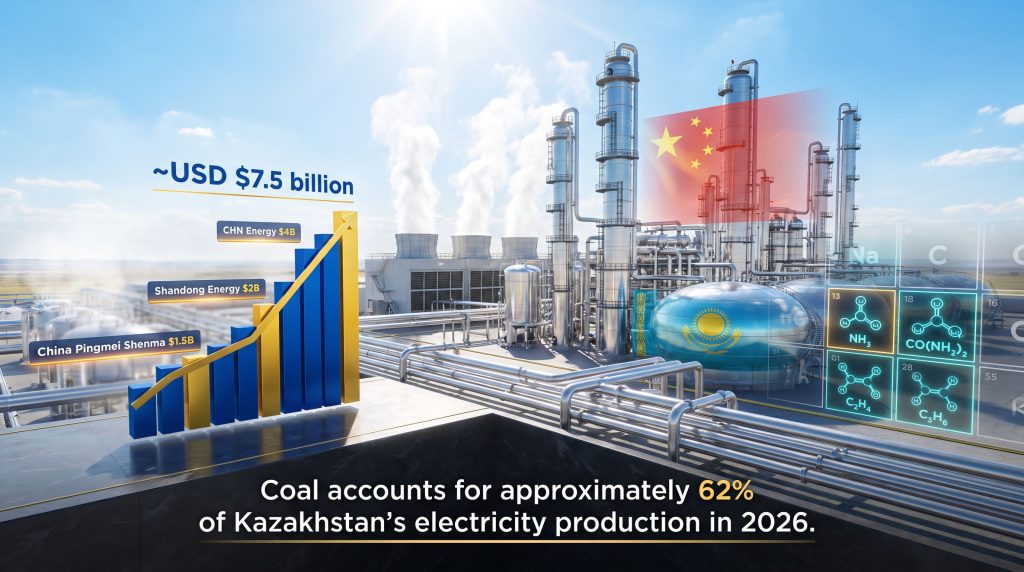
Understanding Kazakhstan's coal chemistry ambitions requires understanding the country's energy architecture. In 2026, coal accounts for approximately 62% of Kazakhstan's total electricity generation. The remaining generation mix breaks down as follows:
| Energy Source | Share of Generation (2026) |
|---|---|
| Coal | ~62% |
| Natural gas | ~23.4% |
| Hydroelectric | ~7.5% |
| Renewables | ~7% |
This concentration in coal-fired generation is not merely a legacy characteristic. It reflects the structural reality that Kazakhstan sits atop some of Central Asia's most substantial coal reserves, and that its existing industrial infrastructure, grid architecture, and skilled workforce are built around coal extraction and combustion.
The country is simultaneously expanding its total generation capacity. At least 2.42GW of new capacity is scheduled for commissioning in 2026, as part of a national target to add 7.8GW by 2030. The investment required for this capacity expansion is estimated at approximately 7.5 trillion tenge, equivalent to roughly USD $15.5 billion.
Once this new generation capacity comes online, Kazakhstan's energy ministry projects a surplus of 1.3TWh by the end of 2027, a surplus that will provide the electricity infrastructure backbone necessary to power large-scale chemical manufacturing operations. This electricity surplus dimension is frequently overlooked in coverage of Kazakhstan's coal chemistry ambitions. Industrial chemical production is extraordinarily energy-intensive, making surplus generation capacity at competitive input costs not simply convenient but a genuine prerequisite.
China's Investment Architecture: Three Companies, USD $7.5 Billion, Multiple Product Streams
A Portfolio Approach, Not a Single Deal
The structure of Chinese investment in Kazakhstan's coal chemistry sector reflects a coordinated portfolio approach rather than isolated deal-making. Three major Chinese enterprises have each committed capital to distinct but complementary segments of the coal chemistry value chain. Coordination between Kazakhstan's Ministry of Industry and Construction and state investment facilitation body Kazakh Invest has provided the institutional scaffolding for these investment agreements.
The combined estimated commitment from Chinese investors currently stands at approximately USD $7.5 billion across three enterprises, as summarised below:
| Chinese Investor | Project Focus | Estimated Investment | Primary Output |
|---|---|---|---|
| CHN Energy | Ammonia, carbamide, polyolefins, polyethylene, polypropylene | ~USD $4 billion | Coal-based chemicals |
| Shandong Energy | Coal chemistry facility via QazaqGaz agreement | Up to USD $2 billion | ~2 billion m³ synthetic gas/year |
| China Pingmei Shenma | Integrated coal-chemical complex | Up to USD $1.5 billion | Integrated coal chemicals |
| Total | ~USD $7.5 billion |
CHN Energy's USD $4 Billion Anchor Commitment
CHN Energy, one of China's largest state-controlled energy enterprises, represents the single largest individual commitment in this investment cluster at approximately USD $4 billion. The scope of this agreement is structured in phases, with ammonia and carbamide production forming the initial output targets, followed by downstream expansion into polyolefins, polyethylene, and polypropylene.
The formal agreement was signed with both Kazakhstan's Ministry of Industry and Construction and Kazakh Invest, reflecting the bilateral government-to-enterprise nature of the engagement model. CHN Energy's investment activities in Kazakhstan have been closely followed by regional analysts given the company's operational credibility and decades of coal chemistry experience within China's domestic market, where coal-to-chemicals has evolved from an experimental industrial programme into a mature, large-scale sector.
What makes this investment particularly meaningful from a market structure perspective is the downstream orientation. CHN Energy is not investing to extract coal. It is investing to process coal into chemical products that command premium pricing on global commodity markets. This distinction has significant implications for how Kazakhstan captures value from its coal reserves, and indeed for how China to invest in Kazakh coal chemistry projects reshapes the region's industrial profile.
Shandong Energy and the QazaqGaz Strategic Partnership
The second major commitment involves Shandong Energy, which has entered a strategic agreement with Kazakhstan's national gas company QazaqGaz to develop a coal chemistry facility in the Karaganda region. The investment scale is up to USD $2 billion, with a projected annual output of approximately 2 billion cubic metres of synthetic gas.
Karaganda's selection as the project location is strategically logical rather than arbitrary. The region holds some of Kazakhstan's most extensive coal deposits, with established mining infrastructure, skilled labour pools, and existing industrial facilities. Direct proximity to coal feedstock reduces both input logistics costs and supply chain complexity, two factors that can make or break the economics of coal-to-gas conversion projects.
Beyond the technical rationale, this project carries meaningful employment implications. Approximately 1,500 direct jobs are anticipated from the Shandong Energy facility, a figure that, while modest relative to the capital investment, reflects the capital-intensive nature of industrial chemical processing relative to labour-intensive coal mining.
China Pingmei Shenma: Completing the Portfolio
China Pingmei Shenma, a specialist coal-chemical enterprise, is pursuing an integrated coal-chemical complex in Kazakhstan with an investment scale of up to USD $1.5 billion. The project is currently under active consideration with institutional facilitation underway. The product focus of this complex is designed to complement rather than replicate the output profiles of CHN Energy and Shandong Energy, reducing the risk of domestic market saturation for any single chemical product category.
How Chinese Investment Compares to Other Foreign Engagement
Kazakhstan as a Multi-Polar Investment Destination
Kazakhstan's coal sector has attracted interest from a genuinely diverse roster of international investors. Russia, Germany, and the United States have all engaged with Kazakhstan's coal and energy sector, positioning the country as a multi-vector investment destination rather than a satellite economy within any single sphere of influence.
| Investor Origin | Investment Focus | Primary Strategic Motivation |
|---|---|---|
| China | Downstream coal chemistry, synthetic fuels, polymers | Chemical feedstock supply chains; industrial capacity expansion |
| Russia | Coal processing and energy cooperation | Regional energy integration |
| Germany | Industrial technology transfer, clean coal applications | Central Asian energy diversification |
| United States | Energy sector development | Geopolitical balancing and market access |
The critical distinction between Chinese engagement and that of other foreign investors is the depth of downstream orientation. Russian, German, and American interest has generally focused on energy cooperation, technology transfer, and resource access. Chinese investment is uniquely structured around building Kazakhstan's capacity to manufacture chemical products at industrial scale, which places Chinese enterprises in an influential position relative to the output, pricing, and offtake arrangements for Kazakhstan's emerging chemical production base.
Analytical Observation: A country that controls the processing infrastructure for another nation's primary resource holds structurally more durable economic influence than one that simply purchases the raw material. Chinese investment in Kazakhstan's coal chemistry sector reflects this logic explicitly.
The Investment Facilitation Environment
Kazakhstan's Toolkit for Attracting Industrial Capital
Kazakhstan has assembled a suite of investment facilitation mechanisms designed to attract and retain foreign capital in its industrial sector. Kazakhstan's regulated coal chemistry framework provides foreign investors with structured pathways for engagement, including the following support mechanisms:
- Tax incentive structures available to qualifying industrial projects, including investment contract frameworks that can provide corporate income tax reductions and land tax relief for specified periods
- Industrial zone infrastructure support, providing qualifying investors with access to utilities, logistics connectivity, and site preparation assistance
- Investment facilitation services administered through Kazakh Invest, which coordinates between foreign investors and relevant government ministries
- Streamlined regulatory engagement processes for large-scale foreign industrial investment projects
Kazakhstan's regulatory environment for foreign industrial investment compares favourably within the Central Asian region, where institutional frameworks for managing large-scale foreign direct investment in industrial sectors remain less developed in neighbouring countries.
Risks and Structural Constraints Worth Monitoring
Carbon Transition Exposure
The most significant long-term risk facing Kazakhstan's coal chemistry buildout is the trajectory of global carbon pricing and climate-related trade barriers. The European Union's Carbon Border Adjustment Mechanism (CBAM), which is in phased implementation, applies carbon costs to imports of certain industrial products. As Kazakhstan targets European markets for chemical exports, the carbon intensity of coal-derived production inputs may increasingly influence competitiveness.
This risk does not invalidate Kazakhstan's coal chemistry strategy in the near term, particularly given the scale of Asian demand for ammonia, carbamide, and polymer products. However, it creates a long-term planning horizon challenge that project developers and investors should model explicitly. Consequently, green steel pricing dynamics offer a useful parallel case study for how carbon transition pressures reshape industrial commodity economics.
Execution and Technology Integration Risk
Large-scale greenfield coal chemistry projects are among the most technically complex and capital-intensive industrial construction undertakings in the global economy. Key risk factors include:
- Capital overrun risk – Coal chemistry facilities consistently experience cost escalation during construction phases, with some Chinese domestic projects running 20-40% above initial capital estimates
- Timeline slippage – Technology integration between coal gasification, synthesis, and chemical processing stages introduces coordination complexity that can extend commissioning timelines
- Technology licensing constraints – Proprietary process technologies for coal-to-ammonia, coal-to-methanol, and coal-to-polyolefins pathways are controlled by a limited number of licensors globally, creating potential bottlenecks
- Water intensity – Coal chemistry processes consume substantial volumes of water; Kazakhstan's water resource constraints in certain regions may limit the sites available for large-scale facility development
Geopolitical Balance Risk
Kazakhstan's multi-vector foreign policy is both a strength and a source of structural tension. The country's simultaneous engagement with Chinese, Russian, Western European, and American investors reflects a deliberate strategy to avoid overdependence on any single external partner. Furthermore, the broader metals and mining geopolitics environment adds another layer of complexity to how foreign investment relationships evolve over time.
However, this also means that Chinese investment operates within a competitive geopolitical environment, and that shifts in Kazakhstan's foreign policy orientation could affect the regulatory and operational conditions facing Chinese enterprises. The influence of global commodity tariffs on trade flows between China and Central Asia further complicates the long-range planning assumptions underpinning these investments.
The next major ASX story will hit our subscribers first
Market Implications: What Kazakh Coal Chemistry Means for Global Chemical Supply
A New Source of Chemical Production Capacity
The emergence of Kazakhstan as a significant coal-derived chemical producer over the 2026-2031 development window has tangible implications for global commodity markets. The product streams being targeted, specifically ammonia, carbamide, polyethylene, and polypropylene, are high-volume commodity chemicals with established global trade flows.
New Kazakh production capacity entering these markets would represent an incremental supply addition that could affect:
- Ammonia and urea trade flows into South and Southeast Asian markets, where Kazakh product would be geographically competitive
- Polyolefin pricing dynamics in regional markets, particularly if Kazakh production achieves cost competitiveness with existing Middle Eastern and Chinese producers
- Central Asian chemical export infrastructure, which currently lacks the pipeline and logistics capacity to efficiently move large chemical volumes, creating a parallel infrastructure investment requirement
Speculative Dimension: If Kazakhstan successfully commissions multiple coal chemistry facilities within the 2026-2031 window, the country could emerge as a swing supplier in certain Asian chemical markets by the early 2030s, with pricing influence that extends beyond Central Asia's historically modest commodity market footprint.
Frequently Asked Questions: China's Investment in Kazakhstan's Coal Chemistry Projects
What is coal chemistry and why is Kazakhstan prioritising it?
Coal chemistry involves the industrial conversion of coal into value-added products including ammonia, carbamide, synthetic gas, methanol, and polymers. Kazakhstan is developing this sector to extract significantly more economic value from its coal reserves than raw coal exports allow, while simultaneously building a domestic manufacturing base that generates skilled employment.
How much is China committing to Kazakhstan's coal chemistry sector?
Across three major enterprises — CHN Energy, Shandong Energy, and China Pingmei Shenma — total estimated Chinese investment commitments currently stand at approximately USD $7.5 billion. This figure reflects the ambition behind China to invest in Kazakh coal chemistry projects at a scale that could fundamentally reshape the region's industrial profile.
What products will these projects produce?
The planned output portfolio includes ammonia, carbamide (urea), metallurgical coke, synthetic fuels, approximately 2 billion cubic metres per year of synthetic gas from the Shandong Energy project, polyolefins, polyethylene, and polypropylene.
Is China the only foreign investor in Kazakhstan's coal sector?
No. Kazakhstan has attracted investment interest from Russia, Germany, and the United States. However, Chinese capital currently represents the largest and most structurally developed commitment to downstream coal-to-chemicals processing specifically.
How does Kazakhstan's electricity sector connect to coal chemistry development?
Coal currently supplies approximately 62% of Kazakhstan's electricity generation. Planned capacity additions of at least 2.42GW in 2026, contributing toward a national target of 7.8GW by 2030, will create an energy surplus projected at 1.3TWh by end-2027. This power infrastructure directly enables the energy-intensive operations of large-scale chemical manufacturing facilities.
What are the main risks for these projects?
The primary risk categories include carbon transition exposure as global decarbonisation frameworks mature, execution and cost overrun risk inherent to greenfield coal chemistry construction, water resource constraints in certain Kazakh regions, and geopolitical balance risk given Kazakhstan's multi-vector foreign policy orientation.
Kazakhstan's Structural Transition: What the Investment Wave Signals
The aggregation of approximately USD $7.5 billion in Chinese industrial investment commitments into Kazakhstan's coal chemistry sector is not an isolated commercial event. It represents the leading edge of a structural economic transition that, if successfully executed within the 2026-2031 development window, will fundamentally alter Kazakhstan's position within Central Asian and global commodity markets.
For decades, Kazakhstan's commodity sector generated revenue primarily by moving raw materials to the point of first processing elsewhere. Coal chemistry inverts this model, retaining processing value within the domestic economy and creating the industrial infrastructure to sustain a manufacturing export base. The depth of Chinese involvement — spanning capital provision, technology application, and likely offtake arrangement — makes Beijing a central actor in whether and how quickly this transition materialises.
For commodity market participants and investors tracking emerging chemical supply sources, Kazakhstan's coal chemistry buildout warrants attention not merely as a Central Asian development story, but as a potential structural shift in the origin points of global ammonia, carbamide, and polymer supply over the coming decade.
This article contains forward-looking analysis based on publicly available investment commitments and policy frameworks. Actual project outcomes, investment timelines, and production volumes are subject to change based on regulatory developments, market conditions, and execution factors. Nothing in this article constitutes investment advice.
Want to Track the Next Major Commodity Discovery Before the Market Does?
Discovery Alert's proprietary Discovery IQ model delivers real-time alerts on significant ASX mineral discoveries, instantly transforming complex data across 30+ commodities into actionable investment insights — precisely the kind of edge that matters as global commodity supply chains rapidly restructure. Explore how historic mineral discoveries have generated substantial returns, then begin your 14-day free trial at Discovery Alert to position yourself ahead of the broader market.