July 30, 2026
The Structural Forces Reshaping Permian Basin Royalty Ownership
The U.S. mineral rights sector has quietly undergone one of its most consequential evolutions in decades. As the Permian Basin continues to dominate American oil production, a growing class of investors and operators have recognised that the traditional royalty trust model, built for a different era of production economics, carries structural inefficiencies that modern capital markets are no longer willing to overlook. The convergence of operational scale, surface asset monetisation, and royalty structure simplification has been building toward a tipping point, and the Permian Basin Royalty Trust Blackbeard merger represents exactly that inflection.
The $2.24 billion combination between SoftVest, Blackbeard, and the Permian Basin Royalty Trust is not simply a consolidation play. It is a fundamental reimagining of how royalty income is captured, structured, and delivered to shareholders in one of the world's most prolific oil-producing regions.
When big ASX news breaks, our subscribers know first
Why the Net Profits Interest Model Has Run Its Course
The Hidden Cost Problem in Traditional Royalty Trusts
Most retail investors treat royalty trusts as passive income vehicles, assuming their distributions track oil prices with minimal friction. In practice, net profits interest structures, the foundational mechanism underpinning many legacy royalty trusts, introduce a layer of cost exposure that fundamentally distorts that relationship.
Under a net profits interest arrangement, the royalty holder receives a percentage of revenues after the deduction of operating costs. This means that when production expenses rise, whether through increased workover costs, water disposal fees, or inflationary pressure on oilfield services, the royalty income shrinks even if oil prices remain constant. For unitholders in the Permian Basin Royalty Trust, this has historically created frustrating disconnects between rising commodity prices and disappointing distributions. Understanding commodity price sensitivity is, consequently, essential for investors evaluating this structure.
The distinction between the two models is significant:
| Feature | Net Profits Interest | Cost-Free Royalty Interest |
|---|---|---|
| Exposure to Operating Costs | High | None |
| Cash Flow Predictability | Variable | More Stable |
| Alignment With Development Activity | Indirect | Direct |
| Complexity for Investors | Higher | Lower |
| Upside Participation | Conditional | Proportional |
The shift to a cost-free royalty interest, central to the Permian Basin Royalty Trust Blackbeard merger, eliminates this cost leakage entirely. The royalty holder receives a defined percentage of gross production revenues with no deduction for operating expenses. This structural change alone has the potential to materially improve both the quantum and predictability of distributions flowing to New PBT shareholders.
What Cost-Free Royalties Mean for Cash Flow Modelling
From an investor modelling perspective, cost-free royalties behave more like a revenue participation right than a profit share. They are simpler to value, less sensitive to operator efficiency, and more closely correlated to production volumes and commodity prices. For institutional income investors, this clarity is not a minor convenience; it is a prerequisite for inclusion in many yield-focused mandates.
The conversion of PBT's existing net profits interest into a cost-free royalty interest is one of the most structurally significant financial decisions embedded in this transaction, and its long-term implications for distribution consistency should not be underestimated by income-focused investors.
How the Waddell Ranch Became the Epicentre of a $2.24 Billion Deal
Central Basin Platform: Geology, Production History, and Strategic Value
The Central Basin Platform occupies a structurally elevated position within the broader Permian Basin system. Unlike the Delaware and Midland sub-basins, which have attracted the most attention for shale development in recent years, the Central Basin Platform is characterised by a mix of conventional and unconventional carbonate reservoirs. These reservoirs, while requiring different completion approaches than horizontal shale wells in the Delaware, have demonstrated sustained productivity at scale when modern drilling techniques are applied systematically.
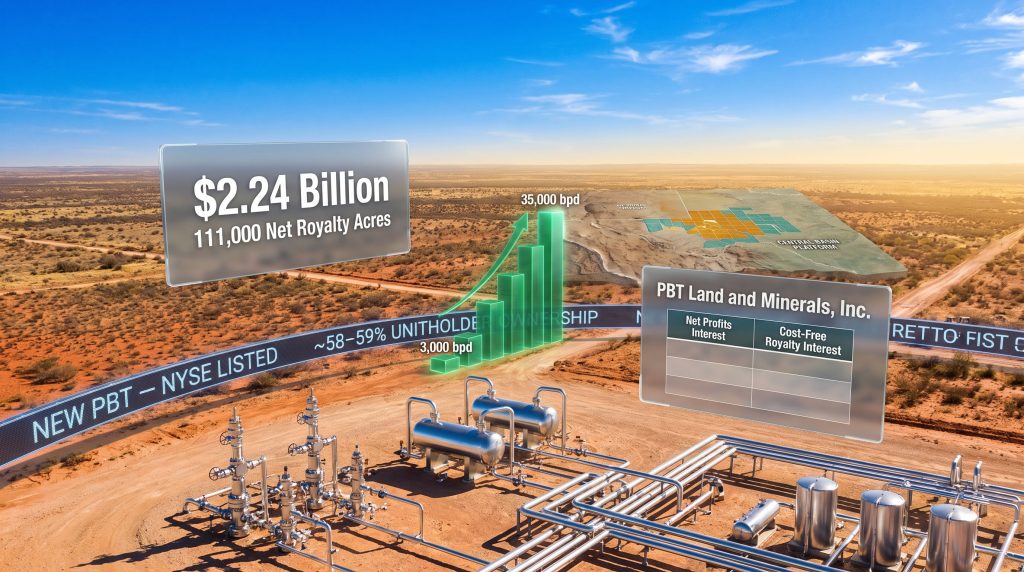
The Waddell Ranch, the geographic anchor of the entire transaction, sits squarely within this setting. What makes the Waddell Ranch particularly compelling from a transactional standpoint is the demonstrated production transformation achieved by Blackbeard Operating. The operator has grown output from approximately 3,000 barrels per day to more than 35,000 barrels per day, representing a greater than tenfold increase achieved through the application of modern horizontal drilling and completion techniques to a legacy asset base.
This production trajectory is important context for understanding the deal's valuation logic. Furthermore, Blackbeard Operating currently holds the position of the largest producer on the Central Basin Platform, a distinction that carries both operational credibility and pricing power in infrastructure negotiations.
The Role of Nile Midstream in the Integrated Value Chain
One element of the transaction that deserves greater attention than it typically receives is the role of Nile Midstream, the affiliated midstream entity providing oil, gas, and water gathering infrastructure across the Waddell Ranch development area. Midstream infrastructure ownership within a royalty and surface platform creates a vertically integrated value capture mechanism that is structurally rare among publicly traded royalty companies.
Most royalty companies are deliberately designed to be passive, collecting royalty cheques without operational involvement. The New PBT structure departs from this convention by embedding midstream infrastructure exposure through affiliated operations, creating a potential secondary revenue layer that operates alongside the royalty interest income.
Transaction Architecture: Assets, Ownership, and Capital Structure
Deal Structure at a Glance
| Component | Detail |
|---|---|
| Total Transaction Value | ~$2.24 billion |
| New Entity Name | PBT Land and Minerals, Inc. (New PBT) |
| Net Royalty Acres (Combined) | ~111,000 net royalty acres |
| Surface Acres | ~68,000 surface acres |
| PBT Unitholder Ownership Post-Close | ~58-59% |
| Blackbeard and Affiliates Ownership | ~41-42% |
| Blackbeard Royalty Contribution | ~80,000 net royalty acres |
| PBT Converted Royalty Interest | ~31,000 net royalty acres |
| Blackbeard Surface Contribution | ~68,000 surface acres |
Blackbeard contributes the larger royalty acreage block at approximately 80,000 net royalty acres, while PBT's converted interest adds roughly 31,000 net royalty acres, bringing the combined platform to approximately 111,000 net royalty acres. This scale positions New PBT among the most significant royalty land holders on the Central Basin Platform.
The $120 Million Rights Offering and Backstop Mechanism
The transaction is accompanied by a $120 million rights offering and private placement, backstopped by SoftVest and Horizon Kinetics. The backstop arrangement is a meaningful risk mitigant for the capital raise component, as it ensures the rights offering proceeds are available regardless of the level of participation by existing PBT unitholders.
For unitholders, participation in the rights offering represents an opportunity to maintain proportional ownership in New PBT. Non-participating unitholders will experience dilution, though their underlying asset exposure through the royalty platform will be substantially enhanced compared to the legacy trust structure.
Transaction Timeline
- May 2026: Non-binding term sheet announced between SoftVest and Blackbeard
- July 28, 2026: Definitive Combination Agreement signed
- Pending: PBT unitholder vote and satisfaction of customary regulatory closing conditions
A definitive feasibility study approach to assessing deal viability is, however, equally important for investors weighing the risks and merits of such a complex transaction.
Credit Facility and Leverage Discipline
New PBT is expected to assume a JPMorgan-led $500 million senior secured revolving credit facility, with an additional $100 million accordion feature providing flexibility for future capital deployment. The combined company has committed to maintaining leverage below 0.4x pro forma annualised adjusted EBITDA following close.
Maintaining leverage below 0.4x pro forma EBITDA post-close positions New PBT as a conservatively capitalised royalty company, a structure that typically attracts income-oriented institutional investors and reduces refinancing risk in volatile commodity price environments.
This leverage discipline is a deliberate signal to the capital markets. Royalty companies that over-lever during commodity price expansions frequently face distribution cuts and equity dilution when prices correct. The sub-0.4x target communicates a philosophy centred on resilience over growth maximisation.
Surface Rights: The Revenue Dimension Most Analysts Are Underweighting
Produced Water Infrastructure as an Emerging Asset Class
The 68,000 surface acres contributed by Blackbeard introduce a revenue category that is only beginning to receive appropriate attention within the broader royalty investment universe. Produced water management has become one of the defining operational and financial challenges across the Permian Basin, with disposal volumes growing proportionally alongside hydrocarbon production.
Surface ownership in active development areas conveys the right to host, negotiate, and charge fees for produced water infrastructure, including gathering pipelines, disposal wells, and recycling facilities. As regulatory scrutiny around seismicity and groundwater protection increases, operators face growing pressure to secure long-term water disposal agreements, which translates directly into pricing power for surface owners.
The inclusion of 68,000 surface acres alongside royalty interests is a deliberate structural choice. Surface ownership unlocks produced water infrastructure revenues and third-party energy development rights, diversifying cash flow beyond traditional hydrocarbon royalties.
Beyond water, surface rights across the Permian Basin are increasingly relevant to solar energy development, transmission corridor easements, and carbon sequestration projects. While these revenue categories remain nascent relative to oil and gas royalties, they represent optionality that is difficult to value using conventional royalty trust metrics.
Leadership, Governance, and the SoftVest Influence
Who Is Running New PBT?
Jordan Barrett, Blackbeard's current chief financial officer, will transition into the chief executive officer role at New PBT. Barrett's background in financial management within an active Permian operator provides the new company with operational credibility that distinguishes it from many passive royalty vehicles led by financial engineers rather than energy practitioners.
Eric Oliver, president of SoftVest Advisors, will serve as board chair. SoftVest's involvement as a backstop party in the rights offering, combined with its board representation, signals a high degree of alignment between the firm's financial interests and New PBT's strategic direction. Investors should, however, remain alert to potential governance red flags whenever significant ownership concentration intersects with management influence.
The governance architecture reflects a deliberate balance. Blackbeard's operational management brings field-level expertise, while SoftVest's oversight ensures that capital allocation decisions remain anchored to distribution discipline and unitholder value creation.
The next major ASX story will hit our subscribers first
Scenario Analysis: How New PBT Performs Across Commodity Environments
For investors evaluating the Permian Basin Royalty Trust Blackbeard merger, commodity price sensitivity is the dominant variable in any forward-looking assessment. An oil price rally, for instance, could meaningfully accelerate distribution growth across the combined platform. The table below outlines how different price environments affect the platform's expected performance:
| Scenario | WTI Oil Price | Impact on New PBT Revenue | Key Risk Factor |
|---|---|---|---|
| Bull Case | Above $85/bbl | Strong royalty distributions, surface revenues expand | Competitive M&A environment for additional acreage |
| Base Case | $65-$85/bbl | Stable distributions, modest organic growth | Integration execution risk |
| Bear Case | Below $65/bbl | Compressed royalty income, surface revenues provide partial cushion | Leverage headroom narrows despite conservative targets |
The cost-free royalty structure provides meaningful downside insulation compared to legacy net profits interest arrangements, since there is no cost-sharing mechanism that amplifies revenue compression in low price environments. However, investors should note that royalty income remains intrinsically linked to production activity, which operators may curtail in a sustained low-price environment.
Disclaimer: Commodity price scenarios and associated revenue impacts are illustrative projections only. They do not constitute financial advice and are subject to significant uncertainty. Past production performance does not guarantee future results.
What Existing PBT Unitholders Need to Understand
The Ownership Exchange: Dilution vs. Asset Uplift
Unitholders entering New PBT will hold approximately 58-59% of a significantly larger and more diversified asset base. The critical question for any existing holder is whether the enhanced asset quality, structural simplification, and scale of the combined platform justify the dilution associated with Blackbeard's 41-42% ownership stake.
Several considerations are relevant:
- The conversion from net profits interest to cost-free royalty improves the intrinsic quality of PBT's underlying asset contribution
- The addition of 80,000 net royalty acres from Blackbeard represents an acreage expansion that would not be achievable through organic growth within the trust structure
- Surface acreage exposure introduces revenue diversification unavailable under the legacy trust model
- The backstopped rights offering provides a defined pathway to additional liquidity without open-market execution risk
Unitholder Vote: The Critical Catalyst
The transaction cannot proceed without formal approval from PBT unitholders. This vote represents the single most important near-term catalyst for the deal's completion. Unitholders should carefully review the definitive proxy materials when distributed, paying particular attention to the independent financial fairness opinion, the rights offering mechanics, and the pro forma financial projections for New PBT under multiple commodity price scenarios. Crafting a sound investment strategy ahead of this vote is consequently advisable for anyone with existing or prospective exposure to the trust.
Frequently Asked Questions: Permian Basin Royalty Trust Blackbeard Merger
Has the Permian Basin Royalty Trust Blackbeard Merger Closed?
As of July 2026, the transaction has not closed. The definitive Combination Agreement was signed on July 28, 2026, but completion remains subject to PBT unitholder approval and customary regulatory closing conditions.
What Will the Combined Company Be Called?
The merged entity will operate as PBT Land and Minerals, Inc., referred to as New PBT, and is expected to be listed on the NYSE.
What Is the Total Acreage of the Combined Platform?
New PBT will control approximately 111,000 net royalty acres and 68,000 surface acres, primarily concentrated across the Central Basin Platform in the Permian Basin.
Why Is the Net Profits Interest Being Converted?
The conversion into a cost-free royalty interest eliminates operating cost exposure for royalty holders, simplifies the asset structure, and improves the predictability of cash distributions to shareholders over the long term.
What Is the $120 Million Rights Offering?
The transaction includes a $120 million rights offering and private placement, backstopped by SoftVest and Horizon Kinetics, designed to provide New PBT with additional balance sheet liquidity at close.
Key Takeaways for Investors Evaluating This Transaction
- The $2.24 billion deal creates one of the most significant publicly traded Permian royalty and surface platforms in the sector's history
- The structural shift from net profits interest to cost-free royalty is the defining financial innovation of the transaction, with material implications for distribution predictability
- Surface acreage exposure and produced water infrastructure introduce genuinely diversified, non-hydrocarbon revenue streams that most traditional royalty trusts cannot access
- Conservative leverage targets below 0.4x EBITDA signal a distribution-focused capital allocation philosophy suited to income investors
- The backstopped rights offering reduces execution risk around the capital raise
- Unitholder approval remains the critical near-term catalyst, and proxy materials should be reviewed carefully before any investment decision is made
This article is provided for informational purposes only and does not constitute investment advice. All financial projections, ownership percentages, and transaction details are based on publicly disclosed information as of July 2026 and are subject to change pending transaction close. Readers should conduct their own due diligence and consult a qualified financial adviser before making any investment decisions.
Want to Stay Ahead of the Next Major Resource Discovery on the ASX?
While the Permian Basin Royalty Trust Blackbeard merger illustrates the transformative value locked inside well-structured resource assets, Discovery Alert's proprietary Discovery IQ model scans ASX announcements in real time, instantly identifying significant mineral discoveries with the potential for outsised returns — explore historic discovery outcomes to understand what early positioning can mean, and begin your 14-day free trial at Discovery Alert to secure your market-leading edge today.