July 30, 2026
The Invisible Gas Powering Modern Technology Has a Supply Problem Australia Can No Longer Ignore
Few industrial supply chains reveal the hidden fragility of modern economies quite like the one built around helium. Unlike oil or iron ore, helium generates little public debate despite underpinning some of the most critical technologies in use today, from hospital MRI scanners to the fabrication facilities producing the AI chips reshaping global industry. It cannot be synthesised, cannot be economically recycled at scale in most applications, and once released into the atmosphere, it escapes Earth's gravitational field permanently. That physical irreversibility places helium in a uniquely vulnerable category among industrial gases, and it helps explain why supply disruptions carry consequences far beyond what the commodity's relatively modest price history might suggest.
For Australia, the vulnerability is no longer theoretical. The country sits entirely exposed to international supply chains for a resource its healthcare system, defence sector, and semiconductor-adjacent industries depend upon. Understanding how that exposure developed, and what Gold Hydrogen Australian helium production efforts underway on the Yorke Peninsula might mean for resolving it, requires stepping back from the immediate headlines and examining the structural dynamics at play.
When big ASX news breaks, our subscribers know first
Australia's Helium Import Dependency: How a Single Closure Changed Everything
Until late 2023, Australia maintained at least a partial domestic helium capability through the BOC Helium processing facility located near Darwin. Its closure ended that, converting Australia into a 100% import-dependent nation for a gas it cannot easily substitute in its most critical applications. The consequences of that transition were initially masked by adequate import availability, but the global supply picture has since deteriorated sharply.
Two of the world's largest helium processing facilities, one in Qatar and one in Russia, have faced significant operational disruptions linked to the regional conflicts in Iran and Ukraine respectively. These are not minor production nodes. Qatar and Russia have collectively represented a substantial share of global helium output, and their simultaneous reduction in availability has cascaded through supply chains in ways that have driven up prices and created allocation shortfalls for industrial consumers worldwide. The global helium supply crisis has consequently placed enormous pressure on downstream markets across every continent.
Australia's geographic position amplifies this exposure. Unlike European or North American consumers who sit closer to multiple supply sources, Australian industrial users sit at the far end of long oceanic shipping routes. Any tightening of global allocation tends to disadvantage end-of-chain markets first, and Australia is structurally positioned as exactly that.
The combination of a closed domestic facility, reduced output from the world's two largest producing regions, and geographic isolation from alternative sources creates a supply vulnerability that goes well beyond ordinary commodity price risk.
Why Helium Demand Is Accelerating Into the Shortage
The timing of this supply contraction is particularly challenging because demand is moving in the opposite direction. Several converging end-use trends are placing simultaneous upward pressure on global helium requirements.
Medical Infrastructure Cannot Substitute Away From Helium
Liquid helium is the cryogenic coolant that maintains the superconducting magnets within MRI machines at the extremely low temperatures required for operation, approximately -269 degrees Celsius, just four degrees above absolute zero. No commercially viable substitute currently exists for this application at scale. For Australian public and private health systems operating tens of thousands of MRI units nationally, helium supply continuity is a patient care issue with direct clinical consequences. A shortage does not result in higher procurement costs alone; it can mean diagnostic imaging capacity reductions with downstream health impacts.
Semiconductor Fabrication and the AI Hardware Buildout
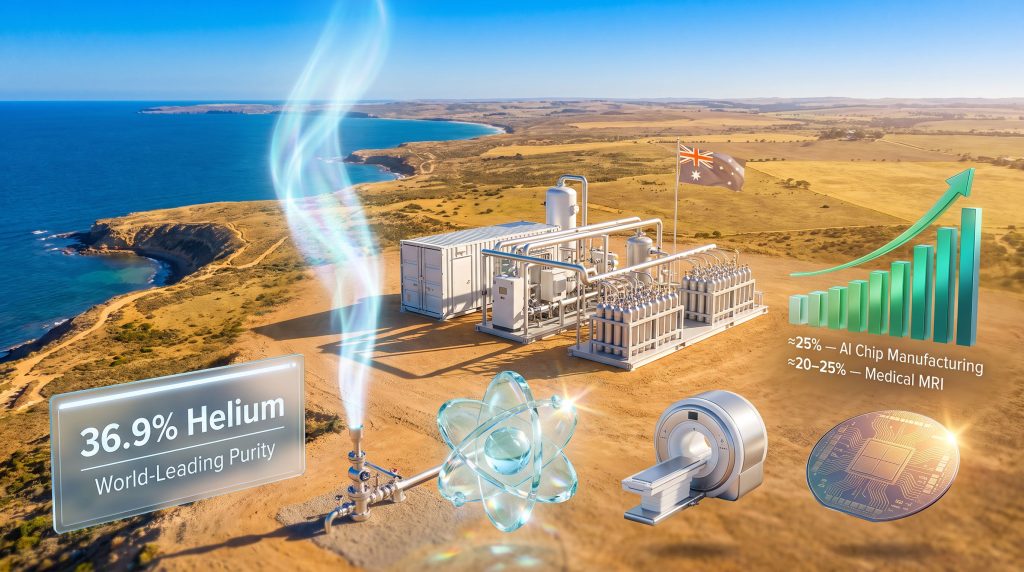
The more rapidly expanding demand driver is the semiconductor manufacturing sector, specifically the fabrication of AI chips. Helium plays multiple roles within chip fabrication: it is used as a carrier gas, a cooling medium, and a purging agent in the highly controlled atmospheric environments required for modern semiconductor production. According to industry data cited in sector analyses, AI chip manufacturing currently accounts for approximately one quarter of total global helium consumption, and that figure is projected to grow in line with the ongoing AI infrastructure buildout.
This creates an unusual dynamic where the same technological wave generating enormous investor enthusiasm is simultaneously intensifying pressure on a supply-constrained critical gas. The intersection is not widely understood by generalist investors, who tend to follow semiconductor and helium markets in separate analytical silos. Furthermore, this dynamic underscores why mineral exploration matters in securing domestic access to resources that underpin advanced technology supply chains.
Global Helium End-Use Distribution
| End-Use Sector | Approximate Share of Global Demand | Growth Trajectory |
|---|---|---|
| Semiconductor / AI Chip Manufacturing | ~25% | Rapidly increasing |
| Medical MRI Cooling | ~20-25% | Stable to growing |
| Industrial and Welding Applications | ~20% | Stable |
| Space and Aerospace | ~10% | Moderate growth |
| Fibre Optics, Research, Other | ~20-25% | Mixed |
The Geology Behind the Ramsay Project: Why the Yorke Peninsula Is Different
Natural helium, sometimes called geological helium to distinguish it from helium extracted as a byproduct of natural gas processing, forms through an entirely different mechanism than conventional hydrocarbon resources. It accumulates over billions of years through the radioactive decay of uranium and thorium within ancient crustal rocks, with the resulting helium atoms migrating upward through permeable formations until they are trapped beneath impermeable cap rocks. Research into the origin of hydrogen and helium occurrences confirms that this billion-year accumulation process makes natural helium genuinely non-renewable on any human timescale.
The geological architecture of South Australia's Yorke Peninsula has attracted serious attention because it provides the structural conditions for helium trapping and concentration. What has distinguished the Ramsay project is not merely the presence of helium but the extraordinary purity levels recorded in testing. Independent geological assessments have confirmed helium concentrations of up to 36.9% in samples from Ramsay wells, a figure that warrants careful contextualisation.
Commercial helium extraction is generally considered viable when raw gas concentrations exceed approximately 0.3-0.5%. The Ramsay sample concentrations of up to 36.9% represent specific point measurements rather than average reservoir grades, but even as indicators of what the system is capable of producing, they are geologically exceptional.
Helium-3: The Rare Isotope Discovery
Analysis conducted by Oxford University on samples drawn from the Ramsay 2 well confirmed the presence of helium-3, the rare isotope of helium that is extraordinarily scarce in terrestrial environments. Most of the world's accessible helium-3 originates from the solar wind captured in lunar regolith; what exists on Earth occurs only in trace quantities within natural helium accumulations. Helium-3 commands significant price premiums over conventional helium-4 for specialised applications in neutron detection systems, quantum computing research, and experimental nuclear fusion programs.
The confirmation of helium-3 co-occurrence within the same system producing high-concentration helium-4 adds a dimension to the Ramsay project that extends beyond conventional industrial gas supply. Whether helium-3 can be separated and monetised at commercial scale from this system remains a question for further investigation, but its presence represents a scientifically significant and potentially commercially relevant finding.
The Natural Hydrogen Co-Production Dimension
A further geological characteristic of the Ramsay system is the co-occurrence of natural (geological) hydrogen within the same subsurface formations hosting the helium resource. Natural hydrogen forms through processes including the serpentinisation of iron-rich rocks and the radiolysis of water by radioactive elements, mechanisms that can overlap geographically with helium-generating radioactive decay environments.
This geological overlap has opened the possibility of a co-production model in which both gases are extracted from the same formation, improving the overall economics of field development. Gold Hydrogen has announced a pre-feasibility study with Japan's Mitsubishi Gas Chemical Company examining the use of natural hydrogen from the Ramsay system for green methanol production, signalling that the hydrogen dimension has attracted credible international industrial interest.
The 2026 Well Testing Campaign: What Is Actually Being Measured
From Discovery to Commercial Validation
Well testing represents the critical technical bridge between identifying a geological resource and determining whether it is commercially producible. Drilling and sampling establish that a resource exists; flow testing establishes whether it can be extracted at rates and volumes sufficient to justify infrastructure investment. These are fundamentally different questions, and the gap between a high-purity sample and a bankable flow rate is where most exploration-stage resource stories encounter their most significant uncertainty. Consequently, understanding mining feasibility studies and their role in bridging this gap is essential context for any investor following the Ramsay program.
The 2026 testing campaign at Ramsay involves two wells with meaningfully different production parameters.
| Parameter | Ramsay 1 | Ramsay 3 |
|---|---|---|
| Pumping Rate | Up to 2,000 barrels of fluid and gas per day | Up to 20,000 barrels per day |
| Well Design | Standard configuration | Purpose-engineered for higher throughput |
| Campaign Status | Active flow testing underway | Next phase of program |
| Primary Objective | Baseline flow validation | Higher-volume commercial simulation |
The 72-Hour Milestone: Significance and Limitations
Within 72 hours of commencing flow testing at Ramsay 1, the team successfully flowed helium to the surface, separated it from the broader gas stream, purified it using portable equipment, and captured it in onsite cylinders. This sequence of steps is significant as a process validation milestone: it confirms that the gas is physically present, that it is extractable under pumping conditions, and that the available purification technology can process it to a capturable grade on site.
The purification work was carried out using a portable modular unit supplied by Quantum Technology Corp, a Canadian specialist in skid-mounted helium and hydrogen purification systems. The company has been identified as the preferred partner for any future helium production infrastructure at the Ramsay project, making this field deployment simultaneously a technical proof of concept and a preliminary vendor qualification exercise.
Critical distinction for investors: Capturing helium in cylinders during a well test is a proof-of-concept milestone confirming presence and extractability. It is not evidence of commercial production volumes. The flow rate data and sustained performance metrics from this campaign are what will determine commercial viability.
What Commercial Viability Would Actually Require
The Worley Threshold: A Remarkably Low Well Count
Independent modelling conducted by Worley Consulting earlier in 2026 concluded that helium production on the Yorke Peninsula could potentially be commercially viable with as few as two producing wells, each generating approximately 29 thousand standard cubic feet per day of helium output. This is a notably low well-count threshold relative to conventional gas development projects, suggesting that if flow rates can be validated at or above this level, the capital requirements for initial production could be substantially lower than those typical of the gas sector.
The modular infrastructure model being contemplated, using Quantum Technology Corp's skid-mounted purification systems, aligns well with this low-capital-intensity approach. Rather than requiring large centralised processing facilities before any revenue can be generated, a modular system can be scaled incrementally as additional wells are brought into production.
The Path From Testing to Pilot Production
A credible commercial pathway would likely progress through the following stages:
-
Flow test validation at both Ramsay 1 and Ramsay 3, establishing sustained rates and confirming that the Worley threshold is achievable.
-
Interim results analysis, expected within days of the initiation of testing, providing the first quantitative data on actual extraction performance.
-
Commercial pilot project decision, contingent on flow test outcomes meeting or exceeding the viability threshold identified in the Worley modelling.
-
Modular purification infrastructure deployment, using Quantum Technology Corp systems scaled to initial well count.
-
Domestic market entry, competing against imported helium on both price and supply security grounds in a market where any locally sourced volume carries strategic premium.
Key Project Milestones Tracker
| Milestone | Status |
|---|---|
| High-purity helium resource confirmation | Completed |
| Helium-3 isotope confirmation (Oxford University) | Completed |
| Worley commercial viability modelling | Completed |
| Ramsay 1 flow testing, 2026 campaign | Active |
| Helium captured in onsite cylinders | Achieved within 72 hours |
| Interim flow test results | Pending, days away |
| Ramsay 3 flow testing | Upcoming |
| Commercial pilot project decision | Contingent on flow results |
| Domestic helium supply re-establishment | Target, timeline dependent on pilot outcomes |
The next major ASX story will hit our subscribers first
Australia's Strategic Position in the Global Helium Supply Landscape
Historically, global helium supply has been dominated by three jurisdictions: the United States (anchored by the US Federal Helium Reserve in Amarillo, Texas), Qatar, and Russia. The simultaneous reduction in output from Qatar and Russia has exposed the degree to which the global market was concentrated within a small number of geopolitically exposed corridors.
Australia's combination of geological prospectivity in the Yorke Peninsula system, political stability, a mature legal and regulatory framework, and direct proximity to Asian end-markets positions any domestic production as carrying strategic value beyond its raw output volume. Semiconductor fabrication hubs across Taiwan, South Korea, and Japan represent major helium consumers that would benefit from a supply source outside the existing geopolitically constrained channels.
Helium is increasingly being assessed alongside rare earths and other critical minerals as a resource where supply chain security considerations justify strategic attention independent of pure price economics. In this context, critical minerals energy security frameworks are beginning to incorporate helium within their strategic planning horizons. Furthermore, Australia's critical minerals strategy creates a policy environment in which domestic helium production would align closely with resource sovereignty objectives, even though no specific government support for the Ramsay project has been confirmed in public announcements.
What Investors Need to Understand About Exploration-Stage Helium
Helium exploration sits at an intersection of geology, industrial gas markets, and critical minerals strategy that most generalist investors have not previously encountered. Several distinctions are worth understanding clearly:
-
Concentration versus flow rate: High helium purity in samples confirms that the geological system is producing helium. It does not confirm that sufficient volumes can be extracted per day to justify production infrastructure. Both metrics must be positive.
-
Natural helium versus byproduct helium: The overwhelming majority of the world's commercial helium supply is extracted as a byproduct of natural gas processing. Natural or geological helium, extracted directly from dedicated accumulations as at Ramsay, is a structurally different supply model with potentially different cost and purity characteristics.
-
Modular versus conventional infrastructure: The skid-mounted modular purification model contemplated for Ramsay reduces the capital intensity of initial production but does not eliminate the need for sustained, bankable flow rates before permanent facilities are justified.
-
Helium-3 optionality: The confirmed presence of helium-3 in the Ramsay system is a potentially significant value dimension that is not yet captured in conventional helium production economics. Its commercial extractability from this system remains to be demonstrated.
-
Co-production economics: The natural hydrogen dimension, and the Mitsubishi Gas Chemical pre-feasibility study on green methanol production, represents a parallel commercial pathway that could materially improve the overall project economics if both gases prove extractable at viable rates.
Investor caution: The 2026 flow testing campaign is the single most important near-term catalyst for Gold Hydrogen Australian helium production ambitions. Encouraging sample concentrations and independent commercial modelling are meaningful indicators, but they are not equivalent to demonstrated commercial production. Interim flow test results, expected within days, represent the critical validation step.
Frequently Asked Questions
Why does helium purity matter so much in semiconductor and medical applications?
Commercial helium for medical MRI and semiconductor fabrication must meet extremely high purity specifications, typically 99.999% (Grade 5) or higher. Impurities can contaminate superconducting magnet systems or introduce defects into chip fabrication processes. This is why raw gas concentration at the wellhead matters: higher natural concentrations require less processing to reach specification, which can translate to lower purification costs and potentially higher margins.
What makes natural hydrogen strategically valuable alongside helium?
Natural hydrogen, unlike hydrogen produced through electrolysis or steam methane reforming, forms through geological processes and requires no energy input to produce. If it can be extracted at sufficient volumes, it represents a genuinely zero-carbon hydrogen source with no manufacturing energy cost. The pre-feasibility study with Mitsubishi Gas Chemical on green methanol conversion adds a potential export-oriented dimension to what would otherwise be a primarily domestic-supply-focused project.
How does the BOC Helium closure in 2023 affect Australian industrial pricing?
With no domestic production, Australian industrial consumers must absorb international spot prices plus long-haul freight costs and supply chain risk premiums. Any restoration of Gold Hydrogen Australian helium production at commercial scale would, at minimum, create competitive pressure on import pricing and provide a supply security alternative that currently does not exist.
This article is intended for informational purposes only and does not constitute financial or investment advice. Resource exploration projects carry material uncertainty, and outcomes from well testing and feasibility studies may differ significantly from preliminary modelling. Readers should conduct their own due diligence and consult a licensed financial adviser before making investment decisions.
Want to Be First When the Next Major Mineral Discovery Hits the ASX?
Discovery Alert's proprietary Discovery IQ model scans ASX announcements in real time, instantly identifying high-potential opportunities across critical minerals, helium, and over 30 other commodities — turning complex geological data into clear, actionable insights. Explore how historic ASX mineral discoveries have generated extraordinary returns, then begin your 14-day free trial to position yourself ahead of the broader market.