
August 5, 2026
Why Consensus Models Keep Getting the PGM Story Wrong
Commodity forecasting has a well-documented blind spot: it anchors too heavily on existing demand patterns and struggles to price in structural shifts until those shifts are already happening. For platinum group metals, this forecasting lag has become one of the most consequential mispricing dynamics in the critical minerals sector. The gap between what standard demand models project and what emerging industrial, technological, and energy applications are beginning to consume is not a rounding error. It is, by some estimates, a multi-million-ounce divergence that could reshape PGM market economics across the next decade.
The Valterra Platinum PGM demand outlook, presented alongside the company's half-year results to June 30, 2026, offers one of the most detailed public frameworks for understanding why that gap exists and why it is likely to widen before consensus forecasters catch up.
When big ASX news breaks, our subscribers know first
The Three-Tier Demand Architecture Redefining the PGM Narrative
Understanding the Valterra Platinum PGM demand outlook requires moving beyond the traditional binary of automotive catalysts versus everything else. A more accurate structural lens separates PGM demand into three tiers:
- Core demand: Established, well-modelled applications such as autocatalysts for internal combustion and hybrid vehicles, industrial process chemicals, and existing jewellery consumption.
- Emerging demand: Applications with commercially validated technology but still scaling, including hydrogen fuel cell systems, AI-adjacent industrial processes, and gold substitution in electronics manufacturing.
- High-conviction upside: Demand vectors where the commercial pathway is becoming sufficiently clear that leading producers are actively investing in acceleration, including through strategic partnerships with downstream processors and manufacturers.
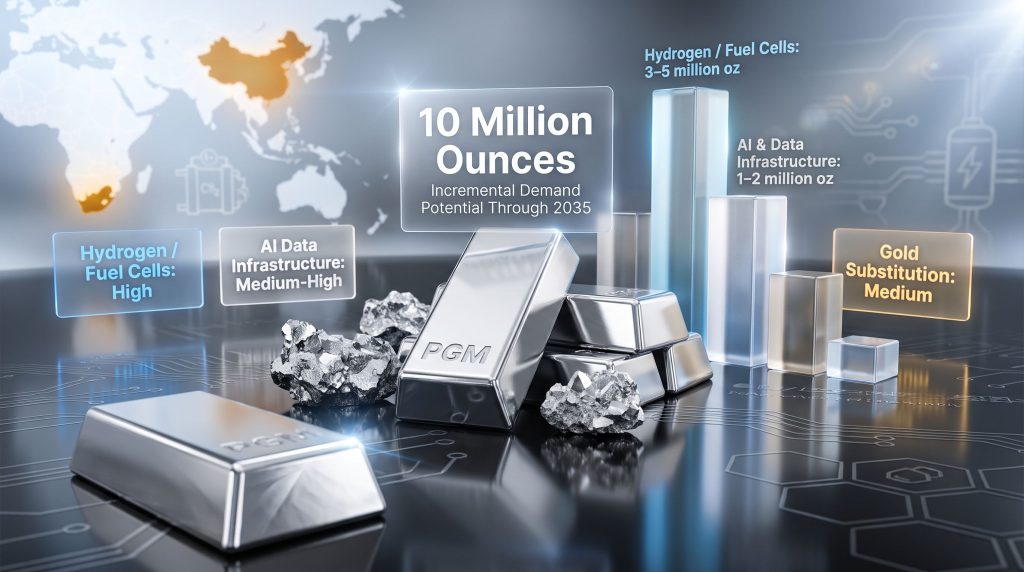
Valterra's Capital Markets Day in 2025 outlined a thesis involving approximately 10 million ounces of additional PGM demand potential by 2035 above then-current consensus forecasts. What has changed since is not the direction of that thesis but its credibility. Within 15 months of that presentation, the company identified evidence suggesting that at least 2 million ounces of that potential is progressing toward high-conviction status, with the remaining volume at varying stages of commercial maturation.
The 10-million-ounce upside figure is not a single-point forecast. It represents a portfolio of demand opportunities at different stages of development, with independent drivers that do not rely on any single application succeeding.
Automotive Demand Has Proven More Durable Than the EV Transition Models Assumed
One of the more underappreciated dimensions of the current PGM cycle is how resilient autocatalyst demand has been despite the accelerating adoption of battery electric vehicles. Early transition models assumed a relatively linear substitution curve. The reality has been considerably more complex.
Hybrid vehicle sales, particularly in Asian markets, have grown substantially, and hybrids carry platinum and palladium loadings comparable to conventional combustion vehicles. Tightening emissions standards across Europe, India, and China have also increased the loading per vehicle required to meet regulatory thresholds, partially offsetting any unit volume decline in pure combustion sales.
This combination of hybrid growth and per-vehicle loading increases has created a more durable demand floor than most models incorporated. It does not eliminate the long-term substitution risk, but it meaningfully extends the timeline over which core autocatalyst demand underpins PGM fundamentals.
Hydrogen: The Demand Driver That Could Dwarf Every Other Application
Of the emerging demand vectors within the Valterra Platinum PGM demand outlook, hydrogen fuel cell applications represent the most significant in potential scale. The mechanics are straightforward: PEM fuel cell technology, the dominant technology in heavy transport applications, requires platinum as a catalyst within the membrane electrode assembly. Unlike palladium-heavy autocatalysts, fuel cell systems are almost entirely platinum-dependent.
China's strategic positioning in hydrogen is the critical variable most Western analysts underweight. The country has embedded hydrogen explicitly within its long-term industrial development planning, with an emphasis on heavy transport decarbonisation through fuel cell trucks. Unlike passenger EV adoption, which competes directly with platinum-bearing hybrids, the fuel cell truck segment creates net new platinum demand that does not cannibalise existing consumption.
Two factors make the Chinese fuel cell truck story particularly consequential for platinum loadings:
- Scale of deployment: China's stated targets for fuel cell vehicle deployment are measured in the hundreds of thousands of units, with heavy trucks prioritised over passenger vehicles due to range and refuelling economics.
- Platinum loading intensity: Heavy commercial fuel cell systems carry meaningfully higher platinum loadings per unit than passenger vehicle fuel cells, with some commercial truck stacks requiring multiples of the platinum content in a typical autocatalyst.
The combination of scale and loading intensity creates a demand trajectory that could, if deployment targets are met, represent several million ounces of incremental annual platinum consumption before 2035.
| Demand Driver | Current Status | Conviction Level | Potential Upside (oz) |
|---|---|---|---|
| Hydrogen / Fuel Cells | Scaling in China | High | Materially above consensus |
| AI Data Infrastructure | Early-stage adoption | Medium-High | Up to 5x current by 2030 |
| Gold Substitution | Economically viable | Medium | Incremental, growing |
| Automotive Catalysts | Established, durable | High | Stable core base |
| Industrial Process Applications | Expanding via partnerships | Medium | Progressing |
AI Infrastructure and the PGM Demand Signal Nobody Is Pricing In
Perhaps the least-discussed element of the Valterra Platinum PGM demand outlook is the connection between artificial intelligence infrastructure buildout and PGM consumption. This is not a relationship that appears in standard demand forecasting frameworks, which helps explain why it represents potential upside rather than an already-priced dynamic.
PGMs appear in AI-adjacent infrastructure through several distinct technical pathways:
- Hard disk drive manufacturing: Platinum-group alloys are used in the sputtering targets that coat magnetic recording layers in high-capacity HDDs. Demand for high-density storage within data centres is accelerating as AI training and inference workloads expand.
- Silicone production: Platinum catalysts are essential in the polymerisation processes that manufacture silicone compounds, which are used extensively in semiconductor packaging, thermal interface materials, and electrical insulation across data centre infrastructure.
- Specialised crucibles: High-purity platinum and rhodium crucibles are critical in the production of single-crystal sapphire and certain optical components used in photonic computing and advanced semiconductor fabrication.
- Power systems: PGM-containing components appear in high-reliability power conditioning and backup systems that data centres require to maintain uptime guarantees.
Current AI-related PGM consumption is estimated in the range of 200,000 to 400,000 ounces annually. Industry analysis suggests this figure could increase as much as fivefold by 2030 as global AI infrastructure continues to scale across data centres, power systems, and semiconductor manufacturing.
The reason this demand vector does not appear in traditional PGM forecast models is largely structural. Most PGM demand databases categorise consumption by end-market sector, and AI infrastructure components are distributed across electronics, chemicals, and industrial categories in ways that make the aggregate AI-specific signal difficult to isolate and quantify. Furthermore, the critical minerals demand picture continues to evolve rapidly, making it increasingly difficult for consensus models to keep pace.
Gold Price Dynamics and the Economics of Platinum Substitution
Gold's sustained elevation above $3,000 per ounce through 2025 and into 2026 has quietly transformed the substitution economics across several industrial applications. When gold prices were lower relative to platinum and palladium, the cost premium of switching to PGM alternatives was difficult to justify for many manufacturers. That calculus has shifted materially, and record gold prices have consequently accelerated the case for industrial reformulation across multiple sectors.
The substitution opportunity operates across multiple channels:
- Electroplating and surface finishing: Gold plating is widely used in electronic connectors and circuit boards for its corrosion resistance and conductivity. At elevated gold prices, platinum and palladium alternatives become cost-competitive while offering comparable or superior technical performance in specific applications.
- Industrial brazing alloys: Gold-based brazing alloys used in aerospace and medical manufacturing face direct competition from platinum-group alternatives when the gold price premium justifies reformulation.
- Jewellery market share: Platinum jewellery has been recovering market share from white gold in several Western markets, driven partly by price positioning and partly by growing consumer awareness of platinum's distinct properties. This is an incremental but compounding shift.
The substitution dynamic is self-reinforcing in an important way: once a manufacturer reformulates a product to use platinum or palladium instead of gold, the switching cost to revert creates a degree of demand stickiness that helps convert what begins as an opportunistic substitution into structural consumption.
The next major ASX story will hit our subscribers first
Strategic Partnerships as Demand Acceleration Infrastructure
One of the structurally distinctive elements of how Valterra is approaching its demand outlook is the deliberate construction of a partnership network designed to move ounces from theoretical to commercial. Rather than relying on organic market adoption of new applications, the company has established collaborative arrangements with downstream processors and industrial users across multiple geographies.
Following earlier partnerships with Johnson Matthey and Sibanye-Stillwater, Valterra has since initiated separate collaborations with Umicore in Germany and Pujing Chemicals in China. These partnerships span industrial chemistry, catalyst technology, and clean energy applications, creating a multi-sector architecture for demand development. According to Valterra's CEO, this positive outlook on the PGM market is maintained even in the face of ongoing price volatility.
The strategic logic is compelling:
- Partners with existing customer relationships and technical credibility can accelerate commercial adoption more efficiently than a producer operating alone.
- Geographic diversification across Europe and Asia reduces dependence on any single regulatory or industrial environment.
- Multi-sector engagement means that setbacks in one application do not undermine the broader demand development programme.
Partnerships spanning industrial chemistry, catalyst technology, and clean energy applications across Germany and China represent a deliberate strategy to de-risk demand development, moving ounces from the known potential category into commercially validated consumption pipelines.
Supply Constraints, Deficits, and the Structural Mismatch That Amplifies Everything
The demand growth story acquires particular significance when viewed against the supply side of the PGM equation. PGM supply constraints remain a defining feature of the market, as South Africa accounts for approximately 70% of global platinum production, and the structural geology of the Bushveld Igneous Complex creates inherent limits on production growth. New mine development faces long lead times, capital intensity, and operating environment challenges that limit the ability of supply to respond quickly to demand signals.
This supply inelasticity means that when demand growth vectors materialise, the price response is amplified. A market already running in deficit is more sensitive to incremental demand than a market in balance or surplus.
Valterra's own operational performance in the first half of 2026 illustrates what is achievable within the existing production base. According to the company's latest market performance report, results were particularly strong across key metrics:
| Metric | Period | Result |
|---|---|---|
| Refined PGM Production Growth | H1 2026 | +25% to 1.7 million oz |
| PGM Sales Volume Growth | H1 2026 | +18% to 1.7 million oz |
| All-In Sustaining Cost Change | H1 2026 | -21% to $996/3E oz |
| Mining EBITDA Margin | H1 2026 | Expanded to 50% from 22% |
| Adjusted EBITDA Growth | H1 2026 | +404% to R33.4 billion |
| Revenue Growth | H1 2026 | +93% to R82 billion |
| Headline Earnings Per Share | H1 2026 | +1,633% to R82.02 from R4.73 |
An all-in sustaining cost of $996 per three-element ounce positions Valterra competitively against virtually any PGM price scenario above the current market, while the expansion of the mining EBITDA margin from 22% to 50% demonstrates the operational leverage available at current PGM price levels.
Renewable Energy Integration and Operational Resilience
Sustainability infrastructure is increasingly a factor in long-term producer economics, and renewable energy in mining is becoming a central pillar of operational resilience. Valterra's commissioning of 520 MW of renewable energy capacity through the Envusa platform, where the company is the largest offtaker, represents a meaningful input cost and emissions reduction initiative. Renewable energy directly reduces the exposure to electricity price inflation and load-shedding risk that has historically pressured South African mining operations.
Water security is a parallel operational risk that the company is addressing through infrastructure investments including a new wastewater treatment plant at Thabazimbi and a water purification facility near the Mogalakwena operation. These are not cosmetic sustainability measures. They directly reduce the operational risk profile of assets in a water-stressed environment.
Scenario Analysis: Three Pathways for PGM Demand Through 2035
Bull Case: Hydrogen fuel cell deployment in China scales to meet stated targets, AI infrastructure buildout continues to accelerate through the late 2020s, gold prices remain elevated and sustain substitution economics, and industrial partnerships convert emerging applications into proven demand. In this scenario, the full 10-million-ounce upside thesis materialises, and consensus forecasts require substantial upward revision.
Base Case: Automotive catalyst demand holds through hybrid vehicle growth and tightening emissions standards, hydrogen deployment proceeds but below the most optimistic targets, AI infrastructure demand grows steadily but is partially offset by efficiency improvements in PGM usage, and substitution gains are incremental. The structural supply deficit provides a price floor that supports producer economics.
Bear Case: Battery electric vehicle adoption accelerates more rapidly than expected and erodes hybrid market share, Chinese hydrogen deployment stalls due to infrastructure or policy challenges, AI demand growth is captured by efficiency gains rather than volume expansion, and industrial partnership programmes develop more slowly than planned.
Even in the base case, a market operating in structural deficit with all-in sustaining costs below $1,000 per three-element ounce creates a durable investment environment for low-cost producers. The bull case rests on at least three independent demand vectors converging simultaneously, providing portfolio-style demand diversification rather than dependence on a single application.
PGM Demand Upside: A Structured Summary
| Demand Category | Estimated Upside (oz) | Conviction Level | Timeline to Materialise |
|---|---|---|---|
| Hydrogen / Fuel Cell Vehicles | 3–5 million oz | High (China-driven) | 2027–2035 |
| AI and Data Infrastructure | 1–2 million oz | Medium-High | 2025–2030 |
| Gold-to-Platinum Substitution | 0.5–1 million oz | Medium | 2025–2028 |
| Industrial Process Applications | 1–2 million oz | Medium | 2026–2032 |
| Total Identified Upside | ~10 million oz | Portfolio basis | Through 2035 |
Frequently Asked Questions: PGM Demand Outlook
What Are the Biggest Drivers of PGM Demand Growth Beyond Automotive?
Hydrogen fuel cell systems, AI-related industrial infrastructure, and gold-to-platinum substitution represent the three most commercially credible demand growth vectors beyond the established autocatalyst base. Each operates through different economic mechanisms and different geographic markets, providing a degree of demand diversification.
How Does China's Hydrogen Strategy Affect Global Platinum Demand?
China's inclusion of hydrogen in its long-term industrial development framework, with heavy transport as a priority application, creates demand for PEM fuel cell systems that carry high platinum loadings per unit. Commercial truck fuel cell stacks require significantly more platinum than passenger vehicle autocatalysts, making the scale of China's deployment targets materially consequential for global platinum demand.
Is the PGM Market Currently in Surplus or Deficit?
The PGM market is operating in a structural deficit. Supply growth from the primary producing regions, predominantly South Africa, is constrained by the capital intensity and lead times associated with new mine development, while demand across multiple applications continues to grow.
How Much Platinum Could AI Infrastructure Consume by 2030?
Current estimates for AI-adjacent PGM consumption range from 200,000 to 400,000 ounces annually. If AI infrastructure continues to scale at current rates, this figure could increase substantially by 2030, representing a demand vector that does not yet appear in most standard PGM forecast models.
Why Are Consensus Forecasts Considered Understated?
Consensus PGM demand models are largely constructed around known, established applications and do not systematically incorporate innovation-driven or substitution-driven demand. As economies generate new technologies that require PGMs and as elevated gold prices improve substitution economics, the gap between consensus forecasts and actual demand outcomes is expected to widen.
What Role Does Gold Price Volatility Play in Platinum Substitution?
Sustained gold price elevation improves the relative cost competitiveness of platinum and palladium in industrial applications where gold has historically been the material of choice. The higher gold prices remain, the more compelling the substitution economics become for manufacturers with the technical capability to reformulate products.
This article is intended for informational purposes only and does not constitute financial or investment advice. All forecasts, scenario projections, and demand estimates involve inherent uncertainty and should not be relied upon as predictions of future outcomes. Readers should conduct independent research and consult qualified advisors before making investment decisions. Readers interested in exploring additional perspectives on platinum group metals market dynamics can find related sector coverage at Mining Weekly.
Want to Know When the Next Major PGM Discovery Hits the ASX?
Discovery Alert's proprietary Discovery IQ model scans ASX announcements in real time, delivering instant alerts on significant mineral discoveries — including platinum group metals — so subscribers can identify actionable opportunities before the broader market reacts. Explore historic discoveries and their extraordinary returns, then begin your 14-day free trial at Discovery Alert to position yourself ahead of the next major find.