August 25, 2026
The Race to Build Domestic Critical Mineral Processing Infrastructure Is Already Underway
For decades, the United States operated under the assumption that global commodity markets would reliably deliver processed critical minerals at competitive prices. That assumption is being systematically dismantled. As battery supply chains tighten, geopolitical fault lines deepen, and the energy transition accelerates critical minerals demand for cobalt, lithium, and nickel, the structural absence of domestic refining capacity has shifted from a theoretical concern to an operational vulnerability.
It is within this context that the announcement of Worley being contracted to build a US Strategic Metals plant in Missouri carries genuine strategic weight. This is not simply an engineering services contract. It is a tangible signal that the architecture of America's critical mineral supply chain is being physically rebuilt, one processing hub at a time.
When big ASX news breaks, our subscribers know first
Understanding the Missouri Multi-Metallic Processing Hub
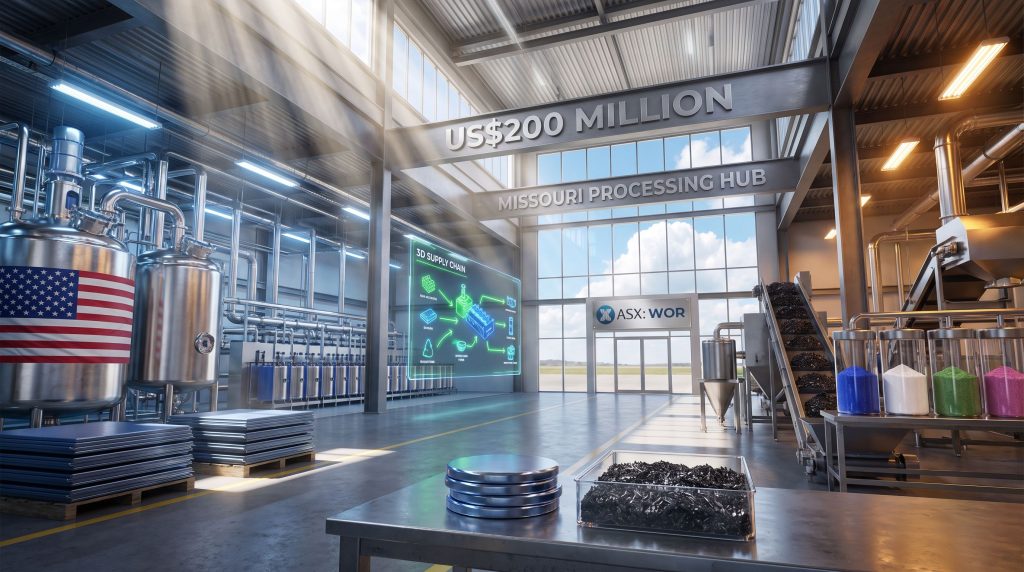
The facility being developed by US Strategic Metals in Missouri represents one of the more ambitious domestic critical mineral processing investments currently underway in North America. Valued at US$200 million, the project is designed as a multi-metallic processing hub incorporating two distinct but complementary operational lines:
- A cobalt refinery capable of processing primary cobalt feedstock into battery-grade and industrial-grade refined material
- A black mass recycling process line designed to recover critical materials from end-of-life lithium-ion batteries
What makes this facility architecturally significant is not either of these lines in isolation, but their deliberate co-location. Combining primary cobalt refining with secondary battery material recovery creates a dual-input processing model that insulates the facility against feedstock disruptions affecting either stream independently.
What Is Black Mass and Why Is It Strategically Important?
Black mass is a term that rarely appears in mainstream coverage but sits at the centre of battery recycling economics. When lithium-ion battery cells reach end-of-life and are shredded or mechanically processed, the resulting dark, fine-grained powder is black mass. It is chemically dense with value, containing recoverable quantities of:
- Cobalt (typically 5 to 20 percent by weight, depending on cathode chemistry)
- Lithium (in lithium carbonate equivalent terms, a meaningful secondary source)
- Nickel (particularly significant from NMC chemistry batteries)
- Manganese (from LMO and NMC formulations)
The concentration of cobalt in black mass varies substantially depending on the original cathode chemistry. NMC 111 batteries, for example, yield meaningfully higher cobalt concentrations than LFP batteries, which contain no cobalt at all. This chemistry-grade distinction is not widely understood outside specialist circles, however it has significant implications for the economics of black mass processing facilities.
A plant primarily handling NMC-derived black mass operates under a very different revenue model than one processing mixed-chemistry feedstock. Furthermore, the battery recycling process demands precise hydrometallurgical expertise to extract value consistently across varying input chemistries.
As global EV adoption accelerates, the volume of end-of-life lithium-ion batteries reaching recyclable status is projected to grow substantially through the 2030s, with some industry forecasts estimating tens of millions of tonnes of cumulative battery material available for recovery by 2040. This creates a structural tailwind for facilities capable of processing black mass at industrial scale.
The inclusion of a black mass recycling line within a cobalt refinery is consequently not merely a diversification strategy. It reflects a deliberate design philosophy: capture value from both the primary mining supply chain and the circular economy simultaneously, reducing dependency on any single feedstock pathway. Indeed, this battery recycling breakthrough in dual-input design is precisely what sets the Missouri hub apart from conventional single-stream processing facilities.
Why Worley Was Contracted to Build the US Strategic Metals Plant
Worley (ASX: WOR), with a current market capitalisation of approximately A$5.3 billion, occupies a distinctive position in the global engineering services landscape. Unlike pure-play mining services firms, Worley operates across the minerals, metals, chemicals, and energy infrastructure sectors simultaneously, giving it cross-domain technical capabilities that are particularly relevant when designing facilities that straddle hydrometallurgical processing, battery chemistry, and industrial engineering.
The scope of Worley's engagement covers engineering services and procurement support delivered within an integrated project management team overseeing construction. This embedded delivery model, where Worley's engineers work within the project management structure rather than as a standalone external contractor, reflects an increasingly common approach to complex processing facility development. It enables faster iteration between design and construction planning while maintaining cohesive oversight across the project lifecycle.
How Worley's Global Integrated Delivery Model Operates
A key structural element of Worley's approach to this contract is its Global Integrated Delivery (GID) framework, which distributes specialised engineering functions across geographically dispersed teams rather than concentrating all expertise in a single location.
| Delivery Hub | Primary Role |
|---|---|
| Louisiana, USA (Lead) | Primary engineering coordination and project management |
| Phoenix, USA | Supplementary design and engineering support |
| United Kingdom | Specialist technical resources via GID network |
| Global Integrated Delivery Team | Cross-border coordination, expertise pooling, delivery optimisation |
This distributed model is not merely a logistical convenience. It allows Worley to draw on specialist expertise in hydrometallurgy, process chemistry, and industrial plant design from wherever that expertise sits within its global workforce, rather than being constrained by the talent pool available in any single geography.
For a processing facility combining cobalt refining with battery black mass recovery, this breadth of accessible technical knowledge is a genuine competitive differentiator. Worley's CEO confirmed the company's focus on applying its minerals and metals expertise to advance the objectives of US Strategic Metals, framing the cobalt refinery work as a direct contribution to the development of critical minerals energy security within the United States.
The Cobalt Supply Chain Problem the Missouri Hub Is Designed to Address
To appreciate the significance of this project, it helps to understand how concentrated the global cobalt supply currently is. The Democratic Republic of Congo accounts for more than 70 percent of global mined cobalt supply, while China dominates the refining and processing stage, controlling an estimated 70 to 80 percent of global cobalt refining capacity according to data tracked by the International Energy Agency. This dual concentration creates a vulnerability that is structurally different from most commodity supply chain risks.
Even if the United States were to develop alternative cobalt mining sources in allied nations, without domestic refining capacity, raw or intermediate cobalt material would still need to flow through Chinese processing infrastructure before becoming battery-grade product. This is the gap the Missouri hub is explicitly designed to close.
Cobalt's Role in Battery Chemistry: Why Purity and Grade Matter
One aspect of cobalt processing that rarely receives attention in infrastructure-focused coverage is the critical importance of product purity and grade. Battery manufacturers do not simply require cobalt; they require cobalt of a specific purity specification, typically 99.8 percent or higher for battery-grade cobalt sulphate or cobalt hydroxide intermediates. Achieving this purity from varied feedstocks, including black mass with its complex multi-metal chemistry, requires sophisticated hydrometallurgical processing involving solvent extraction, precipitation, and crystallisation steps.
The technical challenge of producing consistently battery-grade cobalt from mixed-chemistry black mass feedstock is one reason why very few facilities globally have successfully combined primary refining with secondary recycling operations. Getting the chemistry right across both input streams simultaneously requires deep process engineering expertise, precisely the capability Worley brings to this engagement.
US Industrial Policy Context: What Is Driving Investment in Domestic Refining?
Several interlocking policy frameworks have altered the investment calculus for domestic critical mineral processing in the United States:
- The Inflation Reduction Act introduced domestic content and allied-nation sourcing requirements that effectively penalise battery supply chains relying on Chinese-processed materials for EV tax credit eligibility
- Executive orders addressing critical mineral supply chain security have elevated cobalt to a formal priority designation alongside lithium and rare earths
- Defence procurement requirements increasingly mandate domestically processed or allied-nation-sourced critical minerals for certain applications, creating a non-commercial demand segment that is insensitive to commodity price cycles
These frameworks collectively create a demand floor for domestically refined cobalt that does not rely solely on commercial EV market dynamics. In addition, this adds a layer of investment thesis durability that purely commodity-price-dependent projects cannot claim.
The Engineering Services Sector as Critical Minerals Infrastructure Enabler
There is a tendency in coverage of the critical minerals buildout to focus on mining companies and battery manufacturers as the primary actors. Engineering services firms like Worley occupy a less visible but structurally essential position: they are the organisations that translate resource ambitions and policy objectives into functioning physical infrastructure.
The pipeline of critical mineral processing facilities currently at various stages of development across North America represents a sustained, multi-year source of engineering services demand that is largely decoupled from short-term commodity price volatility. A processing facility contracted and under construction does not stop being built because cobalt prices dip for a quarter.
What the US Strategic Metals Contract Signals for Worley's Strategic Direction
For ASX-listed Worley, this contract carries significance beyond its immediate revenue contribution. The company has been publicly articulating a strategic pivot toward sustainability-linked infrastructure and energy transition projects as a core growth vector. Securing a major US critical minerals processing mandate reinforces that positioning with tangible project evidence.
More subtly, it demonstrates Worley's ability to win work in the United States at a moment when US industrial policy is creating substantial demand for precisely this type of multi-disciplinary processing facility design and delivery capability. For investors assessing Worley's exposure to the energy transition opportunity, this contract is a data point that the strategic rhetoric is converting into contracted project work. Furthermore, analysts tracking the US Department of Energy's Critical Materials Office will recognise the alignment between this project and broader federal infrastructure priorities.
Comparing Domestic and Imported Cobalt Refining: A Supply Chain Trade-Off Analysis
| Factor | Domestic Refining (Missouri Hub) | Imported Refined Cobalt |
|---|---|---|
| Supply Chain Control | High, with domestic feedstock and processing | Low, subject to geopolitical and logistics disruption |
| Cost Structure | Higher capital expenditure, lower sovereign risk premium | Lower upfront cost, higher long-term risk exposure |
| IRA Compliance | Positioned to support domestic content requirements | Potentially incompatible with allied-nation sourcing rules |
| Environmental Accountability | Subject to US regulatory and ESG standards | Variable, depending on origin jurisdiction and oversight |
| Strategic Resilience | Insulated from foreign export restrictions | Vulnerable to trade policy shifts and diplomatic friction |
| Battery Grade Purity Control | Domestically verifiable to specification | Dependent on third-party certification in foreign jurisdictions |
The next major ASX story will hit our subscribers first
Frequently Asked Questions: Worley and the Missouri Critical Minerals Hub
What is Worley's specific role in the US Strategic Metals project?
Worley has been contracted to provide engineering services and procurement support, with its teams embedded within an integrated project management structure that oversees the construction of the Missouri facility. This is an active delivery role rather than an advisory one.
What does the US$200 million project figure represent?
The US$200 million figure represents the total project value of the US Strategic Metals Missouri multi-metallic processing hub, encompassing both the cobalt refinery and the black mass battery recycling process line.
Why is black mass recycling co-located with a cobalt refinery?
The combination creates a dual-input processing model. When primary cobalt feedstock is constrained, secondary battery-derived black mass provides an alternative input stream, and vice versa. This structural flexibility improves both throughput economics and supply security across commodity cycles.
Which Worley offices are involved in delivery?
Project leadership sits with Worley's Louisiana team. Engineering support is provided by the Phoenix office, with specialist technical resources drawn from the UK and coordinated through the company's Global Integrated Delivery team.
Why is Missouri a strategically logical location for this facility?
Missouri's central geographic position within the US industrial heartland provides access to both raw material logistics corridors and downstream battery manufacturing demand centres. The state also has existing industrial infrastructure capable of supporting large-scale processing operations.
What is Worley's current market capitalisation?
As of August 2026, Worley (ASX: WOR) carries a market capitalisation of approximately A$5.3 billion.
Key Takeaways from the Worley US Strategic Metals Engagement
- A US$200 million project commitment represents serious institutional confidence in the long-term economics of domestic critical mineral processing, not a speculative early-stage bet
- The dual-input model combining cobalt refining with black mass recycling is rare globally and represents a technically sophisticated approach to circular battery economy infrastructure
- Worley's GID framework enables access to globally distributed specialist expertise, an important capability advantage for multi-process, multi-metal facility design
- Cobalt purity requirements for battery-grade applications mean this is not a simple processing operation; the hydrometallurgical complexity justifies the involvement of a global engineering firm with cross-domain expertise
- The IRA compliance dimension adds a non-market demand floor to domestically refined cobalt, strengthening the investment thesis beyond pure commodity price dynamics
- For ASX investors, the contract provides concrete evidence that Worley's stated pivot toward energy transition and sustainability infrastructure is producing contracted project wins in high-priority US industrial segments
Readers seeking additional context on US critical mineral processing policy and battery supply chain dynamics may find relevant background through publicly available publications from the International Energy Agency's Critical Minerals Tracker and the US Department of Energy's Critical Materials Office.
Want to Track the Next Major ASX Mineral Discovery Before the Market Does?
Discovery Alert's proprietary Discovery IQ model delivers real-time alerts on significant ASX mineral discoveries — from cobalt and lithium to nickel and beyond — instantly translating complex mineral data into actionable investment insights for both traders and long-term investors. Explore historic examples of major discovery returns on Discovery Alert's discoveries page and begin your 14-day free trial today to position yourself ahead of the broader market.